Weather Details and Aloha Paragraphs
Posted by GlennJune 16-17 2006
Air Temperatures – The following maximum temperatures were recorded across Hawaii Friday:
Lihue, Kauai – 84F
Honolulu, Oahu – 86
Kaneohe, Oahu – 83
Kahului, Maui – 87
Hilo, Hawaii – 80
Kailua-Kona, Hawaii – 86
Temperatures early Saturday morning ranged between these warmest and coolest spots near sea level at the 4 a.m. hour:
Kaneohe, Oahu – 76
Hilo airport – 70
Precipitation Totals – The following numbers represent the largest precipitation totals (inches) during the last 24 hours (as of Saturday morning) on each of the major islands, including:
0.70 MOUNT WAIALEALE. KAUAI
0.34 MANOA LYON ARBORETUM, OAHU
0.09 MOLOKAI
0.00 LANAI
0.00 KAHOOLAWE
0.61 WEST WAILUAIKI, MAUI
1.09 WAIAKEA UKA, BIG ISLAND
Weather Chart – Here’s the latest (automatically updated) weather map…showing high pressure systems located to the NE and NW of our islands. These high pressure cells, with their connecting ridges, will keep our local trade wind speeds in the moderate to fresh category through Sunday. Here’s a Weather Map Symbol page for clarification about what all those funny weather symbols mean.
Hawaii’s Mountains – Here’s a link to the live webcam on the summit of near 14,000 foot Mauna Kea on the Big Island of Hawaii. The tallest peak on the island of Maui is the Haleakala Crater, which is near 10,000 feet in elevation. These two webcams are available during the daylight hours here in the islands…and when there’s a big moon rising just after sunset for an hour or two! Plus, during the nights and early mornings you will be able to see stars, and the sunrise too…depending upon cloud conditions.
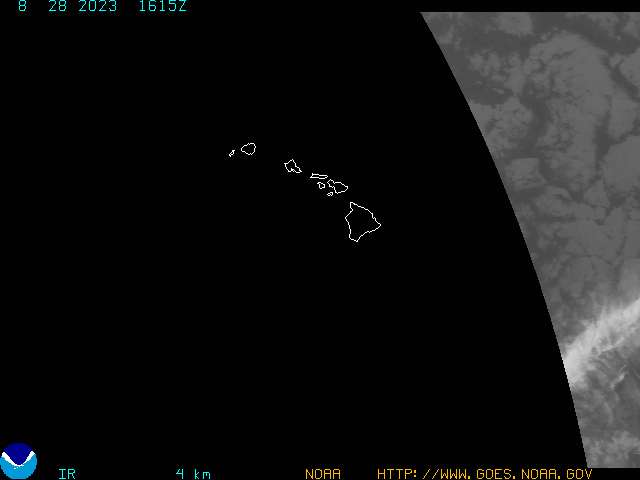
Satellite Images – To view the cloud conditions we have here in Hawaii, please use the following satellite links, starting off with the Infrared Satellite Image of the islands to see all the clouds around the state during the day and night. This next image is one that gives close images of the islands only during the daytime hours, and is referred to as a Close-up visible image. This next image shows a larger view of the Pacific…giving perspective to the wider ranging cloud patterns in the Pacific Ocean…out from the islands. To help you keep track of where any showers may be around the islands, here’s the latest animated radar image.
Tropical Cyclone Activity – The eastern Pacific hurricane season runs from May 15 through November 30…while the central Pacific runs from June 1 through November 30. The latest storm information for eastern Pacific can be found by clicking here. A storm tracking map can be found by clicking here. For the central Pacific, the latest information can be found by clicking here.
Aloha Paragraphs

Sea waterfall in Waipio Valley on the Big Island
Photo Credit: Flikr
The trade winds will continue to blow across the Hawaiian Islands through the foreseeable future. We may see a modest softening over the next day or two, although most folks around the islands won’t notice this subtle easing of the wind speeds. The enthusiasts in the world of water sports, like windsurfing and kiteboarding, probably pay the closest attention to these kinds of details. At any rate, the trade winds will be around through the next week at least, and more than likely quite a bit longer than that. If we are to address the winds up and downs, we would point out a temporary softening through Saturday, with the trades on the upswing again Sunday through next Tuesday…and then getting lighter again starting next Wednesday.
We’ve seen mostly light showers falling over the windward sides lately. They’ve been fairly active though in some parts of the state lately. These showers have been limited in their coverage area, leaving the leeward areas alone for the most part. As usual the Kona slopes of the Big Island often have a few showers falling later in the afternoon hours, or into the evening hours. An upper level trough of low pressure, now to our east, is moving westward towards the state. This atmospheric destabilizing weather feature will cross the state Friday and Saturday. This is turn will likely cause some increase in our showers…especially along the windward sides. This upper low will be moving away by Sunday, when showers should back-off again then.
It’s interesting how almost every morning starts off the same here on the slopes of the Haleakala Crater. This isn’t just during the late spring time frame, but pretty much all year round. It’s most often clear overhead in the morning, extending down through the leeward coast towards Kihei, Wailea, and Makena. Another aspect of this normal reality is the gray early morning clouds over along the windward side, towards Makawao and Haiku, down to Paia. It’s almost like clockwork, like a fine tuned clock that never misses a beat. The one variable is whether those clouds along the windward sides are precipitating or not. This morning they don’t look like there are showers falling from them, like there were most of the day yesterday.
It’s early Friday morning as I begin this last paragraph of today’s narrative. I’ve been wanting to point out that if you happen to have missed one of these narratives, or you come back looking for something that was noted, and find that it’s gone already, replaced by a new narrative, all is not lost. Actually, all of my narratives are being archived now, and you can track back and find older ones. There’s a feature on this page, on the left hand margin, under the heading Other Useful Links, that’s called Archived Narratives. I notice that there are 124 of them in there since this feature was added. So you can go in there and see what the weather was like for the last 3-4 months. I’m about to get out there for my early morning walk, communing with all the lovely singing birds that are around now. I hope you have a great Friday! I’ll be back later with more weather updates. Aloha for now…Glenn.
 Email Glenn James: