











September 29-30, 2009
Air Temperatures – The following maximum temperatures were recorded across the state of Hawaii Tuesday afternoon:
Lihue, Kauai – 85
Honolulu, Oahu – 90
Kaneohe, Oahu – 85
Kahului, Maui – 87
Hilo, Hawaii – 81
Kailua-kona – 88
Air Temperatures ranged between these warmest and coolest spots near sea level around the state – and on the highest mountains…at 5 p.m. Tuesday evening:
Port Allen, Kauai – 87F
Hilo, Hawaii – 78
Haleakala Crater – 58 (near 10,000 feet on Maui)
Mauna Kea summit – 51 (near 14,000 feet on the Big Island)
Precipitation Totals – The following numbers represent the largest precipitation totals (inches) during the last 24 hours on each of the major islands, as of Tuesday afternoon:
0.42 Mount Waialaele, Kauai
0.27 Poamoho 2, Oahu
0.01 Molokai
0.00 Lanai
0.00 Kahoolawe
0.34 West Wailuaiki, Maui
0.44 Mountain View, Big Island
Marine Winds – Here’s the latest (automatically updated) weather map showing a 1037 millibar strong high pressure system far to the north-northeast. Our trade wind speeds will maintain moderate to fresh levels Tuesday and Wednesday.
Satellite and Radar Images: To view the cloud conditions we have here in Hawaii, please use the following satellite links, starting off with this Infrared Satellite Image of the islands to see all the clouds around the state during the day and night. This next image is one that gives close images of the islands only during the daytime hours, and is referred to as a Close-up visible image. This next image shows a larger view of the Pacific…giving perspective to the wider ranging cloud patterns in the Pacific Ocean. Finally, here’s a Looping IR satellite image, making viewable the clouds around the islands 24 hours a day. To help you keep track of where any showers may be around the islands, here’s the latest animated radar image.
Hawaii’s Mountains – Here’s a link to the live webcam on the summit of near 14,000 foot Mauna Kea on the Big Island of Hawaii. The tallest peak on the island of Maui is the Haleakala Crater, which is near 10,000 feet in elevation. These two webcams are available during the daylight hours here in the islands…and when there’s a big moon rising just after sunset for an hour or two! Plus, during the nights and early mornings you will be able to see stars, and the sunrise too…depending upon weather conditions.
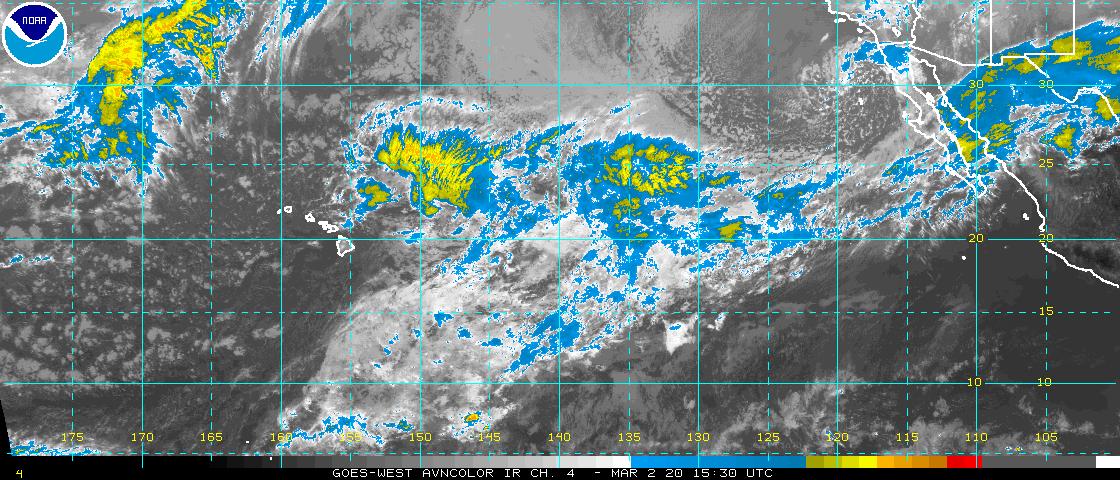
Tropical Cyclone activity in the eastern and central Pacific – Here’s the latest weather information coming out of the National Hurricane Center, covering the eastern north Pacific. You can find the latest tropical cyclone information for the central north Pacific (where Hawaii is located) by clicking on this link to the Central Pacific Hurricane Center. Here’s a tracking map covering both the eastern and central Pacific Ocean. A satellite image, which shows the entire ocean area between Hawaii and the Mexican coast…can be found here.
Aloha Paragraphs

The beautiful south Maui coast
The gusty trade winds will continue through these last few hours of September, then on into the first several days of October. This weather map shows a very large 1036 millibar high pressure cell far to the north-northeast of the
The latest computer forecast models show a cold front approaching the islands later this weekend into early next week…which could interrupt our trade winds. Depending upon just how close this cold front gets to Kauai, will help determine what kind of response we’ll see locally…in terms of wind. If the cold front stops short of Kauai, we’d likely see our ridge get pushed down close to the islands, or even over the
As is often the case, the trade winds will at times carry a few passing showers to the windward sides, although our overlying atmosphere is dry and stable…which will keep us generally high and dry through mid-week. The computer forecast models continue to point out a chance of some modest increase in windward showers during the second half of the work week. This will leave pretty typical weather conditions in place across the state until then, with generally dry conditions along the leeward sides. As we move into early next week, with the possible approach of this impending early October cold front, we could see an increase in showers then. It’s still up in the air whether the front would actually arrive or not…nonetheless, we could at least see afternoon convective showers falling over the leeward slopes then. It may take another day or three before we have a better feel for exactly what will take place early next week.
It’s early Tuesday evening here in Kihei, Maui, as I begin writing this last paragraph of today’s narrative. Today was a big day in the world of earthquakes and tsunmai’s. A huge 8.3 earthquake, on the richter scale, occurred in the western Pacific Ocean…near American Samoa. There have been reports of tsunami related damages and deaths in that area. Here in the islands, we saw small, tsunami generated waves move through, with the two largest anywhere in the state, occurring here on Maui, reaching 1.2 feet…and on the north shore of Oahu, with a 1.5 foot surge. Meanwhile, and if that wasn’t enough on its own, I’ve been tracking four tropical cyclones over in the western Pacific as well. One called typhoon Ketsana brought very damaging floods to the Phillipines, and moved on to Vietnam, where it went ashore early this morning with more devastating weather conditions. There are three other tropical cyclones, named 18W, Parma, and Melor, which continue to churn the waters far to the west of our Hawaiian Islands.
~~~ I’m about ready to leave Kihei, for the drive back upcountry to Kula. Looking out the window before I jump in my car, I see mostly clear skies out there, and the trade winds are blowing as usual. As I mention everyday, I’m very much looking forward to getting away from this computer screen, and out into the real world again! I’ll be back online early Wednesday morning with your next new weather narrative. I hope you have a great Tuesday night until then! Aloha for now…Glenn.
Interesting: Since May 2009, the tropical Pacific Ocean has switched from a cool pattern of ocean circulation known as La Niña to her warmer sibling, El Niño. This cyclical warming of the ocean waters in the central and eastern tropical Pacific generally occurs every three to seven years, and is linked with changes in the strength of the trade winds.
El Niño can affect weather worldwide, including the Atlantic hurricane season, Asian monsoon season and northern hemisphere winter storm season. But while scientists agree that El Niño is back, there’s less consensus about its future strength.
Since May 2009, the tropical Pacific Ocean has switched from a cool pattern of ocean circulation known as La Niña to her warmer sibling, El Niño. This cyclical warming of the ocean waters in the central and eastern tropical Pacific generally occurs every three to seven years, and is linked with changes in the strength of the trade winds.
El Niño can affect weather worldwide, including the Atlantic hurricane season, Asian monsoon season and northern hemisphere winter storm season. But while scientists agree that El Niño is back, there’s less consensus about its future strength.
Interesting2: The Great Depression had a silver lining: During that hard time, U.S. life expectancy actually increased by 6.2 years, according to a University of Michigan study published in the current issue of the Proceedings of the National Academy of Sciences. Life expectancy rose from 57.1 in 1929 to 63.3 years in 1932, according to the analysis by U-M researchers José A. Tapia Granados and Ana Diez Roux. The increase occurred for both men and women, and for whites and non-whites.
"The finding is strong and counterintuitive," said Tapia Granados, the lead author of the study and a researcher at the U-M Institute for Social Research (ISR). "Most people assume that periods of high unemployment are harmful to health."
For the study, researchers used historical life expectancy and mortality data to examine associations between economic growth and population health for 1920 to 1940. They found that while population health generally improved during the four years of the Great Depression and during recessions in 1921 and 1938, mortality increased and life expectancy declined during periods of strong economic expansion, such as 1923, 1926, 1929, and 1936-1937.
The researchers analyzed age-specific mortality rates and rates due to six causes of death that composed about two-thirds of total mortality in the 1930s: cardiovascular and renal diseases, cancer, influenza and pneumonia, tuberculosis, motor vehicle traffic injuries, and suicide. The association between improving health and economic slowdowns was true for all ages, and for every major cause of death except one: suicide.
Interesting3: Lowers blood pressure, encourages exercise, improves psychological health— these may sound like the effects of a miracle drug, but they are actually among the benefits of owning a four-legged, furry pet. This fall, the University of Missouri College of Veterinary Medicine Research Center for Human-Animal Interaction (ReCHAI) will explore the many ways animals benefit people of all ages during the International Society for Anthrozoology and Human-Animal Interaction Conference in Kansas City, Mo., on October 20-25.
“Research in this field is providing new evidence on the positive impact pets have in our lives,” said Rebecca Johnson, associate professor in the MU Sinclair School of Nursing, the College of Veterinary Medicine and director of ReCHAI. “This conference will provide a unique opportunity to connect international experts working in human-animal interaction research with those already working in the health and veterinary medicine fields. A wonderful array of presentations will show how beneficial animals can be in the lives of children, families and older adults.”
Interesting4: Like neighborhood coffee shops and independent movie theaters around the United States, unusual varieties of frogs are rapidly disappearing from rainforests in Central America. A fungal infection seems to be hitting those rare species of frogs harder than common ones, found a new study, leading to local extinctions and a homogenized version of nature where everything is more similar than it used to be. The result is both a less interesting world aesthetically and a less resilient one biologically. "Everyone knew that amphibian declines were really bad," said ecologist Kevin Smith, of Washington University in St. Louis. "But it looks like its worse than we actually thought."
Interesting5: Planning a trip to Mars? Take plenty of shielding. According to sensors on NASA’s ACE (Advanced Composition Explorer) spacecraft, galactic cosmic rays have just hit a Space Age high. "In 2009, cosmic ray intensities have increased 19% beyond anything we’ve seen in the past 50 years," says Richard Mewaldt of Caltech.
"The increase is significant, and it could mean we need to re-think how much radiation shielding astronauts take with them on deep-space missions." The cause of the surge is solar minimum, a deep lull in solar activity that began around 2007 and continues today.
Researchers have long known that cosmic rays go up when solar activity goes down. Right now solar activity is as weak as it has been in modern times, setting the stage for what Mewaldt calls "a perfect storm of cosmic rays."
"We’re experiencing the deepest solar minimum in nearly a century," says Dean Pesnell of the Goddard Space Flight Center, "so it is no surprise that cosmic rays are at record levels for the Space Age." Galactic cosmic rays come from outside the solar system.
They are subatomic particles–mainly protons but also some heavy nuclei–accelerated to almost light speed by distant supernova explosions. Cosmic rays cause "air showers" of secondary particles when they hit Earth’s atmosphere; they pose a health hazard to astronauts; and a single cosmic ray can disable a satellite if it hits an unlucky integrated circuit.
The sun’s magnetic field is our first line of defense against these highly-charged, energetic particles. The entire solar system from Mercury to Pluto and beyond is surrounded by a bubble of solar magnetism called "the heliosphere."
It springs from the sun’s inner magnetic dynamo and is inflated to gargantuan proportions by the solar wind. When a cosmic ray tries to enter the solar system, it must fight through the heliosphere’s outer layers; and if it makes it inside, there is a thicket of magnetic fields waiting to scatter and deflect the intruder. "At times of low solar activity, this natural shielding is weakened, and more cosmic rays are able to reach the inner solar system," explains Pesnell.
Interesting6: More of the fertilizers and pesticides used to grow corn would find their way into nearby water sources if ethanol demands lead to planting more acres in corn, according to a Purdue University study. The study of Indiana water sources found that those near fields that practice continuous-corn rotations had higher levels of nitrogen, fungicides and phosphorous than corn-soybean rotations.
Results of the study by Indrajeet Chaubey, an associate professor of agricultural and biological engineering, and Bernard Engel, a professor and head of agricultural and biological engineering, were published in the early online version of The Journal of Environmental Engineering. "When you move from corn-soybean rotations to continuous corn, the sediment losses will be much greater," Chaubey said.
"Increased sediment losses allow more fungicide and phosphorous to get into the water because they move with sediment." Nitrogen and fungicides are more heavily used in corn crops than soybeans, increasing the amounts found in the soil of continuous-corn fields.
Sediment losses become more prevalent because tilling is often required in continuous-corn fields, whereas corn-soybean rotations can more easily be no-till fields, Engel said. "The common practice is there is a lot of tillage to put corn back on top of corn," Engel said.
"Any time we see changes in the landscape, there is a potential to see changes in water quality." Chaubey said there was no significant change in the amount of atrazine detected in water near fields that changed to continuous-corn rotations.
The commonly used pesticide sticks to plant material and degrades in sunlight, keeping it from reaching water through runoff or sediment. U.S. Department of Agriculture data has shown that corn acreage has increased with the demand for ethanol, with 93 million acres in 2007, an increase of 12.1 million acres that year.
 Email Glenn James:

George Says:
Aloha
I will be in Honolulu October 16-21. What is the expected weather for that period?/
Thanks~~~ Hello George, that is too far ahead to forecast for, so that I’d just continue to monitor the situation using my website. Aloha, Glenn
susan Says:
Hi Glenn
Is there a website where I can track the exact direction of the winds with realtime updates ? I know winds in local areas are related to the terrain. I want to know the overall general direction of the trades on a daily basis, North, North East or Full East. thanks for your help with this. Aloha Susan~~~ Hello Susan, I’d go to the NWS website for Honolulu, do a google for this if you don’t have the address. You won’t find real time wind observations, but they will vary between about 15 minutes to one hour old. Best of luck. Aloha, Glenn