September 1-2, 2010
Air Temperatures – The following maximum temperatures were recorded across the state of Hawaii Wednesday afternoon:
Lihue, Kauai – 84
Honolulu, Oahu – 88
Kaneohe, Oahu – 83
Kaunakakai, Molokai – 84
Kahului, Maui – 88
Hilo, Hawaii – 81
Kailua-kona – 84
Air Temperatures ranged between these warmest and coolest spots near sea level – and on the highest mountain tops…as of 5pm Wednesday evening:
Kahului, Maui – 84
Hilo, Hawaii – 79
Haleakala Crater – 57 (near 10,000 feet on Maui)
Mauna Kea summit – 48 (near 14,000 feet on the Big Island)
Precipitation Totals – The following numbers represent the largest precipitation totals (inches) during the last 24 hours on each of the major islands, as of Wednesday afternoon:
0.51 Hanalei River, Kauai
0.36 Oahu Forest NWR, Oahu
0.00 Molokai
0.00 Lanai
0.00 Kahoolawe
0.04 Puu Kukui, Maui
0.10 Mountain View, Big Island
Marine Winds – Here’s the latest (automatically updated) weather map showing two near 1028 millibar high pressure systems located to the north and northeast of the islands. Our local trade winds will remain active Thursday and Friday…becoming somewhat lighter briefly.
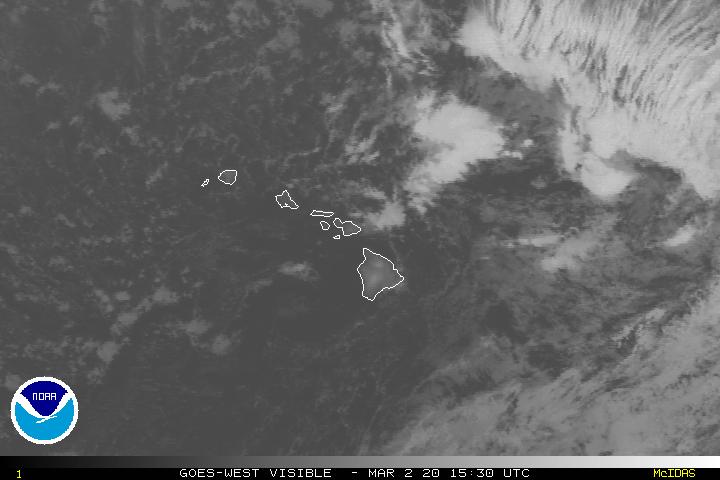
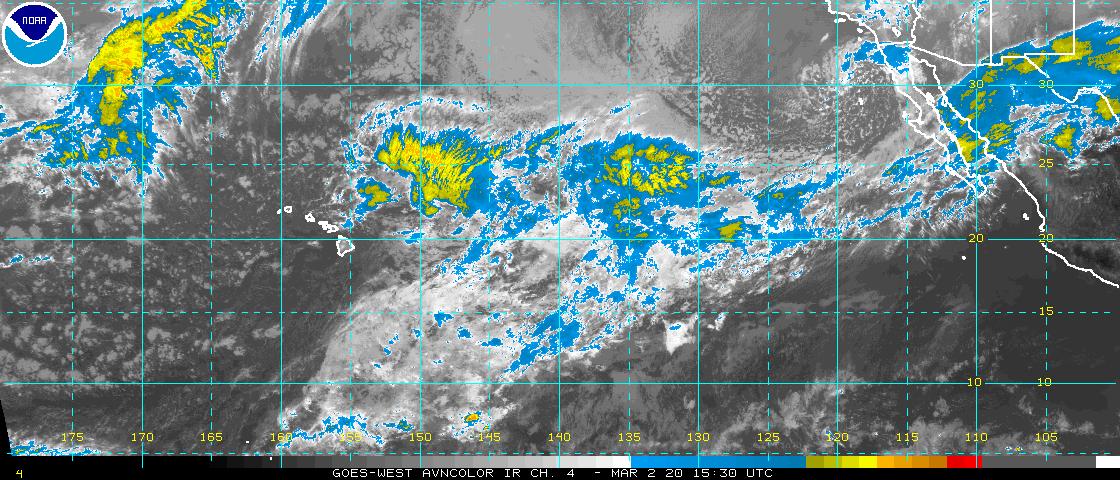
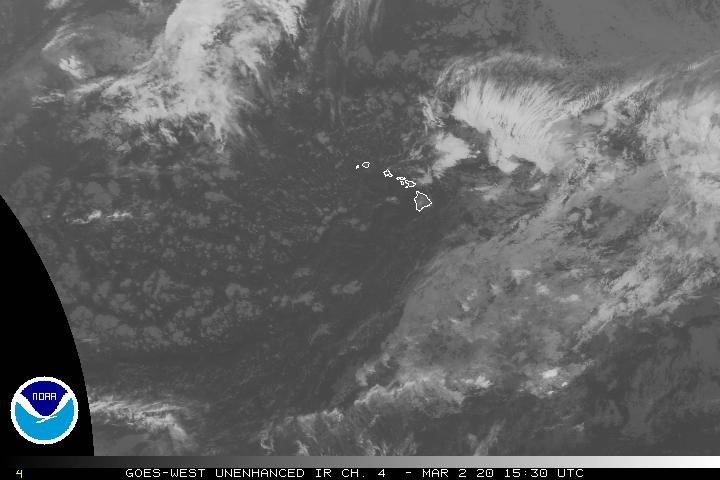
Satellite and Radar Images: To view the cloud conditions we have here in Hawaii, please use the following satellite links, starting off with this Infrared Satellite Image of the islands to see all the clouds around during the day and night. This next image is one that gives close images of the islands only during the daytime hours, and is referred to as a Close-up visible image. This next image shows a larger view of the Pacific…giving perspective to the wider ranging cloud patterns in the Pacific Ocean. Finally, here’s a Looping IR satellite image, making viewable the clouds around the islands 24 hours a day. To help you keep track of where any showers may be around the islands, here’s the latest animated radar image.
Hawaii’s Mountains – Here’s a link to the live webcam on the summit of near 14,000 foot Mauna Kea on the Big Island of Hawaii. The tallest peak on the island of Maui is the Haleakala Crater, which is near 10,000 feet in elevation. These two webcams are available during the daylight hours here in the islands…and when there’s a big moon rising just after sunset for an hour or two! Plus, during the nights and early mornings you will be able to see stars, and the sunrise too…depending upon weather conditions.
Tropical Cyclone activity in the eastern and central Pacific – Here’s the latest weather information coming out of the National Hurricane Center, covering the eastern north Pacific. You can find the latest tropical cyclone information for the central north Pacific (where Hawaii is located) by clicking on this link to the Central Pacific Hurricane Center. Here’s a tracking map covering both the eastern and central Pacific Ocean. A satellite image, which shows the entire ocean area between Hawaii and the Mexican coast…can be found here. Of course, as we know, our hurricane season won’t begin again until June 1st here in the central Pacific.
Aloha Paragraphs

We all love those Hula Dancers
The trade winds will begin slacking-off in strength now, through the next couple of days…before picking up again later Friday into early next week. This weather map shows two near 1028 millibar high pressure systems located to our north, the source of our trade breezes Wednesday afternoon. This elongated area of high pressure has dropped southward, closer to our islands at mid-week…in response to an early season cold front to the northwest. This in turn will gradually take a bite out of our trade wind speeds. Our local environment will begin to feel somewhat more warm and humid, especially during the days along our leeward sides. We may find the trade winds trying to increase a little by the weekend, although not by much. Next week is still up in the air, so to speak…in terms of what the winds will do then…stay tuned.
As the trade winds come down, we may move into a modified convective weather pattern…with some of our localized showers ending up over the leeward slopes during the afternoons. It will depend upon just how light our trade winds become, on where these few showers end up. This satellite image shows just the normal amount of cloud patches heading towards the windward sides. The air mass remains very dry and stable, so whatever few showers that do manage to fall, will be on the light side. Glancing down further to the south of the islands, in the deeper tropics, using this satellite picture, we see an area of thunderstorms to the southeast, which is no big deal…at least at this point.
It’s Wednesday evening
as I begin writing this last section of today’s narrative update. The way it looks from here, we’ll remain in a good weather pattern, with just a temporary lighter trade wind flow Thursday…bouncing right back on Friday into the weekend. As noted above, what the trade winds will do, as we move into early next week, is still a minor question, with perhaps another soft spot in the trade flow again then. There’s nothing unusual in terms of rainfall for the time being, through at least most of the upcoming weekend. As we move into early next week, there could be a change, although we still have time to fine tune that prospect. ~~~ Here in Kihei, Maui, as I look out the windows before taking the drive back upcountry, it’s mostly clear out there before sunset. There are a few clouds around, mostly down towards Makena. It’s been a long busy day here at work, as I’m monitoring and reporting on three storms in the western Pacific, one that is almost ready to start in the eastern Pacific, and of course three storms in the Atlantic…one of which is dangerous hurricane Earl. This major hurricane is getting ready to ride up along our eastern seaboard, dishing out very high surf, along with all the damaging beach erosion that will be associated. Unless this storm veers out into the Atlantic, it will be sweeping up north and northeast, potentially battering the coasts along the way! I’d say without a doubt, if you live close to the coast…batten down the hatches now, and prepare for very heavy swells, very heavy rains, and potentially strong and gusty winds. You folks in the Canadian maritime areas of the northeast, it’s coming your way too! One bit of recent news is that the latest computer model runs, shows Earl staying further off the east coast now…which is a very good thing! This may not help our Canadian friends up north however. ~~~ I’ll be back with you early Thursday morning, have a good night! Aloha for now…Glenn.
Interesting: The geography of Indonesia is dominated by volcanoes that are formed due to subduction zones between the Eurasian plate and the Indo-Australian plate. Some of the volcanoes are notable for their eruptions, for instance, Krakatau for its global effects in 1883, Lake Toba for its supervolcanic eruption estimated to have occurred 74,000 Before Present which was responsible for several years of cold of volcanic winter, and Mount Tambora for the most violent eruption in recorded history in 1815. Indonesia’s Mount Sinabung has recently erupted, two days after it sprang back into life after over 400 years of inactivity.
Volcanoes in Indonesia are a part of the Pacific Ring of Fire. There are about 150 known volcanic sources. Most are in what is called the Sunda Arch (Sumatra and Java). The remaining volcanoes are those of Halmahera, including its surrounding volcanic islands, and the volcanoes of Sulawesi and the Sangihe Islands. The latter group is in one volcanic arc together with the Philippine volcanoes.
The most active Indonesian volcanoes are Kelut and Merapi on Java island which have been responsible for thousands of deaths in the region. Since AD 1000, Kelut has erupted more than 30 times. While Merapi has erupted more than 80 times.
The first eruption of Mount Sinabung — which caught many scientists off guard since the volcano is not as closely monitored as other volcanoes — over the last August weekend was followed by a second, more powerful blast on August 30th that spewed soot and debris more than a mile into the air, leaving the region on high hazard alert.
Mount Sinabung last erupted in 1600 and government vulcanologists acknowledged they had made no efforts before the mountain started rumbling last week to sample gases or look out for rising magma or other signs of seismic activity.
The Indonesian government was reported to have evacuated around 17,500 people from the region on and around the volcano. The government issued the highest-level warning for the area, which was expected to remain in force for around a week, since scientists were unfamiliar with the characteristics of the volcano, due to it having been dormant for so long.
Indonesia is prone to earthquakes, volcanic eruptions, and the occasional tsunami. It can well be considered a very dangerous place to live despite its beauty due to these tectonic caused effects.
Yet geothermal power in Indonesia is an increasingly significant source of renewable energy. As a result of its volcanic geology, Indonesia has about 40% of the world’s potential geothermal resources. To live well one may have to live dangerously.
The signs are all around. Many places in the world show degradation of the air, water, and soil. Species becoming extinct as natural habitats are being destroyed. The emissions of greenhouse gases that can alter the planet’s climate are unacceptable.
All the environmental issues put together amount to a very serious threat to human welfare. Yet at the same time, all accepted measures of well-being show that, on average, quality of life is improving around the globe. How does an environmentalist call society into action under such conditions?
A team of researchers examine this issue of the "environmentalist’s paradox" in the latest issue of the journal, BioScience. They confirm that improvements in overall well-being are real, despite overwhelming evidence of ecosystem decline. The aggregate complacency that is occurring can be attributed to three main culprits.
– Increases in food production
– Technological innovations that decouple people from ecosystems
– Time lags before well-being is affected
The team of authors, led by Ciara Raudsepp-Hearne, agrees with the influential Millennium Ecosystem Assessment, which rates the capacity for ecosystem services for human purposes as low. They also agree with the Human Development Index (measures income, life-expectancy, and literacy), which shows significant improvements in the last forty years.
Unfortunately, the authors find little reassurance for a continued rise in aggregate well-being in the coming years. The observed effects to the environment threaten new gains in agricultural production. These threats can come in the form of wild temperature swings as well as an increased prevalence of floods and droughts. Technological advances can provide only a limited buffer in this regard.
There is mixed evidence that society will be able to successfully adapt to further environmental degradation. The team argues against complacency by pointing out what they call "ecosystem brittleness."
They urge a greater understanding by researchers and decision makers, of the actual benefits of healthy ecosystems to human welfare. In the end, understanding this environmentalist’s paradox is crucial to guiding future management of nature’s services.
Interesting2: Today NOAA reopened 4,281 square miles of Gulf waters off western Louisiana to commercial and recreational fishing. The reopening was announced after consultation with FDA and under a re-opening protocol agreed to by NOAA, the FDA, and the Gulf states. On July 18, NOAA data showed no oil in the area. Light sheen was observed on July 29, but none since.
Trajectory models show the area is at a low risk for future exposure to oil, and fish caught in the area and tested by NOAA experts have shown no signs of contamination. "Scientists, food safety experts, members of the fishing industry and local, state, federal officials, are working together every day to ensure that seafood from the Gulf is safe to eat," said Jane Lubchenco, Ph.D., under secretary of commerce for oceans and atmosphere and NOAA administrator.
"We will remain vigilant and continue to monitor and test seafood in reopened waters." Between July 26 and July 29, NOAA sampled the area for both shrimp and finfish, including mackerel and snapper.
Sensory analyses of 41 samples and chemical analyses of 125 specimens that were composited into 14 samples followed the methodology and procedures in the re-opening protocol, with sensory analysis finding no detectable oil or dispersant odors or flavors, and results of chemical analysis well below the levels of concern.
At its closest point, the area to be reopened is about 185 miles west of the Deepwater/BP wellhead. The entire area is heavily fished by fishermen targeting reef fish, menhaden and shrimp.
"Because of our strict adherence to the reopening protocol agreed to by the states and the federal government we have confidence that seafood harvested from this area is free from harmful oil residues and can be enjoyed by consumers around the nation," said Margaret Hamburg, M.D., Commissioner of the Food and Drug Administration.
NOAA will continue to take samples for testing from the newly re-opened area, and the agency has also implemented dockside sampling to test fish caught throughout the Gulf by commercial fishermen.
Interesting3: A tiny marine filter-feeder, that anchors itself to the sea bed, offers new clues to scientists studying the stability of the West Antarctic Ice Sheet — a region that is thought to be vulnerable to collapse. As part of a study for the Census of Antarctic Marine Life (CAML), scientists from British Antarctic Survey (BAS) analyzed sea-bed colonies of bryozoans from coastal and deep sea regions around the continent and from further afield.
They found striking similarities in particular species of bryozoans living on the continental shelves of two seas — the Ross and Weddell — that are around 1,500 miles apart and separated by the West Antarctic Ice Sheet. This new finding, published this month in the journal Global Change Biology, leads the science team to conclude that these animals could have spread across both seas only by means of a trans-Antarctic seaway through what is now a 2 km solid layer of ice.
They suggest also that this seaway opened up during a recent interglacial (warm period between ice ages) perhaps as recently as 125,000 years ago when sea level was about 5 meters higher than today. While some geological evidence suggests that the West Antarctic Ice Sheet (WAIS) collapsed at least once in the last million years, scientists are keen to determine the frequency of collapse and to understand the processes and connections between warm periods and de-glaciation events.
Elsewhere around Antarctica the marine animals that could help scientists estimate the date when West Antarctica was ice free, were obliterated during ice ages by advancing glaciers that bulldozed their fossil remains off the continental shelf.
Interesting4: The U.S. EPA and Department of Transportation today proposed two new fuel economy labels for passenger vehicles and light trucks, both of which change the way fuel efficiency information is communicated and includes detailed information about vehicles’ greenhouse gas emissions. The first label design (see Image) proposed features a letter grade which communicates the vehicles overall fuel economy and greenhouse gas emissions performance.
It also provides consumers an estimate of the expected fuel cost savings over five years compared to an average gasoline-powered vehicle of the same model year. The second label proposed would keep the standard miles-per-gallon metric and communicate the yearly fuel costs of the vehicle instead of the fuel cost savings. The label also includes metrics about the vehicles GHG emissions as compares overall performance with other vehicles in the same class as well as average vehicle performance.
 Email Glenn James: