August 28-29, 2010
Air Temperatures – The following maximum temperatures were recorded across the state of Hawaii Saturday afternoon:
Lihue, Kauai – 84
Honolulu, Oahu – 90
Kaneohe, Oahu – 84
Kaunakakai, Molokai – 87
Kahului, Maui – 90
Hilo, Hawaii – 84
Kailua-kona – 84
Air Temperatures ranged between these warmest and coolest spots near sea level – and on the highest mountain tops…as of 4pm Saturday afternoon:
Port Allen, Kauai – 88
Hilo, Hawaii – 81
Haleakala Crater – 54 (near 10,000 feet on Maui)
Mauna Kea summit – 39 (near 14,000 feet on the Big Island)
Precipitation Totals – The following numbers represent the largest precipitation totals (inches) during the last 24 hours on each of the major islands, as of Saturday afternoon:
0.91 Kilohana, Kauai
0.14 South Fork Kaukonahua, Oahu
0.01 Molokai
0.00 Lanai
0.10 Kahoolawe
0.09 West Wailuaiki, Maui
0.13 Kawainui Stream, Big Island
Marine Winds – Here’s the latest (automatically updated) weather map showing a large 1036 millibar high pressure system located to the north of the islands. Our local trade winds will remain active Sunday and Monday…gradual strengthening.
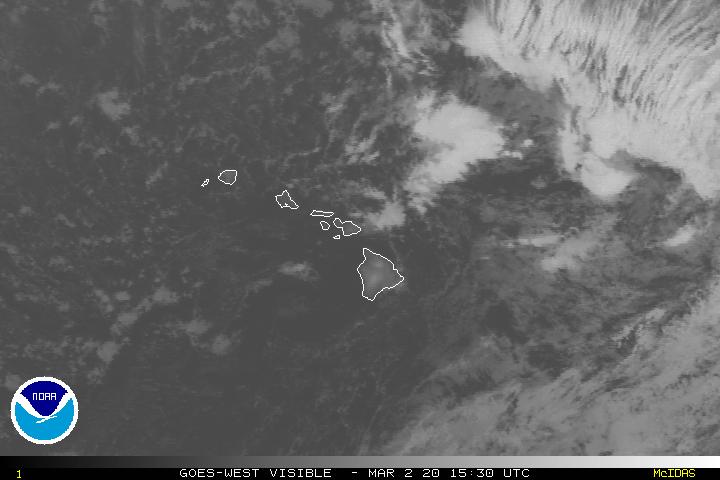
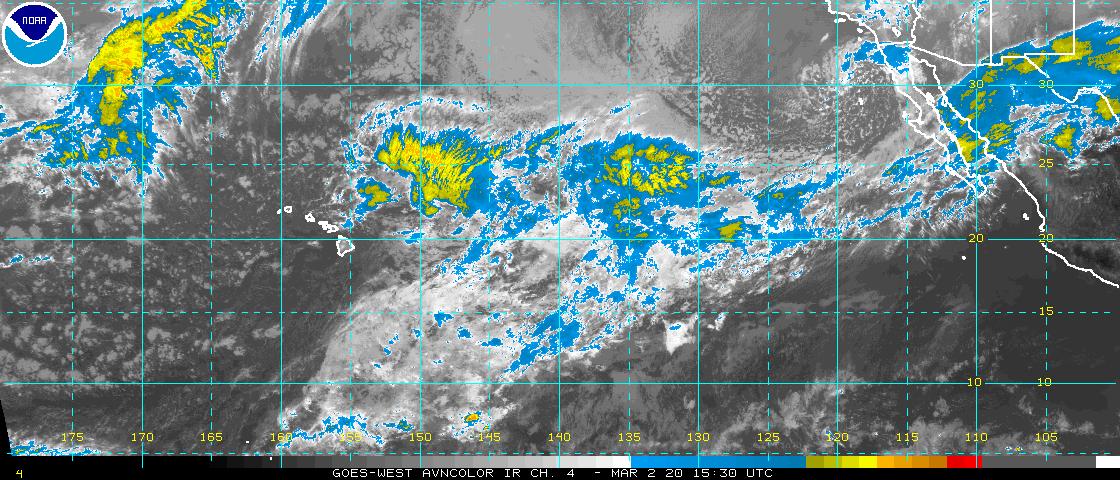
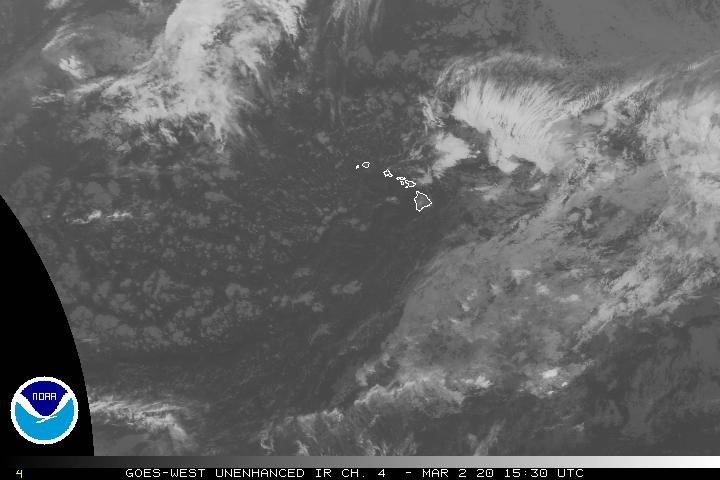
Satellite and Radar Images: To view the cloud conditions we have here in Hawaii, please use the following satellite links, starting off with this Infrared Satellite Image of the islands to see all the clouds around during the day and night. This next image is one that gives close images of the islands only during the daytime hours, and is referred to as a Close-up visible image. This next image shows a larger view of the Pacific…giving perspective to the wider ranging cloud patterns in the Pacific Ocean. Finally, here’s a Looping IR satellite image, making viewable the clouds around the islands 24 hours a day. To help you keep track of where any showers may be around the islands, here’s the latest animated radar image.
Hawaii’s Mountains – Here’s a link to the live webcam on the summit of near 14,000 foot Mauna Kea on the Big Island of Hawaii. The tallest peak on the island of Maui is the Haleakala Crater, which is near 10,000 feet in elevation. These two webcams are available during the daylight hours here in the islands…and when there’s a big moon rising just after sunset for an hour or two! Plus, during the nights and early mornings you will be able to see stars, and the sunrise too…depending upon weather conditions.
Tropical Cyclone activity in the eastern and central Pacific – Here’s the latest weather information coming out of the National Hurricane Center, covering the eastern north Pacific. You can find the latest tropical cyclone information for the central north Pacific (where Hawaii is located) by clicking on this link to the Central Pacific Hurricane Center. Here’s a tracking map covering both the eastern and central Pacific Ocean. A satellite image, which shows the entire ocean area between Hawaii and the Mexican coast…can be found here. Of course, as we know, our hurricane season won’t begin again until June 1st here in the central Pacific.
Aloha Paragraphs

Kayaking…windward Oahu
The trade winds remain active, increasing some Sunday into Monday…and then gradually easing up thereafter. This weather map shows a strong 1036 millibar high pressure system located to our north, the source of our trade breezes Saturday night. This late summer high pressure system will increase our local trade wind speeds, that is until around Tuesday…when they will start to diminish some into the light to moderately strong levels through the rest of the new week.
The small craft wind advisories remain active as we push through the remainder of this weekend. As usual, the advisory is active across those windiest channels and coastal waters around Maui and the
An area of showery looking clouds remained just offshore to our east Saturday…which will finally bring moisture into our windward sides this evening into the night. This satellite image shows the area of moisture taking aim on the windward sides of the islands Saturday evening. This looping radar image will show us where the showers are falling. Glancing down further to the south of the islands, in the deeper tropics, using this satellite picture, we see areas of thunderstorms to the south and southwest of our islands. There’s an area of high cirrus clouds to our west…which will provide streaky high clouds overhead at times. As far as our sunset is concerned Saturday evening, it looks Kauai and Oahu, and maybe Molokai would be best in line to see some color.
It’s Saturday
evening as I begin writing this last section of today’s narrative update. The weather this weekend will be locally quite breezy, and showery at times along our windward sides. The winds will reach just about everywhere, although the showers will be more restricted. There will be sunny areas around during the days, especially along the beaches on the larger islands during the mornings. The smaller islands may see some of this moisture spreading over from the windward sides, during the night and early morning hours. Things will likely dry out some Sunday, although the winds may pick up a tad then, into the new week ahead.
~~~ I went to see a new film Friday evening called Takers (2010), starring Matt Dillion and Paul Walker…among others. The long and short of the film is this: a notorious group of bank robbers find their plans for one last score thwarted by a hardened detective, hell-bent on solving the case. The critics are giving Takers a low grade of C, while the viewers (this is from Yahoo) provided a better A- grade…who to believe? As usual, with these kinds of flicks, I ended up enjoying all this rowdiness! There was the usual mix of violence, heavy characters, focused intensity, and of course the attractive woman…although she played a very minor role. There was a whole host of heavy weight guys packing guns, and doing lots of fast driving, and shooting at each other. What’s not to like about all this? I know, I know, it’s so gut level, and so I don’t know…base. I can’t help myself though, I get sucked into this every time. Here’s the trailer for this film, just in case you have the slightest interest.
~~~ Saturday was an interesting day, which turned out to be drier than expected. A trough of low pressure moved through the state today, which effectively held those showery looking clouds just offshore to our east. As this trough moves away to the west, it should allow the trade winds to carry these clouds inland. Thus, we ought see that area of showers finally bringing some moisture to our islands. This will occur mostly along our windward coasts and slopes, although a few showers may slip over into the leeward sides locally.
~~~ I had a good day, starting off with a nice long walk, and then back home for a tasty breakfast, espresso, and a pastry. I sat around reading for a while after that, and then drove down to Paia for some food shopping. Then it was back home to wash clothes, and now to do this updating, and then…I’m not sure. I may decide to take another long walk…can’t get enough of this pleasurable exercise. I’ll be back Sunday morning with your next new weather narrative, and to discuss whether those clouds just offshore did in fact, finally bring some showers. I hope you have a great Saturday night until then! Aloha for now…Glenn.
Interesting: Health conscious consumers who hesitate at the price of fresh blueberries and blackberries, fruits renowned for high levels of healthful antioxidants, now have an economical alternative, scientists reported at the 240th National Meeting of the American Chemical Society (ACS). It is black rice, one variety of which got the moniker "Forbidden Rice" in ancient China because nobles commandeered every grain for themselves and forbade the common people from eating it.
"Just a spoonful of black rice bran contains more health promoting anthocyanin antioxidants than are found in a spoonful of blueberries, but with less sugar and more fiber and vitamin E antioxidants," said Zhimin Xu, Associate Professor at the Department of Food Science at Louisiana State University Agricultural Center in Baton Rouge, La., who reported on the research. "If berries are used to boost health, why not black rice and black rice bran?
Especially, black rice bran would be a unique and economical material to increase consumption of health promoting antioxidants." Like fruits, "black rice" is rich in anthocyanin antioxidants, substances that show promise for fighting heart disease, cancer, and other diseases.
Food manufacturers could potentially use black rice bran or the bran extracts to boost the health value of breakfast cereals, beverages, cakes, cookies, and other foods, Xu and colleagues suggested. Brown rice is the most widely produced rice variety worldwide. Rice millers remove only the outer husks, or "chaff," from each rice grain to produce brown rice.
If they process the rice further, removing the underlying nutrient rich "bran," it becomes white rice. Xu noted that many consumers have heard that brown rice is more nutritious than white rice. The reason is that the bran of brown rice contains higher levels of gamma-tocotrienol, one of the vitamin E compounds, and gamma-oryzanol antioxidants, which are lipid-soluble antioxidants.
Numerous studies showed that these antioxidants can reduce blood levels of low-density lipoprotein cholesterol (LDL) — so called "bad" cholesterol — and may help fight heart disease. Xu and colleagues analyzed samples of black rice bran from rice grown in the southern United States. In addition, the lipid soluble antioxidants they found in black rice bran possess higher level of anthocyanins antioxidants, which are water-soluble antioxidants.
Thus, black rice bran may be even healthier than brown rice bran, suggested Dr. Xu. The scientists also showed that pigments in black rice bran extracts can produce a variety of different colors, ranging from pink to black, and may provide a healthier alternative to artificial food colorants that manufacturers now add to some foods and beverages.
Several studies have linked some artificial colorants to cancer, behavioral problems in children, and other health problems. Black rice is used mainly in Asia for food decoration, noodles, sushi, and pudding. Dr. Xu said that farmers are interested in growing black rice in Louisiana and that he would like to see people in the country embrace its use.
Interesting2: Every year an amazing event happens on this small island, owned by Australia, which is 220 miles away from the nearest land mass. Christmas Island’s geographic isolation and history of limited human disturbance has brought about a high level of species not found elsewhere in the world. Among these species is the Christmas Island Red Crab. Millions of these crabs simultaneously embark on a five kilometer journey to their ocean breeding grounds.
Scientists from the University of Bristol and Bangor University believe they have unlocked the mystery to this incredible feat. The project was led by Professor Steve Morris of the University of Bristol and Professor Simon Webster of Bangor University. They conclude that it is hormones that make the journey possible for the Christmas Island Red Crab.
Specifically, it is the Crustacean Hyper-glycaemic Hormone that enables them to efficiently use the stored energy in their muscles. This added energy is essential for this small terrestrial crab to travel five kilometers over land from their home on the high rainforest plateau to their spawning grounds in the ocean. The island is not heavily populated, so there is not much danger from humans, however, the path does cross over several roadways.
The estimated 120 million crabs literally blanket the landscape as they travel. They are prompted to commence their journey with the arrival of the monsoon season in November or December. What is amazing is that during their non-migrating period, the crabs are relatively inactive, staying in their burrows on the forest floor. They only emerge for a short period in the early morning to feed. To go from such a hypoactive state to an incredibly hyperactive state requires some internal tinkering to get the metabolism moving.
Surprisingly, the hyper-glycaemic hormone levels were lower during the migrating season than during the inactive dry season. To figure out the puzzle, the scientists gave the crabs glucose (sugars). According to Professor Webster, during the migrating season, the glucose prevented the release of the exercise-dependent hormone. This put the crabs in a negative feedback loop.
Therefore, during migration, the glucose stored in the crabs’ glycogen stores is sufficient to fuel the long journey. This also allows the ability to release the hyper-glycaemic hormone which unlocks that stored energy. Then, during the inactive dry season, the hormone shuts down, and the glycogen stores are built up again. Isn’t evolution amazing?
Interesting3: A geomagnetic storm (or solar storm) is a temporary disturbance of the Earth’s magnetosphere caused by a massive solar flares or related sun output. A geomagnetic storm is caused by a solar wind shock wave which typically strikes the Earth’s magnetic field 3 days after the event on the sun. The effect on the earth can be small or it can be large. Astronomers are predicting that a massive solar storm, much bigger in potential than the one that caused spectacular light shows on Earth earlier this month, will strike our planet in 2012 with a force of 100 million hydrogen bombs.
This is far larger than average. What does a solar storm do? The easily observable effects will be the northern lights (which will be far more south than they should be) and electromagnetic interference (cell phones and GPS may not work, radio and TV signals may be disrupted.). On March 13, 1989 a severe geomagnetic storm caused the collapse of the Hydro-Québec power grid in a matter of seconds as equipment protection relays tripped in a cascading sequence of events.
The same storm even caused auroras as far south as Texas. The geomagnetic storm causing this event was itself the result of a coronal mass ejection, ejected from the Sun on March 9, 1989. Ice cores show evidence that events of similar intensity recur at an average rate of approximately once per 500 years. Since 1859, less severe storms have occurred in 1921 and 1960, when widespread radio disruption was reported. On September 1-2, 1859, the largest recorded geomagnetic storm occurred.
Aurora were seen around the world, most notably over the Caribbean; also noteworthy were those over the Rocky Mountains that were so bright that their glow awoke gold miners, who began preparing breakfast because they thought it was morning. Telegraph systems all over Europe and North America failed. Telegraph pylons threw sparks and telegraph paper spontaneously caught fire. Some telegraph systems were reported to continue to send and receive messages despite having been disconnected from their power supplies.
Many astronomers report that this coming Solar maximum (2012 but possibly later into 2013) will be the most violent in 100 years. Compared to earlier major solar storms there is more electromagnetic equipment and systems than ever before. As a result, the effect of this new solar storm cannot be easily predicted. Satellites, circuit breakers, air flights, cell phones, and wireless systems will be affected.
Dr Richard Fisher, director of NASA’s Helio-physics division, stated that the super storm would hit like "a bolt of lightning", causing catastrophic consequences for the world’s health, emergency services and national security unless precautions are taken. NASA said that a recent report by the National Academy of Sciences found that if a similar storm occurred today, it could cause 1 to 2 trillion dollars in damages to society’s high-tech infrastructure and require four to 10 years for complete recovery. The findings are published in the most recent issue of Australasian Science.
Interesting4: A relatively new type of El Niño, which has its warmest waters in the central-equatorial Pacific Ocean, rather than in the eastern-equatorial Pacific, is becoming more common and progressively stronger, according to a new study by NASA and NOAA. The research may improve our understanding of the relationship between El Niños and climate change, and has potentially significant implications for long-term weather forecasting.
Lead author Tong Lee of NASA’s Jet Propulsion Laboratory, Pasadena, Calif., and Michael McPhaden of NOAA’s Pacific Marine Environmental Laboratory, Seattle, measured changes in El Niño intensity since 1982. They analyzed NOAA satellite observations of sea surface temperature, checked against and blended with directly-measured ocean temperature data. The strength of each El Niño was gauged by how much its sea surface temperatures deviated from the average.
They found the intensity of El Niños in the central Pacific has nearly doubled, with the most intense event occurring in 2009-10. The scientists say the stronger El Niños help explain a steady rise in central Pacific sea surface temperatures observed over the past few decades in previous studies-a trend attributed by some to the effects of global warming.
While Lee and McPhaden observed a rise in sea surface temperatures during El Niño years, no significant temperature increases were seen in years when ocean conditions were neutral, or when El Niño’s cool water counterpart, La Niña, was present. "Our study concludes the long-term warming trend seen in the central Pacific is primarily due to more intense El Niños, rather than a general rise of background temperatures," said Lee.
"These results suggest climate change may already be affecting El Niño by shifting the center of action from the eastern to the central Pacific," said McPhaden. "El Niño’s impact on global weather patterns is different if ocean warming occurs primarily in the central Pacific, instead of the eastern Pacific. "If the trend we observe continues," McPhaden added, "it could throw a monkey wrench into long-range weather forecasting, which is largely based on our understanding of El Niños from the latter half of the 20th century."
El Niño, Spanish for "the little boy," is the oceanic component of a climate pattern called the El Niño-Southern Oscillation, which appears in the tropical Pacific Ocean on average every three to five years. The most dominant year-to-year fluctuating pattern in Earth’s climate system, El Niños have a powerful impact on the ocean and atmosphere, as well as important socioeconomic consequences.
They can influence global weather patterns and the occurrence and frequency of hurricanes, droughts and floods; and can even raise or lower global temperatures by as much as 0.2 degrees Celsius (0.4 degrees Fahrenheit). During a "classic" El Niño episode, the normally strong easterly trade winds in the tropical eastern Pacific weaken. That weakening suppresses the normal upward movement of cold subsurface waters and allows warm surface water from the central Pacific to shift toward the Americas.
In these situations, unusually warm surface water occupies much of the tropical Pacific, with the maximum ocean warming remaining in the eastern-equatorial Pacific. Since the early 1990s, however, scientists have noted a new type of El Niño that has been occurring with greater frequency. Known variously as "central-Pacific El Niño," "warm-pool El Niño," "dateline El Niño" or "El Niño Modoki" (Japanese for "similar but different"), the maximum ocean warming from such El Niños is found in the central-equatorial, rather than eastern, Pacific.
Such central Pacific El Niño events were observed in 1991-92, 1994-95, 2002-03, 2004-05 and 2009-10. A recent study found many climate models predict such events will become much more frequent under projected global warming scenarios. Lee said further research is needed to evaluate the impacts of these increasingly intense El Niños and determine why these changes are occurring. "It is important to know if the increasing intensity and frequency of these central Pacific El Niños are due to natural variations in climate or to climate change caused by human-produced greenhouse gas emissions," he said.
 Email Glenn James: