September 24-25, 2009
Air Temperatures – The following maximum temperatures were recorded across the state of Hawaii Thursday afternoon:
Lihue, Kauai – 84
Honolulu, Oahu 88
Kaneohe, Oahu – 86
Kahului, Maui – 87
Hilo, Hawaii – 81
Kailua-kona – 86
Air Temperatures ranged between these warmest and coolest spots near sea level around the state – and on the highest mountains…at 4 p.m. Thursday afternoon:
Honolulu, Oahu – 87F
Kapalua, Maui – 77
Haleakala Crater – 50 (near 10,000 feet on Maui)
Mauna Kea summit – 43 (near 14,000 feet on the Big Island)
Precipitation Totals – The following numbers represent the largest precipitation totals (inches) during the last 24 hours on each of the major islands, as of Thursday afternoon:
0.65 Mount Waialaele, Kauai
0.35 Nuuanu Upper, Oahu
0.00 Molokai
0.00 Lanai
0.00 Kahoolawe
0.10 Puu Kukui, Maui
0.39 Kealakekua, Big Island
Marine Winds – Here’s the latest (automatically updated) weather map showing high pressure systems to the northeast and northwest. Our trade wind speeds will increase into Saturday, as these high pressure cells provide stronger trade winds.
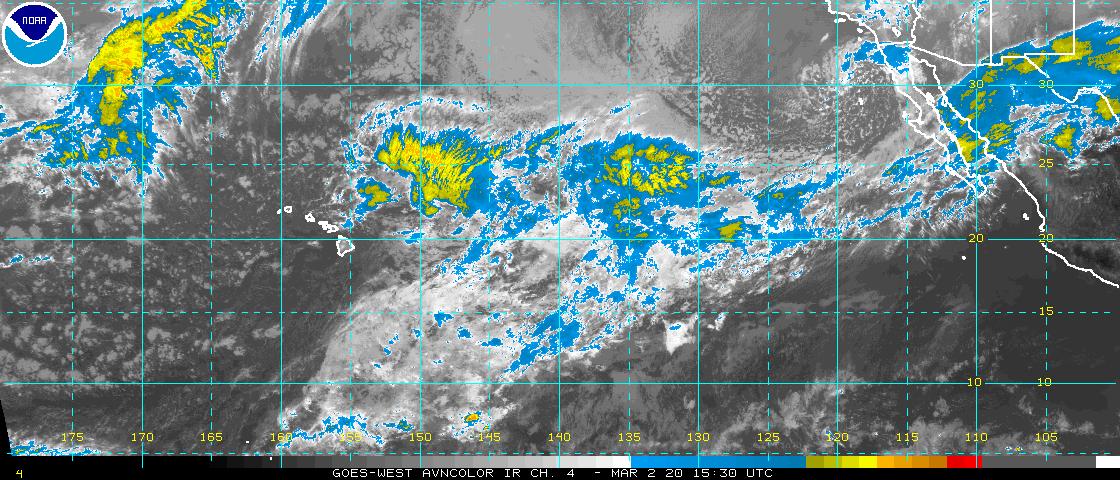
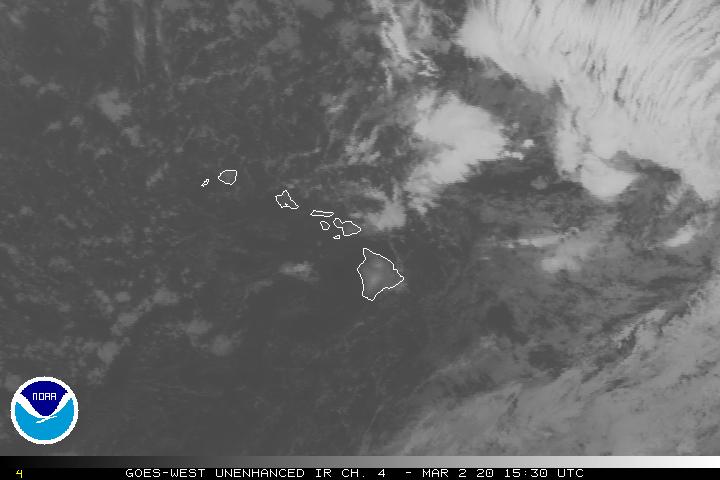
Satellite and Radar Images: To view the cloud conditions we have here in Hawaii, please use the following satellite links, starting off with this Infrared Satellite Image of the islands to see all the clouds around the state during the day and night. This next image is one that gives close images of the islands only during the daytime hours, and is referred to as a Close-up visible image. This next image shows a larger view of the Pacific…giving perspective to the wider ranging cloud patterns in the Pacific Ocean. Finally, here’s a Looping IR satellite image, making viewable the clouds around the islands 24 hours a day. To help you keep track of where any showers may be around the islands, here’s the latest animated radar image.
Hawaii’s Mountains – Here’s a link to the live webcam on the summit of near 14,000 foot Mauna Kea on the Big Island of Hawaii. The tallest peak on the island of Maui is the Haleakala Crater, which is near 10,000 feet in elevation. These two webcams are available during the daylight hours here in the islands…and when there’s a big moon rising just after sunset for an hour or two! Plus, during the nights and early mornings you will be able to see stars, and the sunrise too…depending upon weather conditions.
Tropical Cyclone activity in the eastern and central Pacific – Here’s the latest weather information coming out of the National Hurricane Center, covering the eastern north Pacific. You can find the latest tropical cyclone information for the central north Pacific (where Hawaii is located) by clicking on this link to the Central Pacific Hurricane Center. Here’s a tracking map covering both the eastern and central Pacific Ocean. A satellite image, which shows the entire ocean area between Hawaii and the Mexican coast…can be found here.
Aloha Paragraphs

Large surf along our north and west shores
We’re moving into a spell of long lasting trade winds, which will prevail through the rest of this week…and then well into next week. These early autumn trades are blowing across our islands thanks to high pressure systems to the northeast and northwest of Hawaii. This weather map shows these two high pressure cells. These high’s will help to keep any early season cold front’s out of our area. As the trades pick up a bit more in strength over the next couple of days, we should see small craft wind advisories going up over those typically windiest areas around Maui and the Big Island.
As is often the case, the stronger trade winds tend to bring periods of increased windward showers…which will happen in an on and off manner now. Computer models continue to suggest that there will be moisture being carried our way on the trade wind flow. Meanwhile, an upper level trough of low pressure will add some enhancement to these showers. These showery clouds will influence the weather most directly along the windward coasts and slopes. The leeward sides will see drier weather, although a few showers could occur along these sides too through Friday…with drier weather everywhere this weekend. Here’s a satellite image, so we can keep an eye on clouds in our area. It looks as though we may see some high cirrus clouds approaching from the southeast as well.
Our north and west facing beaches will see large surf, as a northwest swell train of waves continues breaking into Friday. The source of this swell was typhoon chai-won, which whipped the north western Pacific into a fury last week. This tropical cyclone has moved out of the tropics, having gone through what we call an extra-tropical transition, into a gale low pressure system in the northern latitudes…moving into the
It’s early Thursday evening here in Kihei, Maui, as I begin writing this last paragraph of today’s narrative. As noted above, we have some increase in showers on the horizon, so that we’d better keep this looping radar image handy. This incoming moisture will be good for us, as we could use the rainfall in many areas of the state. This will be a rather short lived affair however, with drier weather already on the way, arriving this weekend. I’m getting ready to take the drive back upcountry, but just before leaving, and taking a quick glance out the windows here, I see lots of clouds, and what looks like wet weather over on the windward sides. ~~~ I’ll be back early Friday morning with your next new weather narrative, I hope you have a great Thursday night! Aloha for now…Glenn.
Extra: Here’s a lightning detection website…showing where strikes are occurring across the U.S. mainland
Interesting: El Niño, the periodic eastern Pacific phenomenon credited with shielding the United States and Caribbean from severe hurricane seasons, may be overshadowed by its brother in the central Pacific due to global warming, according to an article in the September 24 issue of the journal Nature. "There are two El Niños, or flavors of El Niño," said Ben Kirtman, co-author of the study and professor of meteorology and physical oceanography at the University of Miami’s Rosentstiel School of Marine and Atmospheric Science.
"In addition to the eastern Pacific El Niño which we know and love, a second El Niño in the central Pacific is on the increase." El Niño is a recurring warm water current along the equator in the Pacific Ocean that affects weather circulation patterns in the tropics. The eastern El Niño increases wind sheer in the Atlantic that may hamper the development of major hurricanes there.
The central Pacific El Niño, near the International Dateline, has been blamed for worsening drought conditions in Australia and India as well as minimizing the effects of its beneficial brother to the east. Led by Sang-Wook Yeh of the Korea Ocean Research & Development Institute, a team of scientists applied Pacific Ocean sea surface temperature data from the past 150 years to 11 global warming models developed by the Intergovernmental Panel on Climate Change.
Eight of the models showed that global warming conditions will increase the incidence of the central Pacific El Niño. Over the past 20 years, according to the data, the frequency of an El Niño event in the central Pacific has increased from one out of every five to half of all El Niño occurrences. "The results described in this paper indicate that the global impacts of El Niño may significantly change as the climate warms," said Yeh.
Though the centers of the central and eastern areas are roughly 4,100 miles apart, El Niños historically have not simultaneously occurred in both places. An increase in central Pacific El Niño events may reduce the hurricane-shielding effects of the eastern Pacific event. "Currently, we are in the middle of a developing eastern Pacific El Niño event," said Kirtman, "which is part of why we’re experiencing such a mild hurricane season in the Atlantic.
We also anticipate the southern United States to have a fairly wet winter, and the northeast may be dry and warm." Kirtman expects the current El Niño event to end next spring, perhaps followed by a La Niña, which he expects may bode for a more intense Atlantic hurricane season in 2010. Growing up in southern California, Kirtman frequently had to man the sump pump in his family’s basement during the rainy season, which he learned later was caused by El Niño.
"We’re finally learning about how ocean current flows and increases in sea surface temperature influence weather patterns, which affect every one of us, including the kid manning the sump pump," he said. "I have devoted much of my career to studying El Niño because of how it affects people and their lives." Kirtman works with various meteorological organizations around the world to help developing countries respond to climate extremes. "We provide them with the forecasts," he said, "and the countries use the results to develop their response."
Interesting2: The most comprehensive picture of the rapidly thinning glaciers along the coastline of both the Antarctic and Greenland ice sheets has been created using satellite lasers. The findings are an important step forward in the quest to make more accurate predictions for future sea level rise.
Reporting this week in the journal Nature, researchers from British Antarctic Survey and the University of Bristol describe how analysis of millions of NASA satellite measurements from both of these vast ice sheets shows that the most profound ice loss is a result of glaciers speeding up where they flow into the sea.
The authors conclude that this ‘dynamic thinning’ of glaciers now reaches all latitudes in Greenland, has intensified on key Antarctic coastlines, is penetrating far into the ice sheets’ interior and is spreading as ice shelves thin by ocean-driven melt. Ice shelf collapse has triggered particularly strong thinning that has endured for decades.
Interesting3: New approaches are needed to help humanity deal with climate change and other global environmental threats that lie ahead in the 21st century, according to a group of 28 internationally renowned scientists. The scientists propose that global biophysical boundaries, identified on the basis of the scientific understanding of the earth system, can define a "safe planetary operating space" that will allow humanity to continue to develop and thrive for generations to come.
This new approach to sustainable development is conveyed in the current issue of the scientific journal Nature. The authors have made a first attempt to identify and quantify a set of nine planetary boundaries, including climate change, freshwater use, biological diversity, and aerosol loading.
The research was performed by a working group at UC Santa Barbara’s National Center for Ecological Analysis and Synthesis (NCEAS), in cooperation with the Stockholm Resilience Centre at Stockholm University. One important strand of the research behind this article is based in the global project known as IHOPE.
The goal of the Integrated History and future Of People on Earth (IHOPE) project is to understand the interactions of the environmental and human process over the ten to hundred millennia to determine how human and biophysical changes have contributed to Earth system dynamics.
The IHOPE working group is assembled at NCEAS today. The scientists emphasize that the rapid expansion of human activities since the industrial revolution has now generated a global geophysical force equivalent to some of the great forces of nature. "We are entering the Anthropocene, a new geological era in which our activities are threatening the earth’s capacity to regulate itself," said co-author Will Steffen, professor at the Australian National University (ANU) and director of the ANU Climate Change Institute.
"We are beginning to push the planet out of its current stable Holocene state, the warm period that began about 10,000 years ago and during which agriculture and complex societies, including our own, have developed and flourished. The expanding human enterprise could undermine the resilience of the Holocene state, which would otherwise continue for thousands of years into the future."
Interesting4: Researchers at North Carolina State University are working to demonstrate that trees can be used to degrade or capture fuels that leak into soil and ground water. Through a process called phytoremediation – literally a “green” technology – plants and trees remove pollutants from the environment or render them harmless. Through a partnership with state and federal government agencies, the military and industry, Dr. Elizabeth Nichols, environmental technology professor in NC State’s Department of Forestry and Environmental Resources, and her team are using phytoremediation to clean up a contaminated site in Elizabeth City, N.C.
Phytoremediation uses plants to absorb heavy metals from the soil into their roots. The process is an attractive alternative to the standard clean-up methods currently used, which are very expensive and energy intensive. At appropriate sites, phytoremediation can be a cost-effective and sustainable technology, Nichols says. The Coast Guard site was planted with a mixture of fast-growing trees such as hybrid poplars and willows to prevent residual fuel waste from entering the Pasquotank River by ground water discharge.
About 3,000 trees were planted on the five-acre site, which stored aircraft fuel for the Coast Guard base from 1942 until 1991. Fuels had been released into the soil and ground water over time. Efforts to recover easily extractable fuel using a free product recovery system – also called “oil skimmers” – had stalled so other remedial options were considered before choosing phytoremediation.
 Email Glenn James: