September 23-24, 2009
Air Temperatures – The following maximum temperatures were recorded across the state of Hawaii Wednesday afternoon:
Lihue, Kauai – 84
Honolulu, Oahu 88
Kaneohe, Oahu – 85
Kahului, Maui – 90
Hilo, Hawaii – 82
Kailua-kona – 87
Air Temperatures ranged between these warmest and coolest spots near sea level around the state – and on the highest mountains…at 5 p.m. Wednesday evening:
Honolulu, Oahu – 85F
Hilo, Hawaii – 76
Haleakala Crater – 54 (near 10,000 feet on Maui)
Mauna Kea summit – 41 (near 14,000 feet on the Big Island)
Precipitation Totals – The following numbers represent the largest precipitation totals (inches) during the last 24 hours on each of the major islands, as of Wednesday afternoon:
0.03 Poipu, Kauai
0.21 Oahu Forest NWR, Oahu
0.00 Molokai
0.00 Lanai
0.00 Kahoolawe
0.01 Kaupo Gap, Maui
0.81 Laupahoehoe, Big Island
Marine Winds – Here’s the latest (automatically updated) weather map showing a weak 1018 millibar high pressure system to the northeast, with its ridge extending southwest to a point just north of the islands. This will keep our trade winds on the light side, although as the ridge migrates northward, we’ll find them gradually increasing later Wednesday into Thursday.
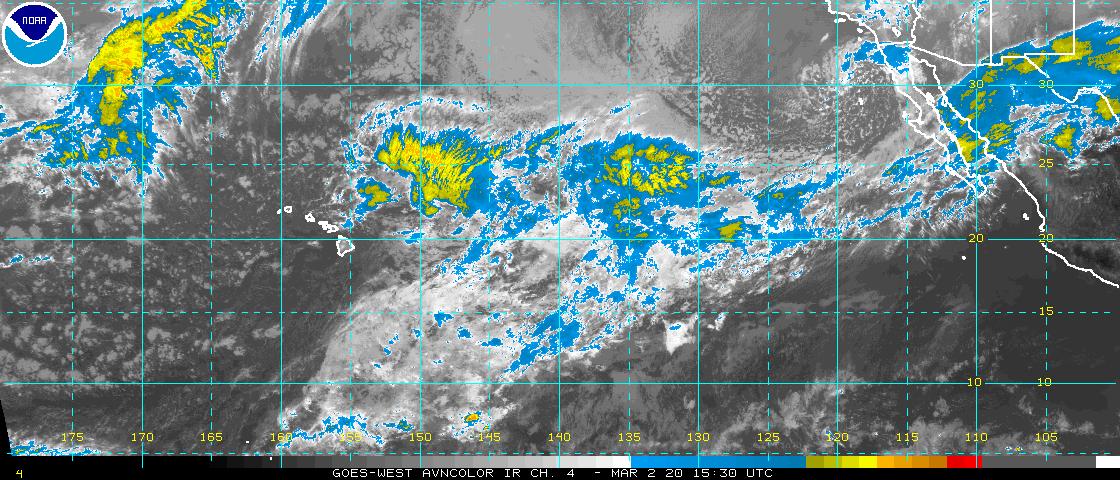
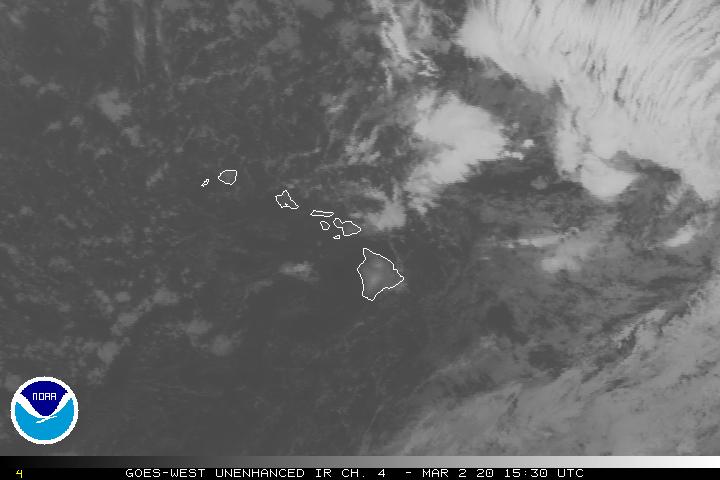
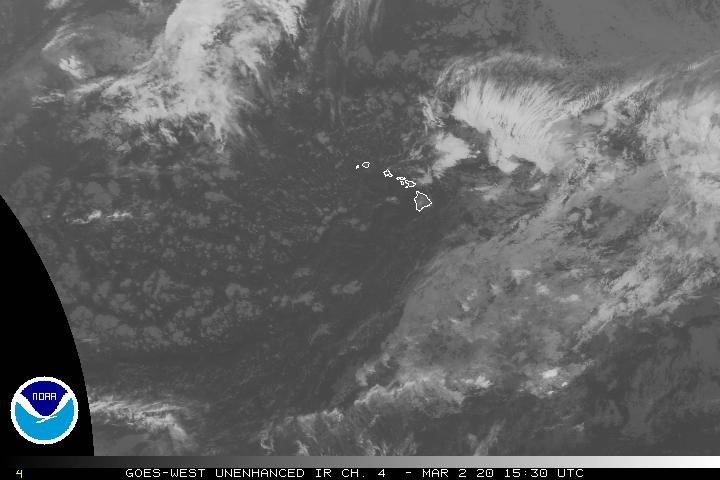
Satellite and Radar Images: To view the cloud conditions we have here in Hawaii, please use the following satellite links, starting off with this Infrared Satellite Image of the islands to see all the clouds around the state during the day and night. This next image is one that gives close images of the islands only during the daytime hours, and is referred to as a Close-up visible image. This next image shows a larger view of the Pacific…giving perspective to the wider ranging cloud patterns in the Pacific Ocean. Finally, here’s a Looping IR satellite image, making viewable the clouds around the islands 24 hours a day. To help you keep track of where any showers may be around the islands, here’s the latest animated radar image.
Hawaii’s Mountains – Here’s a link to the live webcam on the summit of near 14,000 foot Mauna Kea on the Big Island of Hawaii. The tallest peak on the island of Maui is the Haleakala Crater, which is near 10,000 feet in elevation. These two webcams are available during the daylight hours here in the islands…and when there’s a big moon rising just after sunset for an hour or two! Plus, during the nights and early mornings you will be able to see stars, and the sunrise too…depending upon weather conditions.
Tropical Cyclone activity in the eastern and central Pacific – Here’s the latest weather information coming out of the National Hurricane Center, covering the eastern north Pacific. You can find the latest tropical cyclone information for the central north Pacific (where Hawaii is located) by clicking on this link to the Central Pacific Hurricane Center. Here’s a tracking map covering both the eastern and central Pacific Ocean. A satellite image, which shows the entire ocean area between Hawaii and the Mexican coast…can be found here.
Aloha Paragraphs

Surf’s gonna be coming up overnight
Wednesday started off with light breezes, which will become stronger trade winds into Thursday, with moderately strong winds continuing through the week…into next week. The strongest winds Wednesday morning were on the light side, with many calm observations noted. All coastal areas had less than 10 mph winds blowing just after sunrise. As we’ve moved into the afternoon hours, those trade winds began their anticipated strengthening. As of 12 noon, we saw that the
As this weather map shows, we have two high pressure systems more or less to our northeast. One is moving northeast away from the islands, while the other is moving towards us. The tail-end of a cold front is dissipating, which will allow the high pressure ridge to our northeast, to spread west and north…prompting our rebounding trade wind activity.
As the trade winds fill back into the
Thus, we’ll see off and on showers falling along the north and east windward coasts and slopes…with generally fair conditions prevailing along our leeward beaches throughout. As the trade wind speeds accelerate, we may begin to see some showers traveling over to the leeward sides, carried over from the windward sides by those trades.
There’s still that same area of showery clouds just to the east of the state today…as they have been the last couple of days. This area has become less impressive looking during the day Wednesday though, becoming more scattered and less likely to provide all that many showers after all. It will however bring some increase in showers to our windward sides Wednesday into the night.
These clouds were already being carried into the
Our north and west facing beaches will see rising surf, as a new northwest swell train of waves arrives this evening into Thursday. The source of this swell was super-typhoon chai-won, which whipped the north western Pacific into a fury last week. This tropical cyclone has moved out of the tropics, having gone through what we call an extra-tropical transition, into a gale low pressure system in the northern latitudes…moving into the
All of this strong wind, blowing on the surface of the ocean up there, has generated a swell train of large waves…driving southeast in our direction. The forerunners of this higher than normal early autumn surf, will begin arriving now into Thursday. This in turn will prompt NWS issued high surf advisories for our north and west facing beaches. It will take several days of breaking on our local beaches, before this surf’s influence will gradually weaken during the weekend.
It’s early Wednesday evening here in Kihei, Maui, as I begin writing this last paragraph of this morning’s narrative. At the risk of sounding like a broken record, I see mostly clear skies out the windows here, along with the trade winds blowing. There will finally be that expected modest increase in windward showers, as those folks have been a bit dry lately. I’m about ready to hop in my car for the drive back upcountry, and am looking forward to being up in that cooler air. I’ll get right out on my early evening walk shortly thereafter, then have dinner, do some reading, and hit the hay. I’ll be back online early Thursday morning though, preparing your next new weather narrative from paradise. I hope you have a great Wednesday night until then! Aloha for now…Glenn.
Interesting: Humans have been using wood fires for heating somewhere between 400,000 and a million years. Today, though, using wood involves some compromises. Modern wood-burning systems have much, much lower emissions than old ones, but still can emit more than 100 times as much pollution as oil or gas furnaces, inside and outside your home.
Some communities have even banned woodstoves for this reason. But in other areas, wood is the preferred heating option because of price, lack of availability of other fuels, or simply some individuals’ economic or political commitment to live "off the grid," independent of utilities and energy companies.
If a household has available timber, wood is virtually a free source of energy. Another plus for using wood is that it contributes less to global warming than burning fossil fuels. Oil, gas, coal, and wood all give off carbon dioxide as they burn.
But if a tree is replanted for one that was cut down to use for fuel, it will absorb carbon dioxide as it grows, offsetting the emissions from burning. Of course a full environmental advantage only exists if the wood is harvested sustainably, without damage to the forest environment.
Interesting2: A wind-driven wildfire reported to have spontaneously ignited in a manure pile grew to nearly 10,000 acres on Wednesday as it crept for a second day toward a town north of Los Angeles. The blaze erupted on Tuesday morning on the first day of fall, the traditional start of the Santa Ana wind season in Southern California marked by hot, dry gusts that blow in to coastal mountains, foothills and canyons from the deserts to the east.
The so-called Guiberson Fire, the most menacing of several wildland blazes flaring across the region, had charred at least 9,700 acres of tinder-dry grasslands and brush as it advanced on the outskirts of Moorpark, a community of 45,000 people about 30 miles north of Los Angeles.
The extreme fire weather comes as Los Angeles County still battles its worst fire ever. The Station Fire that broke out a month ago has destroyed more than 160,000 acres and 89 homes and killed two firefighters.
In the latest fire, about 1,000 homes, most of them in Moorpark, were immediately threatened by the flames, said Bill Nash, a Ventura County Fire Department spokesman. Hundreds of people have been advised to leave their homes, but no dwellings have been lost.
Four firefighters have been slightly injured since the blaze erupted on Tuesday morning, ignited, according to the Los Angeles Times and local TV, by the spontaneous combustion of a manure pile in triple-digit heat.
The rolling hills in the area are dotted by ranches and fruit and avocado orchards. Nearly 900 firefighters were assembled to battle the blaze, backed by an aircraft arsenal that includes water-dropping helicopters and several air tankers equipped to drop water or fire retardant chemicals.
"We’re hitting it with everything we’ve got," Nash said, adding that vegetation fueling the blaze in extremely low humidity "will burn just as fast as the wind will push it." The flames were being fanned by gale-force wind gusts, with strong, steady winds forecast for Wednesday.
Interesting3: A plant that lives along muddy waterways in Asia has inspired a NASA team to develop a special coating to prevent dirt and even bacteria from sticking to and contaminating the surfaces of spaceflight gear. Researchers at NASA’s Goddard Space Flight Center in Greenbelt, Md., are developing a transparent coating that prevents dirt from sticking in the same way a lotus plant sheds water — work begun through collaboration with Northrop Grumman Electronics Systems, Linthicum, Md., and nGimat Corporation, Atlanta, Ga.
Although a lotus leaf appears smooth, under a microscope, its surface contains innumerable tiny spikes that greatly reduce the area on which water and dirt can attach. "If you splash lotus leaves with water, it just beads up and rolls off, indicating they have a special hydrophobic or water-repelling ability," said Eve Wooldridge, the James Webb Space Telescope (JWST) Project Contamination and Coatings Lead at Goddard.
"This ability also prevents dust from adhering to the leaves." This special quality is what the NASA team is attempting to replicate to prevent dirt from accumulating on the surfaces of spacesuits, scientific instruments, robotic rovers, solar array panels and other hardware used to gather scientific data or carry out exploratory activities on other objects in the solar system. The trick is developing a coating that can withstand the harsh space environment.
Interesting4: New species are not just discovered in exotic locales—even places as urban as California still yield discoveries of new plants and animals. Academy scientists recently named a new species of chimaera, an ancient and bizarre group of fishes distantly related to sharks, from the coast of Southern California and Baja California, Mexico.
The new species, the Eastern Pacific black ghostshark (Hydrolagus melanophasma), was described in the September issue of the international journal Zootaxa by a research team including Academy Research Associates David Ebert and Douglas J. Long.
Additional co-authors included Kelsey James, a graduate student at Moss Landing Marine Laboratories, and Dominique Didier from Millersville University in Pennsylvania. This is the first new species of cartilaginous fish to be described from California waters since 1947.
Chimaeras, also called ratfish, rabbitfish, and ghostsharks, are perhaps the oldest and most enigmatic groups of fishes alive today. Their closest living relatives are sharks, but their evolutionary lineage branched off from sharks nearly 400 million years ago, and they have remained an isolated group ever since.
Like sharks, chimaeras have skeletons composed of cartilage and the males have claspers for internal fertilization of females. Unlike sharks, male chimaeras also have retractable sexual appendages on the forehead and in front of the pelvic fins and a single pair of gills.
Most species also have a mildly venomous spine in front of the dorsal fin. Chimaeras were once a very diverse and abundant group, as illustrated by their global presence in the fossil record.
They survived through the age of dinosaurs mostly unchanged, but today these fishes are relatively scarce and are usually confined to deep ocean waters, where they have largely avoided the reach of explorers and remained poorly known to science.
This new species belongs to the genus Hydrolagus, Latin for ‘water rabbit’ because of its grinding tooth plates reminiscent of a rabbit’s incisor teeth. This new species was originally collected as early as the mid 1960s, but went unnamed until this year because its taxonomic relationships were unclear.
A large blackish-purple form, Hydrolagus melanophasma (melanophasma is Latin for ‘black ghost’), is found in deep water from the coast of Southern California, along the western coast of Baja California, and into the Sea of Cortez (Gulf of California).
This species is known from a total of nine preserved museum specimens, and from video footage taken of it alive by a deep-water submersible in the Sea of Cortez.
Interesting5: Vaccinations against flu for the 2010 influenza season in the southern hemisphere should also contain viruses against the current pandemic H1N1 virus, the World Health Organization said on Wednesday. The WHO is currently coordinating the production of vaccines against pandemic H1N1, known as swine flu, for this year’s influenza season in the northern hemisphere, which will start in November as the northern winter approaches.
But in early guidance to health authorities and vaccine makers, it said vaccines should contain the pandemic H1N1 virus plus two seasonal flu strains likely to circulate next year. The WHO declared that swine flu was a global pandemic in June after it was detected in April.
"Outbreaks subsequently occurred in all regions of the world and by July pandemic A (H1N1) was the predominant influenza virus circulating in many countries in the Americas, Asia, Europe and Oceania," it said in a note on its website.
It said it was too soon to say whether vaccines next year should comprise a single shot with all three viruses or whether there should be separate shots for pandemic and seasonal flu.
It said it would give guidance on this issue after its Strategic Advisory Group of Experts, which makes recommendations on immunization, considers the question in late October.
The pandemic H1N1 virus is becoming much more common than seasonal H1N1 strains that have also been circulating, it said. The WHO has said the swine flu pandemic could affect one third of the world’s nearly seven billion people.
It is so infectious that most countries have stopped gathering statistics on how many people have caught it, but in the vast majority of cases so far the symptoms have been mild.
Interesting6: In a new study, Clemson University researchers have concluded that the number of hurricanes and tropical storms in the Atlantic Basin is increasing, but there is no evidence that their individual strengths are any greater than storms of the past or that the chances of a U.S. strike are up. Robert Lund, professor of mathematical sciences at Clemson, along with colleagues Michael Robbins and Colin Gallagher of Clemson and QiQi Lu of Mississippi State University, studied changes in the tropical cycle record in the North Atlantic between 1851 and 2008.
“This is a hot button in the argument for global warming,” said Lund. “Climatologists reporting to the U.S. Senate as recently as this summer testified to the exact opposite of what we find. Many researchers have maintained that warming waters of the Atlantic are increasing the strengths of these storms.
We do not see evidence for this at all, however we do find that the number of storms has recently increased.” The study represents one of the first rigorous statistical assessments of the issue with uncertainty margins calculated in.
For example, Lund says “there is less than a one in 100,000 chance of seeing this many storms occur since 1965 if in truth changes are not taking place.” He adds, “Hopefully such a rigorous assessment will clear up the controversy and the misinformation about what is truly happening with these storms.”
The study, submitted to the Journal of the American Statistical Association, also found changes in storm pattern records starting around 1935. This was expected at the onset of aircraft reconnaissance, which allowed record-keepers to identify and document storms occurring in the open ocean.
While the study did conclude that more storms are being documented, researchers found no evidence of recent increases in U.S. landfall strike probability of the strongest of hurricanes. Lund notes that “because these types of storms are so uncommon, it will take many more years of data to reliably assess this issue."
Interesting7: Think of the biggest crowd you’ve ever been in – perhaps 50,000 in a sports stadium. Just 6 hours from now there will be that many more people in the world, and another 50,000 in the following 6 hours, and on and on… No wonder that the burgeoning human population is often seen as is the single biggest problem facing our world. There are nearly 7 billion humans alive today, twice as many as there were in 1965, with 75 million more being added each year.
UN predictions say there could be an extra 2 to 4 billion of us by 2050. The planet has never experienced anything like it. Can the world sustain this growing horde? It’s a contentious question. While it is clear that the population cannot go on increasing forever, history is littered with dire but failed predictions of famine and death resulting from over-population.
Most famously, Thomas Malthus warned more than two centuries ago that population would be held in check by rising mortality. What he failed to anticipate was the ability of newly industrialized societies to support large numbers of people. Today, the "population problem" is firmly back on the agenda.
Earlier this year the UK government’s chief scientific adviser John Beddington predicted a population-led global crisis by 2030, and a group of influential billionaires including Bill Gates and George Soros identified overpopulation as the greatest threat facing humanity.
Every time we publish an article in New Scientist detailing yet another of the planet’s environmental woes, readers respond by arguing that the real problem is overpopulation. The population statistics are indeed staggering. Yet the raw numbers hide a multitude of complexities.
Look closely, and it becomes clear that the common-sense assumption that population is the root of all evil is simplistic. For example, while the human population is growing in absolute terms, the rate of growth is slowing – from a peak of 2 per cent in the early 1960s to around 1 per cent today.
In Japan, Russia and many European countries, women are having so few children that populations are shrinking or will do so soon – an unprecedented state of affairs other than in times of war or plague. At the same time, the populations of many of the least developed nations are exploding, with women in some countries giving birth to more than five children on average.
"We are burdensome to the world, the resources are scarcely adequate for us… already nature does not sustain us." So wrote Tertullian, an early Christian, back in the 3rd century. At that time, the world population stood at some 200 million. Eighteen centuries on and with 34 times as many people on the planet, the debate continues.
 Email Glenn James: