August 23-24, 2010
Air Temperatures – The following maximum temperatures were recorded across the state of Hawaii Monday afternoon:
Lihue, Kauai – 84
Honolulu, Oahu – 88
Kaneohe, Oahu – 83
Kaunakakai, Molokai – 84
Kahului, Maui – 87
Hilo, Hawaii – 84
Kailua-kona – 84
Air Temperatures ranged between these warmest and coolest spots near sea level – and on the highest mountain tops…as of 5pm Monday evening:
Port Allen, Kauai – 86
Kailua-kona – 79
Haleakala Crater – missing (near 10,000 feet on Maui)
Mauna Kea summit – 48 (near 14,000 feet on the Big Island)
Precipitation Totals – The following numbers represent the largest precipitation totals (inches) during the last 24 hours on each of the major islands, as of Monday afternoon:
0.31 Mount Waialeale, Kauai
0.07 South Fork Kaukonahua, Oahu
0.01 Molokai
0.00 Lanai
0.00 Kahoolawe
0.10 West Wailuaiki, Maui
0.07 Kealakekua, Big Island
Marine Winds – Here’s the latest (automatically updated) weather map showing two high pressure systems located to the north of the islands. Our local trade winds will remain active Tuesday and Wednesday.
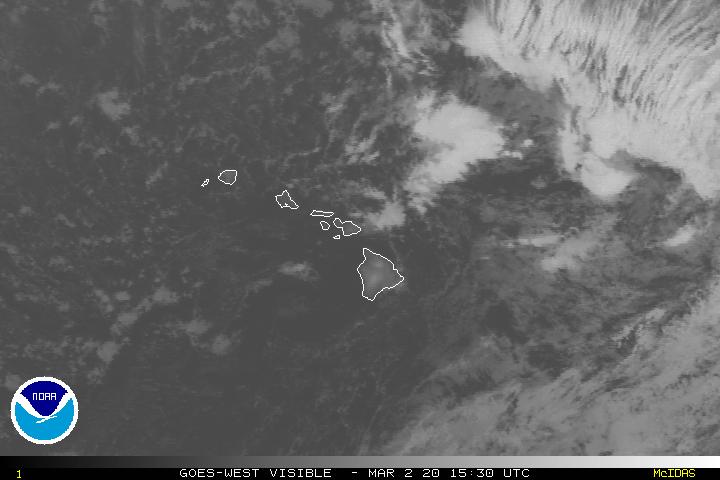
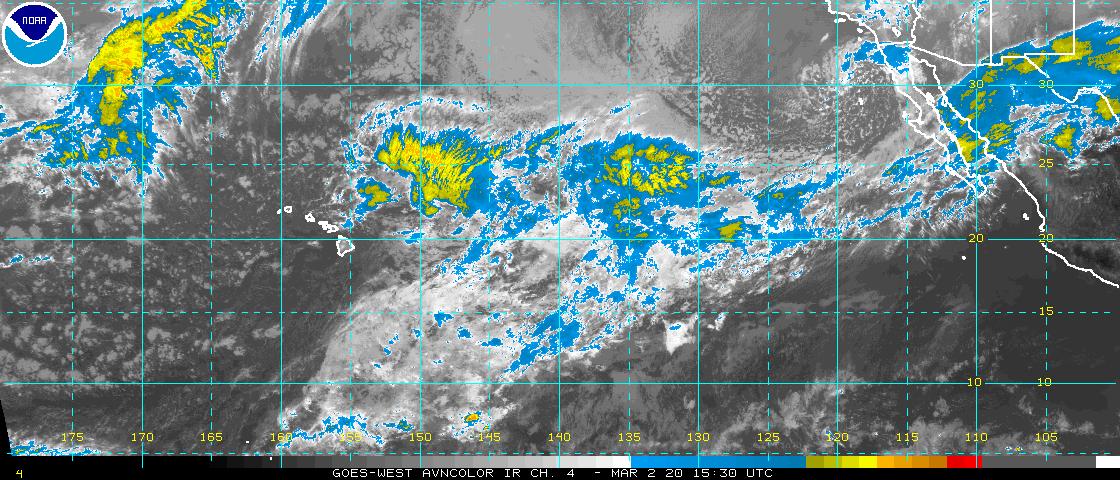
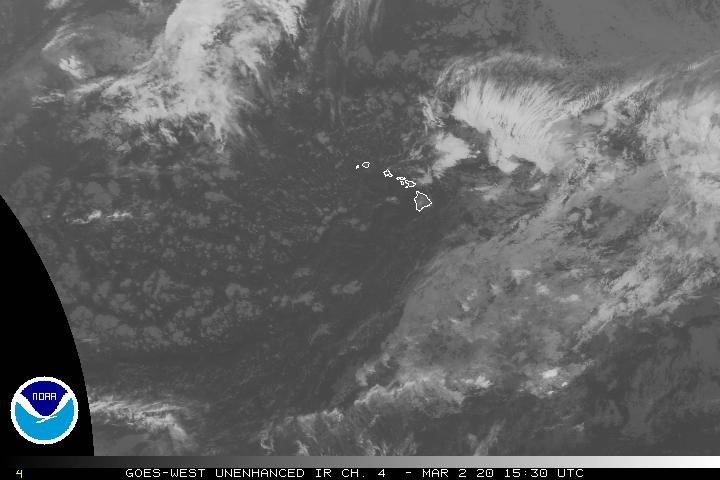
Satellite and Radar Images: To view the cloud conditions we have here in Hawaii, please use the following satellite links, starting off with this Infrared Satellite Image of the islands to see all the clouds around during the day and night. This next image is one that gives close images of the islands only during the daytime hours, and is referred to as a Close-up visible image. This next image shows a larger view of the Pacific…giving perspective to the wider ranging cloud patterns in the Pacific Ocean. Finally, here’s a Looping IR satellite image, making viewable the clouds around the islands 24 hours a day. To help you keep track of where any showers may be around the islands, here’s the latest animated radar image.
Hawaii’s Mountains – Here’s a link to the live webcam on the summit of near 14,000 foot Mauna Kea on the Big Island of Hawaii. The tallest peak on the island of Maui is the Haleakala Crater, which is near 10,000 feet in elevation. These two webcams are available during the daylight hours here in the islands…and when there’s a big moon rising just after sunset for an hour or two! Plus, during the nights and early mornings you will be able to see stars, and the sunrise too…depending upon weather conditions.
Tropical Cyclone activity in the eastern and central Pacific – Here’s the latest weather information coming out of the National Hurricane Center, covering the eastern north Pacific. You can find the latest tropical cyclone information for the central north Pacific (where Hawaii is located) by clicking on this link to the Central Pacific Hurricane Center. Here’s a tracking map covering both the eastern and central Pacific Ocean. A satellite image, which shows the entire ocean area between Hawaii and the Mexican coast…can be found here. Of course, as we know, our hurricane season won’t begin again until June 1st here in the central Pacific.
Aloha Paragraphs

Jumping off the big rock…into the warm Pacific Ocean
Moderately strong trade winds will continue to blow over the Hawaiian Islands this week. This weather map shows two moderately strong high pressure systems to our north, the source of our trade breezes Monday night. The wind flow across our islands has dropped just enough to have ended the NWS issued small craft wind advisories through the channels around Maui and the Big Island…and along those few windier coastal areas in the southern part of the state as well.
Also typical for this late summer period, rainfall left to its own devices…won’t be drawing much attention. Actually, we need more precipitation to combat the ongoing localized drought conditions, in the leeward areas around the state. This satellite image shows one patch of clouds that is bringing some showers to the windward sides between Maui and
It’s Monday
evening as I begin writing this last section of today’s narrative update. Monday was able as normal as it gets for this period in our late summer season. High temperatures were near normal, wind speeds were about average…and precipitation wasn’t anything unusual either. If you’re here in the islands now, and you liked today, you’re in luck…as our weather will remain pleasantly similar this week. The surf is small in most areas, which will provide good swimming and snorkeling conditions. The winds have lost a bit of strength now, so golf, tennis, and what have you, will be great too. I can’t think of any outdoor experience that won’t be in good shape as far as our local weather is concerned now. ~~~ Looking out the window here in Kihei, Maui, before I take the drive back home to Kula, it’s partly cloudy and breezy. I would estimate the temperature to be around 80F at 530pm. It may sound funny, but I can hardly wait to get back into my new walking shoes, and to get back on the road, on my feet rather than my tires. I enjoy the simple things in life, and always have for some reason. At any rate, I hope you have a great Monday night, until I see you here again early Tuesday morning, with your next new weather narrative from paradise! Aloha for now…Glenn.
Interesting: As hurricane season gets into full swing, mental health teams will be ready to respond and help survivors cope with possible devastation. Psychologists have analyzed decades of research and found that disaster response strategies should address the needs of the population affected, specifically those with disabilities and mental disorders.
Research conducted in the aftermaths of the Oklahoma City bombing and Hurricane Katrina also showed that the type of disaster can have a distinct effect on how people respond psychologically. These and other findings are reported in a special section of Rehabilitation Psychology devoted to disaster management and people with disabilities.
The journal is published by the American Psychological Association. "Katrina taught us a harsh lesson about the plight of vulnerable people in times of disaster and national emergency," said the journal’s editor, Timothy Elliott, PhD, of Texas A&M University.
"Solutions to these problems won’t be provided by any single profession or service, which is why this special section brings together colleagues from psychology, special education and rehabilitation administration to provide information that will help us find solutions."
In a study looking at Hurricane Katrina victims, researchers focused on survivors with a wide range of disabilities. Nearly two years after the storm, they surveyed and interviewed disaster case managers and supervisors who provided services to 2,047 individuals with disabilities and their families through the Katrina Aid Today project.
They found that considerable barriers to housing, transportation and disaster services were still present two years after the storm. For example, they found that survivors with disabilities were less likely to own homes than survivors without disabilities. This meant that some of the Federal Emergency Management Agency homeowner programs did not help them or, in the case of FEMA trailers, were not accessible to them.
People with disabilities were also less likely to be employed, which affected their ability to pay utility bills or purchase furniture when they did transition to more permanent housing. Individuals with disabilities were more likely to have medical needs, which affected their ability to travel to service agencies or get jobs.
Case management with the survivors with disabilities was seen as taking longer because these people needed assistance in multiple areas. "Case managers who are knowledgeable about the needs of people with disabilities are essential when navigating an already difficult service system following a disaster of this magnitude," said the study’s lead author, Laura Stough, PhD, from Texas A&M University.
Interesting2: Mindulle, a moderate tropical storm as of Monday, will spin ashore in northern Vietnam with squalls and torrential rain before the middle of the week. On Monday morning, EDT, the center of Mindulle had pulled to within 100 miles northeast of Da Nang. Highest sustained winds at the time were near 45 mph. Movement was towards the west-northwest at 10 mph.
Owing to the shape of the northern Vietnam coast, Mindulle will approach land at a shallow angle or even track alongside the coast before making a full landfall, mostly likely on Tuesday. Satellite imagery of Tropical Storm Mindulle as of Monday morning, EDT. Image courtesy of the Navy/NRL Tropical Cyclone Page.
Barring a sudden strengthen before landfall, Mindulle will pose little wind threat to the Vietnam coast. Torrential rain and flooding will, however, be a threat to areas along and near the path of Mindulle, both in Vietnam and in neighboring Laos. Rugged highlands on both sides of the international border will be prone to mudslides in areas of heaviest rain from Mindulle.
Interesting3: If you had a dinner invitation in Utah’s Escalante Valley almost 10,000 years ago, you would have come just in time to try a new menu item: mush cooked from the flour of milled sage brush seeds. After five summers of meticulous excavation, Brigham Young University archaeologists are beginning to publish what they’ve learned from the "North Creek Shelter."
It’s the oldest known site occupied by humans in the southern half of Utah and one of only three such archaeological sites state-wide that date so far back in time. BYU anthropologist Joel Janetski led a group of students that earned a National Science Foundation grant to "get to the bottom" of a site occupied on and off for the past 11,000 years, according to multiple radiocarbon estimates.
"The student excavators worked morning till night in their bare feet," Janetski said. "They knew it was really important and took their shoes off to avoid contaminating the old dirt with the new." In the upcoming issue of the journal Kiva, Janetski and his former students describe the stone tools used to grind sage, salt bush and grass seeds into flour. Because those seeds are so tiny, a single serving would have required quite a bit of seed gathering.
But that doesn’t mean whoever inhabited North Creek Shelter had no other choice. Prior to the appearance of grinding stones, the menu contained duck, beaver and turkey. Sheep became more common later on. And deer was a staple at all levels of the dig. "Ten thousand years ago, there was a change in the technology with grinding stones appearing for the first time," Janetski said.
"People started to use these tools to process small seeds into flour." BYU graduates David Yoder, Mark Bodily and Brad Newbold are also authors on the new study. Though they have moved on in their careers, the group members continue to work with Janetski to investigate the animal bones, projectile points and signs of climate change influencing human diet.
The North Creek Shelter is located at the base of a sheer sandstone cliff on the same property as the Slot Canyon Inn, which now contains an exhibit about the researchers’ findings. Janetski notes the generous support received from the property owners, Jeff and Joette Rex.
Interesting4: Mauritania has launched a tree-planting program aimed at protecting its capital from the advancing desert and coastal erosion, a project that could eventually extend thousands of kilometers across Africa. President Mohamed Ould Abdel Aziz on Saturday planted the first of some 2 million trees that are meant to form a "green belt" around the capital, Nouakchott, and curb erosion elsewhere in the desert nation that straddles black and Arab Africa.
"The aim of this green belt is to stop the advancing desert and stop encroachment by the sea, which is threatening the town with floods," Ba Housseynou Hammadi, minister for the environment and sustainable development, said.
"This belt will also play an economic role. Some of the trees that have been chosen can be used for firewood. Others will produce gum acacia, which is (a natural gum) sought after for pharmaceutical products," Hammadi added.
It will take four years to plant the trees in Mauritania. The project is part of a broader ant-desertification plan, the "Great Green Wall," launched by the African Union in 2005 to try to create a 15 km-wide wall of greenery stretching 7,000 km between Africa’s east and west coasts. Image shows the planned location of the Great Green Wall across Africa.
 Email Glenn James: