











August 18-19, 2010
Air Temperatures – The following maximum temperatures were recorded across the state of Hawaii Wednesday afternoon:
Lihue, Kauai – 84
Honolulu, Oahu – 87
Kaneohe, Oahu – 82
Kaunakakai, Molokai – 85
Kahului, Maui – 87
Hilo, Hawaii – 81
Kailua-kona – 82
Air Temperatures ranged between these warmest and coolest spots near sea level – and on the highest mountain tops…as of 4pm Wednesday afternoon:
Honolulu, Oahu – 85
Molokai airport – 79
Haleakala Crater – 61 (near 10,000 feet on Maui)
Mauna Kea summit – 48 (near 14,000 feet on the Big Island)
Precipitation Totals – The following numbers represent the largest precipitation totals (inches) during the last 24 hours on each of the major islands, as of Wednesday afternoon:
1.05 Mount Waialeale, Kauai
0.22 Nuuanu Upper, Oahu
0.03 Molokai
0.00 Lanai
0.15 Kahoolawe
0.93 West Wailuaiki, Maui
0.82 Kawainui Stream, Big Island
Marine Winds – Here’s the latest (automatically updated) weather map showing a 1026 millibar high pressure system located northeast of the islands. Our local trade winds will remain active Thursday and Friday.
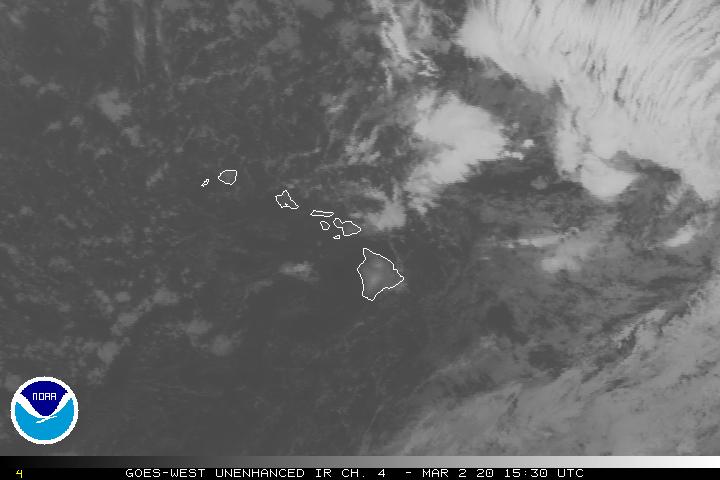
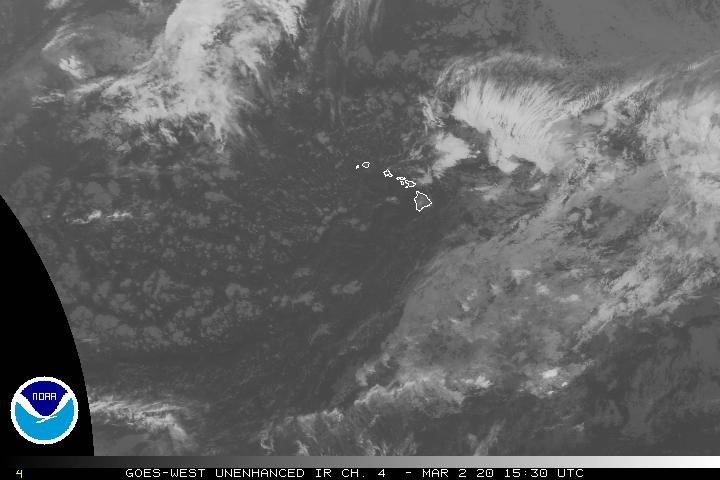
Satellite and Radar Images: To view the cloud conditions we have here in Hawaii, please use the following satellite links, starting off with this Infrared Satellite Image of the islands to see all the clouds around during the day and night. This next image is one that gives close images of the islands only during the daytime hours, and is referred to as a Close-up visible image. This next image shows a larger view of the Pacific…giving perspective to the wider ranging cloud patterns in the Pacific Ocean. Finally, here’s a Looping IR satellite image, making viewable the clouds around the islands 24 hours a day. To help you keep track of where any showers may be around the islands, here’s the latest animated radar image.
Hawaii’s Mountains – Here’s a link to the live webcam on the summit of near 14,000 foot Mauna Kea on the Big Island of Hawaii. The tallest peak on the island of Maui is the Haleakala Crater, which is near 10,000 feet in elevation. These two webcams are available during the daylight hours here in the islands…and when there’s a big moon rising just after sunset for an hour or two! Plus, during the nights and early mornings you will be able to see stars, and the sunrise too…depending upon weather conditions.
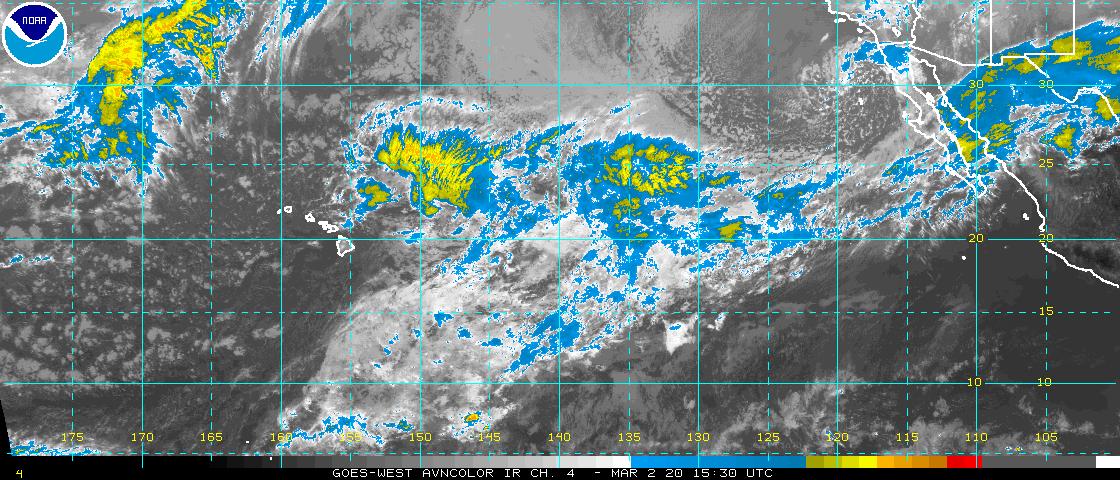
Tropical Cyclone activity in the eastern and central Pacific – Here’s the latest weather information coming out of the National Hurricane Center, covering the eastern north Pacific. You can find the latest tropical cyclone information for the central north Pacific (where Hawaii is located) by clicking on this link to the Central Pacific Hurricane Center. Here’s a tracking map covering both the eastern and central Pacific Ocean. A satellite image, which shows the entire ocean area between Hawaii and the Mexican coast…can be found here. Of course, as we know, our hurricane season won’t begin again until June 1st here in the central Pacific.
Aloha Paragraphs

Nice surf along our south, west, and north shores
Moderately strong trades will remain active through the rest of this week…into next week. This weather map shows a moderately strong 1026 milibar high pressure system located to our north-northeast, the source of our trade breezes early Wednesday night. This high pressure cell extends northward into the Gulf of Alaska, to south of the
This active trade wind shower activity will remain in place for several more days. This satellite image shows no lack of showery looking clouds being carried our way in the breezy trade winds. These clouds will impact the windward sides most generously, although some showers will make it to our leeward sides at times. Glancing down further to the south of the islands, in the deeper tropics, using this satellite picture, we see areas of thunderstorms to the southeast through southwest of our islands. Meanwhile, there’s that same dissipating arc of thunderstorms to our northwest, part of a cold front…which will be going away soon.
It’s Wednesday
evening as I begin writing this last section of today’s narrative update. Our trade winds will remain moderately strong for the time being, although as the aforementioned cold front to our northwest dissipates…our trades will strengthen. As noted above, we’re finding a good amount of passing shower activity along our windward sides. These showers will continue tonight, and into Thursday, which is a good thing. We just wish that more of these showers would make their way down to the leeward coasts, where the drought conditions are most pronounced. ~~~ Looking out the window here in Kihei, Maui, before I head back upcountry to Kula, it’s cloudy up that way, and a bit showery too. That whole area needs as much rain as we can get, so I’m stoked to see that light rain falling up there. I can hardly wait to get home, and feel that cool air on my skin, and maybe even a few drops of that wet stuff when I head out on my evening walk. I’ll be back early Thursday morning with your next new weather narrative, I hope you have a great Wednesday night until then! Aloha for now…Glenn.
Interesting: New research published by University of Washington seismologists reports the results of monitoring they have been recording of a slow-moving and unfelt seismic event under the Olympic Peninsula. It promises to be the best-documented such event in the eight years since the regularly occurring phenomena were first discovered.
"It appears to be right on time," Steve Malone, a UW Earth and space sciences professor, said of the most recent of what are termed episodic tremor-and-slip, or slow-slip, events. "The first signals were mostly fairly weak, but they were easily detected."
The first ground motion associated with the event was recorded very early Sunday morning in an area north of Olympia and west of Tacoma. By Monday afternoon the signals were substantially stronger. If the event behaves like past occurrences, the source of the rumbling will move north through the Olympic Peninsula during the next week before crossing the Strait of Juan de Fuca to Canada’s Vancouver Island.
Such slow-slip events have been documented on the Olympic Peninsula at an average frequency of every 14½ to 15 months since 2002 (an event last year actually started three months earlier than expected). They typically last several weeks and can release as much energy as a magnitude 6 earthquake.
The UW-based Pacific Northwest Seismic Network already has eight arrays with 10 seismic recording stations, each deployed across the northern part of the Olympic Peninsula from Port Angeles to Port Townsend. In the next couple of days, using funding from the National Science Foundation’s EarthScope program, crews will double the number of stations in each array to document this three-week event with unprecedented precision.
"One of the reasons we’re placing these arrays is to confirm the three-dimensional depth," Malone said. "We’ve been able with our seismic network to get an approximate epicenter (for past events) but the resolution for depth has been very poor."
If several stations are focused on the same tremor source, he said, a very precise depth can be triangulated to provide better understanding about the stresses building up within the Earth’s crust. Episodic tremor-and-slip events have been associated with the entire Cascadia subduction fault zone, which runs along the Northwest coast, as well as a dozen other dangerous fault lines worldwide. The fault zone is created by the Juan de Fuca tectonic plate sliding beneath the section of the North American plate where western Washington is located.
It is believed the two plates are locked together by friction near the surface but that they slide past each other easily at greater depth, where heat has made the rock more pliable. Slow-slip events are likely to be occurring at a depth where the plates transition from being locked to being free-moving, Malone said.
"Models indicate these events are loading a little extra stress on the fault zone," he said. Interest in slow-slip events has been intense in recent years because they alter stresses in the subduction zone, which ruptures in magnitude 9 mega-thrust earthquakes on the order of every 500 years. The last one occurred in 1700. (The earthquake that caused the devastating 2004 Indian Ocean tsunami had a magnitude of 9.1.)
Interesting2: Not everyone can drive to work in their own vehicle. Planners must find ways to blend individual vehicles with the needs of mass transportation. Building train stations or subways is highly capital intensive and involves years of construction and related delays due to construction.
Adding buses adds to traffic. Furthermore mass transit needs to be safe, clean and inexpensive. The straddling bus, first exhibited on the 13th Beijing International High-tech Expo in May this year, maybe one answer. In the near future, the model is to be put into pilot use in Beijing’s Mentougou District.
This straddle bus is really a monorail with a wheel. One side of the bus rides a rail next to the side of the road while the other side has a normal tire. Under the bus is an open space, sort of like a tunnel, in which ordinary cars can pass through like in a tunnel. Such a bus is also similar to an old style trolley bus that also rides on a rail.
Shenzhen Hashi Future Parking Equipment Co., Ltd, describes the model like a subway or light-rail train bestriding the road. It is 4-4.5 meter high with two levels: passenger’s board on the upper level while other vehicles lower than 2 meters (about 7 feet) can go through under.
These buses are powered by electricity and solar energy. The bus can is designed for speeds of 40 miles per hour carrying 1200-1400 passengers at a time without blocking other vehicle’s way. In theory, traffic jams are reduced and the capital costs are less than a train or a subway.
The straddle bus is planned to be mainly installed in China at this time. At present, there are 3 types of public transits in China: subway, light-rail train, and bus.
Subways and trains have a high capital costs and take a long time to build. Buses take up road spaces, are noisy and usually pollute a lot more due to fuel combustion.
To build a straddle bus line one needs the bus as well as the rail system and support systems to be built. For cities without an existing subway or train system, the straddle bus may be a cost effective solution.
There is a potential issue of vehicles that are too high entering into the bus tunnel. The designers say too high vehicles can be warned off by signs and alarms activated by warning laser scanners.
The height of the bus is also a potential issue because people have to climb up to board as well as go down to escape. There are already double deck buses and trains that are exactly the same in concept. The straddle bus also has a emergency inflatable chute which the same as is used in emergencies for escape from a plane.
At the moment, the straddle bus is a Chinese solution for mass transit. It is similar to monorails and trolley cars in concept. The uniqueness is the tunnel underneath which will take getting used to for the motorist underneath.
Interesting3: A massive reduction in grasslands and the spread of forests may have been the primary cause of the decline of mammals such as the woolly mammoth, woolly rhino and cave lion, according to Durham University scientists. The findings of the new study challenge the theory that human beings were the primary cause of the extinction of mammals through hunting, competition for land and increased pressure on habitats.
The research is part of the most comprehensive study to date of Northern Hemisphere climate and vegetation during and after the height of the last Ice Age, 21,000 years ago. It shows that, over a huge part of the Earth’s surface, there was a massive decline in the productivity and extent of grasslands due to climatic warming and the spread of forests.
It shows that, over a huge part of the Earth’s surface, there was a massive decline in the productivity and extent of grasslands due to climatic warming and the spread of forests.
These habitat changes made grazing much more difficult for large mammals and dramatically reduced the amount of food available for them. The changes in grassland quality and availability coincided with increases in the distribution and abundance of modern man, Homo sapiens, ensuring a time of wide-scale upheaval for herbivorous mammals and other mammals that preyed on them.
The decrease in productivity and extent of grassland is likely to have been the major contributor to the extinction of many large mammals across most of northern Eurasia and north-western North America by about 11,400 years ago, the onset of the present warm interglacial period.
Interesting4: Waterborne chemicals leached from plastics and detergents, including bisphenol A (BPA), may have contributed to significant lobster die-offs in the waters of Long Island Sound over the last decade, researchers say. As many as half of the lobsters tested in areas where lobster populations have plunged showed high levels of alkylphenols, a group of chemicals derived from detergents, paints, and plastics, according to researchers at the University of Connecticut.
Those chemicals interfere with hormones crucial to the growth of young lobsters, doubling the time it takes for lobsters to molt their shells and create new hard shells, and making them more susceptible to disease, said Hans Laufer, a research professor in the university’s Department of Molecular and Cellular Biology.
The lobsters are consuming these chemicals with their food, including mollusks that filter the chemicals from the water. Lobster shell disease has caused a large drop in lobster populations since the late-1990s in the Sound, with the annual Connecticut lobster catch plummeting to about one-sixth of 1998 levels.
Aside from being a concern for the fisheries industry, Laufer also thinks that alkylphenol contamination is a serious threat to human health. About 90 percent of the U.S. population is also contaminated with alkylphenols, which in some cases — such as BPA — have been shown to affect human reproduction.
Interesting5: Less noise, less exhaust, less refuse — air travel of the future is expected to be quieter, cleaner and more environmentally friendly. To achieve this goal, new structural concepts and aerodynamic profiles have to be engineered, along with better drive concepts as well as adapted logistical designs, and then put to use. In the EU project Clean Sky, Fraunhofer researchers want to make their contribution to solving this Herculean task.
They present their initial findings at ILA, the international aerospace trade show in Berlin, from June 8 to 13, 2010.
Flying can become considerably more environmentally friendly — the aviation experts from the "Advisory Council for Aeronautics Research in Europe" ACARE are certain of this. In the guidelines that they compiled for the European aviation industry, the experts are calling for a 50 percent reduction in carbon dioxide and noise emissions by 2020; nitrogen oxide output should be reduced by 80 percent.
The goals are ambitious, Professor Holger Hanselka thinks — but achievable. Since 2008, the head of the Fraunhofer Institute for Structural Durability and System Reliability LBF in Darmstadt has been a member of the Governing Board, the decision-making body of the EU’s "Clean Sky" project, one of the most expansive and complex research projects in Europe, with a subsidy volume of 1.6 billion euro.
The goal of the 86 participating industry and research partners from 16 nations is not only to develop unique technologies for specific applications, but also to evaluate and advance the entire aeronautics system.
In its first stages a task force set the plot for the technology fields for the airplane encompassing engines, wings and fuselage structures as well as systems and landing gear, etc.. Each of these components can be put into an improved ecological balance of the system as a whole.
An optimized airflow profile on the wings cuts noise and saves energy; improved engine technology minimizes kerosene consumption; materials with long life spans save on raw materials; the application of recyclable materials prevents the accumulation of waste.
The breadth of detail is immense: Materials have to be tested, material flows simulated, calculation methods refined, experiments conducted and analyzed. "At every level of the undertaking, goals must be precisely defined, so that everyone knows exactly what he or she has to do," explains John Simpson, Fraunhofer program manager and steering member.
For the first time, the researchers also intend to take into account the lifecycle of materials within airline construction; until now, aircraft headed for retirement were extremely difficult to scrap and dispose of. Specialists at the Fraunhofer Institute for Chemical Technology ICT, for example, developed special plastics that not only possess the exact material characteristics desired by the manufacturer, but can also be disposed of at the end of their economic lives in an environmentally sound manner.
"Airplane manufacturers who had hitherto built their aircraft primarily at manufacturing plants want to automate their production in the future. Fraunhofer institutes that specialize in production processes can bring their experiences into the equation," explains Hanselka.
Therefore, researchers at the Fraunhofer Institute for Manufacturing Engineering and Applied Materials Research IFAM are investigating the best way of joining the most important lightweight construction materials in use today, and how new paint systems can reduce frictional resistance.
The aviation industry places a particularly premium on safety — for good reason, because the lives of passengers and crew depend on the integrity of the materials used being able to withstand mercurial pressure and temperature conditions as well as the vibrations and shearing forces that occur over the course of each flight. At ILA, the LBF experts will display a new sensor system for online monitoring of airfoil wings: Actuators that are integrated into the wings emit impulses.
A network of sensors receives the signals and transmits them to an electronic data processing system. Changes in the transfer pathway that indicate tears in the material can be immediately detected in this manner. The researchers at the Fraunhofer Institute for Electronic Nano Systems ENAS are currently engineering a demonstrator that can measure deformations as they occur when an airplane takes off or lands.
Right after safety come health and passenger well-being. So, for example, testing should indicate if a newly developed material diminishes the air quality in the passenger cabin. In the Flight Test Facility at the Fraunhofer Institute for Building Physics IBP, researchers can simulate the pressure, temperature and moisture conditions during a flight.
 Email Glenn James: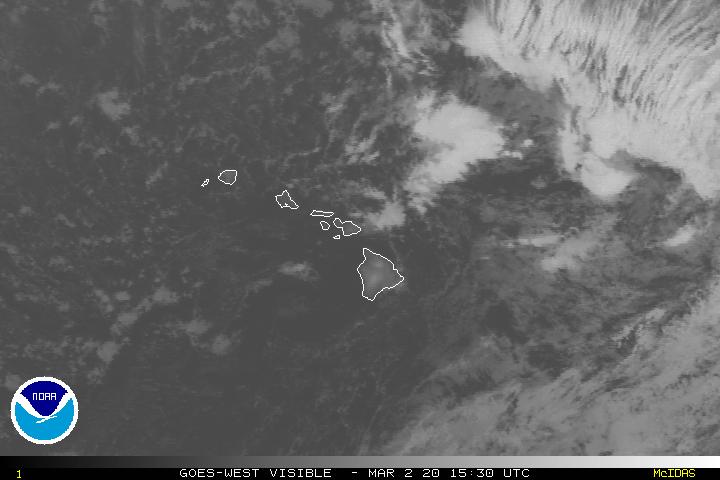


Amanda Says:
It feels like it has been 6 months since we’ve had a decent rain here (I’m just above Pukalani). I’m still waiting. I just returned from the mainland and I barely recognized the island as I flew in. My boyfriend says he hasn’t seen it this dry in his entire life (just turned 39) and that he is seeing parts of the island he couldn’t really see before since the vegetation is so low.~~~Hi Amanda, you’re exactly right, it is dry here in the islands, most markedly in the leeward coastal areas…and the pasture lands upslope from there. That’s why we have a fire hazard, and need the rain badly. Fortunately, it looks like we could be looking at a somewhat wetter than normal winter rainy season coming up. Welcome back, Aloha, Glenn