August 16-17, 2010
Air Temperatures – The following maximum temperatures were recorded across the state of Hawaii Monday afternoon:
Lihue, Kauai – 82
Honolulu, Oahu – 88
Kaneohe, Oahu – 82
Kaunakakai, Molokai – 85
Kahului, Maui – 87
Hilo, Hawaii – 83
Kailua-kona – missing
Air Temperatures ranged between these warmest and coolest spots near sea level – and on the highest mountain tops…as of 4pm Monday afternoon:
Honolulu, Oahu – 86
Princeville, Kauai – 77
Haleakala Crater – 59 (near 10,000 feet on Maui)
Mauna Kea summit – 48 (near 14,000 feet on the Big Island)
Precipitation Totals – The following numbers represent the largest precipitation totals (inches) during the last 24 hours on each of the major islands, as of Monday afternoon:
1.48 Mount Waialeale, Kauai
0.80 Moanalua RG, Oahu
0.04 Molokai
0.00 Lanai
0.02 Kahoolawe
0.69 Puu Kukui, Maui
0.38 Waiakea Uka, Big Island
Marine Winds – Here’s the latest (automatically updated) weather map showing a 1026 millibar high pressure system located northeast of the islands. Our local trade winds will remain active Tuesday and Wednesday.
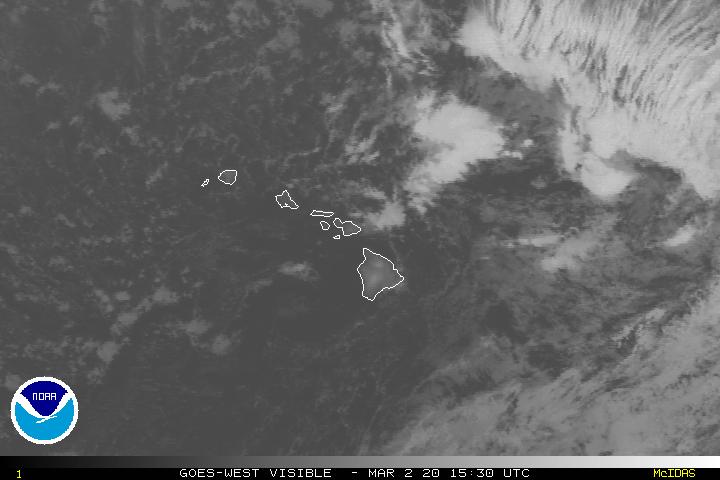
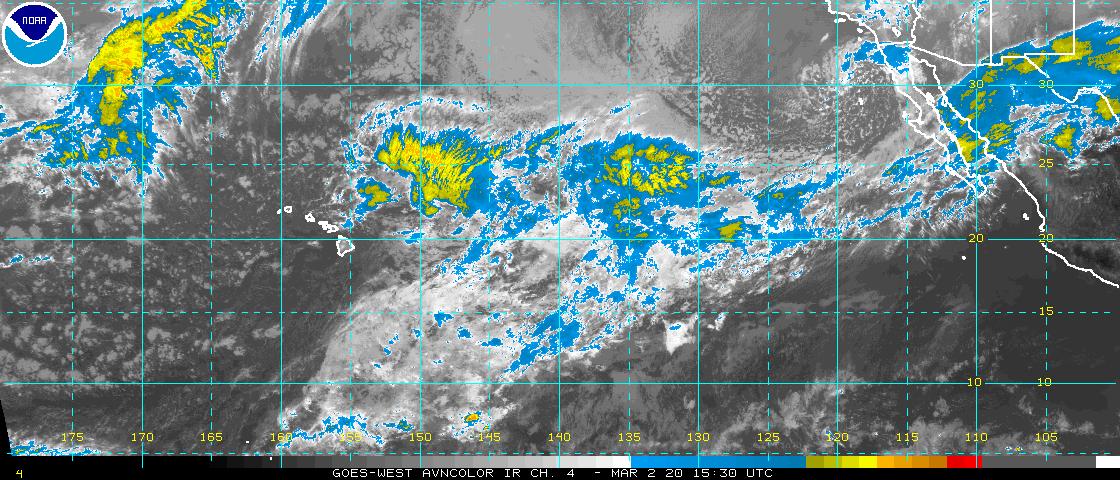
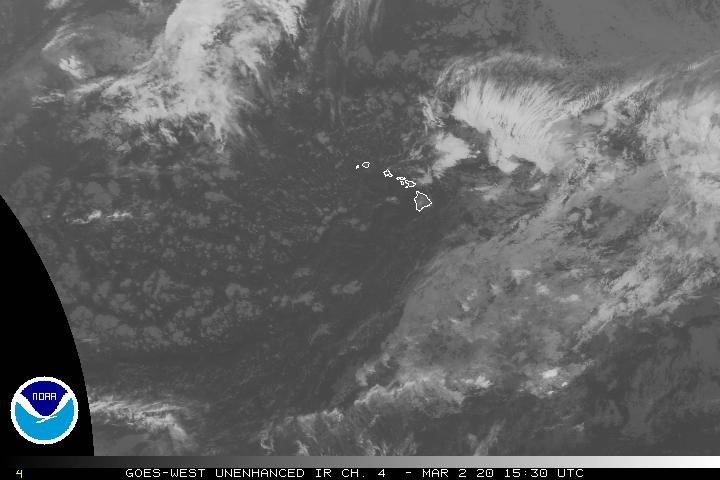
Satellite and Radar Images: To view the cloud conditions we have here in Hawaii, please use the following satellite links, starting off with this Infrared Satellite Image of the islands to see all the clouds around during the day and night. This next image is one that gives close images of the islands only during the daytime hours, and is referred to as a Close-up visible image. This next image shows a larger view of the Pacific…giving perspective to the wider ranging cloud patterns in the Pacific Ocean. Finally, here’s a Looping IR satellite image, making viewable the clouds around the islands 24 hours a day. To help you keep track of where any showers may be around the islands, here’s the latest animated radar image.
Hawaii’s Mountains – Here’s a link to the live webcam on the summit of near 14,000 foot Mauna Kea on the Big Island of Hawaii. The tallest peak on the island of Maui is the Haleakala Crater, which is near 10,000 feet in elevation. These two webcams are available during the daylight hours here in the islands…and when there’s a big moon rising just after sunset for an hour or two! Plus, during the nights and early mornings you will be able to see stars, and the sunrise too…depending upon weather conditions.
Tropical Cyclone activity in the eastern and central Pacific – Here’s the latest weather information coming out of the National Hurricane Center, covering the eastern north Pacific. You can find the latest tropical cyclone information for the central north Pacific (where Hawaii is located) by clicking on this link to the Central Pacific Hurricane Center. Here’s a tracking map covering both the eastern and central Pacific Ocean. A satellite image, which shows the entire ocean area between Hawaii and the Mexican coast…can be found here. Of course, as we know, our hurricane season won’t begin again until June 1st here in the central Pacific.
Aloha Paragraphs

Rain erosion…covered with lush vegetation
Moderately strong trade winds continue…perhaps picking up further Friday into the weekend. This weather map shows a moderately strong 1026 milibar high pressure system located to our northeast, the source of our trade breezes early Monday night. There are two ridges that exit from the base of this high pressure cell. One travels straight southeast, running down towards the southern tip of
Light windward biased showers will fall at times, with that occasional more generous shower here and there. This more or less normal trade wind shower activity will remain in place through the rest of this week. This satellite image shows a minor cloud band just moving past Oahu and
It’s Monday
evening as I begin writing this last section of today’s narrative update. Our skies here in Kihei, Maui were clear to partly cloudy, along with light to moderately strong trade winds…before I leave for the drive back upcountry to Kula. As noted above, there’s that fairly large area of clouds just upwind of the windward sides of the islands, generally from Maui up through Kauai, which will increase showers locally tonight. There’s nothing unusual going on in our Hawaiian Island weather picture, with just the common almost late summer conditions prevailing. There’s no tropical cyclones anywhere in the Pacific, and no cold fronts anywhere near our islands either. This leaves us with pleasant weather just about everywhere, with little change expected through at least the next several days. ~~~ I’m just about ready to head up to Kula now, where there’s the typical upslope clouds. As soon as I get home, I’ll change clothes, put my walking shoes on, and be on the road for my lovely evening walk, before making dinner, doing some reading, and to bed. I’ll be up at 430am Tuesday morning, and have your next new weather narrative available at a little before 6am. I hope you have a great Monday night until then! Aloha for now…Glenn.
Interesting: Environmentalists are dismayed at plans by the Tanzanian government to build a major commercial highway through Serengeti National Park. The Tanzanian President has vowed to go ahead with controversial plans to construct a major road through the Serengeti, despite fierce opposition from environmentalists and the tourism industry.
The 480-kilometer road will link the Lake Victoria area with eastern Tanzania and, according to the Tanzanian government, bring essential economic development to the region – linking remote communities to the major road network, allowing transport of people and goods and connecting farmers with markets. However the project has attracted criticism from environmental groups which fear the effects on the ecosystem could be devastating and may even result in huge releases of carbon into the atmosphere.
The road will bisect the path of the renowned "great migration" of wildebeest and zebra, when each year millions of animals migrate between the Tanzanian Serengeti and Kenyan Masai Mara in search of fresh water sources. "Recent calculations show that if wildebeest were to be cut off from these critical dry season areas, the population would likely decline from 1.3 million animals to about 200,000," said Dagmar Andres-Brümmer of the Frankfurt Zoological Society (FZS), who have been heavily involved with Tanzania National Parks for over 50 years.
Interesting2: It’ll take years to fully know the effects of the BP oil spill on wildlife in the Gulf of Mexico. One thing we do know now is what that wildlife was like before the 206 million gallons of oil spewed into the water. For that knowledge, we have the Smithsonian Institution to thank. The Smithsonian Institution’s Museum Support Center is an anonymous beige warehouse complex just outside Washington, D.C. It doesn’t look like anything special until you get inside.
These buildings house all the things that don’t fit into the museums on the National Mall, in endless rows of jars and bottles and boxes. Among them is the world’s largest collection of invertebrates from the Gulf of Mexico, all floating in 150-proof alcohol. It’s a pretty comprehensive snapshot of life before the spill. Jonathan Coddington is the head of research and collections at the Smithsonian’s Museum of Natural History.
He tells NPR’s Guy Raz that those thousands of jars are an invaluable resource for scientists. "It describes the way the Gulf was prior to the spill," Coddington says. "So all of the questions coming at us — about the effects of the spill, the effects it has on the economy, the effects it has on the environment — are going to need a comparison. So we know the way it is now; how was it prior to the spill?"
The Smithsonian’s Museum Support Center has the world’s largest collection of invertebrates from the Gulf of Mexico. Scientists are particularly concerned with the effect of the spill on eggs and larvae of Gulf creatures, Coddington says. Oil has already been found in the larvae of blue crabs off the Gulf Coast, and the Smithsonian’s collection can help scientists figure out what that really means. "How much oil is there in a crab larva normally? Maybe crab larvae have some oil in them anyway. What kind of effect does oil have on crab larvae?
Interesting3: Commercial fishermen can now trawl Louisiana’s waters for white shrimp as the season opened on Monday, but questions linger about the effects BP Plc’s Gulf of Mexico oil spill will have on the harvest. Some state waters have been open for brown shrimping since the well ruptured on April 20, but the overall catch has been down from previous years partly because a number of boats are signed up with BP’s oil spill clean-up program.
The plump, sweet white shrimp are typically larger than brown shrimp and more desired by chefs. The U.S. government has said that seafood pulled from the areas of the Gulf of Mexico that is open to fishing is safe to eat despite all the oil that gushed into the ocean. More than a fifth of federal waters in the Gulf remain closed due to fear of oil contaminating the seafood.
"Uncertainty has ruled this whole shrimping season," said Ewell Smith, executive director of the Louisiana Seafood Promotion and Marketing Board. "Our brand has been tarnished and we have a lot of work to do ahead of us." Shrimpers are worried about what prices their catch will bring and also what effects the oil spill will have on the shrimp population, Smith said.
Smith said it is a positive for the industry that more waters are opening to fishing, a view shared by others. "We are hoping for the best," said Errol Voisin, plant manager at Lafitte Frozen Seafood in Lafitte, Louisiana. Voisin said his plant on Monday was processing domestic shrimp caught in waters off Texas and North Carolina, but noted that some shrimping boats had just set out in waters off Louisiana. The shrimping industry in Louisiana creates 14,384 jobs and brings in $1.3 billion dollars a year for the state, according to the seafood marketing board.
Interesting4: The deadly spell of heat and smog will finally come to an end this week across western Russia. A large storm system currently spinning over central Europe will gradually slide eastward by midweek. The cold front associated with this system is expected to push through Moscow Thursday. This storm will cause the record heat to retreat to the east, while much cooler, more seasonable air settles western Russia.
High temperatures will drop from near 90 degrees Wednesday to around 70 degrees Thursday, and the cool, seasonable temperatures are expected to last for at least several days. This relief from the heat will be welcome news to people across the region. The Associated Press has reported that deaths have doubled to 700 people a day, many of which are believed to be related to the smog that has enveloped the region from hundreds of wildfires fueled by the heat and extreme drought.
Since June 1, Moscow has recorded only 51 percent of their normal rainfall. Fire and drought have also caused Russian officials to ban the export of wheat grains after reports that nearly a third of the crops were damaged or destroyed.
July was the warmest month on record in Moscow as the city recorded an average temperature of 77.8, an astounding 15 degrees above normal. August has followed suit, with temperatures running 17.9 degrees F above normal so far. On July 29, the mercury in Moscow exceeded the 100-degree mark for the first time in 130 years of records.
 Email Glenn James: