August 9-10, 2010
Air Temperatures – The following maximum temperatures were recorded across the state of Hawaii Monday afternoon:
Lihue, Kauai – 85
Honolulu, Oahu – 88
Kaneohe, Oahu – missing
Kaunakakai, Molokai – 85
Kahului, Maui – 89
Hilo, Hawaii – 83
Kailua-kona – 84
Air Temperatures ranged between these warmest and coolest spots near sea level – and on the highest mountain tops too…as of 5pm Monday evening:
Port Allen, Kauai – 86
Hilo, Hawaii – 79
Haleakala Crater – 59 (near 10,000 feet on Maui)
Mauna Kea summit – 39 (near 14,000 feet on the Big Island)
Precipitation Totals – The following numbers represent the largest precipitation totals (inches) during the last 24 hours on each of the major islands, as of Monday afternoon:
0.68 Mount Waialeale, Kauai
0.25 Oahu Forest NWR, Oahu
0.00 Molokai
0.00 Lanai
0.00 Kahoolawe
0.06 West Wailuaiki, Maui
0.69 Honaunau, Big Island
Marine Winds – Here’s the latest (automatically updated) weather map showing a 1032 millibar high pressure system to the north-northeast of the islands. Our local trade winds will remain active Tuesday and Wednesday.
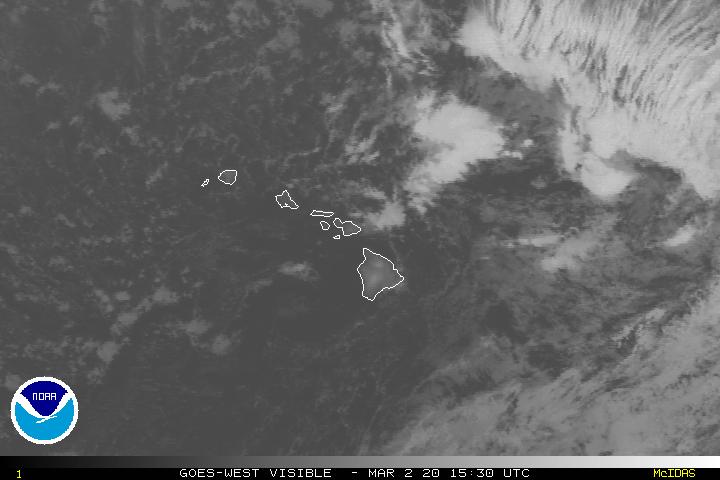
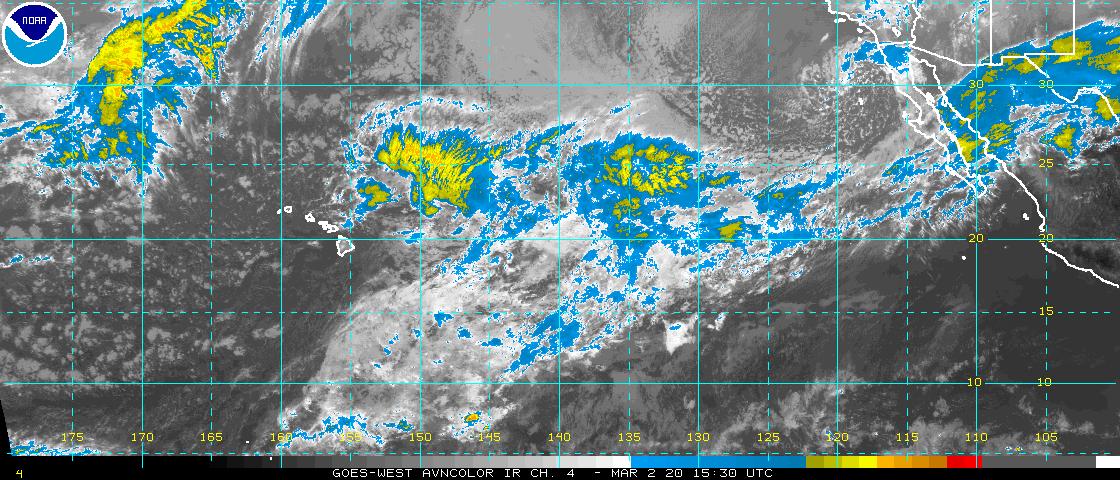
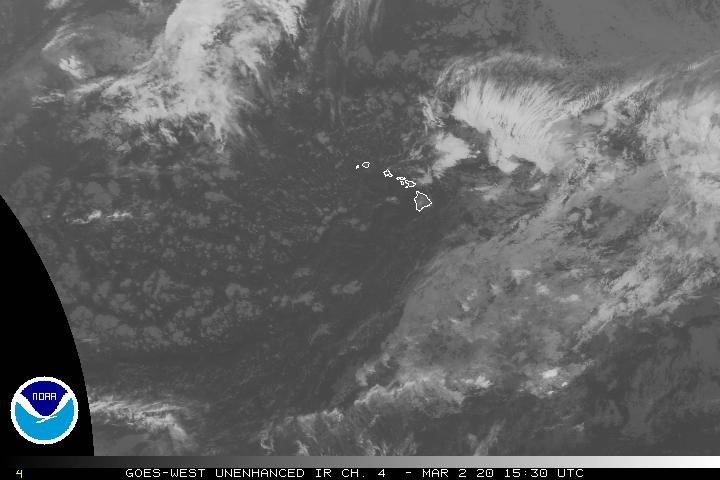
Satellite and Radar Images: To view the cloud conditions we have here in Hawaii, please use the following satellite links, starting off with this Infrared Satellite Image of the islands to see all the clouds around during the day and night. This next image is one that gives close images of the islands only during the daytime hours, and is referred to as a Close-up visible image. This next image shows a larger view of the Pacific…giving perspective to the wider ranging cloud patterns in the Pacific Ocean. Finally, here’s a Looping IR satellite image, making viewable the clouds around the islands 24 hours a day. To help you keep track of where any showers may be around the islands, here’s the latest animated radar image.
Hawaii’s Mountains – Here’s a link to the live webcam on the summit of near 14,000 foot Mauna Kea on the Big Island of Hawaii. The tallest peak on the island of Maui is the Haleakala Crater, which is near 10,000 feet in elevation. These two webcams are available during the daylight hours here in the islands…and when there’s a big moon rising just after sunset for an hour or two! Plus, during the nights and early mornings you will be able to see stars, and the sunrise too…depending upon weather conditions.
Tropical Cyclone activity in the eastern and central Pacific – Here’s the latest weather information coming out of the National Hurricane Center, covering the eastern north Pacific. You can find the latest tropical cyclone information for the central north Pacific (where Hawaii is located) by clicking on this link to the Central Pacific Hurricane Center. Here’s a tracking map covering both the eastern and central Pacific Ocean. A satellite image, which shows the entire ocean area between Hawaii and the Mexican coast…can be found here. Of course, as we know, our hurricane season won’t begin again until June 1st here in the central Pacific.
Aloha Paragraphs

Steady trade winds this week
Artist: Ed Lane
Moderately strong trade winds will prevail this week…easing off potentially by the weekend into early next week. This weather map shows a moderately strong 1032 millibar high pressure system located to our north-northeast, the source of our trade breezes Monday afternoon. The usual small craft wind advisory flags have been hoisted through the major channels around Maui and the
Here’s the strongest gusts as of early Monday evening:
Kauai – 31 mph
Oahu – 42
Molokai – 36
Kahoolawe – 36
Maui – 38
Lanai – 17
Big Island – 31
We’ll find just a few showers falling most of this week, almost exclusively along the windward sides…due to our very dry and stable overlying air mass. This drier than normal trade wind flow Monday night will remain in place through most of this week. As always however, moisture pockets will bring a few passing showers to our windward coasts and slopes…most generously during the night and early morning hours. This satellite image shows quite a few clouds upwind of the islands, with a few streaks of high cirrus clouds around the edges too. Glancing down further to the south of the islands, in the deeper tropics, using this satellite picture…we see a degree or two of increasing thunderstorm activity, especially to the south-southwest of our islands. It appears that we could see an increase of high cirrus clouds coming our way from the west over the next day or two too.
It’s Monday
evening as I begin writing this last section of today’s narrative update. Our trade winds will remain active, with just few showers falling. The gusty trade winds, along with the dry conditions, will keep the danger of wild fires alive on our leeward sides. Here in Kihei, Maui at 530pm or so, it was mostly clear, and not a breath of those strong winds were reaching where I am. Looking up towards the Haleakala Crater, or at least the slopes where I’m headed, in Kula…there were just a few clouds. This week seems to be shaping up just about like expected. Looking around the rest of the world however, there are all kinds of weather related disasters going on! A search online for weather related problems isn’t hard to find at the moment. There are so many major floods, and fires, and smog, and tropical cyclones, and of course the Russian heat wave…it’s unnerving. Actually, I can’t remember a time when we’ve had more weather related disasters going on at any one time! At any rate, I’ll be back here early Tuesday morning with your next new weather narrative, where the living is easy it seems! Aloha for now…Glenn.
Interesting: Since the Obama Administration came to power in Washington, the EPA has taken upon itself the mission of addressing global climate change. They have been very proactive in getting information out confirming that climate change exists and that it is caused, at least in part, by human activities. Ten petitions were sent to the agency to challenge the EPA’s position on climate change.
Upon review, the EPA has decided to fully reject the claims made in the petitions, determining that they are without merit. In December of 2009, EPA made the determination that climate change caused by greenhouse gas emissions threatens public health and the environment. This sparked a barrage of petitions which claimed that climate science is unreliable.
The petitioners claimed the presence of a high-level conspiracy to promote the "myth" of human induced climate change. Among the entities involved in the conspiracy are the Intergovernmental Panel on Climate Change (IPCC), the US National Academy of Sciences, and the US Global Research Program. Several petitions also expressed dismay with the process the EPA used to develop its December 2009 finding, known as the "Endangerment Finding."
For example, they claim the EPA did not independently judge the underlying science and did not post the referenced scientific studies in the docket. They also take issue with the fact that EPA ignored public concerns over emails sent by scientists from the Climatic Research Unit at the University of East Anglia in the UK. This episode was known colloquially as "climate-gate." The petitions originated from industry groups, individuals, and even state governments.
The petitioners include the Ohio Coal Association, Peabody Energy, the Commonwealth of Virginia, the State of Texas, the Southeastern Legal Foundation, the Competitive Enterprise Institute, Arthur Randol, the Coalition for Responsible Regulation, the Pacific Legal Foundation, and the United States Chamber of Commerce. The petitions were thought-out, well written, and they warranted serious attention by the EPA. However, in the end, the EPA rejected their petitions.
EPA found there is no evidence to support the claims made by the petitioners, and felt the claims were not sufficient to alter the conclusions of the December 2009 Endangerment Finding. They believe that evidence supporting their finding is strong, thorough, and compelling. EPA believes climate change is happening, can be proved by examining key climate change indicators, and that climate change is effected by human activity.
Whether or not this action by the EPA is enough to silence anthropogenic climate change skeptics remains to be seen. Both sides are fully entrenched in their positions and believe the facts are on their side. Regardless of their disagreements, action on reducing man’s impact on climate change is imminent and perhaps long overdue.
Interesting2: For most of us, finding a bathroom or toilet isn’t hard. Chances are it’s not more than a short walk away – you may even be there now. For 2.5 billion people around the world, however, it isn’t that easy. Their bathroom is likely shared, has no running water and is a walk from their house. And you thought port-a-potties were bad. The lack of access to sanitation is a huge challenge to the 1 billion people living in urban slums in Africa, Asia and Latin America.
The dangers of inadequate sanitation infrastructure are well known – contaminated drinking water and disease transmission become difficult to avoid. Even more unfortunate is the fact that these dangers are often lethal to children, the elderly and the sick, the most vulnerable members of communities. And in cities, the lack of bathrooms and latrines can also be dangerous, particularly for women, who are often harassed and assaulted when seeking out a latrine or place to bathe.
Or consider the amount of time that urban residents spend waiting in line for public restrooms. The World Health Organization estimates that the average is 30 minutes per person per day. That’s almost 20 days per year, time that could be better spent in economic activities, education or child rearing. In Pune, a city of almost 5 million in western India, 40 percent live in slums.
Ratnakar Gaikwad, the municipal commissioner of Pune, describes the situation: "When I took over as municipal commissioner of Pune, the ratio of toilets to people in the slums was one toilet seat for every 800 persons. We did the math to understand the magnitude of the problem. Technically, if everybody queued up to use one of these toilets, the last man’s turn would arrive after 15 days."
And although the benefits of improved sanitation deliver huge boosts to public health, gender equality, economic growth and poverty reduction, they often remain low priorities for budget allocations and official development assistance. While large intergovernmental organizations such as UN Habitat are working to help slum dwellers gain access to sanitation, there is also a role for smaller organizations, including those in the private sector, to address these issues.
Interesting3: Seismologists have identified potentially active faults near Olympia, Washington State, adding to the number of faults that may be active in the area. Researchers from the University of Washington and the U.S. Geological Survey collected marine seismic reflection data to explore shallow structures associated with inferred faults in the Tacoma and Olympia areas of Washington State.
Seismic reflection profiling, which uses sound waves to look into the Earth in the same way that sonograms do in medical imaging, is a valuable tool for examining faults beneath the surface. Layers of glacial deposits formed beneath Puget Sound during the last glacial advance and retreat in the past 16,000 years provide a record of recent faulting in the region.
This study documents two apparent faults cutting young deposits near Olympia. Because the faults cut through strata that may have been deposited during or after the glacial retreat, the faults appear to have had recent activity and therefore could pose an earthquake hazard to the population of the southern Puget Sound region.
Interesting4: A new NOAA study looking at how to curb the rapid growth of lionfish, an invasive species not native to the Atlantic Ocean, suggests that approximately 27 percent of mature lionfish will have to be removed monthly for one year to reduce its population growth rate to zero. But the good news is that the invasive fish happens to be delicious—and NOAA is encouraging chefs to find new ways to introduce it to U.S. consumers.
Lionfish are native to the western and central Pacific Ocean, but have established themselves from North Carolina to South America. They are a popular aquarium fish that were likely first released in Florida waters in the mid-1980s. Since then, the species has spread rapidly. Scientists and public officials are seriously concerned at the effect lionfish are having on reef ecosystems, since this predator is capable of rapid population growth and out-competing native fish for food and territory.
"This study offers us the first target for fishing and other local control efforts such as lionfish derbies, "says Lad Akins, director of operations for the Reef Environmental and Education Foundation, an organization of divers and marine enthusiasts who are working to combat the lionfish problem.
The effort to fish down the species has already begun. Caribbean nations such as the Turks and Caicos Islands are encouraging widespread fishing for lionfish by instituting year-long tournaments with cash prizes for the most lionfish caught. Authorities are also encouraging a local market for the species, whose delicate white flesh tastes similar to a snapper or grouper.
NOAA scientists concur that developing a market for lionfish is one of the only ways to substantially reduce their numbers. To this end, NOAA has developed an "Eat Lionfish" campaign that brings together fishing communities, wholesalers, and chefs in an effort to broaden U.S. consumers’ awareness of this delicious invader.
While the study represents a significant step forward in understanding how to turn the tide of the invasion, the study’s authors warn that more work is needed to understand the ecological effects of lionfish, track the population, and develop control strategies. "Lionfish represent the first reef fish invader to become established in the Atlantic, but as we know from history, invasive species are a persistent problem," says Dr. James Morris, a marine ecologist with NOAA’s Center for Coastal Fisheries and Habitat Research.
"Understanding the factors involved in the spread of lionfish may help us be better prepared for future invasions." The study’s recommendation of a 27 percent monthly reduction represents a major fishing effort which may not be feasible in some areas, such as the expansive areas where lionfish have become established off the southeast U.S. coast, but which may be possible in areas where lionfish habitat is more constrained.
The study, a collaboration between scientists from NOAA and North Carolina State University, can be found in the June 2010 issue of Biological Invasions. NOAA’s mission is to understand and predict changes in the Earth’s environment, from the depths of the ocean to the surface of the sun, and to conserve and manage our coastal and marine resources.
 Email Glenn James: