











September 16-17, 2009
Air Temperatures – The following maximum temperatures were recorded across the state of Hawaii Wednesday afternoon:
Lihue, Kauai – 84
Honolulu, Oahu – 89
Kaneohe, Oahu – 84
Kahului, Maui – 87
Hilo, Hawaii – 83
Kailua-kona – 87
Air Temperatures ranged between these warmest and coolest spots near sea level around the state – and on the highest mountains…at 5 p.m. Wednesday evening:
Honolulu, Oahu – 85F
Hilo, Hawaii – 79
Haleakala Crater – 57 (near 10,000 feet on Maui)
Mauna Kea summit – 63 (near 14,000 feet on the Big Island)
Precipitation Totals – The following numbers represent the largest precipitation totals (inches) during the last 24 hours on each of the major islands, as of Wednesday afternoon:
0.04 Mount Waialeale, Kauai
0.03 Kahuku training area, Oahu
0.00 Molokai
0.00 Lanai
0.00 Kahoolawe
0.00 Maui
0.14 Pahoa, Big Island
Marine Winds – Here’s the latest (automatically updated) weather map showing high pressure systems to the northeast, and far northwest. Ridges that are connecting these high pressure cells, to our north…will keep breezy trade winds blowing through Thursday.
Satellite and Radar Images: To view the cloud conditions we have here in Hawaii, please use the following satellite links, starting off with this Infrared Satellite Image of the islands to see all the clouds around the state during the day and night. This next image is one that gives close images of the islands only during the daytime hours, and is referred to as a Close-up visible image. This next image shows a larger view of the Pacific…giving perspective to the wider ranging cloud patterns in the Pacific Ocean. Finally, here’s a Looping IR satellite image, making viewable the clouds around the islands 24 hours a day. To help you keep track of where any showers may be around the islands, here’s the latest animated radar image.
Hawaii’s Mountains – Here’s a link to the live webcam on the summit of near 14,000 foot Mauna Kea on the Big Island of Hawaii. The tallest peak on the island of Maui is the Haleakala Crater, which is near 10,000 feet in elevation. These two webcams are available during the daylight hours here in the islands…and when there’s a big moon rising just after sunset for an hour or two! Plus, during the nights and early mornings you will be able to see stars, and the sunrise too…depending upon weather conditions.
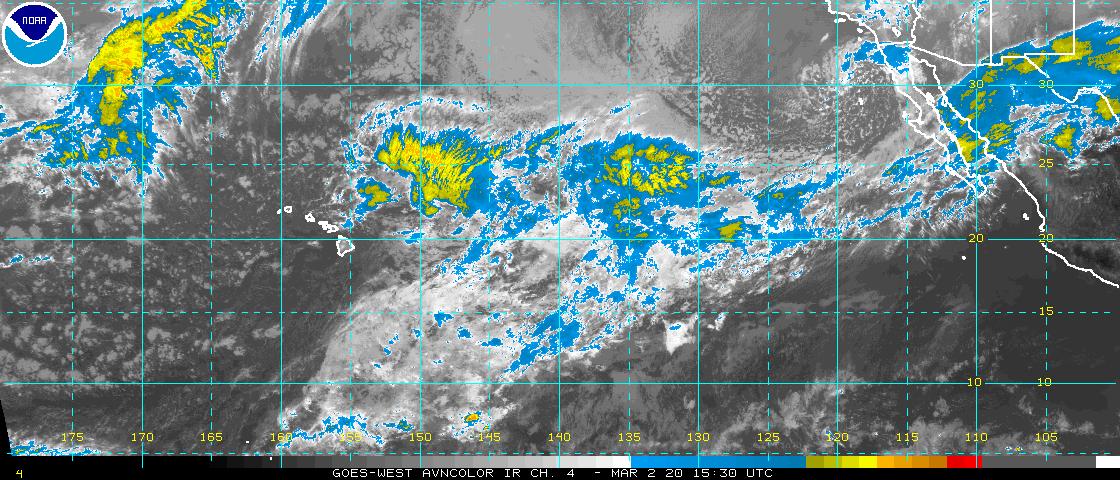
Tropical Cyclone activity in the eastern and central Pacific – Here’s the latest weather information coming out of the National Hurricane Center, covering the eastern north Pacific. You can find the latest tropical cyclone information for the central north Pacific (where Hawaii is located) by clicking on this link to the Central Pacific Hurricane Center. Here’s a tracking map covering both the eastern and central Pacific Ocean. A satellite image, which shows the entire ocean area between Hawaii and the Mexican coast…can be found here.
Aloha Paragraphs

Amakihi…native Hawaiian bird
The trade winds have accelerated as expected Wednesday…and will remain on the blustery side into the weekend. The computer forecast models show another early season cold front approaching the state late this weekend. If this front gets as close as some of the models suggest, our trade winds could become very light again as we move into early next week. If the winds take a turn to the east-southeast, or even southeast…we could possibly see a bit of volcanic haze moving up over some of the smaller islands, from the Big Island vents.
Other than a few windward biased showers, we will remain drier than normal for the time being. The trade winds may pick up a few showers from over the ocean to our east, carrying them towards the windward sides of the islands. The leeward sections will remain dry, as they have been all this week. As we get into early next week, there’s a bit more uncertainty in the general forecast. If the trade winds break down, we could see some afternoon showers developing along the leeward slopes then. Some of the computer models are also showing a bit of tropical moisture riding in on the southeast wind flow then too.
It’s early Wednesday evening here in Kihei, Maui, as I begin writing this last paragraph of this morning’s narrative. The trade winds came barreling back into town today, in no uncertain terms. The strongest gust that I say Wednesday afternoon was around 36 mph at Maalaea Bay, although there were several 30+ mph gusts around other places in Maui County. As of 5pm, the winds were still on the gusty side in the southern part of the Aloha state, with 35 mph on the Big Island, 38 at Maalaea Bay, 32 mph at Kahului, and 35 at Kahoolawe. We’ll see more of these types of winds, and it likely won’t be long before the NWS issues small craft advisories in those windier locations around the state.
~~~ Looking out the windows here in Kihei this evening, it’s cloudier than it has been the last 3-4 days…although only partly cloudy at best. The trade winds are starting to carry a bit more moisture our way, although those clouds remain on the dry side, with little in the way of rainfall expected…almost all of which will be deposited along the windward sides. I’m about ready to head upcountry now, up to Kula, which will be nice to get home. I’ll be back early Thursday morning as usual though, ready to prepare your next new weather narrative. I hope you have a great Wednesday night wherever you happen to be spending it! Aloha for now…Glenn.
Interesting: Some killer whale populations favor king salmon so much that the whales will actually die when numbers of this largest member of the salmon family drop, according to new research. The study, published in the latest Royal Society Biology Letters, suggests that although killer whales may consume a variety of fish species and mammals, many are highly specialized hunters dependent on this single salmon species.
Lead author John Ford explained to Discovery News that "nutritional stress" probably leads to killer whale deaths because it can make the whales "susceptible to other factors leading to mortality, such as disease and parasitism," and possibly also more vulnerable to the "immuno-suppressive effects of PCBs" and other ocean pollutants.
Ford, a research scientist at Fisheries and Oceans Canada, and his colleagues used 25 years of demographic data from two populations of fish-eating killer whales in the northeastern Pacific Ocean, along with data on numbers of chum and Chinook salmon, commonly known as king salmon.
The data consisted of annual photo ID censuses for the whales and Pacific Salmon Commission population estimates for the fish. The scientists determined that from 1974 to the mid 1990’s, resident killer whale populations steadily grew in number at an increase of nearly 2.6 percent per year.
That pattern abruptly ended in the mid 1990’s, when both analyzed populations of killer whales entered a period of prolonged decline, dropping by up to 17 percent as of 2001. By 2004, the populations began to recover and show growth again.
Interesting2: Physicists at the University of Toronto have discovered that changes in the Earth’s ozone layer due to climate change will reduce the amount of ultraviolet (UV) radiation in northern high latitude regions such as Siberia, Scandinavia and northern Canada. Other regions of the Earth, such as the tropics and Antarctica, will instead face increasing levels of UV radiation.
“Climate change is an established fact, but scientists are only just beginning to understand its regional manifestations,” says Michaela Hegglin, a postdoctoral fellow in the Department of Physics, and the lead author of the study published in Nature Geoscience on September 6.
Using a sophisticated computer model, Hegglin and U of T physicist Theodore Shepherd determined that 21st-century climate change will alter atmospheric circulation, increasing the flux of ozone from the upper to the lower atmosphere and shifting the distribution of ozone within the upper atmosphere.
The result will be a change in the amount of UV radiation reaching the Earth’s surface which varies dramatically between regions: e.g. up to a 20 per cent increase in UV radiation over southern high latitudes during spring and summer, and a nine per cent decrease in UV radiation over northern high latitudes, by the end of the century.
While the effects of increased UV have been widely studied because of the problem of ozone depletion, decreased UV could have adverse effects too, e.g. on vitamin D production for people in regions with limited sunlight such as the northern high latitudes.
“Both human and ecosystem health are affected by air quality and by UV radiation,” says Shepherd. “While there has been much research on the impact of climate change on air quality, our work shows that this research needs to include the effect of changes in stratospheric ozone.
And while there has been much research on the impact of ozone depletion on UV radiation and its impacts on human and ecosystem health, the notion that climate change could also affect UV radiation has not previously been considered. This adds to the list of potential impacts of climate change, and is especially important for Canada as northern high latitudes are particularly affected.”
Interesting3: Global warming could actually chill down North America within just a few decades, according to a new study that says a sudden cooling event gripped the region about 8,300 years ago. Analysis of ancient moss from Newfoundland, Canada, links an injection of freshwater from a burst glacial lake to a rapid drop in air temperatures by a few degrees Celsius along North America’s East Coast.
This event created a colder year-round climate with a much shorter growing season for about 150 years, from northern Canada to what is now Cape Hatteras, North Carolina. The results suggest that North America’s climate is highly sensitive to melt water flowing into the ocean, said lead study author Tim Daley of Swansea University in the U.K.
The work also means that history could repeat itself: Currently Greenland’s ice sheet is melting at a rapid clip, releasing freshwater into the North Atlantic. In a worst-case scenario, the authors say, a sudden melt could trigger another regional cooling event—although other experts say today’s extreme, human-driven warming might cancel out any strong cooling effect.
Daley and colleagues studied mosses dating back more than 8,700 years that were preserved in a Newfoundland peat bog. The ratios of two different types of oxygen in the mosses allowed the team to trace changes in atmospheric temperature over time. When air temperatures are lower, the mosses contain less oxygen-18, a heavier version of the more common type, oxygen-16.
About 8,350 years ago, the amount of oxygen-18 relative to oxygen-16 suddenly dropped, the team reports in the September issue of the journal Geology. Previous research had found that, around the same time, a northern ice dam burst, releasing the contents of a vast glacial lake into the Labrador Sea, between Canada and Denmark.
Normally a warm ocean current called the Gulf Stream runs up the east coast of North America, helping to keep the region balmier than it should be, considering how far north it is. But the entire glacial lake drained within less than a year, injecting a huge pulse of freshwater into the North Atlantic Ocean.
Daley and colleagues think the lake water diluted the salty ocean current and slowed the Gulf Stream, which in turn led to rapid cooling in North America. "As a result, Canadian summer temperatures would have been similar to those currently experienced in autumn or spring," said team member Neil Loader, also of Swansea University.
Climate records from Greenland and Europe also show a sudden cooling during the same time period, but this is the first clear evidence for a North American chill. The moss data show that current climate models "significantly underestimate the impact and duration of the climate perturbation resulting from the mega-flood," said Swansea team member Alayne Perrott.
This means these same models might not be accurately predicting what might happen in the future if Greenland’s ice sheet continues to melt. However, some scientists say that the data showing a prehistoric North American cool down may only indicate a coastal phenomenon.
"The study site is very close to the North Atlantic Ocean, and it is very likely that the climate change is primarily an oceanic signal," said Hans Renssen, a climate researcher at Vrije University in Amsterdam, who was not involved in the study.
As for whether today’s melt in Greenland could trigger another round of cooling, Renssen thinks it’s possible, but he doesn’t believe the change would be as dramatic as last time. In fact, he said, any future cooling is likely to be overwhelmed by human-caused warming, "resulting in no cooling in North America at all, only less warming than without the event."
Interesting4: A small group of Himalayan glaciers grew in size when the earth became hotter 9,000 years ago, new research shows. Summer Rupper, professor of geology at Brigham Young University in the United States, reports in the September issue of Quaternary Research that a small group of Himalayan glaciers grew by several kilometers 9,000 years ago — during an ‘inter-glacial’ period when central Asia grew hotter by six degrees Celsius.
Her findings are based on a model that predicts both glacier mass and energy balance at its surface under varying regional climatic factors such as temperature, humidity, cloudiness and rainfall, and wind. Rupper reports that shifting weather patterns at the time brought more clouds and winds to the area, making it cooler and helping ice formation.
Her team is now extrapolating the findings to a new project to predict future water changes in the area — now under threat as glaciers melt because of global warming. However, the paradox of glaciers increasing in size — and not melting — during warmer conditions occurred under very different conditions.
During the last four inter-glacial periods, including the period addressed in Rupper’s research, that occurred in the past 350,000 years, carbon dioxide concentrations remained below 300 parts per million (ppm).
Present carbon dioxide levels have exceeded 380 ppm because of global warming, Kulkarni told a South Asian media workshop on climate change last month (27 August). Satellite data from 1962 to 2004 indicates that more than 1,000 Himalayan glaciers have retreated by around 16 per cent, Kulkarni says.
The glaciers are retreating at varying speeds. Some are melting faster, such as the Parbati glacier at a rate of 50 meters per year and Gangotri at 28 meters; while others like the Pindari glacier are retreating more slowly, at five meters per year. The Himalayan glaciers are breaking into pieces and many are not forming new ice, "A large number of glaciers have no [ice] accumulation," Kulkarni says.
Scientists at the International Centre for Integrated Mountain Development (ICIMOD) in Kathmandu, Nepal, also report large-scale melting in Himalayas of 10—60 meters each year, while the Imja glacier south of Mount Everest is retreating by 74 meters each year.
 Email Glenn James:
Glenn Says:
Hi Alan, that’s a good question. It has to do partially with the lack of heat over the islands, which help to pull the trade winds through the Maalaea Bay, and down to Kihei. The daytime heating sets up a localized low pressure system over the central valley, drawing the trades in over the land, from the ocean. Also, the exposure is best aligned for the trade winds to travel along the north and east shores, even at night. I hope this helps. Aloha, Glenn
alan Says:
why do the tradewinds settle down at night in Kihei, but keep blowing on north shore? ~~~ Hi Alan, that’s a good question. It has to do partially with the lack of heat over the islands, which help to pull the trade winds through the Maalaea Bay, and down to Kihei. The daytime heating sets up a localized low pressure system over the central valley, drawing the trades in over the land, from the ocean. Also, the exposure is best aligned for the trade winds to travel along the north and east shores, even at night. I hope this helps. Aloha, Glenn
Catherine Lee Says:
Hi Glenn We are travelling from Australia in Nov this year. I am surprised to hear you talk of winter as i thought you had warm weather all year. Can you tell us what to expect in Waikiki and the Big island in late November.Kind Regards Catherine Lee ~~~ Hello Catherine, we do have winter in Hawaii, it runs from December 23rd or so until March 22nd or so. Winter is not like in the middle latitudes, as you have to remember that we are in the tropics. Thus, when you see that I wrote winter, please don’t misunderstand that. November is often quite a nice month, with a bit of early winter sometimes, and a bit of late summer sometimes too. I wouldn’t become unnecessarily nervous with the word winter in this regard. Come ahead, have a great time! Aloha, Glenn
Jack Weber Says:
Cheers, Glenn….All rain here this morning…pounding down at times..and the trades have been barely noticeably reduced this work week…that’s the report from here…cooler weather seems to have come on earlier this year, starting Sept. 1 or so, when usually I recognize that change around Oct. 1… wondering if this is a sign of a cold winter ahead?
Best, Jack ~~~ Hi Jack, thanks for the observations, your area was definitely wetter than everywhere else in the state, I’m sure your vegetation down that way appreciated a watering! On your other thought, I wonder too, not sure if we can make the leap into a cold winter…from things going on in late summer? I suppose we could just keep it in mind, and see how things turn out. Good to hear from you down on the Big Island! Aloha, Glenn