











August 4-5, 2010
Air Temperatures – The following maximum temperatures were recorded across the state of Hawaii Wednesday afternoon:
Lihue, Kauai – 84
Honolulu, Oahu – 86
Kaneohe, Oahu – 83
Kaunakakai, Molokai – 84
Kahului, Maui – 87
Hilo, Hawaii – 82
Kailua-kona – 83
Air Temperatures ranged between these warmest and coolest spots near sea level – and on the highest mountain tops too…as of 5pm Wednesday evening:
Barking Sands, Kauai – 87
Princeville, Kauai – 73
Haleakala Crater – 55 (near 10,000 feet on Maui)
Mauna Kea summit – 46 (near 14,000 feet on the Big Island)
Precipitation Totals – The following numbers represent the largest precipitation totals (inches) during the last 24 hours on each of the major islands, as of Wednesday afternoon:
1.02 Mount Waialeale, Kauai
1.05 Oahu Forest NWR, Oahu
0.23 Molokai
0.00 Lanai
0.00 Kahoolawe
1.26 Puu Kukui, Maui
0.44 Pahoa, Big Island
Marine Winds – Here’s the latest (automatically updated) weather map showing high pressure systems to the north-northwest through north-northeast of the islands. Our local trade winds will remain active Thursday and Friday.
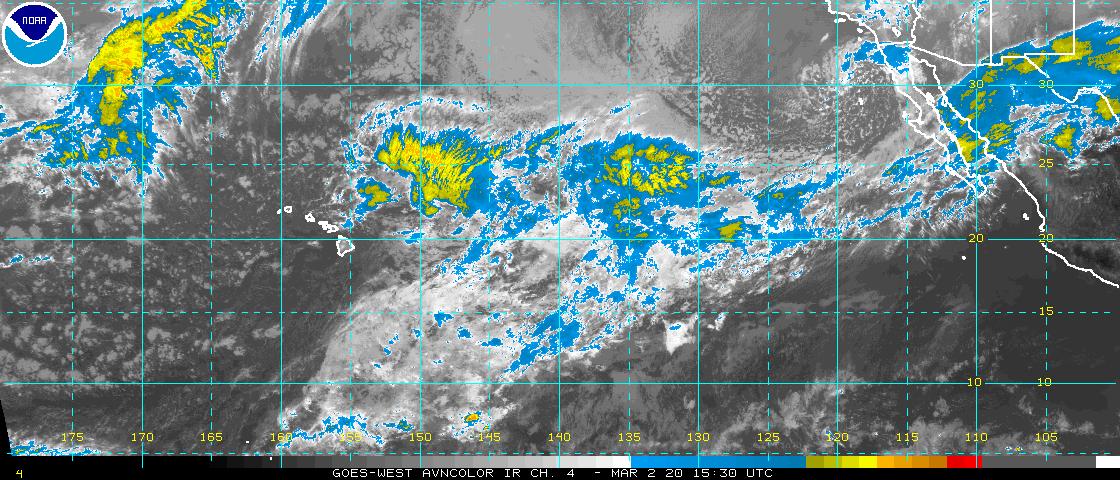
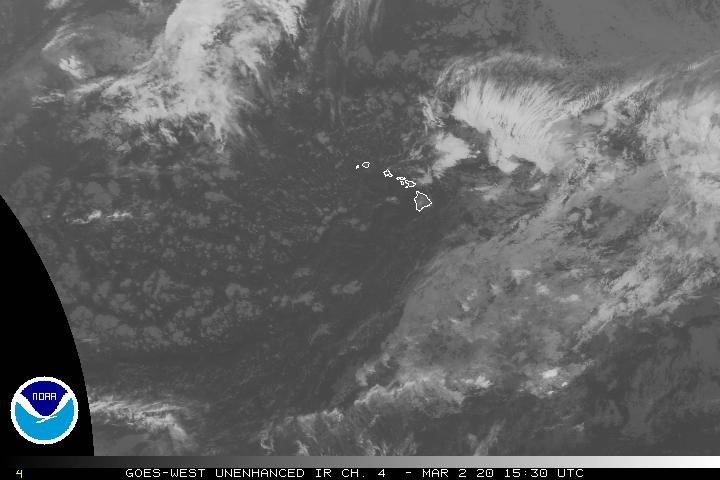
Satellite and Radar Images: To view the cloud conditions we have here in Hawaii, please use the following satellite links, starting off with this Infrared Satellite Image of the islands to see all the clouds around during the day and night. This next image is one that gives close images of the islands only during the daytime hours, and is referred to as a Close-up visible image. This next image shows a larger view of the Pacific…giving perspective to the wider ranging cloud patterns in the Pacific Ocean. Finally, here’s a Looping IR satellite image, making viewable the clouds around the islands 24 hours a day. To help you keep track of where any showers may be around the islands, here’s the latest animated radar image.
Hawaii’s Mountains – Here’s a link to the live webcam on the summit of near 14,000 foot Mauna Kea on the Big Island of Hawaii. The tallest peak on the island of Maui is the Haleakala Crater, which is near 10,000 feet in elevation. These two webcams are available during the daylight hours here in the islands…and when there’s a big moon rising just after sunset for an hour or two! Plus, during the nights and early mornings you will be able to see stars, and the sunrise too…depending upon weather conditions.
Tropical Cyclone activity in the eastern and central Pacific – Here’s the latest weather information coming out of the National Hurricane Center, covering the eastern north Pacific. You can find the latest tropical cyclone information for the central north Pacific (where Hawaii is located) by clicking on this link to the Central Pacific Hurricane Center. Here’s a tracking map covering both the eastern and central Pacific Ocean. A satellite image, which shows the entire ocean area between Hawaii and the Mexican coast…can be found here. Of course, as we know, our hurricane season won’t begin again until June 1st here in the central Pacific.
Aloha Paragraphs

Not too bad!
Our common summertime trade winds are blowing at mid-week…which are expected to keep it up through the foreseeable future. These winds remain strong enough for small craft wind advisory flags to remain alive in all the major channels…plus those few windiest spots on Maui and the
The overlying atmosphere remains a bit on the unstable side for the time being, prompting a few extra windward biased showers now. This somewhat wetter than normal trade wind flow is expected to dry out some Thursday through Saturday…before potentially turning a little more moist again later this weekend into early next week. This satellite image shows a fairly uniform distribution of clouds upwind of the islands from Kauai down through the
Meanwhile, the inter-tropical convergence zone (ITCZ) remains fairly active at the moment. The ITCZ is simply that area in the deeper tropics to our south, where the trade winds from the southern and northern hemispheres converge. This is where we often find thunderstorms flaring up, and lots of rain falling over the ocean down there. We could certainly use some of that fresh water up here in the islands! At any rate, here’s a picture of that elongated zone of thunderstorms, most noticeable at the moment…to the southeast to southwest. There’s one particular area that is most dynamic, and is circled in yellow in this satellite picture from the NWS. Since this area has only a 10% chance of developing into a tropical cyclone, it’s not that much of a concern at the moment. However, this area needs to be watched, as something could spin up over the next 3-4 days perhaps.
It’s Wednesday evening as I begin writing this last section of today’s narrative update. As noted above, our trade winds remain quite breezy now, with no end in sight to our gusty weather. To get an idea how strong the trade winds are near sea level, in gusts…these were the highest as of late in the day Wednesday, on each of the islands:
Kauai – 35 mph
Oahu – 32
Molokai – 30
Kahoolawe – 32
Lanai – 27
Maui – 35
Big Island – 36
~~~ The numbers above suggest that our trade winds are still blowing quite briskly as we head into the night Wednesday. These winds will remain active, although when I update the list again, early Thursday morning, they will be back down to their diurnal low point.
~~~ We still have larger than normal surf breaking along those south and west facing beaches Wednesday night. This swell train of waves was generated down in the southern hemisphere, where it is winter now. The responsible storm generated this swell last week, and it has taken that long to travel the distance between here and there. In response, the NWS office in Honolulu is keeping a high surf advisory in force, which means that there will be waves large enough to require caution when entering the ocean. This swell activity will be locally on the large side into Thursday morning, and then gradually lower in size thereafter into Friday.
~~~ Here in Kihei, Maui this evening, before I take the drive back upcountry to Kula, it was cloudier than normal, and still quite breezy as well. I’ll be back online early Thursday morning with your next new weather narrative. I hope you have a great Wednesday night until then! Aloha for now…Glenn.
Interesting: It’s taken millions of dollars to cap it, and it could take billions more to clean it up. BP’s oil spill in the Gulf of Mexico is acknowledged the environmental catastrophe of the century. But Tel Aviv University has a solution that may help "bioremediate" the remaining problems.
Prof. Eugene Rosenberg and Prof. Eliora Ron of Tel Aviv University’s Department of Molecular Microbiology and Biotechnology are using naturally occurring oil-munching bacteria, grown at the TAU lab, to clean the hard-to-reach oil pockets that occur when oil mixes with sand and organic matter on beaches and forms a thin layer on the Gulf’s precious waterways.
"It’s worked to clean up an oil spill on the coast of Haifa, Israel, so we’ve already got good evidence it could work in Florida too," says Prof. Ron. Details of their decades of research appear in The Handbook of Hydrocarbon and Lipid Microbiology, published this year by Springer Verlag.
Using nature itself to fight contamination
The researchers identified a naturally occurring variety of sea-borne bacteria that digests oil. By studying the bacteria’s genetic background, developing methods of growing the bacteria, and increasing their capacity to ingest the oil, the scientists have developed a solution that could clean up the residual oil that can’t be removed by mechanical means.
Prof. Ron says that sucking up surface oil pools and containing the oil are important and necessary first-step actions. But her solution addresses the smaller amounts of oil left behind — that which isn’t easily removed from sand and water. It is this small percentage of oil that sits under rocks and forms a thin film on the water’s surface. Her bacterial solution can remove this oil, which is necessary to protect the sea’s wildlife.
"We see sad pictures of birds covered in oil and people with good intentions cleaning bird wings," says Prof. Ron. "But by the time the oil is on their wings, it’s too late. Birds die because oil gets into their lungs."
Going the last mile
"The problem is huge and even with just a little bit in your lungs, oil is bad. Even when cleanup crews reduce the amount of oil at sea, there will probably be enough left behind to kill birds and wildlife." At this level of oil removal, the researcher says, the only solution is bioremediation — using nature itself to do the final cleanup.
Featured in Time magazine in the 1970s, the bacterial bioremediation solution developed at Tel Aviv University has been applied to clean out the bilges of oil tankers at sea and is used around the world.
Interesting2: Researchers at the University of Hawaii at Manoa say that the Leeward side of Hawaiian Islands may be ideal for future ocean-based renewable energy plants that would use seawater from the oceans’ depths to drive massive heat engines and produce steady amounts of renewable energy. The technology, referred to as Ocean Thermal Energy Conversion (OTEC), is described in the Journal of Renewable and Sustainable Energy, which is published by the American Institute of Physics (AIP).
It involves placing a heat engine between warm water collected at the ocean’s surface and cold water pumped from the deep ocean. Like a ball rolling downhill, heat flows from the warm reservoir to the cool one. The greater the temperature difference, the stronger the flow of heat that can be used to do useful work such as spinning a turbine and generating electricity.
The history of OTEC dates back more than a half century. However, the technology has never taken off — largely because of the relatively low cost of oil and other fossil fuels. But if there are any places on Earth where large OTEC facilities would be most cost competitive, it is where the ocean temperature differentials are the greatest.
Analyzing data from the National Oceanic and Atmospheric Administration’s National Oceanographic Data Center, the University of Hawaii’s Gérard Nihous says that the warm-cold temperature differential is about one degree Celsius greater on the leeward (western) side of the Hawaiian Islands than that on the windward (eastern) side.
This small difference translates to 15 percent more power for an OTEC plant, says Nihous, whose theoretical work focuses on driving down cost and increasing efficiency of future facilities, the biggest hurdles to bringing the technology to the mainstream. "Testing that was done in the 1980s clearly demonstrates the feasibility of this technology," he says. "Now it’s just a matter of paying for it."
Interesting3: The sweltering heat that has gripped European Russia this summer has shifted, at least temporarily, the climate hundreds of miles southward from where it should be. In Moscow, July brought the highest temperature in about 130 years of weather records when, on the 29th, the mercury soared above the 100-degree F mark for the first time. The actual maximum for the day was 101F.
The previous record, a fraction below 100F, was set on two previous days in July, the 26th and the 28th. More stunning, perhaps, is that the monthly average temperature, which is reportedly 79.1F, made it the warmest month of all historical record in Moscow. However, here is where the extremity of this Russian summer comes into true focus.
The old record for highest temperature of any month was that of July 1938, when the average temperature was 73.9 F. So that is a more than 5-degree F departure above any previous monthly mean temperature reached in over 130 years of weather history. Talk about shattering a record!
For perspective, the normal monthly temperature for June in Moscow is about 63F, but the 79F monthly average registered in July 2010 would be about par for a normal July in Washington, D.C. — at a latitude of 1,170 miles nearer to the equator!
Interesting4: Parts of northwest Pakistan inundated by the worst floods in 80 years face life-threatening food shortages, creating another crisis for the politically fragile president and a government perceived as inept. President Asif Ali Zardari and his government have been hit by a barrage of criticism for their handling of the catastrophe which has so far killed at least 1,400 people. Zardari left for Europe earlier this week, at the height of the disaster.
World Food Program (WFP) spokesman Amjad Jamal said the organizations’ workers were urgently trying to reach flood areas in the northwest cut off from food supplies, which a U.N. aid agency said devastated the lives of over 3 million people. It’s too early to gauge the economic costs of the flood but they are likely to be staggering.
Pakistan is heavily dependent on foreign aid and its civilian governments have a poor history of managing crises, leaving the powerful military to step in. "You can imagine for five or six days floods have caused havoc in these areas. People have lost their food stocks. The markets are not up and running.
Shops have collapsed. People are definitely in the greatest need of food," Jamal said. "That’s what we fear. The need to rush to those areas which have been cut off for the past week to provide life-saving food." The mainstay agriculture industry has been hit hard. Thousands of acres of crops have been destroyed in the Punjab agricultural heartland alone.
Interesting5: Even Charles Darwin was unsure whether the dog’s true ancestry could be determined, because dog breeds vary so greatly. In fact, the domestic dog is far more variable in size, shape and behavior than any other living mammal, according to James Serpell, professor at the University of Pennsylvania School of Veterinary Medicine and editor of "The Domestic Dog: Its Evolution, Behaviour, and Interactions With People" (Cambridge University Press, 1995).
There are many theories on how dogs evolved as a species, including the view that they are mixed descendants of two or more wild species, such as wolves, dingoes and jackals. But newer evidence hasn’t supported that theory. "Nowadays, based on a growing body of anatomical, genetic, and behavioral evidence, most experts believe that the dog originated exclusively from a single species: the gray wolf, Canis lupus," Serpell told Life’s Little Mysteries.
The similarities between wolves and dogs are great. In the 1960s, ethologist John Paul Scott tried to untangle the behaviors of these two species, and created a catalog of 90 behaviors of dogs. All but 19 of them, however, were also observed in wolves, and the missing behaviors tended to be minor activities that probably had not been recorded at the time but do occur in wolves, Serpell said.
"Recent anatomical and molecular evidence has confirmed that wolves, dogs and dingoes are all more closely related to each other than they are to any other member of the family Canidae," Serpell said. The oldest skeletal remains of probable domestic wolf-dogs were excavated from the Upper Paleolithic site of Eliseyevichi in western Russia, close to the Ukrainian border, and date as far back as 19,000 years.
Two skulls resembled those of Siberian huskies in their general shape, according to Serpell. Loyal companions Bones of ancient domestic wolf-dogs also have been found in central Europe, the Near East and North America, where they appear to have been deliberately buried with their human companions or in separate graves. The 14,000-year-old remains of a puppy and an elderly person were found buried together in Israel, Serpell said.
The person’s left hand was apparently positioned so that it rested on the dog’s flank, which shows that the relationship between man and dog is one of the oldest and most durable of friendships, he said. So what allows for dogs to get along with humans so well? "Several biological and behavioral factors predisposed dogs to fit easily within human groups," said Leslie Irvine of the University of Colorado at Boulder.
"They have a long primary socialization period during which they can become closely bonded with humans." Dogs are active during the same hours as their owners, as opposed to nocturnal animals, said Irvine, author of "If You Tame Me: Understanding Our Connection With Animals" (Temple University Press, 2004). Their loyal and obedient behavior allows them to be house-trained and to be taught to behave in return for little more than a treat and a pat on the head.
In fact, a domestic dog considers its owner or owners to be its "pack," and the owners’ home to be its territory, according to "Simon & Schuster’s Guide to Dogs" (Fireside, 1980). "If a reciprocal understanding and affection have grown up between man and dog, it is because the domestication of the dog took place through an agreement on work and the division of food and lodging," according to "Simon & Schuster’s Guide to Dogs." "This resulted in an affectionate and intelligent cooperation and the integration of the dog into human society."
 Email Glenn James: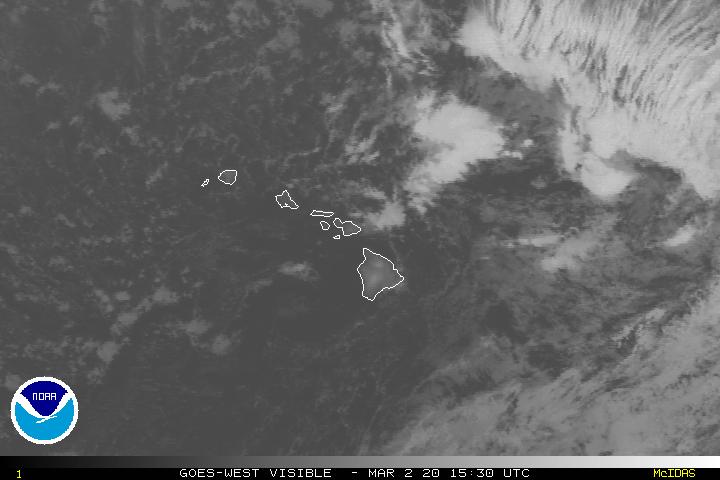



Eliza Says:
Will be in Ma’alaea – and we know just how breeeeezy it is there! LoL! Probably no showers there, just makani! – ALoha~~~Yes Eliza, there’s often some wind funneling across the Bay. Best of luck, Aloha, Glenn
Eliza Says:
Aloha Glenn –
Just how subtle will the downshift in tradewind speed be this weekend? I have an art project to complete – which requires being outside with loose flowers. Silly me.
Thanks for all you do ~ Eliza~~~Hi Eliza, it will still be breezy, at least locally, not sure where you will be with your loose flowers? There will likely be passing showers carried in those trade winds too. Aloha, Glenn
Marko Cunningham Says:
Hi Glen,
Is there any way to access your archived daily reports?
I heard you had an awesome surf pic yesterday, and id like to see a copy.
Thanks for your great service. I teach science and use your info frequently, both from your Kihei office (PDC) and from your maui weather today website.
Aloha,
Marko~~~Hello Marko, good to hear from you. I do archive my daily weather narratives, a link to those is available on the left hand side of each of the various pages on my website. I don’t archive my surf pages though. I appreciate your acknowledgment, glad you find value in the products from both the PDC, and my personal web pages too. Aloha, Glenn