Weather Details & Aloha Paragraphs
Posted by GlennMay 1 – 2 Â 2006
Air Temperatures – The following maximum temperatures were recorded across Hawaii Sunday:
Lihue, Kauai – 80F
Honolulu, Oahu – 78
Kaneohe, Oahu – 78
Kahului, Maui – 82
Hilo, Hawaii – 80
Kailua-Kona, Hawaii – 83
Temperatures early Sunday morning ranged between these warmest and coolest spots near sea level at the 5 a.m. hour:
Kailua-kona – 73
Hilo airport – 63
Precipitation Totals – The following numbers represent the largest precipitation totals during the last 24 hours (as of Sunday afternoon) on each of the major islands, including:
0.67 KOKEE, KAUAI
1.08 AHUIMANU LOOP, OAHU
0.01 MOLOKAI
0.00 LANAI
0.00 KAHOOLAWE
0.25 WEST WAILUAIKI, MAUI
0.16 PAHOA, BIG ISLAND
Weather Chart – Here’s the latest (automatically updated) weather map…showing high pressure systems far to the north of Hawaii. At the same time we find a weak cold front south of these highs. At the same time, we have a new low pressure system which is forming to the NW of Hawaii. This pressure configuration will cause lighter winds Saturday and Sunday. Here’s a Weather Map Symbol page for clarification about what all those funny weather symbols mean.
Hawaii’s Mountains – Here’s a link to the live webcam on the summit of near 14,000 foot Mauna Kea on the Big Island of Hawaii. The tallest peak on the island of Maui is the Haleakala Crater, which is near 10,000 feet in elevation. These two webcams are available during the daylight hours here in the islands…and when there’s a big moon rising just after sunset for an hour or two! Plus, during the nights and early mornings you will be able to see stars, and the sunrise too…depending upon cloud conditions.
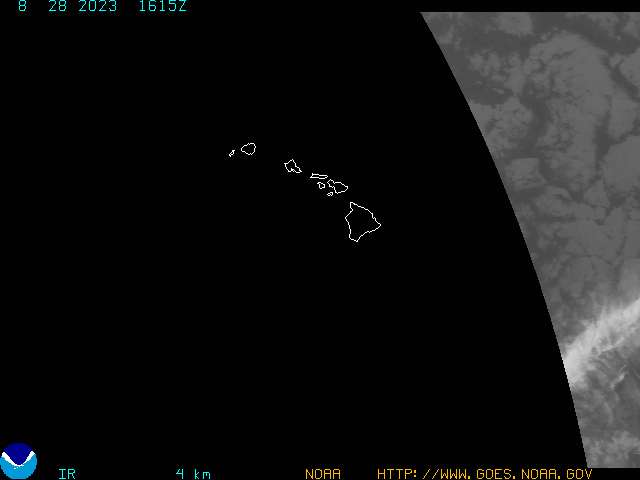
Satellite Images – To view the cloud conditions we have here in Hawaii, please use the following satellite links, starting off with the Infrared Satellite Image of the islands to see all the clouds around the state during the day and night. This next image is one that gives close images of the islands only during the daytime hours, and is referred to as a Close-up visible image. This next image shows a larger view of the Pacific…giving perspective to the wider ranging cloud patterns in the Pacific Ocean…out from the islands. To help you keep track of where any showers may be around the islands, here’s the latest animated radar image.

A nice sunset in Hawaii
A weak low pressure system has developed about 600 miles north of Maui with a dissipating shearline extending down to near the Big Island of Hawaii. The low is forecasted to remain weak and turn into an inverted trough as the work week progresses. This trough will slowly drift south closer to the islands and maintain our light and variable generally weak trade wind pattern. Skies will be partly cloudy with a few showers. These clouds and showers will be favoring mainly the interior sections of the islands and will occur mainly during the afternoon and early evening hours.
The low to the north of the Islands will be centered initially near 30N 155W. It is a cutoff low not tied in directly with the upper westerly jet stream. It will therefore be slow moving and gradually sink southeastward and southward at upper levels as it weakens. Thus the Islands will be on the dry west side of the low underneath the northwesterly flow aloft. Not that we cannot be on the receiving end of a few locally heavy showers during the next few days. As the low opens up into an inverted trough embedded in the trade wind easterlies, it will then likely get carried westward across the Islands. Our wind directions may therefore slowly change from northeast to east to southeast as the week progresses.  For the same spacing of isobars, winds will be somewhat weaker within a trough. Thus light winds should dominate the weather scene pretty much all week. By an inverted trough in the easterlies we mean a trough that will not hold water…excuse the pun…that is, a trough that has its rounded bottom pointing up or toward the north on our usual weather maps. In contrast, a trough in the westerlies will have the usual orientation on our charts. We are of course talking northern hemisphere here. Down under most things, as you know, are somewhat different. Thus for a southern hemisphere weather map to make sense to a northern hemisphere meteorologist, he will take the chart and turn it upside down and inside out and hold it up against the light, and then things look very normal.
We are now getting into the month of May and the sun is very powerful. Be sure to protect yourself against the harmful rays of the sun. At our latitudes near 20N, the sun is already almost vertical overhead at local noon which is about 12:30 pm standard time. The sun beating down on the ocean warms the upper layers of the water from a seasonal low value of about 22C (72F) in February to 27C (80F) in August. The water vapor content of the air goes up exponentially with this modest increase in temperature, and this is what supplies fuel for tropical cyclones which fortunately are a rarity around here but still a force to be reconned with. Our hurricane season here in the central North Pacific starts June 1, but we usually don’t have to worry much till about July 15th. Elsewhere, things are quiet though a disturbed area has developed centered right on the equator to the west of the dateline not far from Tarawa. The progs develop this area into a low pressure system not far from Pohnpei in 4 to 5 days. We will have to wait and see if that happens. This could be bad news for Guam and other areas further down the road. Some people with long memories still remember Pamela in May of 1976. The models have developed a very high degree of skill in predicting tropical cyclogenesis to an extent that it is almost scary that we are getting this close to nature.Â
Much Aloha to you all from Hans substituting for Glenn.
 Email Glenn James: