September 14-15, 2009
Air Temperatures – The following maximum temperatures were recorded across the state of Hawaii Monday afternoon:
Lihue, Kauai – 84
Honolulu, Oahu – 89
Kaneohe, Oahu – 85
Kahului, Maui – 85
Hilo, Hawaii – 82
Kailua-kona – 86
Air Temperatures ranged between these warmest and coolest spots near sea level around the state – and on the highest mountains…at 6 p.m. Monday evening:
Barking Sands, Kauai – 86F
Hilo, Hawaii – 75
Haleakala Crater – 52 (near 10,000 feet on Maui)
Mauna Kea summit – 52 (near 14,000 feet on the Big Island)
Precipitation Totals – The following numbers represent the largest precipitation totals (inches) during the last 24 hours on each of the major islands, as of Monday afternoon:
0.06 Mount Waialaele, Kauai
0.01 Dillingham, Oahu
0.00 Molokai
0.00 Lanai
0.00 Kahoolawe
0.01 Ulupalakua, Maui
0.52 Kahuku Ranch, Big Island
Marine Winds – Here’s the latest (automatically updated) weather map showing high pressure systems to the northeast, and far to the northwest. Winds becoming gradually lighter Tuesday, picking up later Wednesday or Thursday.
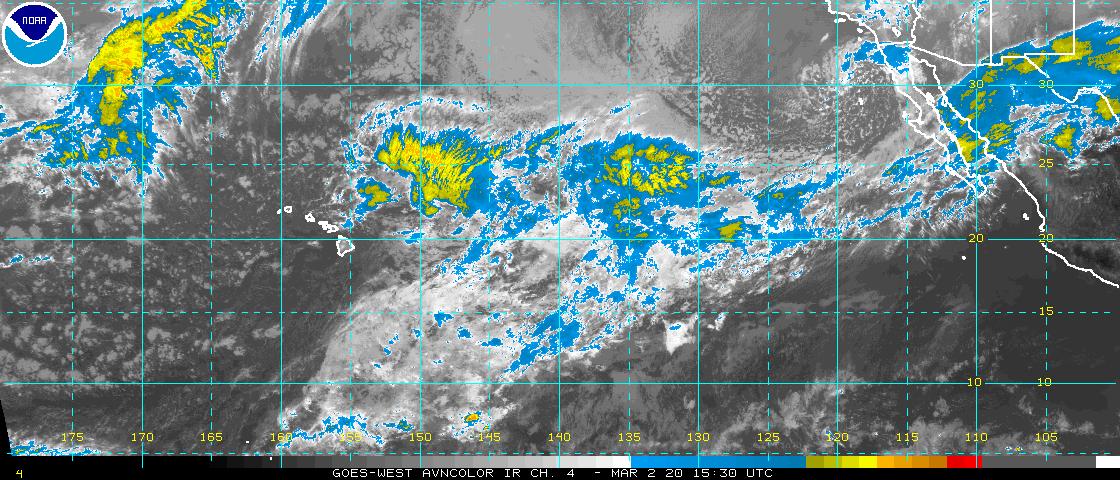
Satellite and Radar Images: To view the cloud conditions we have here in Hawaii, please use the following satellite links, starting off with this Infrared Satellite Image of the islands to see all the clouds around the state during the day and night. This next image is one that gives close images of the islands only during the daytime hours, and is referred to as a Close-up visible image. This next image shows a larger view of the Pacific…giving perspective to the wider ranging cloud patterns in the Pacific Ocean. Finally, here’s a Looping IR satellite image, making viewable the clouds around the islands 24 hours a day. To help you keep track of where any showers may be around the islands, here’s the latest animated radar image.
Hawaii’s Mountains – Here’s a link to the live webcam on the summit of near 14,000 foot Mauna Kea on the Big Island of Hawaii. The tallest peak on the island of Maui is the Haleakala Crater, which is near 10,000 feet in elevation. These two webcams are available during the daylight hours here in the islands…and when there’s a big moon rising just after sunset for an hour or two! Plus, during the nights and early mornings you will be able to see stars, and the sunrise too…depending upon weather conditions.
Tropical Cyclone activity in the eastern and central Pacific – Here’s the latest weather information coming out of the National Hurricane Center, covering the eastern north Pacific. You can find the latest tropical cyclone information for the central north Pacific (where Hawaii is located) by clicking on this link to the Central Pacific Hurricane Center. Here’s a tracking map covering both the eastern and central Pacific Ocean. A satellite image, which shows the entire ocean area between Hawaii and the Mexican coast…can be found here.
Aloha Paragraphs

Windward Oahu
We find ourselves in a lighter trade wind weather pattern…edging into a modified convective weather regime. These lighter winds will remain in place through the middle of this work week…with the refreshing trade winds returning later Wednesday or Thursday into the weekend. The lighter winds now, will make our local atmosphere feel rather warm and sultry during the days, and slightly cooler at night.
The overlying atmosphere will remain quite dry and stable however, so that whatever shower activity that develops…will be limited. As noted above, we’ll begin feeling rather hot and muggy during the days as we move through these first several days of the week. We’ll have daytime sea breezes from off the ocean…and land breezes heading back to the ocean at night locally. There will be cloud free skies much of the time over the next several days!
Monday was a great day, with a maximum amount of sunshine in most areas. These generally clear blue skies across the state, with all that sunshine, and somewhat lighter trade winds…made for gorgeous beach weather conditions! Skies across the state were absolutely clear Monday afternoon, unusually clear as a matter of fact. I expect similar conditions Tuesday, with classic late summer weather conditions prevailing. ~~~ I had trouble with my website editor today, although after lots of repair work, that things are back in order now…thank goodness! Aloha for now…Glenn.
Interesting: Fish in U.S. waters from Cape Hatteras to the Canadian border have moved away from their traditional, long-time habitats over the past four decades because of fundamental changes in the regional ecosystem, according to a new report by NOAA researchers. The 2009 Ecosystem Status Report also points out the need to manage the waters off the northeastern coast of the United States as a whole rather than as a series of separate and unrelated components.
Known as the Northeast U.S. Continental Shelf Large Marine Ecosystem (NES LME), the ecosystem spans approximately 100,000 square miles and supports some of the highest revenue-generating fisheries in the nation. During the past 40 years, the ecosystem has experienced extensive fishing by domestic and foreign fleets, changes in ocean water temperatures due to climate change, and pressures from increasing human populations along the coast.
Michael Fogarty, who heads the Ecosystem Assessment Program at the Northeast Fisheries Science Center (NEFSC) of NOAA’s Fisheries Service in Woods Hole, Mass., says his team’s report highlights the need to understand natural and human-related changes in this region and to develop effective management and mitigation strategies.
"There are many pressures on the ecosystem including fishing, pollution, habitat loss from coastal development, and impacts on marine life from shipping and other uses of the ocean," Fogarty said. "In addition, changing climate conditions are warming ocean waters, changing ocean chemistry and circulation patterns, and altering atmospheric systems. These changes have, in turn, been linked to changes in the distribution and abundance of fish species in the region and their major sources of food."
Interesting2: Us humans have a very short attention span. This year it might be global warming, next year it might be some other disaster we have to worry about; this is the cycle of politics, media and hysteria that never really addresses the issue. But the inconvenient thing about climate change is that it is happening now, each and every one of us is to blame for it, and unless something is done now (or yesterday), this annoying global warming thing is eventually going to make the hellish surface of Venus look like a water park.
And guess what? To enact any kind of change, there needs to be tight controls on man made carbon production, there needs to be grass roots efforts to alter individual’s consumption of raw materials and science must find ways to help nature to mend the impact we’ve already had on the world. Climate change could very well be mankind’s next World War; rather than killing an enemy with bombs and bullets, we’ll see huge numbers of people indiscriminately dying through rapid changes in weather cycles and unexpected climate-related disasters.
In short, global warming will begin to affect each and every one of us as time goes on, and the effects may seem small at first, but they are going to get bigger and more deadly unless we find ways to curb the quantity of greenhouse gases in our atmosphere.
So, how does the average rise in global temperatures impact me? For those of you who know me, I’m an avid fan of fine wines (of the $5-$10 price bracket) and good beers. I’d be very upset if anything disrupted the supply of either to the market shelves. Unfortunately, it looks like global warming is directly impacting one of the world’s most famous beers, and there’s not a lot we can do about it.
In a paper recently published in the Journal of Agricultural and Forest Meteorology, a team led by climatologist Martin Mozny of the Czech Hydrometeorological Institute has found that the quality of Saaz hops — a delicate variety of hop used to make pilsner lager — has been decreasing in recent years. Why? It would appear the continuing rise of air temperature in the Czech Republic (where the crops are located) is the culprit.
The team used high-resolution weather pattern, crop yield and hop quality data to gauge the impact of climate change on the Saaz crops between 1954 to 2006. Mozny’s team found that the acidity of the hops had dropped 0.06% every year in this time period. Ideally, to get that characteristic delicate bitter pilsner taste, the hops must contain around 5% alpha acid. Unfortunately, this quantity is dropping and showing little sign of stabilizing. In fact, the team predict that it is only going to get worse.
But this isn’t an isolated case, the hop growing regions of eastern Germany and central Slovakia have noticed similar changes in their crops. So what? This doesn’t mean the world is going to run out of beer any time soon does it. But wait, this is just the thin edge of the wedge. Currently we are seeing changes in entire crops that we use to produce consumables. It is naive to think these changes are limited to a small number of beer-making crops. This situation will become more and more common, not just for specialty beers, but for staple foods.
Climate change is creeping into our daily lives, what will it take to make us realize that global warming isn’t going away and that we are causing it? This realization may already be too late for us to do much about it. The phrase "act now!" isn’t an overused environmentalist slogan, it’s a necessity.
 Email Glenn James: