September 12-13, 2009
Air Temperatures – The following maximum temperatures were recorded across the state of Hawaii Saturday afternoon:
Lihue, Kauai – 84
Honolulu, Oahu – 89
Kaneohe, Oahu – 84
Kahului, Maui – 87
Hilo, Hawaii – 83
Kailua-kona – 87
Air Temperatures ranged between these warmest and coolest spots near sea level around the state – and on the highest mountains…at 5 p.m. Saturday evening:
Barking Sands, Kauai – 86F
Kapalua, Maui – 77
Haleakala Crater – 50 (near 10,000 feet on Maui)
Mauna Kea summit – 54 (near 14,000 feet on the Big Island)
Precipitation Totals – The following numbers represent the largest precipitation totals (inches) during the last 24 hours on each of the major islands, as of Saturday afternoon:
0.21 Mount Waialaele, Kauai
0.15 South Fork Kaukonahua, Oahu
0.05 Molokai
0.00 Lanai
0.00 Kahoolawe
0.38 Oheo Gulch, Maui
0.97 Kealakekua, Big Island
Marine Winds – Here’s the latest (automatically updated) weather map showing far away high pressure systems this weekend. Winds becoming gradually lighter Sunday into Monday.
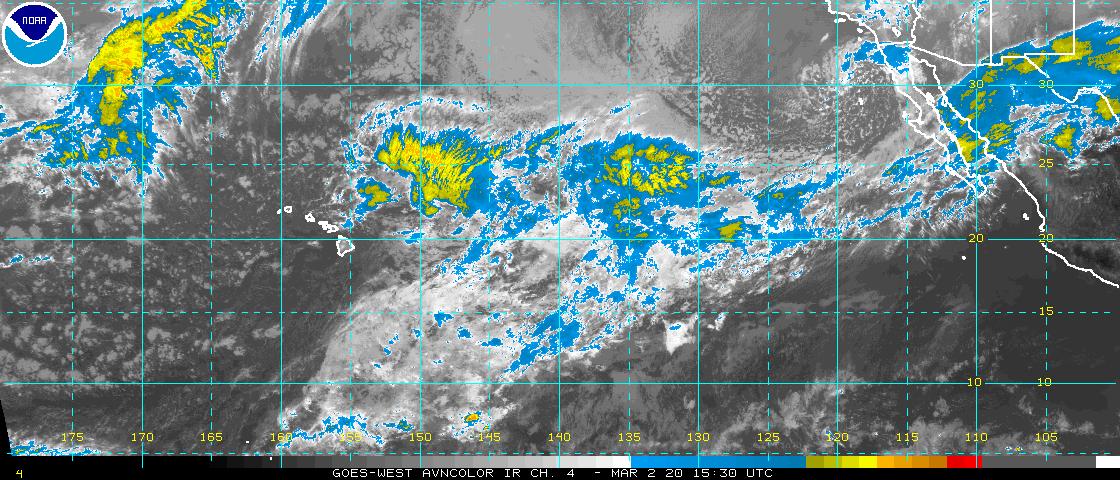
Satellite and Radar Images: To view the cloud conditions we have here in Hawaii, please use the following satellite links, starting off with this Infrared Satellite Image of the islands to see all the clouds around the state during the day and night. This next image is one that gives close images of the islands only during the daytime hours, and is referred to as a Close-up visible image. This next image shows a larger view of the Pacific…giving perspective to the wider ranging cloud patterns in the Pacific Ocean. Finally, here’s a Looping IR satellite image, making viewable the clouds around the islands 24 hours a day. To help you keep track of where any showers may be around the islands, here’s the latest animated radar image.
Hawaii’s Mountains – Here’s a link to the live webcam on the summit of near 14,000 foot Mauna Kea on the Big Island of Hawaii. The tallest peak on the island of Maui is the Haleakala Crater, which is near 10,000 feet in elevation. These two webcams are available during the daylight hours here in the islands…and when there’s a big moon rising just after sunset for an hour or two! Plus, during the nights and early mornings you will be able to see stars, and the sunrise too…depending upon weather conditions.
Tropical Cyclone activity in the eastern and central Pacific – Here’s the latest weather information coming out of the National Hurricane Center, covering the eastern north Pacific. You can find the latest tropical cyclone information for the central north Pacific (where Hawaii is located) by clicking on this link to the Central Pacific Hurricane Center. Here’s a tracking map covering both the eastern and central Pacific Ocean. A satellite image, which shows the entire ocean area between Hawaii and the Mexican coast…can be found here.
Aloha Paragraphs

North shore of Kauai
Light to moderately strong trade winds are getting lighter now, with light winds beginning Sunday…into the new work week ahead. These light winds will remain in place through most of the upcoming week…with the refreshing trade winds returning around next Thursday or Friday into the weekend. The lighter winds soon, will make our local atmosphere feel very warm and sultry during the days, and slightly cooler at night.
We’ll see several retired cold fronts approaching the islands during the next week, helping to keep a high pressure ridge quite near…or even over the Aloha state. As the fronts keep our ridge near by, our local winds will be lighter in turn. This will take us out of a trade wind weather pattern soon, shifting us into a convective weather pattern. This will bring clear mornings, giving way to afternoon cloudy periods…with a few localized upcountry showers on the leeward slopes.
The overlying atmosphere will remain quite dry and stable however, so that whatever shower activity that develops…will be limited. As noted above, we’ll begin feeling rather hot and muggy during the days through much of next week. We’ll have daytime sea breezes coming onto the islands from off the ocean…and land breezes heading back over the ocean from the land at night. This type of later summer weather pattern is quite common this time of year.
The computer models all agree that we’ll see lighter than normal wind speeds, along with lighter than normal rainfall amounts well into the future. This is all good news, at least in terms of nice weather. The one draw back perhaps, will be the somewhat muggy conditions that will prevail during the heat of the days…starting in a day to two. It will take the return of the trade winds around next Friday, to bring back our windward showers, and a more comfortable environment.
I went to see a new film Friday evening after work, called The Hurt Locker (2009). A brief synopsis is: "members of the Army’s elite, battle insurgents and each other, as they seek out and disarm a wave of roadside bombs on the streets of Baghdad." This film is receiving very good ratings by the critics, although the subject matter was intense, to say the least. The critics and users of the film both gave The Hurt Locker an A-, which I would have to agree with. It had me sitting on the edge of the sit in many parts of the film, and I had to remind myself to relax my body many, many times as well. Once again, it is not a film that I could honestly recommend to most of you readers, although there are some of you, those that have the stomach for it, who will be very glad you saw such an engaging piece of work. I found it quite interesting that a woman directed this very macho film! Here’s a trailer, if you happen to be interested.
It’s Saturday evening here in Kula, Maui, as I begin writing this last part of today’s narrative. Saturday’s not over yet, and actually it’s early in the evening as I begin writing this part of this narrative update. I hung around the house the first part of the day, reading, talking on the phone, having breakfast, drinking some coffee, and generally relaxing in a fun way. I then took off for Paia, and ended up at Baldwin Beach. It was a lovely day there, and reminded me deeply what a wonderful place Maui is to live! I took a long walk down to what’s called Baby Beach, in Spreckelsville. I jumped in the warm ocean afterwards, and enjoyed being sloshed around by the larger than normal waves that were breaking. Then I went shopping at the health food store, before heading upcountry to Kula again. It’s such a good day to be alive! It’s interesting how sometimes you can take all this beauty for granted, and at other times it just seems so amazingly special. At any rate, I’m feeling relaxed, and ready to head into the evening hours, with another great day off from work on Sunday. Speaking of which, I’ll meet you back here Sunday morning with your next new weather narrative from paradise. I hope you have a great Saturday night! Aloha for now…Glenn.
Imagining with the Lennons…and again with this song…Woman
Interesting: The quality of a person’s social life could have an even greater impact than diet and exercise on their health and well-being. There is growing evidence that being a member of a social group can significantly reduce the risk of conditions like stroke, dementia and even the common cold.
New research by the Universities of Exeter and Queensland, Australia, shows that membership of social groups has a positive impact on health and well-being.
The work highlights the importance of belonging to a range of social groups, of hanging onto social groups, and of building new social groups in dealing with life changes such as having a stroke and being diagnosed with dementia.
Writing in Scientific American Mind, the researchers from the Universities of Exeter, Queensland and Kansas review a number of previous studies, including many of their own, which identify a link between group membership and physical and mental health.
Some more recent studies which support the same conclusion are presented by the Exeter-based researchers at the British Science Festival. Commenting on this work, Professor Alex Haslam of the University of Exeter, said: "We are social animals who live and have evolved to live in social groups.
Membership of groups, from football teams to book clubs and voluntary societies, gives us a sense of social identity. This is an indispensable part of who we are and what we need to be in order to lead rich and fulfilling lives. For this reason groups are central to mental functioning, health and well-being".
Interesting2: After searching for more than 50 years, scientists finally have discovered a number of new mosquito repellents that beat DEET, the gold standard for warding off those pesky, sometimes disease-carrying insects. The stuff seems like a dream come true. It makes mosquitoes buzz off three times longer than DEET, the active ingredient in many of today’s bug repellents.
It does not have the unpleasant odor of DEET. And it does not cause DEET’s sticky-skin sensation. But there’s a fly in the ointment: The odds may be stacked against any of the new repellents finding a place on store shelves this year or next — or ever. Ulrich Bernier, Ph.D., lead researcher for the repellent study, said the costly, time-consuming pre-market testing and approval process is a hurdle that will delay availability of the repellents, which were discovered last year.
The results of his team’s work were presented at the 238th National Meeting of the American Chemical Society (ACS) by Maia Tsikoli, Ph.D., a post-doctoral researcher working with Bernier. "Commercial availability of topical repellents can take years and a significant investment to achieve that end goal," Bernier said.
"The cost will be several hundred thousand dollars. Once you determine that the repellent works through some screening process, we then have to go through a toxicological hazard evaluation involving numerous toxicological tests."
Provided the repellents continue to work well when tested in the laboratory on human skin, and if they pass the battery of toxicological tests, they would still face a series of tests to prove their effectiveness in making mosquitoes bug off, Bernier said.
"Clearly, the odds are stacked against new repellent products making it to market," he noted. Bernier and his team discovered the repellents with what they say is the first successful application of a computer model using the molecular structures of more than 30,000 chemical compounds tested as repellents over the last 60 years.
Using 11 known compounds, they synthesized 23 new ones. Of those, 10 gave about 40 days protection, compared to 17.5 days for DEET, when a soaked cloth was worn by a human volunteer. When applied to the skin, however, DEET lasts about five hours.
Bernier routinely participates in repellency studies, which involve about 500 mosquitoes trying to land on his arm and bite through a repellent-soaked cloth. "If the mosquitoes don’t even land, we know the repellent is surely working," he explained. "If they walk around on the cloth-covered-arm, they are on the verge of being repelled. If they bite… on to the next repellent."
Overall, in addition to lasting longer than current products, including DEET, the new repellents don’t have the stickiness or unpleasant smell common with today’s insect sprays and liquids, said Bernier. He said that extended studies are now evaluating the effectiveness of the repellents against flies and ticks.
"This was quite an ambitious project," Bernier said. "The USDA historical archives and repellents database we used consisted of more than 30,000 chemical structures tested over the past six decades." To search for the best repellents, the team devised software that recognized structural features of a chemical that would make it effective in keeping the bugs away.
They trained it by feeding it the molecular structures of 150 known repellents. Based on this information, the program learned to identify the chemical traits of a good repellent without the chemists even having to know what those traits were. For example, the team checked out 2,000 variants of a compound found in black pepper that repels insects.
Interesting3: It was back-to-school time for much of the U.S. this week, as millions of students bustled into classrooms to start the new year. But compared with school years past, this academic season has been decidedly more fraught, since it marks what could be the full-scale return of the H1N1 influenza virus.
If previous flu pandemics are any measure, we may see spikes in infection once school gets under way. Kids in classrooms are major spreaders of infectious disease; they get sick, infect one another, then bring the disease back home.
That’s why officials are trying to get the new H1N1 vaccine tested and ready for use as soon as possible — the longer America’s schoolchildren go unprotected, the bigger the H1N1 pandemic could become.
A new study in the Sept. 10 edition of Science makes the case for widespread and speedy immunization, suggesting that doing so could stifle the pandemic. A team of researchers led by Ira Longini, a biostatistician at Fred Hutchinson Cancer Research Center, used data from earlier H1N1 outbreaks this year in the U.S. and Mexico to model how the pandemic is likely to unfold this fall. The team found that by first vaccinating children, then adults, until 70% of the U.S. population is covered, officials would be able to all but stop the pandemic.
Interesting4: Tens of millions of people could be infected with swine flu in China in the coming months, a health ministry official warned today, adding that fatalities would be "unavoidable". "According to expert estimates, our nation during the autumn season might have several tens of millions infected with A(H1N1),” Liang Wannian, deputy director of the ministry’s health emergency office, said.
Mr Liang said of that total, "half of them could experience clinical symptoms, several millions will seek medical help, and serious cases and fatalities will be unavoidable.” The spread of A(H1N1) influenza in China has gathered pace as the autumn months approach, Mr Liang said, with over half of the nation’s nearly 7000 cases detected between August 24 and September 10.
Of those cases, nearly 95 per cent were contracted within China, whereas the vast majority of cases reported from June to August originated abroad, he said. "The situation we face is not optimistic,” Mr Liang said, noting that the virus had been found in all of China’s 31 provinces and regions.
"We are facing severe challenges in our prevention and control work.” China has so far reported no swine flu deaths. The State Council, or cabinet, yesterday issued new regulations on handling A(H1N1) outbreaks, ordering the ministries of health and education, and the food and drug administration to coordinate prevention and control.
Since June, China has witnessed over 200 "large-scale” outbreaks of swine flu with over 85 per cent of them occurring in schools or at school-related activities, Mr Liang said. China is soon expected to launch a nationwide vaccination program. The World Health Organization has said it could be the first country in the world to do so.
Interesting5: Upon first entering the White House, President Obama expressed to Barbara Walters his intention to set an example for Americans on how to live more eco-friendly: "Each of us have a role to play in not being wasteful when it comes to energy… Part of what I want to do is to show the American people it’s not that hard." The Obama family put those words into action very quickly from Michelle Obama’s organic herb and vegetable garden on the south lawn to the Obama girls’ green swing-set made of recycled materials, shredded tires and nontoxic dyes.
The current first family isn’t the first in the White House to implement energy-saving practices. In 1979 President Jimmy Carter had a $28,000 solar water heater installed on the roof of the West Wing, and President George W. Bush installed a small photovoltaic system as well as two solar water heating systems.
Obama, however, plans to earn a LEED certification to make the White House the greenest it has ever been. The Leadership in Energy and Environmental Design (LEED) certification was developed by the U.S. Green Building Council (USGBC) to measure and reward buildings and communities that implement green building design, construction, operation, and maintenance.
Greening a home is no easy task, but with the historic status and required security of the White House, the Obama family has their work cut out for them. Rick Fedrizzi, CEO and President of the USGBC, believes that "LEED certification of the White House is absolutely possible and viable."
On top of the availability of recycling in the East and West Wings, White House drinking fountains — which apparently did not accommodate the refilling of water-bottles — are even being modified to make the process much easier.
White House Council on Environmental Quality (CEQ) spokesperson, Christine Glunz, says the effort to get the White House to LEED certification includes energy and water systems as well as waste.
She believes it is vital to consider toxicity and life-cycle when making purchases for facilities. CEQ is looking to reduce the carbon footprint of the White House by implementing computerized energy management systems, automatic light sensors that turn off in unoccupied rooms and low-flow water valves.
Paints and sealers with low or no volatile organic compounds (VOCs), biodegradable cleaners and recycled equipment will all be used by White House groundskeepers and engineers, according to a White House spokesperson. Window films that will lower UV rays and save energy will also be added.
According to an article on the National Geographic website, any leftover materials from White House renovations and demolitions will be donated to local reuse organizations. If President Obama continues to enforce such eco-friendly changes throughout his term, he will be on the right track to making the White House more of a "green house," proving with a LEED certification that he can lead Americans to a greener world.
 Email Glenn James: