September 10-11, 2009
Air Temperatures – The following maximum temperatures were recorded across the state of Hawaii Thursday afternoon:
Lihue, Kauai – 84
Honolulu, Oahu – 92
Kaneohe, Oahu – 85
Kahului, Maui – 91
Hilo, Hawaii – 81
Kailua-kona – 87
Air Temperatures ranged between these warmest and coolest spots near sea level around the state – and on the highest mountains…at 5 p.m. Thursday evening:
Honolulu, Oahu – 85F
Hilo, Hawaii – 73
Haleakala Crater – 54 (near 10,000 feet on Maui)
Mauna Kea summit – 57 (near 14,000 feet on the Big Island)
Precipitation Totals – The following numbers represent the largest precipitation totals (inches) during the last 24 hours on each of the major islands, as of Thursday afternoon:
0.04 Kapahi, Kauai
0.12 Ahuimanu Loop, Oahu
0.00 Molokai
0.00 Lanai
0.00 Kahoolawe
0.36 West Wailuaiki, Maui
1.42 Mountain View, Big Island
Marine Winds – Here’s the latest (automatically updated) weather map showing weak high pressure systems to the northeast, and far to the west-northwest Trade winds will be active through Friday…although becoming gradually lighter into the weekend.
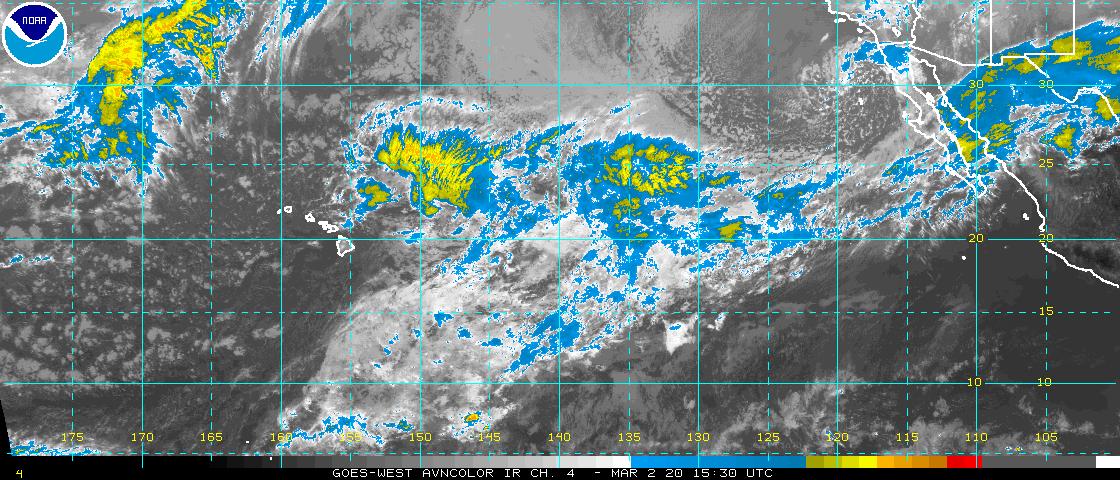
Satellite and Radar Images: To view the cloud conditions we have here in Hawaii, please use the following satellite links, starting off with this Infrared Satellite Image of the islands to see all the clouds around the state during the day and night. This next image is one that gives close images of the islands only during the daytime hours, and is referred to as a Close-up visible image. This next image shows a larger view of the Pacific…giving perspective to the wider ranging cloud patterns in the Pacific Ocean. Finally, here’s a Looping IR satellite image, making viewable the clouds around the islands 24 hours a day. To help you keep track of where any showers may be around the islands, here’s the latest animated radar image.
Hawaii’s Mountains – Here’s a link to the live webcam on the summit of near 14,000 foot Mauna Kea on the Big Island of Hawaii. The tallest peak on the island of Maui is the Haleakala Crater, which is near 10,000 feet in elevation. These two webcams are available during the daylight hours here in the islands…and when there’s a big moon rising just after sunset for an hour or two! Plus, during the nights and early mornings you will be able to see stars, and the sunrise too…depending upon weather conditions.
Tropical Cyclone activity in the eastern and central Pacific – Here’s the latest weather information coming out of the National Hurricane Center, covering the eastern north Pacific. You can find the latest tropical cyclone information for the central north Pacific (where Hawaii is located) by clicking on this link to the Central Pacific Hurricane Center. Here’s a tracking map covering both the eastern and central Pacific Ocean. A satellite image, which shows the entire ocean area between Hawaii and the Mexican coast…can be found here.
Aloha Paragraphs

Wonderful Hawaiian Waterfall
Light to moderately strong trade winds will continue, with daytime sea breezes along the leeward sides this weekend…into next week. We find high pressure systems located far to the northeast, and west-northwest of the islands Thursday evening, the source of our trades. These trade winds will remain locally light to moderately strong into Friday, then drop down in strength into the light levels this weekend. The light winds will make our local atmosphere feel very warm and sultry during the days…and slightly cooler than normal at night.
A few passing showers along the windward coasts and slopes…with typical dry weather for the most part along the south and west facing leeward sides. A deep storm, as shown on this weather map, in the Gulf of Alaska, will push an early season cold front in our direction, although it won’t reach our islands. It’s approach however will help to weaken our trade wind producing ridge of high pressure, the reason our local trade winds will be lighter soon. Meanwhile, this storm has generated a northwest swell in our direction…keeping our surf up along the north and west facing beaches.
As the winds calm down during the next few days, we’ll slide into a modified convective weather pattern. This simply means relatively clear, slightly cool mornings, giving way to afternoon cloudy periods…with a few localized upcountry showers on the leeward slopes. It will take the return of stronger trade winds to bring us around full circle, to a normal trade wind pattern, perhaps by the end of next week or so. As noted above, we’ll begin feeling rather hot and muggy during the days this weekend through much of next week.
We still have quite a long time before we begin to see autumn weather conditions…as summer hangs on down here in the tropics. Here’s another look at that weather map, which I placed above. I want to draw your attention this time to the big red L in the Gulf of Alaska. This deep storm will bring true autumn weather conditions to the coast of Alaska, in no uncertain terms! They will have gales, and storm force winds in the marine environment, and wind advisories over the inland areas. There will be lots of heavy rain involved in this storm too, ending the summer season in the north country.
It’s Thursday evening here in Kihei, Maui, as I begin writing this last section of today’s narrative. As we can see on this looping satellite image, we seen lots of high cirrus clouds moving in our direction from the west today. These icy high clouds will likely make for a colorful sunset, and if they are still around Friday morning…more striking colors then. A trough of the south of Maui is keeping Maui and parts of the Big Island cloudier than normal now. As this next satellite image shows, the high cirrus clouds are hiding the cloudiness arriving as this trough slowly moves by to our south.
~~~ As mentioned above, the trade winds are still blowing Thursday evening. As a matter of fact, they are quite strong locally, with 30 mph gusts at Kapalua and Kahului, Maui, and 35 mph at the windy Maalaea Bay. These trade winds will persist Friday, and then as an early season cold front draws near, our winds will tumble in strength this weekend, lasting well into next week. I’ll be back early Friday morning with your next new weather narrative. I hope you have a great Thursday night until then! Aloha for now…Glenn.
Cute youtube cat video: when you need a drink…you need a drink!
Interesting Live Science article: Arctic may be changed forever…study finds
Interesting: For many of the types of fish we buy in stores or order in restaurants, the chance that an individual dies from fishing is several times higher than dying of natural causes. This may seem obvious to most (they had to get to our table somehow), but what may not be apparent is that the relentless pursuit of consumer-friendly fish product is having a massive impact on fish populations around the world.
By repeatedly choosing only the biggest fish, or only those found in certain habitats, the fisheries industry may be permanently altering the genetic composition of fish populations. What are the long-term evolutionary implications of prolonged fishing for the fish that humans and, perhaps more importantly, diverse ecosystems so depend on?
A group of concerned international scientists convened at the 2008 American Fisheries Society Annual Meeting to address this issue, and contributions to the symposium are now available online in an August 2009 special issue of Evolutionary Applications.
Several groups of scientists focused on teasing apart how much of the shift in fish morphology, development and behavior that has been documented over the years is due to genetic versus non-genetic changes. Long-term genetic changes may be more problematic since these may not be reversible and they make predicting the composition of fish stocks in the future very difficult.
Equally contentious among scientists was distinguishing between changes that were caused by artificial selection due to fishing per se, versus environmental influences such as habitat destruction or climate change.
Interesting2: Analysis of a rock type found only in the world’s oldest oceans has shed new light on how large animals first got a foothold on Earth. A scientific team led by Professor Robert Frei at the University of Copenhagen in Denmark, and including scientists from Newcastle University, UK, and universities in Uruguay and Southern Denmark, have for the first time managed to plot the rise and fall of oxygen levels in the Earth’s atmosphere over the last 3.8 billion years.
By analyzing the isotopes of chromium in iron-rich sediments formed in the ancient oceans, the team has found that a rise in atmospheric oxygen levels 580 million years ago was closely followed by the evolution of animal life. Published today in the academic journal Nature, the data offers new insight into how animal life – and ultimately humans – first came to roam the planet.
"Because animals evolved in the sea, most previous research has focused on oceanic oxygen levels," explains Newcastle University’s Dr Simon Poulton, one of the authors of the paper. "Our research confirms for the first time that a rise in atmospheric oxygen was the driving force for oxygenation of the oceans 580 million years ago, and that this was the catalyst for the evolution of large complex animals."
Interesting3: Interim results from an international research project which looks at bilingual education reveal that children can learn a second language as early as preschool. The University of Hertfordshire is one of nine European partners in ELIAS (Early Language and Intercultural Acquisition Studies) which was awarded €300,000 by the European Union last year to research bilingual education and intercultural awareness in children through observational studies and language assessments in six project preschools.
The researchers use a concept called ‘immersion teaching’, whereby children are addressed in each language by the respective native speaker and asked to respond in that language. The study focuses on bilingual preschools in Germany, Sweden and Belgium, where the staff members are teachers from the respective country, but at least one teacher is a native speaker of English.
Data is also collected from nurseries in Hertfordshire and the bilingual nursery of the German school in London. Children’s progress in English is measured through a receptive vocabulary test and a grammar task that was designed within the project. So far, 266 preschool children aged between three and five took part in the tests.
The researchers found that although not all the preschool groups performed equally well in the tests, and there was a large amount of individual variation in children’s comprehension of vocabulary and grammatical phenomena, there was clear evidence that it is feasible for children to start to learn a second language in a preschool context, using immersion methods.
Interesting4: By extracting dissolved carbon dioxide from seawater and combining it with hydrogen stripped from water molecules, Navy chemists hope to one day secure a cheap and steady fuel source for its fleet of jets. "The U.S. Navy is surrounded by seawater and the Navy needs jet fuel," said Robert Dorner, a scientist at the Naval Research Laboratory in Washington, D.C. who works on the technology.
"In the seawater you have CO2 and you have hydrogen. The question is how do you convert that into jet fuel." The answer, according to Dorner, is a modified version of the chemical reaction known as the Fischer-Tropsch process.
Interesting5: Like the robotic rovers Spirit and Opportunity, which wheeled tirelessly across the dusty surface of Mars, a new robot spent most of July traveling across the muddy ocean bottom, about 25 miles off the California coast. This robot, the Benthic Rover, has been providing scientists with an entirely new view of life on the deep seafloor.
It will also give scientists a way to document the effects of climate change on the deep sea. The Rover is the result of four years of hard work by a team of engineers and scientists led by MBARI project engineer Alana Sherman and marine biologist Ken Smith.
About the size and weight of a small compact car, the Benthic Rover moves very slowly across the seafloor, taking photographs of the animals and sediment in its path. Every 10 to 16 feet the Rover stops and makes a series of measurements on the community of organisms living in the seafloor sediment.
These measurements will help scientists understand one of the ongoing mysteries of the ocean—how animals on the deep seafloor find enough food to survive. Most life in the deep sea feeds on particles of organic debris, known as marine snow, which drift slowly down from the sunlit surface layers of the ocean.
But even after decades of research, marine biologists have not been able to figure out how the small amount of nutrition in marine snow can support the large numbers of organisms that live on and in seafloor sediment. The Benthic Rover carries two experimental chambers called "benthic respirometers" that are inserted a few centimeters into the seafloor to measure how much oxygen is being consumed by the community of organisms within the sediment.
This, in turn, allows scientists to calculate how much food the organisms are consuming. At the same time, optical sensors on the Rover scan the seafloor to measure how much food has arrived recently from the surface waters. MBARI researchers have been working on the Benthic Rover since 2005, overcoming many challenges along the way.
The most obvious challenge was designing the Rover to survive at depths where the pressure of seawater is about 420 kilograms per square meter (6,000 pounds per square inch). To withstand this pressure, the engineers had to shield the Rover’s electronics and batteries inside custom-made titanium pressure spheres.
Interesting6: An extremely rare bird seen only a dozen times in the past 150 years has finally been spotted at sea. But the news for the critically-endangered Fiji petrel is not good. Even in optimal conditions – the best season, best location and using the most pungent-smelling bait – only eight birds have been sighted.
Fijians have long appreciated the rarity of the chocolate-colored gull, featuring it on a bank note and protecting it under law. Known for its elusiveness, it was first identified on Fiji’s Gau island by British surveyors in 1855 and was not seen again for 130 years.
Since 1984 there have been a handful of reports of petrels injured after crashing into village roofs on Gau but never have the birds been seen at sea until now. "Finding this bird and capturing such images was a fantastic and exhilarating experience," Hadoram Shirihai, who led the two-week search by the British Ornithologists’ Club, said.
A paper published this week is the first ever to detail how the species behaves, with the team hoping it could hold the key to the bird’s survival. "The present evidence is that very few Fiji petrels survive and that immediate efforts to find the nest sites are needed," expedition member Tony Pym said.
"Prompt, effective protection is urgently required before it is too late." The Fiji petrel is one of 192 bird species worldwide listed as critically endangered. Jez Bird from BirdLife International said because the bird was exceptionally rare and extremely poorly known, any new data concerning range and abundance was vital to its conservation.
Interesting7: The USA’s summer was cooler than average in 2009, for only the second time this decade, according to data released Thursday by the National Oceanic and Atmospheric Administration. Several Midwest states — including Michigan, Wisconsin, Minnesota, and South Dakota— recorded one of their 10 coldest summers on record. Northwestern Pennsylvania recorded its coldest summer ever.
Climate records date to 1895. At the nation’s largest outdoor water park in Wisconsin, "every Saturday but one had an issue with rain, wind or just plain cold," says Tim Gantz, president and co-owner of Noah’s Ark Waterpark in Wisconsin Dells, Wis. He added that summer business was down slightly overall, and that one Saturday all 2,000 of the park’s wet suits were in use by customers.
July was the second-coldest on record in Wisconsin. The culprit for the cold? "A recurring trough of low pressure across the central USA and interior Canada, which was there throughout the summer," says Deke Arndt, chief of the climate monitoring branch at the National Climatic Data Center in Asheville, N.C. Low pressure causes clouds to form, keeping temperatures cool.
The chill continued into August, as temperatures were below normal across the Midwest, Plains and parts of the South. More than 300 low-temperature records were set across the Midwest during the last two days of August. On the other end of the spectrum, it was one of the hottest, driest summers on record in parts of south Texas, according to the climate center.
"They’ve been fighting a really bad drought situation there," Arndt said. McAllen, Texas, broke its all-time record for highest-average summer temperature. Overall, the South, Southeast and Southwest regions were drier than average this summer. Arizona had its third-driest summer, while both South Carolina and Georgia had their sixth-driest. Global climate data for the summer will be released on September 17.
 Email Glenn James: