September 9-10, 2009
Air Temperatures – The following maximum temperatures were recorded across the state of Hawaii Wednesday afternoon:
Lihue, Kauai – 84
Honolulu, Oahu – 90
Kaneohe, Oahu – 84
Kahului, Maui – 89
Hilo, Hawaii – 83
Kailua-kona – 87
Air Temperatures ranged between these warmest and coolest spots near sea level around the state – and on the highest mountains…at 5 p.m. Wednesday evening:
Honolulu, Oahu – 86F
Hilo, Hawaii – 78
Haleakala Crater – 52 (near 10,000 feet on Maui)
Mauna Kea summit – 64 (near 14,000 feet on the Big Island)
Precipitation Totals – The following numbers represent the largest precipitation totals (inches) during the last 24 hours on each of the major islands, as of Wednesday afternoon:
0.39 Mount Waialaele, Kauai
0.22 Ahuimanu Loop, Oahu
0.00 Molokai
0.00 Lanai
0.00 Kahoolawe
0.10 Oheo Gulch, Maui
0.56 Piihonua, Big Island
Marine Winds – Here’s the latest (automatically updated) weather map showing weak high pressure systems to the northeast, and far to the west-northwest Trade winds will be active through Friday…although becoming gradually lighter.
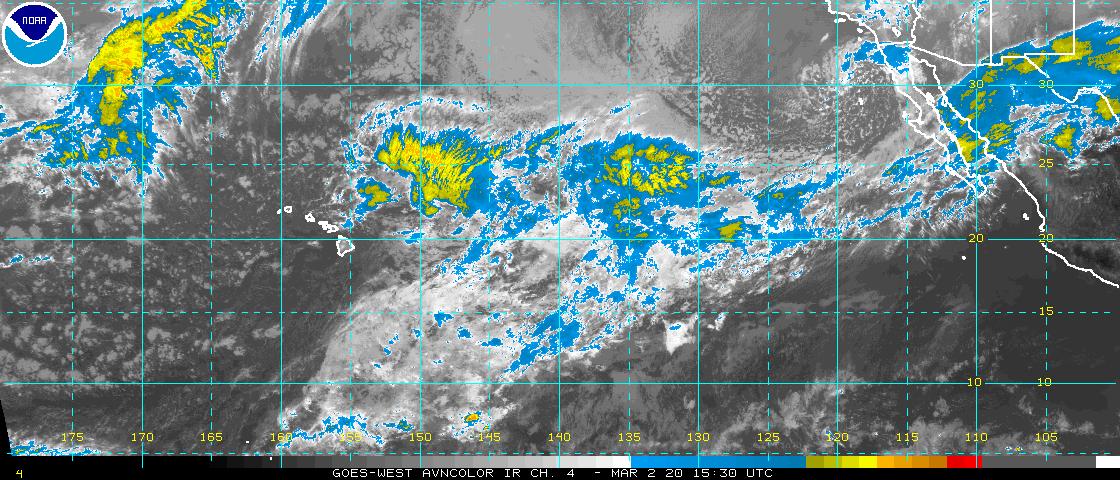
Satellite and Radar Images: To view the cloud conditions we have here in Hawaii, please use the following satellite links, starting off with this Infrared Satellite Image of the islands to see all the clouds around the state during the day and night. This next image is one that gives close images of the islands only during the daytime hours, and is referred to as a Close-up visible image. This next image shows a larger view of the Pacific…giving perspective to the wider ranging cloud patterns in the Pacific Ocean. Finally, here’s a Looping IR satellite image, making viewable the clouds around the islands 24 hours a day. To help you keep track of where any showers may be around the islands, here’s the latest animated radar image.
Hawaii’s Mountains – Here’s a link to the live webcam on the summit of near 14,000 foot Mauna Kea on the Big Island of Hawaii. The tallest peak on the island of Maui is the Haleakala Crater, which is near 10,000 feet in elevation. These two webcams are available during the daylight hours here in the islands…and when there’s a big moon rising just after sunset for an hour or two! Plus, during the nights and early mornings you will be able to see stars, and the sunrise too…depending upon weather conditions.
Tropical Cyclone activity in the eastern and central Pacific – Here’s the latest weather information coming out of the National Hurricane Center, covering the eastern north Pacific. You can find the latest tropical cyclone information for the central north Pacific (where Hawaii is located) by clicking on this link to the Central Pacific Hurricane Center. Here’s a tracking map covering both the eastern and central Pacific Ocean. A satellite image, which shows the entire ocean area between Hawaii and the Mexican coast…can be found here.
Aloha Paragraphs

Hawaiian I’iwi bird…Ohia Lehua blossoms
Light to moderately strong trade winds will continue, with daytime sea breezes along the leeward sides this weekend…into early next week. We find high pressure systems located to the northeast, and west-northwest of the islands Wednesday evening, as shown on this weather map. These trades will remain locally light to moderately strong Thursday…then relax in strength Friday into the weekend.
A few passing showers along the windward coasts and slopes…with typical dry weather for the most part along the south and west facing leeward sides. The weather map above shows a deep storm low pressure system to the north of Hawaii Wednesday evening. This storm will push an early season cold front in our direction, although it won’t reach our islands. It’s approach however will help to weaken our trade wind producing ridge of high pressure, the reason our local trade winds will be lighter in a few days. Meanwhile, this storm will generate a northwest swell in our direction…arriving later Thursday into Friday.
Perhaps the most interesting thing going on now, in terms of weather, is the unusually strong low pressure system, and its associated cold front to our north. The cold front, if it were later in the autumn, or during the winter season, would likely barrel its way down through the Hawaiian Islands…bringing good showers with it. Although, since it’s still summer, the front will skid to a stop well north of our Aloha state, late this weekend into early next week. An interesting aspect of this storm, will be the potential high surf that it sends us…arriving later Thursday into the weekend.
Besides the soon to be lighter trade winds, we’re involved in what could be considered a fairly typical late summer trade wind weather pattern at the moment. As the winds calm down during the next few days, we’ll slide into a modified convective weather pattern. This simply means relatively clear mornings, giving way to afternoon cloudy periods…with a few localized upcountry showers on the leeward slopes. It will take the return of stronger trade winds to bring us around full circle, to a normal trade wind pattern, perhaps by around the middle of next week or so.
It’s Wednesday evening here in Kihei, Maui, as I begin writing this last section of today’s narrative. Wednesday still saw a pretty good amount of trade winds blowing. They’ve begun to slow down some, although at 5pm, the windy Maalaea Bay, here on Maui, was still reporting a gust to 33 mph. Most other areas around the state say considerably lighter winds. Skies were clear to partly cloudy, with just the Hilo Bay reporting cloudy skies. Rainfall was rather limited today, and will remain so through Thursday. Speaking of which, Thursday should be a nice day, more or less about like it was Wednesday. Looking out the window here on the South Coast, in Kihei, it was just about totally clear in most directions, with just the usual clouds around the edges. I’ll be back early Thursday morning with your next new weather narrative. I hope you have a great Wednesday night until then! Aloha for now…Glenn.
Interesting date today: 9/9/9 – Number 9 definition: Artistic genius, humanitarianism, romance, emotionalism, dissipation
Interesting body fact: Our salivary glands, which are located on the inside of each cheek, at the bottom of the mouth and under the jaw at the front of the mouth, churn out about two to four pints of spit every day.
The mere mention or aroma hint of chocolate chip cookies can make for a mouth full of drool. That’s a good thing. The clear substance, made up mostly of water, mixes in with food to help even the driest snack slide with ease down into your stomach. Before those morsels hit the belly, special enzymes in saliva start to break down that food into its simpler components.
Saliva’s enzymes also help to fight off infections in your mouth. In addition, the goop cleans the inside of your mouth and teeth, though brushing and flossing are still musts.
Interesting: Despite Washington’s nearly single-minded focus on healthcare reform, the Obama administration still expects the U.S. Senate to pass climate change legislation, Interior Secretary Ken Salazar said on Tuesday. "Right now we are focused on this crusade for healthcare reform for the country and that’s where our time and energy will go for the days ahead," Salazar said during an interview at the Reuters Global Climate and Alternative Energy Summit. Even so, he added, "We want both (healthcare and climate bills). The president has been very clear that these are two big issues for the United States and for our time."
Interesting2: A team of scientists from Britain, the United States and Papua New Guinea found more than 40 previously unidentified species when they climbed into the kilometer-deep crater of Mount Bosavi and explored a pristine jungle habitat teeming with life that has evolved in isolation since the volcano last erupted 200,000 years ago. In a remarkably rich haul from just five weeks of exploration, the biologists discovered 16 frogs which have never before been recorded by science, at least three new fish, a new bat and a giant rat, which may turn out to be the biggest in the world.
The discoveries are being seen as fresh evidence of the richness of the world’s rainforests and the explorers hope their finds will add weight to calls for international action to prevent the demise of similar ecosystems. They said Papua New Guinea’s rainforest is currently being destroyed at the rate of 3.5% a year. "It was mind-blowing to be there and it is clearly time we pulled our finger out and decided these habitats are worth us saving," said Dr George McGavin who headed the expedition.
Interesting3: Green Seal’s certification standard for restaurants and foodservice operations has been approved by the American National Standards Institute (ANSI), making the guidelines the first of their kind to be nationally recognized, Green Seal said today. The GS-46 Environmental Standard for Restaurants and Foodservices, released in May, is also the first Green Seal specification to be approved as an American National Standard.
The standard for restaurants and foodservice establishments provides a framework for the facilities to reduce their environmental impacts. The standard addresses food purchasing and waste reduction, which present the greatest opportunities for restaurateurs and foodservice operators to shrink their facilities’ environmental footprint. Resource efficiency and water and energy management are among the other key issues covered.
Interesting4: China’s increasing air pollution has cut the light rainfall essential to the country’s agriculture over the last 50 years, new research suggests. The research, published in the Journal of Geophysical Research last month, is based on rainfall data collected from weather stations across China.
The number of light rain days — those with precipitation of less than ten millimeters — in northeast and southeast China has been cut by 25 per cent and 21 per cent respectively over the past five decades, researchers have found.
"Analyses of air pollution data, satellite data, and large-scale circulation all suggest that aerosols may have played a more dominant role in the observed decrease trend in light rain in East China," the authors write. Qian Yun, co-author of the research and an atmospheric scientist at the Pacific Northwest National Laboratory, United States, told SciDev.Net: "The decreased light rain will definitely deal a blow to agricultural potential in east China, the main food production area in China."
"Light rain soaks slowly into the ground [making it easier for the soil to absorb] which is better than heavy rain, which can flood fields and run off into nearby waterways." The authors say that increased levels of aerosols — particles of pollution in the air above China — are caused by increasing fossil fuel consumption, particularly in big cities like Beijing.
They think that because rain drops form around aerosol particles, more particles means smaller drops that are less likely to form rain clouds. Qian says the team will now build a model to calculate the agricultural and economic losses caused by air pollution to guide policymakers.
But Guo Jianping, a meteorologist at the Chinese Academy of Meteorological Sciences, who was not involved in the research, says the relationship between light rain and agricultural growth is difficult to define.
"Usually it is hard for small amounts of water to seep down into the ground and be absorbed. In addition, more rain days do not mean it’s good for agriculture as less solar radiation is available," he told SciDev.Net.
Interesting5: A new study by the Wildlife Conservation Society, U.S. Fish and Wildlife Service, and other groups reveals how oil development in the Arctic is impacting some bird populations by providing "subsidized housing" to predators, which nest and den around drilling infrastructure and supplement their diets with garbage – and nesting birds. A new study by the Wildlife Conservation Society, U.S. Fish and Wildlife Service, and other groups reveals how oil development in the Arctic is impacting some bird populations by providing "subsidized housing" to predators, which nest and den around drilling infrastructure and supplement their diets with garbage – and nesting birds.
The authors monitored nearly 2,000 nests of 17 passerine and shorebird species over a four-year period. Birds from five continents migrate to the Arctic each year to nest. "This is the first study specifically designed to evaluate the so-called oil ‘footprint’ effect in the Arctic on nesting birds," said the study’s lead author, Joe Liebezeit of the Wildlife Conservation Society.
"The study was also unique in that it was a collaborative effort among conservation groups, industry, and federal scientists." The impetus for this study stemmed from previous evidence suggesting predators have increased in the oil fields near Prudhoe Bay.
"The findings of this study shed new light on growing concerns about oil development impacts to wildlife in the Alaskan Arctic, an immense region that, outside of Prudhoe Bay, is still largely undisturbed by humans and home to vast herds of caribou, the threatened polar bear, and millions of breeding birds," said Jodi Hilty, Director of the Wildlife Conservation Society’s North America Programs.
WCS is engaged in separate studies in remote areas of the western Arctic, evaluating where wildlife protection would be most effective in advance of development. "Our interest is in ensuring a balance of both wildlife protection in key areas and helping industry minimize potential impacts to wildlife as they begin to pursue development in western Arctic Alaska," said Steve Zack, coauthor and Coordinator of the Arctic Program for WCS. "This study helps inform industry on some consequences of development."
Interesting6: In a national survey of businesses that looks at their preparations for a possible widespread H1N1 outbreak, Harvard School of Public Health (HSPH) researchers found that only one-third believe they could sustain their business without severe operational problems if half their work force were absent for two weeks due to H1N1 (also known as "swine flu").
Just one-fifth believe they could avoid such problems for one month with half their employees out. The survey also found that while 74% of businesses offer paid sick leave for employees, only 35% of businesses offer paid leave that would allow employees to take care of sick family members, and even fewer would allow paid time off to care for children if schools/daycares were closed (21%).
The survey is part of an ongoing series about the country’s response to the H1N1 flu outbreak undertaken by the Harvard Opinion Research Program at HSPH. The polling was done July 16-August 12, 2009. "Businesses need to start planning how to adjust their operations to account for greater absenteeism and to slow the spread of H1N1 in the workplace," said Robert J. Blendon, Professor of Health Policy and Political Analysis at HSPH.
Just over half of businesses in the U.S. (52%) believe there will be a more widespread and more severe outbreak of novel influenza A (H1N1) in the fall. If such an outbreak does occur, 84% of firms are concerned that it will negatively affect their business. One key reason that businesses may be concerned is that they have a limited ability to maintain operations successfully if a significant portion of their workforce is absent due to an outbreak of H1N1.
Only a third of businesses believe they could avoid having severe operational problems for 2 weeks if 50% of their workforce were absent due to H1N1; less than a quarter (22%) of firms believe they could do so for a month. In general, more small businesses believe they would be able to avoid having severe operational problems with a reduced workforce as compared to large businesses.
For example, small business are more likely than large businesses to say they could avoid having severe operational problems for 2 weeks if half their workforce were absent (40% vs. 27%), or to avoid having severe operational problems for a month if half their workforce were absent (27% vs. 18%).
 Email Glenn James: