September 4-5, 2009
Air Temperatures – The following maximum temperatures were recorded across the state of Hawaii Friday afternoon:
Lihue, Kauai – 84
Honolulu, Oahu – 89
Kaneohe, Oahu – 84
Kahului, Maui – 87
Hilo, Hawaii – 83
Kailua-kona – 87
Air Temperatures ranged between these warmest and coolest spots near sea level – and on the highest mountains…at 5 p.m. Friday evening:
Barking Sands, Kauai – 87F
Hilo, Hawaii – 80
Haleakala Crater – 54 (near 10,000 feet on Maui)
Mauna Kea summit – 55 (near 14,000 feet on the Big Island)
Precipitation Totals – The following numbers represent the largest precipitation totals (inches) during the last 24 hours on each of the major islands, as of Friday afternoon:
0.41 Mount Waialaele, Kauai
0.18 South Fork Kaukonahua, Oahu
0.06 Molokai
0.00 Lanai
0.00 Kahoolawe
0.47 Oheo Gulch, Maui
0.86 Kealakekua, Big Island
Marine Winds – Here’s the latest (automatically updated) weather map showing high pressure systems to the north-northwest and northeast of the islands. Trade winds will be active through Saturday…locally strong and gusty.
Satellite and Radar Images: To view the cloud conditions we have here in Hawaii, please use the following satellite links, starting off with this Infrared Satellite Image of the islands to see all the clouds around the state during the day and night. This next image is one that gives close images of the islands only during the daytime hours, and is referred to as a Close-up visible image. This next image shows a larger view of the Pacific…giving perspective to the wider ranging cloud patterns in the Pacific Ocean. Finally, here’s a Looping IR satellite image, making viewable the clouds around the islands 24 hours a day. To help you keep track of where any showers may be around the islands, here’s the latest animated radar image.
Hawaii’s Mountains – Here’s a link to the live webcam on the summit of near 14,000 foot Mauna Kea on the Big Island of Hawaii. The tallest peak on the island of Maui is the Haleakala Crater, which is near 10,000 feet in elevation. These two webcams are available during the daylight hours here in the islands…and when there’s a big moon rising just after sunset for an hour or two! Plus, during the nights and early mornings you will be able to see stars, and the sunrise too…depending upon weather conditions.
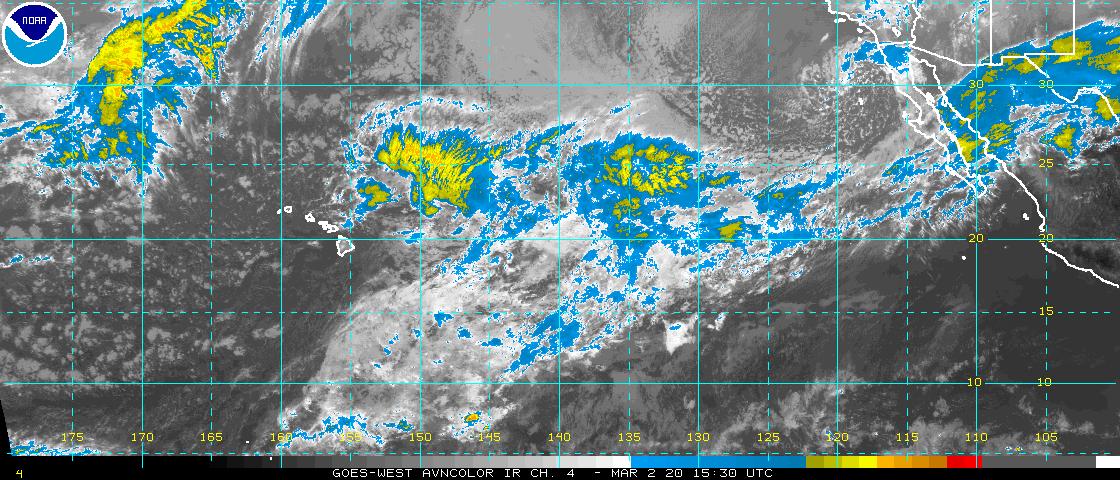
Tropical Cyclone activity in the eastern and central Pacific – Here’s the latest weather information coming out of the National Hurricane Center, covering the eastern north Pacific. You can find the latest tropical cyclone information for the central north Pacific (where Hawaii is located) by clicking on this link to the Central Pacific Hurricane Center. Here’s a tracking map covering both the eastern and central Pacific Ocean. A satellite image, which shows the entire ocean area between Hawaii and the Mexican coast…can be found here.
Aloha Paragraphs

Kayaks ready to go
Gusty trade winds will remain in place Saturday…gradually calming down later this weekend into the Labor Day holiday. High pressure systems to our northeast through north-northwest will provide the push for these locally gusty winds…as shown on this weather map. Our local trade winds will become lighter towards Sunday, going into the new week ahead. Small craft wind advisories remain active across the entire state.
All this trade wind activity will help to carry showers to the windward sides at times…while the leeward sides remain generally dry. Looking a bit further ahead, some of the computer models bring an area of moisture our way late Saturday into Sunday from the east, and then again…around the middle of the new week ahead. Otherwise, favorably inclined weather conditions will hold firm during this late summer period.
After work this evening, I’m be going to the Maui Arts and Cultural Center, for dinner and a film with a friend. This film is called Unmistaken Child…a mysterious, enchanting and compelling film that documents The Dalai Lama’s challenge to a deceased monk’s disciple to search for his reincarnation. Salon.com raved "offers the viewer an intimate look at Tibetan Buddhism in action." The Los Angeles Times added that it provides "a privileged glimpse deep into unfamiliar spiritual territory. It has the strength of revelation." Stunningly shot, this is a beguiling, surprising, touching, even humorous cinematic experience. In English and Tibetan, Nepali and Hindi with English subtitles. I’m looking forward to seeing this film, and will let you know what I think Satuday morning. Here’s a trailer if you’re interested in taking a look.
It’s Friday evening here in Kihei, Maui, as I begin writing this last section of this morning’s narrative update. How many different ways are there to describe yet another lovely end to the day? Friday was a gorgeous late summer day, with ample sunshine to make anyone happy. All the sunshine that we’ve been seeing lately, is definitely warming our surrounding ocean up into the most pleasant state. Saturday should be another great day, with Sunday perhaps becoming somewhat more cloudy…with a possible increase in windward showers. We can check out that prospect more thoroughly later Saturday afternoon, when it should become more clear about the details. I hope you have a great Friday night, and by the way, that recent full moon will be doing its thing in a big way again into early Saturday morning! Aloha for now…Glenn.
Extra: video showing dog and cat love…so sweet!
Interesting: Forecasts of climate change are about to go seriously out of kilter. One of the world’s top climate modelers said Thursday we could be about to enter "one or even two decades during which temperatures cool. "People will say this is global warming disappearing," he told more than 1500 of the world’s top climate scientists gathering in Geneva at the UN’s World Climate Conference.
"I am not one of the sceptics," insisted Mojib Latif of the Leibniz Institute of Marine Sciences at Kiel University, Germany. "However, we have to ask the nasty questions ourselves or other people will do it." Few climate scientists go as far as Latif, an author for the Intergovernmental Panel on Climate Change.
But more and more agree that the short-term prognosis for climate change is much less certain than once thought. This is bad timing. The UN’s World Meteorological Organization called the conference in order to draft a global plan for providing "climate services" to the world: that is, to deliver climate predictions useful to everyone from farmers worried about the next rainy season to doctors trying to predict malaria epidemics and builders of dams, roads and other infrastructure who need to assess the risk of floods and droughts 30 years hence.
But some of the climate scientists gathered in Geneva to discuss how this might be done admitted that, on such timescales, natural variability is at least as important as the long-term climate changes from global warming. "In many ways we know more about what will happen in the 2050s than next year," said Vicky Pope from the UK Met Office.
Latif predicted that in the next few years a natural cooling trend would dominate over warming caused by humans. The cooling would be down to cyclical changes to ocean currents and temperatures in the North Atlantic, a feature known as the North Atlantic Oscillation (NAO).
Breaking with climate-change orthodoxy, he said NAO cycles were probably responsible for some of the strong global warming seen in the past three decades. "But how much? The jury is still out," he told the conference. The NAO is now moving into a colder phase. Latif said NAO cycles also explained the recent recovery of the Sahel region of Africa from the droughts of the 1970s and 1980s.
James Murphy, head of climate prediction at the Met Office, agreed and linked the NAO to Indian monsoons, Atlantic hurricanes and sea ice in the Arctic. "The oceans are key to decadal natural variability," he said. Another favorite climate nostrum was upturned when Pope warned that the dramatic Arctic ice loss in recent summers was partly a product of natural cycles rather than global warming.
Preliminary reports suggest there has been much less melting this year than in 2007 or 2008. In candid mood, climate scientists avoided blaming nature for their faltering predictions, however. "Model biases are also still a serious problem. We have a long way to go to get them right.
They are hurting our forecasts," said Tim Stockdale of the European Centre for Medium-Range Weather Forecasts in Reading, UK. The world may badly want reliable forecasts of future climate. But such predictions are proving as elusive as the perfect weather forecast.
Interesting2: A key number in the struggle to tackle global warming is flawed. The cost of adapting to the effects of climate change is two to three times the figure quoted by the UN climate change convention, a new study claims. The UN has estimated that meeting health needs, adapting farming and infrastructure, and so on will cost $70 to 100 billion a year by 2030.
Now Martin Parry of Imperial College London says this "back of a metro ticket calculation" ignores major sectors, including energy generation and manufacturing, as well as the costs of protecting people from inland flooding and coastal storms, and of maintaining ecosystems. It badly underestimates other areas, too.
"If you read the small print, the health figure covers the cost of preventing increases in just three diseases – malaria, diarrhea and malnutrition," says Parry. "The real figure will be far higher." Parry fears that the UN figure could be damaging if it is used when politicians meet in December to agree on future emissions targets. They might conclude it is cheaper to adapt to climate change than to prevent it, he says.
Interesting3: In a classic case of a perverse incentive, California state law actually encourages homeowners to build in brushy canyons prone to massive wildfires like the "Station fire", which burned over 350,000 hectares and destroyed dozens of homes near Los Angeles this month. In 1968, the state legislature mandated that every property owner must be able to buy affordable fire insurance, no matter how risky their location.
An industry-sponsored syndicate, the California Fair Plan, serves as insurer of last resort for those deemed too high-risk for conventional fire insurance. Some 17,400 owners of brushland property now obtain insurance through this route, says Mike Harris, a spokesman for the plan.
That may be a bad idea, because coastal brushland, or chaparral, is naturally prone to infrequent but very intense fires. Unlike in forest, where planned fires can clear out dead wood and keep wildfires small, fire managers can do little to prevent massive fires in chaparral.
Homeowners can take some steps to reduce their risk, such as replacing wood shingles with non-flammable material – but anyone living in chaparral must expect to be burned out eventually. "We’ve been deluding ourselves to think we can stop these fires.
They’re going to burn no matter what," says Jon Keeley, an ecologist with the US Geological Survey in Three Rivers, California. The best solution in the long term, fire experts agree, is to avoid building in the riskiest areas – a solution made harder by the state’s insistence on insuring such properties.
Interesting4: Dam projects by neighboring states are drastically reducing the flow of the Tigris and Euphrates and helping to turn a once-fertile plain into desert. Phil Sands and Nizar Latif report as an environmental crisis deepens. As bombs continue to tear apart its towns and villages, Iraq is now in the grip of an environmental crisis that experts and officials warn may do what decades of war have not been able to — destroy the country.
The new war on Iraq, says one member of the country’s parliament, "is a war of water". The Tigris and Euphrates, two of the world’s great water courses fed life to the historic lands of Mesopotamia, "the land between two rivers".
The previously lush plains south of Baghdad are widely held to be the cradle of civilization, the birthplace of some of humanity’s greatest achievements and earliest empires.
Today, however, those same rivers are increasingly starved of water. The floodplains on either side of the Euphrates and Tigris, Iraq’s old fertile agricultural heart lands, are parched. In northern Iraq, underground supplies of water have been so depleted they may never recover.
 Email Glenn James: