September 3-4, 2009
Air Temperatures – The following maximum temperatures were recorded across the state of Hawaii Thursday afternoon:
Lihue, Kauai – 83
Honolulu, Oahu – 89
Kaneohe, Oahu – 85
Kahului, Maui – 87
Hilo, Hawaii – 80
Kailua-kona – 87
Air Temperatures ranged between these warmest and coolest spots near sea level – and on the highest mountains…at 5 p.m. Thursday evening:
Kailua-kona – 90F
Hilo, Hawaii – 72
Haleakala Crater – 46 (near 10,000 feet on Maui)
Mauna Kea summit – 32 (near 14,000 feet on the Big Island)
Precipitation Totals – The following numbers represent the largest precipitation totals (inches) during the last 24 hours on each of the major islands, as of Thursday afternoon:
0.22 Mount Waialaele, Kauai
0.42 South Fork Kaukonahua, Oahu
0.09 Molokai
0.00 Lanai
0.00 Kahoolawe
0.73 Puu Kukui, Maui
0.48 Hilo airport, Big Island
Marine Winds – Here’s the latest (automatically updated) weather map showing high pressure systems to the north-northwest and northeast of the islands. Trade winds will be active through Saturday…locally strong and gusty.
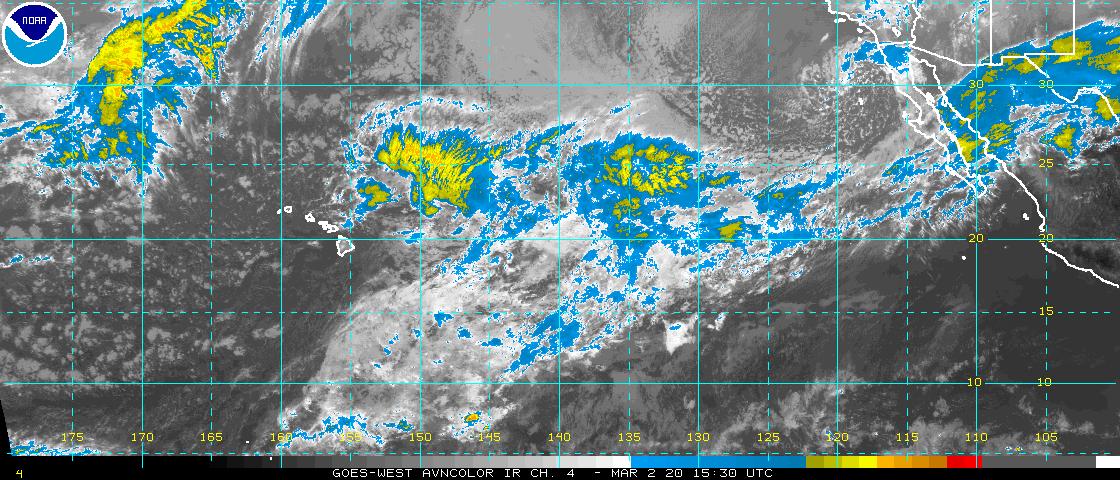
Satellite and Radar Images: To view the cloud conditions we have here in Hawaii, please use the following satellite links, starting off with this Infrared Satellite Image of the islands to see all the clouds around the state during the day and night. This next image is one that gives close images of the islands only during the daytime hours, and is referred to as a Close-up visible image. This next image shows a larger view of the Pacific…giving perspective to the wider ranging cloud patterns in the Pacific Ocean. Finally, here’s a Looping IR satellite image, making viewable the clouds around the islands 24 hours a day. To help you keep track of where any showers may be around the islands, here’s the latest animated radar image.
Hawaii’s Mountains – Here’s a link to the live webcam on the summit of near 14,000 foot Mauna Kea on the Big Island of Hawaii. The tallest peak on the island of Maui is the Haleakala Crater, which is near 10,000 feet in elevation. These two webcams are available during the daylight hours here in the islands…and when there’s a big moon rising just after sunset for an hour or two! Plus, during the nights and early mornings you will be able to see stars, and the sunrise too…depending upon weather conditions.
Tropical Cyclone activity in the eastern and central Pacific – Here’s the latest weather information coming out of the National Hurricane Center, covering the eastern north Pacific. You can find the latest tropical cyclone information for the central north Pacific (where Hawaii is located) by clicking on this link to the Central Pacific Hurricane Center. Here’s a tracking map covering both the eastern and central Pacific Ocean. A satellite image, which shows the entire ocean area between Hawaii and the Mexican coast…can be found here.
Aloha Paragraphs

Gusty trade winds…and full moon
The trade winds will remain locally strong and gusty through Saturday, then calming down some thereafter into next week. High pressure systems to our northeast through northwest have moved somewhat closer to our islands Thursday…thus the stronger winds. Our local trade winds will likely lose a little steam on Sunday, going into the Labor Day holiday early next week. Small craft wind advisories have been expanded across all the major channels between the Big island and Kauai…including those windiest coastal waters too.
There continues to be some passing shower activity along the windward sides Thursday night…likely backing off some later Friday into the weekend. There will likely be just the usual amount of incoming shower activity, carried our way on the fresh trade winds. The cold air aloft associated with an upper trough of low pressure, may prompt a few localized heavy showers, especially on the Big Island…perhaps on Maui too. The leeward sides will remain generally dry, and continue to have pleasant weather conditions well into the future. There are no organized areas of showers in our area of the central Pacific now, so that these fairly nice early September weather circumstances will prevail.
It’s Thursday evening here in Kihei, Maui, as I begin writing this last section of today’s narrative update. Thursday was a nice day, although there were a few locally heavy showers falling along the Big Island’s windward coasts and slopes. Case in point, heavy rain was being reported at the Hilo airport at 5pm Thursday evening. Showers were less frequent, and less intense elsewhere along the windward sides of the other islands. The trade winds were blowing briskly in those exposed areas, with the strongest gust as of 5pm being reported at Maalaea Bay here on Maui…where a strong 42 mph gust was blowing.
~~~ Looking out the window before I take the drive upcountry to Kula, it was mostly sunny, with lots of clear blue skies. As the sun goes down, that September full moon will rise, flooding the islands with reflected light from the sun during the night…into Friday morning. This would be a perfect night for some after dark hiking around, or just taking a nice walk along one of our great sandy beaches! I’ll be back here again with your next new weather narrative from paradise, early Friday morning. I hope you have a great Thursday night until then! Aloha for now…Glenn.
Extra: video showing dog and cat love…so sweet!
Interesting: California Governor Arnold Schwarzenegger has demanded that President Barack Obama’s cabinet rethink federal policy that would divert water from parched farms and cities to threatened fish, his administration said on Wednesday. California’s rivers used to brim with salmon and sturgeon, but a massive system of canals diverted water that fed farms and cities, now suffering through a third year of drought.
Schwarzenegger has gained credibility as an environmentalist for his push to curb greenhouse gases but he argued that federal plans to save fish will worsen a water crisis that has cost farmers more than $700 million and caused mandatory rationing in cities of the most populous state.
Interesting2: This month the Senate is set to take up the climate and energy bill that Congress began work on last spring. One provision will likely set up a system to pay farmers for something called "no-till farming." The concept: When crops are planted without tilling, the soil holds more carbon, which means less goes up into the atmosphere. But scientists aren’t sure no-till really sequesters carbon any better than conventional farming.
Soil scientist Michel Cavigelli of the U.S. Department of Agriculture agrees that no-till fields, like the one he studies in rural Maryland, can hold more carbon than plowed fields. But that is only at the surface. Researchers have discovered that when you dig down three feet or so, plowed fields hold just as much — if not more — carbon than no-till.
Interesting3: Risky and unproven climate-changing technologies could have "catastrophic consequences" for the earth and humankind if used irresponsibly, according to a new report. Yet without drastic further cuts in carbon dioxide emissions, a geo-engineering solution may offer the only hope of saving the world from disastrous run-away global warming, experts warned.
A report by the Royal Society, Britain’s leading academic institution, looks at the feasibility and potential dangers of technologies designed to cool the earth. They include artificial "trees" that suck carbon dioxide out of the air, and spraying sulphate particles high in the atmosphere to scatter the sun’s rays into space. The scientists concluded that, although some approaches were possible, they had not yet been properly researched and posed serious potential dangers for the planet.
Professor John Shepherd, who chaired the Royal Society geo-engineering working group, said: "It is an unpalatable truth that unless we can succeed in greatly reducing carbon dioxide emissions we are heading for a very uncomfortable and challenging climate future, and geo-engineering will be the only option left to limit further temperature increases."
"Our research found that some geo-engineering techniques could have serious unintended and detrimental effects on many people and ecosystems — yet we are still failing to take the only action that will prevent us from having to rely on them."
Interesting4: In the wake of a massive oil spill from the tanker Prestige, poisoned seagulls displayed smaller red spots on their beaks than healthy birds, according to a new study. The finding could open the way for the birds, fish and lizards to be used as signposts for a host of environmental ills. The dark story of the Prestige began in November 2002, when the ship tore in half off the coast of northwestern Spain, spilling some 63,000 tons of oil into the Atlantic Ocean.
The Spanish and French coasts were mired in a thick muck of heavy fuel oil. Thousands of sea birds perished, and local fishing fleets were grounded for months. Today the cleanup crews are long gone, but scientists are still tallying the environmental damage.
Interesting5: More computers discarded by consumers in the United States are getting a second life in developing countries than previously believed, according to a new study –– the most comprehensive ever done on the topic –– reported in ACS’ semi-monthly journal Environmental Science & Technology. The findings may ease growing concerns about environmental pollution with toxic metals that can result from dismantling and recycling computer components in developing countries.
In the study Ramzy Kahhat and Eric Williams focused on the situation in Peru, where Kahhat was born. They used a Peruvian government database that tracks importation of new and used computers and computing equipment. The researchers found that at least 85 percent of computers imported into Peru are reused, rather than going directly into recycling.
The finding challenges the widespread belief that the trade in e-waste was mainly about dumping unusable junk or recycling components is inaccurate, at least for Peru. The U.S. is the source of up to 76 percent of used computers imported to Peru from 2003-2007, the researchers indicated. They note uncertainty on whether the same holds true for other, much larger countries like China and India.
 Email Glenn James: