August 29-30, 2009
Air Temperatures – The following maximum temperatures were recorded across the state of Hawaii Saturday afternoon:
Lihue, Kauai – 83
Honolulu, Oahu – 90
Kaneohe, Oahu – 84
Kahului, Maui – 87
Hilo, Hawaii – 79
Kailua-kona – 89
Air Temperatures ranged between these warmest and coolest spots near sea level – and on the highest mountains…at 5 p.m. Saturday evening:
Kailua-kona – 86F
Hilo, Hawaii – 76
Haleakala Crater – 55 (near 10,000 feet on Maui)
Mauna Kea summit – 52 (near 14,000 feet on the Big Island)
Precipitation Totals – The following numbers represent the largest precipitation totals (inches) during the last 24 hours on each of the major islands, as of Saturday afternoon:
0.21 Lihue, Kauai
0.75 Oahu Forest NWR, Oahu
0.00 Molokai
0.00 Lanai
0.00 Kahoolawe
0.25 West Wailuaiki, Maui
0.86 Mountain View, Big Island
Marine Winds – Here’s the latest (automatically updated) weather map showing high pressure systems far to the northeast through northwest of the islands. Trade winds will be active through Monday.
Satellite and Radar Images: To view the cloud conditions we have here in Hawaii, please use the following satellite links, starting off with this Infrared Satellite Image of the islands to see all the clouds around the state during the day and night. This next image is one that gives close images of the islands only during the daytime hours, and is referred to as a Close-up visible image. This next image shows a larger view of the Pacific…giving perspective to the wider ranging cloud patterns in the Pacific Ocean. Finally, here’s a Looping IR satellite image, making viewable the clouds around the islands 24 hours a day. To help you keep track of where any showers may be around the islands, here’s the latest animated radar image.
Hawaii’s Mountains – Here’s a link to the live webcam on the summit of near 14,000 foot Mauna Kea on the Big Island of Hawaii. The tallest peak on the island of Maui is the Haleakala Crater, which is near 10,000 feet in elevation. These two webcams are available during the daylight hours here in the islands…and when there’s a big moon rising just after sunset for an hour or two! Plus, during the nights and early mornings you will be able to see stars, and the sunrise too…depending upon weather conditions.
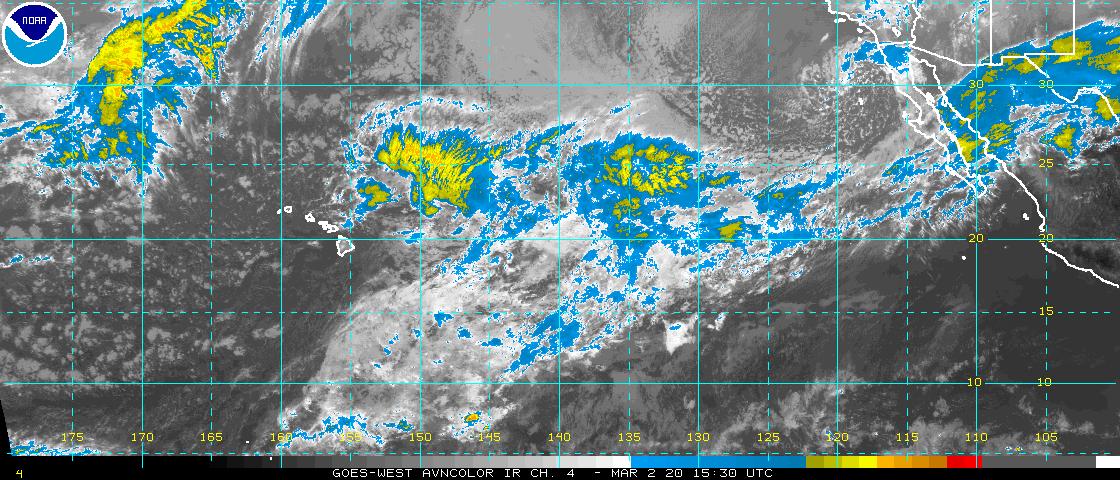
Tropical Cyclone activity in the eastern and central Pacific – Here’s the latest weather information coming out of the National Hurricane Center, covering the eastern north Pacific. You can find the latest tropical cyclone information for the central north Pacific (where Hawaii is located) by clicking on this link to the Central Pacific Hurricane Center. Here’s a tracking map covering both the eastern and central Pacific Ocean. A satellite image, which shows the entire ocean area between Hawaii and the Mexican coast…can be found here.
Aloha Paragraphs

Under the Hawaiian Moon
Trade wind weather will continue, with our winds blowing generally in the light to moderately strong realms…continuing well into the new week ahead. There continues to be no end in sight for these warm winds, continuing right on into the first part of September. The trade winds are strong enough only in the Alenuihaha Channel between Maui and the Big Island, and in certain coastal areas around the Big Island…to warrant small craft wind advisories.
Showers will be at a minimum for the most part, with just a few falling along the windward sides…with dry conditions expected along most of our leeward beaches. The local shower activity will be at a minimum for the most part. Looking a bit further ahead, the models point out an increase in showers towards the middle of the new week…focused most intently around the Big Island.
The warm tropical waters of the world remain active this weekend. We have tropical storm Krovanh in the western Pacific; tropical depression 2C here in the central Pacific; hurricane Jimena in the eastern Pacific, along with newly formed tropical storm Kevin. Just for the record, none of these threaten our Hawaiian Islands whatsoever. As mentioned, and coming back to our local weather…it will remain near perfect right through the weekend!
Friday evening after work I went to see the new film called Inglourious Basterds (2009)…starring Brad Pitt among others. This is Quentin Tarantino’s new violent WWII tale of soldiers, peasants and resistance fighters who collide in Nazi-occupied France. The critics are raving about this film, giving it anywhere from a B+ to an A-, although it is violent to say the least. Therefore, I’m not going to be providing a link to the trailer, as I’m sure it would offend many of you. I must admit, I was a bit anxious about seeing the film, but as it turned out, I enjoyed it very much. There’s no doubt about it, this film is gruesome, but I found it didn’t end up offending my sensibilities as much as I feared. I can’t say that I would recommend it, at least to probably 80% of you readers, although there are those 20% of you that would likely find it entertaining.
It’s Saturday evening here in Kula, Maui, as I begin writing this last paragraph of this morning’s narrative update. Saturday was another fabulous day! The local beaches basked in abundant sunshine in most areas. The trade winds blew enough, so that it kept us feeling relatively cool and comfortable. At 6pm Sunday evening here in Kula, at the 3,100 foot elevation, it was a warm 71.6F degrees. The breeze is light, but just active enough to keep my wind chimes singing sweetly. I anticipate that Sunday will be just as nice, as will Monday and Tuesday. This is the time of year when our Hawaiian weather is often very near perfect. I’ll be back Sunday morning with your next new weather narrative. I hope you have a great Saturday night until then! Aloha for now…Glenn.
Extra: Hula dancing and chant
Interesting: A comprehensive new study of irrigation in Asia warns that, without major reforms and innovations in the way water is used for agriculture, many developing nations face the politically risky prospect of having to import more than a quarter of the rice, wheat and maize they will need by 2050. This warning, along with related forecasts and possible solutions, appear in a report entitled, "Revitalizing Asia’s Irrigation: To Sustainably Meet Tomorrow’s Food Needs", which was presented August 17 at 2009 World Water Week in Stockholm by the International Water Management Institute (IWMI).
IWMI, FAO and partner researchers obtained the findings using a computer model called WATERSIM, which helps examine difficult tradeoffs between food security and the environment, specifically in relation to water supplies. The study was carried out by IWMI and the United Nations Food and Agriculture Organization (FAO) along with researchers from partner organizations with funding from the Asian Development Bank (ADB).
It outlines three options for meeting the food needs of Asia’s population, which will expand by one and a half billion people over the next 40 years. The first is to import large quantities of cereals from other regions; the second to improve and expand rainfed agriculture; and the third to focus on irrigated farmlands.
"In the wake of a major global food crisis in 2007 and 2008, cereal prices are expected to be higher and more volatile in the coming years," said Colin Chartres, director general of IWMI, whose research is supported by the Consultative Group on International Agricultural Research (CGIAR).
"Asia’s food and feed demand is expected to double by 2050. Relying on trade to meet a large part of this demand will impose a huge and politically untenable burden on the economies of many developing countries. The best bet for Asia lies in revitalizing its vast irrigation systems, which account for 70 percent of the world’s total irrigated land."
Interesting2: Scientists have just completed an unprecedented journey into the vast and little-explored "Great Pacific Ocean Garbage Patch." On the Scripps Environmental Accumulation of Plastic Expedition (SEAPLEX), researchers got the first detailed view of plastic debris floating in a remote ocean region. It wasn’t a pretty sight.
The Scripps research vessel (R/V) New Horizon left its San Diego homeport on August 2, 2009, for the North Pacific Ocean Gyre, located some 1,000 miles off California’s coast, and returned on August 21, 2009. Scientists surveyed plastic distribution and abundance, taking samples for analysis in the lab and assessing the impacts of debris on marine life.
Before this research, little was known about the size of the "garbage patch" and the threats it poses to marine life and the gyre’s biological environment. The expedition was led by a team of Scripps Institution of Oceanography (SIO) graduate students, with support from University of California Ship Funds, the National Science Foundation (NSF) and Project Kaisei.
"SEAPLEX was an important education experience for the graduate students, and contributed to a better understanding of an important problem in the oceans," said Linda Goad, program director in NSF’s Division of Ocean Sciences. "We hope that SEAPLEX will result in increased awareness of a growing issue." After transiting for six days aboard the research vessel, the researchers reached their first intensive sampling site on August 9th.
Team members began 24-hour sampling periods using a variety of tow nets to collect debris at several ocean depths. "We targeted the highest plastic-containing areas so we could begin to understand the scope of the problem," said Miriam Goldstein of SIO, chief scientist of the expedition.
"We also studied everything from phytoplankton to zooplankton to small mid-water fish." The scientists found that at numerous areas in the gyre, flecks of plastic were abundant and easily spotted against the deep blue seawater. Among the assortment of items retrieved were plastic bottles with a variety of biological inhabitants.
The scientists also collected jellyfish called by-the-wind sailors (Velella velella). On August 11th, the researchers encountered a large net entwined with plastic and various marine organisms; they also recovered several plastic bottles covered with ocean animals, including large barnacles.
Interesting3: An international team of scientists has found that the polyphenol content of fruits has been underestimated. Polyphenol content in fruits usually refers to extractable polyphenols, but a Spanish scientist working at the Institute of Food Research in Norwich analyzed apple, peach and nectarine. She found that non-extractable polyphenol content is up to five times higher than extractable compounds. This work has been published in the Journal of Agricultural and Food Chemistry.
“These polyphenols need to be treated with acid to extract them from the cell walls of fruit in the lab,” said Sara Arranz from the Spanish Council for Scientific Research (CSIC) in Madrid. “If non-extractable polyphenols are not considered, the levels of beneficial polyphenols such as proanthocyanidins, ellagic acid and catechin are substantially underestimated.”
Dr Paul Kroon from IFR explains: “In the human body these compounds will be fermented by bacteria in the colon, creating metabolites that may be beneficial, for example with antioxidant activity.” The Spanish research group, led by Professor Fulgencio Saura-Calixto, has been working to show that non-extractable polyphenols, which mostly escape analysis and are not usually considered in nutritional studies, are a major part of bioactive compounds in the diet.
“These polyphenols are major constituents of the human diet with important health properties. To consider them in nutritional and epidemiological research may be useful for a better understanding of the effects of plant foods in health,” says Professor Saura-Calixto.
Interesting4: Yields of three of the most important crops produced in the United States – corn, soybeans and cotton – are predicted to fall off a cliff if temperatures rise due to climate change. In a paper recently published online in Proceedings of the National Academy of Sciences, North Carolina State University agricultural and resource economist Dr. Michael Roberts and Dr. Wolfram Schlenker, an assistant professor of economics at Columbia University, predict that U.S. crop yields could decrease by 30 to 46 percent over the next century under slow global warming scenarios, and by a devastating 63 to 82 percent under the most rapid global warming scenarios.
The warming scenarios used in the study – called Hadley III models – were devised by the United Kingdom’s weather service. The study shows that crop yields tick up gradually between roughly 50 to 86 degrees Farenheit. But when temperature levels go over 84.2 degrees Farenheit for corn, 86 degrees Farenheit for soybeans and 89.6 degrees Farenheit for cotton, yields fall steeply. “While crop yields depend on a variety of factors, extreme heat is the best predictor of yields,” Roberts says.
“There hasn’t been much research on what happens to crop yields over certain temperature thresholds, but this study shows that temperature extremes are not good.” Roberts adds that while the study examined only U.S. crop yields under warming scenarios, the crop commodity market’s global reach makes the implications important for the entire world, as the United States produces 41 percent of the world’s corn and 38 percent of the world’s soybeans. “Effects of climate change on U.S. crop production will surely be felt around the globe, especially in developing countries,” he says.
Interesting5: Small changes in the energy output of the sun can have a major impact on global weather patterns, such as the intensity of the Indian monsoon, which could be predicted years in advance, a team of scientists said. The sun swings through an 11-year cycle measured in the number of sun spots on the surface that emit bursts of energy.
The difference in energy is only about 0.1 percent between a solar maximum and minimum and determining just how that small variation affects the world’s climate has been one of the great challenges facing meteorologists. Using a century of weather observations and complex computer models, the international team of scientists led by the National Center for Atmospheric Research (NCAR) in the United States showed that even a small increase in the sun’s energy can intensify wind and rainfall patterns.
"Small changes in the sun’s output over the 11-year solar cycle have long been known to have impacts on the global climate system," said Julie Arblaster, from the Center for Australian Weather and Climate Research, a co-author of the study published in the latest issue of the journal Science.
"Here we reconcile for the first time the mechanisms by which these small variations get amplified, resulting in cooler sea surface temperatures in the tropical Pacific and enhancing off-equatorial rainfall."
The researchers found that during periods of strong solar activity the air in the upper atmosphere, in a layer called the stratosphere, heats up. This occurs over the tropics, where sunlight is typically most intense. The extra warming alters wind patterns in the upper atmosphere, which in turn increases tropical rainfall.
 Email Glenn James: