August 26-27, 2009
Air Temperatures – The following maximum temperatures were recorded across the state of Hawaii Wednesday afternoon:
Lihue, Kauai – 82
Honolulu, Oahu – 88
Kaneohe, Oahu – 84
Kahului, Maui – 87
Hilo, Hawaii – 82
Kailua-kona – 87
Air Temperatures ranged between these warmest and coolest spots near sea level – and on the highest mountains…at 5 p.m. Wednesday evening:
Barking Sands, Kauai – 85F
Molokai airport – 78
Haleakala Crater – 63 (near 10,000 feet on Maui)
Mauna Kea summit – 63 (near 14,000 feet on the Big Island)
Precipitation Totals – The following numbers represent the largest precipitation totals (inches) during the last 24 hours on each of the major islands, as of Wednesday afternoon:
0.40 Mount Waialaele, Kauai
0.03 Poamoho, Oahu
0.01 Molokai
0.00 Lanai
0.00 Kahoolawe
0.16 West Wailuaiki, Maui
0.20 Kamuela upper, Big Island
Marine Winds – Here’s the latest (automatically updated) weather map showing high pressure systems far to the northeast through northwest of the islands. Trade winds will be active through Friday into the weekend and beyond.
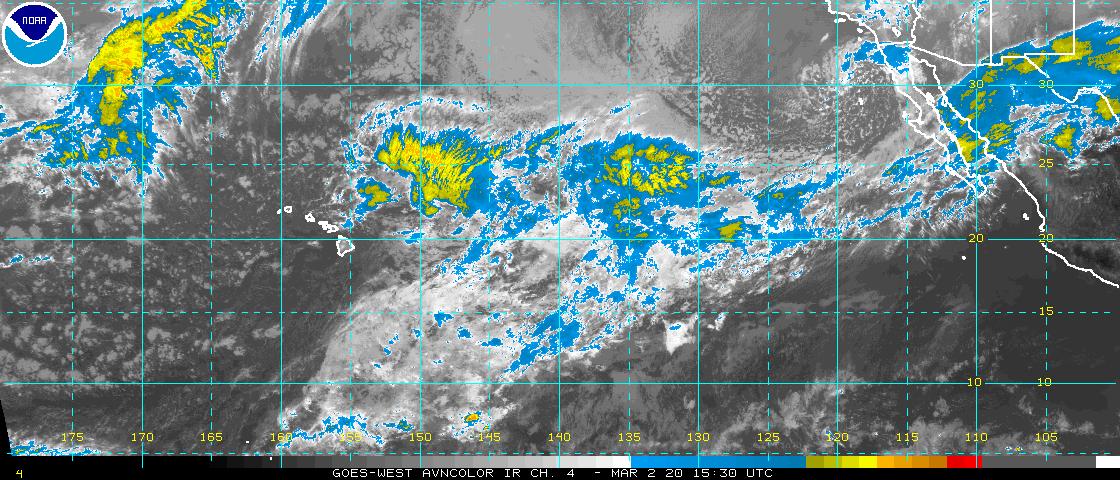
Satellite and Radar Images: To view the cloud conditions we have here in Hawaii, please use the following satellite links, starting off with this Infrared Satellite Image of the islands to see all the clouds around the state during the day and night. This next image is one that gives close images of the islands only during the daytime hours, and is referred to as a Close-up visible image. This next image shows a larger view of the Pacific…giving perspective to the wider ranging cloud patterns in the Pacific Ocean. Finally, here’s a Looping IR satellite image, making viewable the clouds around the islands 24 hours a day. To help you keep track of where any showers may be around the islands, here’s the latest animated radar image.
Hawaii’s Mountains – Here’s a link to the live webcam on the summit of near 14,000 foot Mauna Kea on the Big Island of Hawaii. The tallest peak on the island of Maui is the Haleakala Crater, which is near 10,000 feet in elevation. These two webcams are available during the daylight hours here in the islands…and when there’s a big moon rising just after sunset for an hour or two! Plus, during the nights and early mornings you will be able to see stars, and the sunrise too…depending upon weather conditions.
Tropical Cyclone activity in the eastern and central Pacific – Here’s the latest weather information coming out of the National Hurricane Center, covering the eastern north Pacific. You can find the latest tropical cyclone information for the central north Pacific (where Hawaii is located) by clicking on this link to the Central Pacific Hurricane Center. Here’s a tracking map covering both the eastern and central Pacific Ocean. A satellite image, which shows the entire ocean area between Hawaii and the Mexican coast…can be found here.
Aloha Paragraphs

Tropical depression Hilda south-southeast of Hilo
The local trade winds in the Hawaiian Islands will remain more or less moderately strong through the rest of the week…into next week. The winds have dropped just enough Wednesday evening, so that the small craft wind advisory has been dropped around Maui and the Big Island.
Showers brought in by the trade winds, will be limited through the rest of the week…confined to the windward sides exclusively. The leeward sides will be dry through this period, with perhaps a random afternoon shower along the leeward slopes of the Big Island. The chance for a few showers in the wake of quickly dissipating tropical depression Hilda…is fading fast.
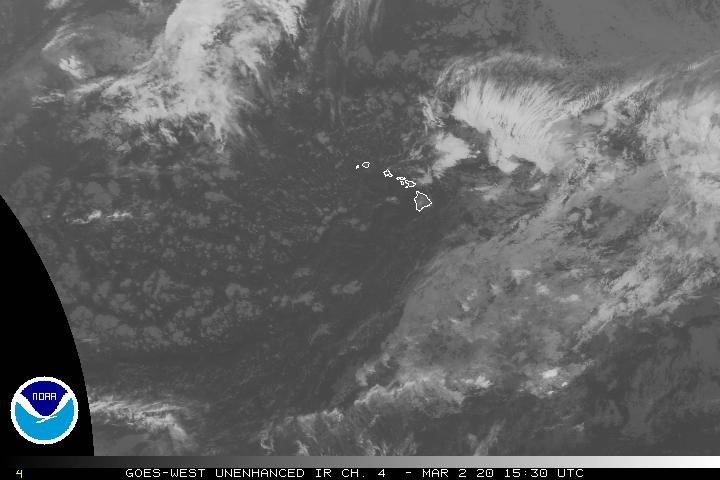
Tropical depression Hilda remains active to the south-southeast of the Hawaiian Islands Wednesday evening. Hilda will be retiring soon, as it becomes a remnant low on Thursday. Here’s an IR satellite image of Hilda…in relation to the Hawaiian Islands. There will essentially be no direct influence whatsoever on our weather here in the islands…from Hilda.
It’s Wednesday evening here in Kihei, Maui, as I begin writing this last section of today’s narrative update. Our great summertime weather conditions will stretch out through the rest of this week…into next week. August is often a really nice month, unless a tropical cyclone moves into close proximity…which isn’t happening now. The trade winds will continue to blow, and other than just a few scattered windward biased showers…our weather will be near perfect! The one rather interesting thing will be an out of season north and northwest swell, which will arrive Friday and then on Sunday. This will cause larger than normal surf conditions on our north through northwest beaches for several days.
~~~ As I look out the window of my office here in Kihei, just before leaving for the drive back upcountry to Kula, I see clear to partly cloudy skies for the most part. The trade winds are still blowing, with the strongest gust at 5pm noted at Maalaea Bay here on Maui…where there was a 35 mph gust. I’ll back back early Thursday morning with your next new weather narrative. I hope you have a great Wednesday night until then! Aloha for now…Glenn.
Interesting: A new study shows just what it takes to convince a person that he isn’t qualified to achieve the career of his dreams. Researchers found that it’s not enough to tell people they don’t have the skills or the grades to make their goal a reality. People will cling to their dreams until they’re clearly shown not only why they’re not qualified, but also what bad things can happen if they pursue their goals and fail.
“Most people don’t give up easily on the dreams. They have to be given a graphic picture of what failure will look like if they don’t make it,” said Patrick Carroll, co-author of the study and assistant professor of psychology at Ohio State University at Lima.
The findings are especially relevant now as students prepare for an uncertain job market and they, along with their teachers and guidance counselors, try to find the best career choices for them. “Educators are trying to lead students to the most realistic career options,” Carroll said.
“You want to encourage students to pursue their dreams, but you don’t want to give them false hope about their abilities and talents. It’s a fine line. “This research is important to understanding how students make revisions in their career goals and decide which career possibilities should be abandoned as unrealistic given their current qualifications. They can then zero in on more realistic possible selves that they actually are qualified to achieve,” he said.
Interesting2: London Mayor Boris Johnson has announced plans to create Britain’s first "hydrogen highway" by building a network of hydrogen filling stations throughout the capital. As part of the scheme, a pilot fleet of around 150 hydrogen cars, five buses and 20 black taxis will be assembled in the run-up to the 2012 London Olympics.
The flamboyant mayor has gone on record as saying that he wants Britain to become a world leader in fuel cell technology and his team have made the ambitious claim that, within twenty years, up to one in three of the 31 million cars in Britain could be fueled by hydrogen.
Interesting3: Two banana diseases spreading in Africa could hurt food supply for 30 million people on the continent who largely rely on the crop, an international agricultural research body said on Wednesday. The Consultative Group on International Agricultural Research (CGIAR) said the banana bunchy top viral disease has infected 45,000 hectares of bananas in Malawi alone and a survey done last year found it in 11 other countries.
"We found the disease to be well-established in Gabon, DRC (Democratic Republic of Congo), Northern Angola and central Malawi," CGIAR quoted Lava Kumar, a researcher at the International Institute of Tropical Agriculture and the survey’s leader, saying in a statement.
Interesting4: After a big earthquake, it’s key to keep the water system afloat. Water is necessary for life, and it fights the fires that often accompany such disasters. UC Irvine engineers plan to outfit the local water system with sensors that will alert officials when and where pipes crack or break, hastening repair – thanks to nearly $5.7 million over three years from the National Institute of Standards and Technology and several local water groups.
"When an earthquake occurs and infrastructure systems fail, continued service of the water network is most critical," said Masanobu Shinozuka, lead project investigator and civil & environmental engineering chair. "Before anything happens, I’d like to have a pipe monitoring system in place to let us know when and where damage occurs. It could minimize misery and save lives."
About 240,000 water-main breaks occur per year in the U.S., according to the Environmental Protection Agency. For example, in December a burst sent about 150,000 gallons of water per minute onto a busy Maryland road, stranding motorists in the icy deluge. Water system failures are estimated to waste up to 6 billion gallons of drinking water every day.
Shinozuka and Pai Chou, electrical engineering & computer science associate professor, have created CD-sized sensing devices that attach to the surface of pressurized (drinking water) and nonpressurized (wastewater) pipes. They will detect vibration and sound changes that could indicate pipe problems. Through antennae, the sensors will relay information wirelessly over long distances to a central location for recording, processing and diagnostic analysis.
Initially, the sensor network will cover about one square mile of the local water system; eventually, it could encompass more than 10 square miles – the largest of its kind to date. A small-scale pressurized water pipe network designed and built by UCI researchers has confirmed that this type of damage identification works well.
Interesting5: A widely used pesticide known to impact wildlife development and, potentially, human health has contaminated watersheds and drinking water throughout much of the United States, according to a new report released today by the Natural Resources Defense Council (NRDC). Banned by the European Union, atrazine is the most commonly detected pesticide in U.S. waters and is a known endocrine disruptor, which means that it affects human and animal hormones.
It has been tied to poor sperm quality in humans and hermaphroditic amphibians. "Evidence shows Atrazine contamination to be a widespread and dangerous problem that has not been communicated to the people most at risk," said Jennifer Sass, PhD, NRDC Senior Scientist and an author of the report.
"U.S. EPA is ignoring some very high concentrations of this pesticide in water that people are drinking and using every day. This exposure could have a considerable impact on reproductive health. Scientific research has tied this chemical to some ghastly impacts on wildlife and raises red flags for possible human impacts."
The report reveals that all of the watersheds monitored by EPA and 90% of the drinking water sampled tested positive for atrazine. Contamination was most severe in Illinois, Iowa, Indiana, Missouri, and Nebraska.
An extensive U.S. Geological Survey study found that approximately 75 percent of stream water and about 40 percent of all groundwater samples from agricultural areas contained atrazine, and according to the New York Times, an estimated 33 million Americans have been exposed to atrazine through their drinking water systems.
"The extent of contamination we found in the data was breathtaking and alarming," said Andrew Wetzler, Director of NRDC’s Wildlife Conservation Program and Deputy Director of NRDC’s Midwest Program, as well as one of the report’s authors. "The EPA found atrazine almost everywhere they looked. I think that the public will find this hard to swallow and I hope it will help force the EPA to address the situation more aggressively."
Interesting6: From mid July to early August 2006, a heat wave swept through the southwestern United States. Temperature records were broken at many locations and unusually high humidity levels for this typically arid region led to the deaths of more than 600 people, 25,000 cattle and 70,000 poultry in California alone.
An analysis of this extreme episode carried out by researchers at Scripps Institution of Oceanography, UC San Diego, put this heat wave in the context of six decades of observed heat waves. Their results suggest that such regional extremes are becoming more and more likely as climate change trends continue.
The team, led by climate scientist Alexander Gershunov, examined meteorological conditions that lead to this and other recorded heat waves, when temperatures rose into the hottest one percent of historical summertime daily and nightly temperatures recorded in California and Nevada since 1948.
The scientists found that heat waves in the region often fall into either of two types: the typical "daytime" events characterized by dry daytime heat and rejuvenating nighttime cooling, or the less typical "nighttime" heat waves characterized additionally by high humidity and hot muggy days and nights.
Since the early 1990s, nighttime heat wave events in California, which historically had been less common, have become more prevalent, increasing in both frequency and intensity. The pinnacle of nighttime heat waves occurred in a 17-day episode during July 2006 when a persistent warm pattern was aggravated by unusually humid conditions, associated with warm ocean waters off Baja California, Mexico.
"Water vapor is the main greenhouse gas. During the night in humid environments, air doesn’t cool nearly as much as it does in dry conditions," said Gershunov. "Elevated humidity also causes heat waves to last longer. Hotter nights pre-condition hotter days and the cycle feeds on itself until the winds change.
The weather pattern that traditionally causes heat waves in California is tending to bring with it more humidity, changing the character of heat waves from the dry daytime heat and cool nights typical for this region, to the muggy heat around the clock that locals are simply not accustomed to."
 Email Glenn James: