August 20-21, 2009
Air Temperatures – The following maximum temperatures were recorded across the state of Hawaii Thursday afternoon:
Lihue, Kauai – 81
Honolulu, Oahu – 87
Kaneohe, Oahu – 84
Kahului, Maui – 88
Hilo, Hawaii – 82
Kailua-kona – 85
Air Temperatures ranged between these warmest and coolest spots near sea level – and on the highest mountains…at 5 p.m. Thursday evening:
Kailua-Kona – 86F
Princeville, Kauai – 77
Haleakala Crater – 55 (near 10,000 feet on Maui)
Mauna Kea summit – 55 (near 14,000 feet on the Big Island)
Precipitation Totals – The following numbers represent the largest precipitation totals (inches) during the last 24 hours on each of the major islands, as of Thursday afternoon:
3.92 Mount Waialaele, Kauai
0.74 Poamoho 2, Oahu
0.03 Molokai
0.00 Lanai
0.01 Kahoolawe
0.82 West Wailuaiki, Maui
0.63 Laupahoehoe, Big Island
Marine Winds – Here’s the latest (automatically updated) weather map showing a 1026 millibar high pressure system to the northeast of the islands. Trade winds will be active through Saturday.
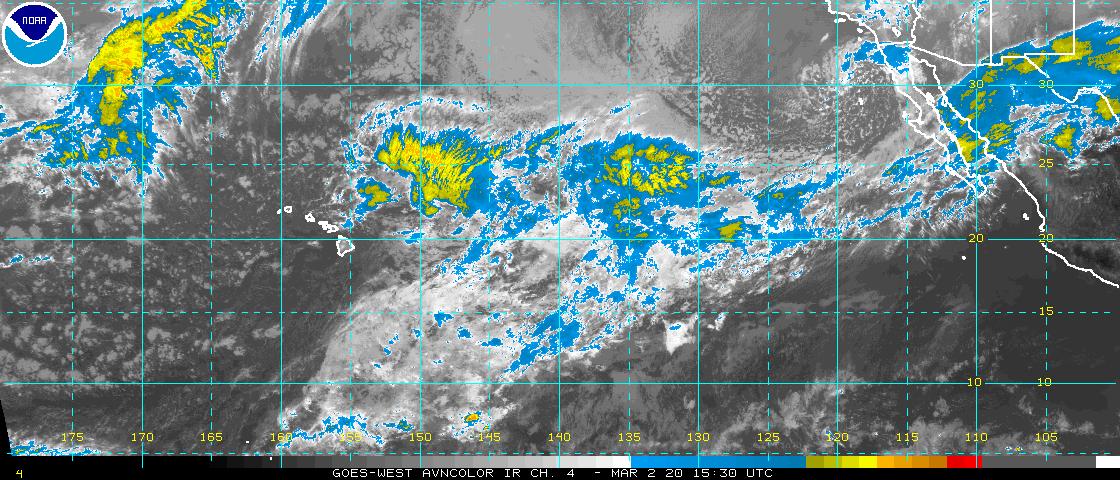
Satellite and Radar Images: To view the cloud conditions we have here in Hawaii, please use the following satellite links, starting off with this Infrared Satellite Image of the islands to see all the clouds around the state during the day and night. This next image is one that gives close images of the islands only during the daytime hours, and is referred to as a Close-up visible image. This next image shows a larger view of the Pacific…giving perspective to the wider ranging cloud patterns in the Pacific Ocean. Finally, here’s a Looping IR satellite image, making viewable the clouds around the islands 24 hours a day. To help you keep track of where any showers may be around the islands, here’s the latest animated radar image.
Hawaii’s Mountains – Here’s a link to the live webcam on the summit of near 14,000 foot Mauna Kea on the Big Island of Hawaii. The tallest peak on the island of Maui is the Haleakala Crater, which is near 10,000 feet in elevation. These two webcams are available during the daylight hours here in the islands…and when there’s a big moon rising just after sunset for an hour or two! Plus, during the nights and early mornings you will be able to see stars, and the sunrise too…depending upon weather conditions.
Tropical Cyclone activity in the eastern and central Pacific – Here’s the latest weather information coming out of the National Hurricane Center, covering the eastern north Pacific. You can find the latest tropical cyclone information for the central north Pacific (where Hawaii is located) by clicking on this link to the Central Pacific Hurricane Center. Here’s a tracking map covering both the eastern and central Pacific Ocean. A satellite image, which shows the entire ocean area between Hawaii and the Mexican coast…can be found here.
Aloha Paragraphs

Nice beach on Oahu
The islands will enjoy pleasant weather conditions, under the influence of the well established trade wind weather pattern…right on into the weekend. The trade winds will be the major weather influence through the next several days. The winds are strong enough now, that we find a small craft wind advisory in those typically gusty areas around Maui County…down to the Big Island. These winds will likely ease up a little later this weekend, into the start of next work.
Our local skies will be clear to partly cloudy, with those localized cloudy periods…along with a few showers too. The lower level cumulus and stratocumulus clouds are being carried generally from east to west by the trade winds. The bias for showers will remain anchored on the windward sides generally. This looping radar image will allow you to see just where those rain drops will be falling. The overlying air mass is still unstable, so that we could see a few localized heavier showers around through Friday. Here’s a satellite image showing those brighter white areas…where locally heavy showers are falling over the ocean, to the north and south of the islands Thursday evening.
It’s Thursday evening here in Kihei, Maui, as I begin writing this last part of today’s narrative. That satellite image, in the paragraph just above, is pretty impressive. At the time of this writing, around 6pm Thursday evening, there’s thunderstorms quite close to the Big Island, and to Kauai too. It wouldn’t take much movement of these areas, to bring some heavy showers to our island chain! In addition, we can see lots of lower level clouds being carried in our direction, by the blustery trade winds as well. Those will fall most frequently along the windward coasts and slopes.
~~~ I’m about ready to head over to Kahului, to see a new film this evening. This will be one of those that you will likely dismiss right away, and probably not waste your time clicking on the trailer either. It’s called District 9 (2009), starring Sharlto Copley and Jason Cope…neither of which I’ve heard of quite honestly. The short synopsis of this film reads, "Alien refugees in South Africa hold the key to a mysterious, powerful secret." For some reason, I believe it was the most watched new film at theatres last weekend. So, because I’m adventuresome, or whatever you might call my desire to see this film, I’ll take a chance and go see it. Here’s a trailer, just in case you’re feeling like taking a quick look at what I’ll be seeing. I’ll let you know what I think of this film early Saturday morning, when I’ll be back online with your next new weather narrative from paradise. I hope you have a great Thursday night! Aloha for now…Glenn.
Extra: Hurricane Bill youtube video from the International Space Station…there is sound with this video.
Interesting: The U.S. Geological Survey released a study that showed mercury contamination in every fish sampled in 291 streams across the country. The work was part of the National Water-Quality Assessment Program (NAWQA) which provides an understanding of water-quality conditions such as whether conditions are getting better or worse over time and how natural features and human activities affect those conditions.
Regional and national assessments are possible because of a consistent study design and uniform methods of data collection and analysis. About a quarter of the fish were found to contain mercury at levels exceeding the criterion for the protection of people who consume average amounts of fish, established by the U.S. Environmental Protection Agency.
More than two-thirds of the fish exceeded the U.S. EPA level of concern for fish-eating mammals. "This study shows just how widespread mercury pollution has become in our air, watersheds, and many of our fish in freshwater streams," said Secretary of the Interior Ken Salazar. "This science sends a clear message that our country must continue to confront pollution, restore our nation’s waterways, and protect the public from potential health dangers."
Some of the highest levels of mercury in fish were found in the tea-colored or "blackwater" streams in North and South Carolina, Georgia, Florida and Louisiana — areas associated with relatively undeveloped forested watersheds containing abundant wetlands compared to the rest of the country. High levels of mercury in fish also were found in relatively undeveloped watersheds in the Northeast and the Upper Midwest.
Elevated levels are noted in areas of the Western United States affected by mining. Mercury, a neurotoxin, is one of the most serious contaminants threatening our nation’s waters. The main source of mercury to natural waters is mercury that is emitted to the atmosphere and deposited onto watersheds by precipitation.
However, atmospheric mercury alone does not explain contamination in fish in our nation’s streams. Naturally occurring watershed features, like wetlands and forests, can enhance the conversion of mercury to the toxic form, methylmercury. Methylmercury is readily taken up by aquatic organisms, resulting in contamination in fish.
An unexpected finding was that the production of methylmercury in channel sediment within the streams themselves appears to be relatively unimportant for controlling methylmercury in stream water. Stream water provides methylmercury to the base of the food chain, and it is the amount of methylmercury in the water that is the primary driver of how much mercury that accumulates in top predator fish.
In general, concentrations in fish increased with increasing concentrations of methylmercury in water. Once in the food web, methylmercury biomagnifies at a fairly consistent rate from algae to invertebrates to fish—even among diverse stream ecosystems. In the ecosystems studied, foodweb characteristics have less impact on the amount of mercury in fish than do methylmercury levels in water.
Interesting2: Kenya has been losing 100 lions a year for the past seven years, leaving the country with just 2000 of its famous big cats, says the Kenya Wildlife Service (KWS) — which concludes the country could have no wild lions at all in 20 years. Conservationists have blamed habitat destruction, disease and conflict with humans for the population collapse.
But Laurence Frank, a wildlife biologist at the University of California, Berkeley, thinks the KWS estimate is optimistic. "Lions are disappearing so fast from Kenya, as well as the rest of Africa, that I think they will disappear [from Kenya] in less than 10 years if action is not taken very quickly," says Frank, who runs several lion conservation projects in the country.
The IUCN suggests that large lion populations of 50 to 100 prides are necessary to conserve genetic diversity and avoid inbreeding. Frank says that the decline of the big cats is due to the inexorable growth in human population and consequent conflict with people over livestock, rather than disease.
Interesting3: Amidst waves and wildlife in the world’s oceans, billions of pounds of polystyrene, water bottles, fishing wire and other plastic products float in endless circles. This bobbing pollution is more than just an eyesore or a choking hazard for birds. According to a new study, plastic in the oceans can decompose in as little as a year, leaching chemical compounds into the water that may harm the health of animals and possibly even people.
"Most people in the world believe that this plastic is indestructible for a very long time," said Katsuhiko Saido, a chemist at Nihon University in Chiba, Japan. He spoke this week at a meeting of the American Chemical Society in Washington, D.C. "We are now concerned that plastic pollution is caused by invisible materials," Saido said through an interpreter. "This will have a great effect on marine life."
Interesting4: Mexico is suffering from its driest year in 68 years, killing crops and cattle in the countryside and forcing the government to slow the flow of water to the crowded capital. Below-average rainfall since last year has left about 80 of Mexico’s 175 largest reservoirs less than half full, said Felipe Arreguin, a senior official at the Conagua commission, which manages the country’s water supply.
"We have zones where the reservoirs are totally full but others that don’t have even a drop of water," he said in an interview late on Tuesday. More than 1,000 cattle have been lost due to lack of rainfall, and up to 20 million tons of crops managed by 3.5 million small farmers are at risk of being lost, agriculture groups say.
 Email Glenn James: