August 18-19, 2009
Air Temperatures – The following maximum temperatures were recorded across the state of Hawaii Tuesday afternoon:
Lihue, Kauai – 82
Honolulu, Oahu – 90
Kaneohe, Oahu – 83
Kahului, Maui – 87
Hilo, Hawaii – 85
Kailua-kona – 87
Air Temperatures ranged between these warmest and coolest spots near sea level – and on the highest mountains…at 5 p.m. Tuesday evening:
Honolulu, Hawaii – 88F
Lihue, Kauai – 80
Haleakala Crater – 50 (near 10,000 feet on Maui)
Mauna Kea summit – 45 (near 14,000 feet on the Big Island)
Precipitation Totals – The following numbers represent the largest precipitation totals (inches) during the last 24 hours on each of the major islands, as of Tuesday afternoon:
1.79 Opaekaa Stream, Kauai
0.35 Oahu Forest NWR, Oahu
0.00 Molokai
0.00 Lanai
0.00 Kahoolawe
0.70 Kaupo Gap, Maui
0.45 Pali 2, Big Island
Marine Winds – Here’s the latest (automatically updated) weather map showing a 1030 millibar high pressure system far to the northeast of the islands. As Guillermo passes between us and our trade wind producing high…our winds will light into Wednesday.
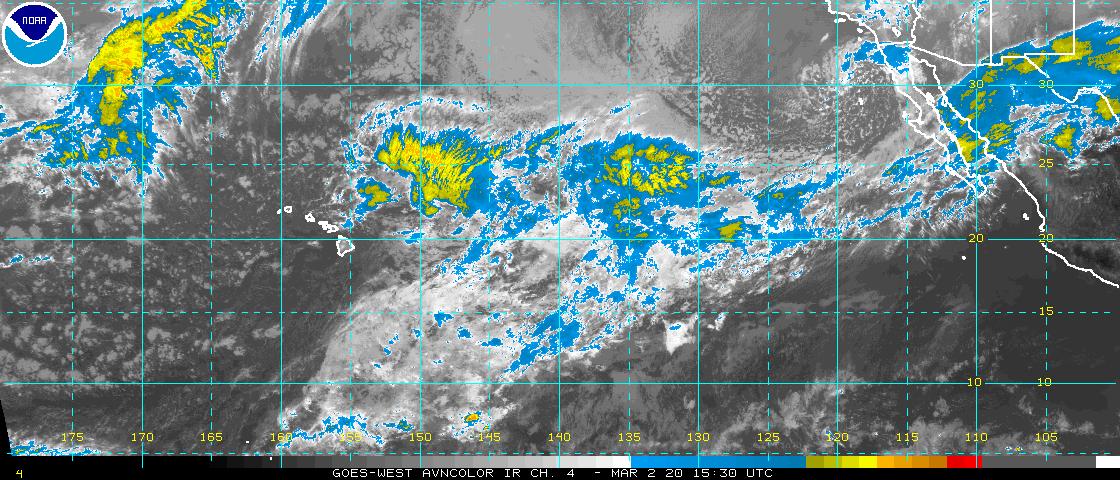
Satellite and Radar Images: To view the cloud conditions we have here in Hawaii, please use the following satellite links, starting off with this Infrared Satellite Image of the islands to see all the clouds around the state during the day and night. This next image is one that gives close images of the islands only during the daytime hours, and is referred to as a Close-up visible image. This next image shows a larger view of the Pacific…giving perspective to the wider ranging cloud patterns in the Pacific Ocean. Finally, here’s a Looping IR satellite image, making viewable the clouds around the islands 24 hours a day. To help you keep track of where any showers may be around the islands, here’s the latest animated radar image.
Hawaii’s Mountains – Here’s a link to the live webcam on the summit of near 14,000 foot Mauna Kea on the Big Island of Hawaii. The tallest peak on the island of Maui is the Haleakala Crater, which is near 10,000 feet in elevation. These two webcams are available during the daylight hours here in the islands…and when there’s a big moon rising just after sunset for an hour or two! Plus, during the nights and early mornings you will be able to see stars, and the sunrise too…depending upon weather conditions.
Tropical Cyclone activity in the eastern and central Pacific – Here’s the latest weather information coming out of the National Hurricane Center, covering the eastern north Pacific. You can find the latest tropical cyclone information for the central north Pacific (where Hawaii is located) by clicking on this link to the Central Pacific Hurricane Center. Here’s a tracking map covering both the eastern and central Pacific Ocean. A satellite image, which shows the entire ocean area between Hawaii and the Mexican coast…can be found here.
Aloha Paragraphs

Weakening tropical storm Guillermo…to the NNE of Hawaii
Weakening Guillermo has essentially stopped our local trade winds, which will remain the case through Wednesday…they will return Thursday through the rest of the week. Guillermo is acting as a blocking force, causing our trade winds to become very light, or disappearing completely, with light sea breezes replacing them during the days…and offshore flowing land breezes at night. This will make our overlying atmosphere feel very warm and muggy temporarily. The trades will return late Wednesday or by Thursday, bringing back refreshing breezes then into the weekend…and beyond.
Guillermo will drop down below a tropical storm, into the tropical depression category…as it moves by to the north of the islands. We have dodged another bullet, with the winds and heavy rains associated with this tropical system…missing our islands to the north. Here’s a tracking map, showing the storm’s track, moving it by to the north of the islands. Here’s a satellite image showing Guillermo in relation to the Hawaiian Islands. Here’s a close-up satellite image of Guillermo. Here’s a satellite presentation…showing the looping of Guillermo.
Guillermo’s latest wind reports, as of Tuesday evening, showed 40 mph sustained winds…with gusts to 52 mph. The current path of this tropical storm keeps it far enough to our north, that there will be no direct influence from the storm itself. Our faltering wind speeds, along with the sultry atmosphere…will be a couple of the indirect effects however. A trough of low pressure aloft, with its destabilizing influence on our air mass, has brought afternoon cloud buildups, especially over the interior sections. These clouds dropped localized generous rain Tuesday, which will have a repeat performance on Wednesday.
It’s Tuesday evening here in Kihei, Maui, as I begin writing this last section of today’s narrative. Tuesday started off in the most spectacular way, with generally clear skies most everywhere…certainly that was the case here on Maui. As expected, the clouds quickly increased over most islands by late morning, with cloudy skies enveloping most of the state during the afternoon hours. Those convective cumulus clouds got darker and darker, and there was only one thing for them to do…and that was of course rain down on us! I understand that there was a thunderstorm off the north shore of east Maui in the afternoon…with thunder heard in Haiku. Here in Kihei, Maui, it rained down hard enough at one point, that there was some very minor flooding of the parking lot outside the Pacific Disaster Center. At around 530pm, the rain had stopped, but it was still very cloudy out, with a few sprinkles falling.
~~~ At 5pm at the Honolulu airport, the air temperature was a very hot 88F degrees! That’s unusual for that time of day, and with hardly a breeze to speak about, I’m sure it must have felt like 90+ in parking lot outside the terminal. I’m about ready to take the drive back upcountry, and am quite sure that I’ll find foggy conditions up in Kula, which is one of my favorite weather conditions. Rain or shine though, I’ll be out there taking my evening walk! I’ll be back here online early Wednesday morning with your next new weather narrative from paradise. I hope you have a great night, and that you will join me here for more fun Wednesday! Aloha for now…Glenn.
Extra: A nice youtube music video of Hawaiian beaches…with a relaxing and meditative focus, like a free trip to the islands…enjoy the warm ocean!
Interesting: The roadrunner might have eluded Wile E. Coyote in cartoons, but now scientists are finally capturing its secrets. Radio tags on roadrunners are revealing the small birds can each have surprisingly large home ranges. Building on knowledge of roadrunners could shed light on the plight of endangered species in those areas, researchers added.
Although the roadrunner is fairly common across the southwestern United States, surprisingly little is known about the bird. "As a predatory bird, they’re pretty wary, and they appear somewhat intelligent in terms of being able to avoid a trap, so they’re not easy to capture for study," explained researcher Dean Ransom, a wildlife ecologist at Texas AgriLife Research.
To study roadrunners, at first Ransom and his colleagues tried luring the birds toward nets with taped playbacks of roadrunner calls, but while the birds did come to look for encroaching rivals, "we couldn’t get them in the nets," he recalled. "We hit upon using a trap for birds of prey, a leg noose baited with a live mouse."
After capturing the roadrunners, they attached radio transmitters onto them and let the birds go, studying their movements of some 50 roadrunners over the past four years. As their name suggests, roadrunners spend most of their time walking and running along the ground, but are capable of flight when pressured.
"It’s not graceful, but it works," Ransom said. Roadrunners are monogamous and likely mate for life, with the male helping in all facets of nesting and feeding the young, including incubating the eggs at night, the researchers helped confirm.
They lay about four eggs on average per nest, but the clutch size can range as high as 10. In the larger clutches, many of the young don’t survive and older nestlings have been seen eating their younger siblings. "We used nest cameras to document what the parents were feeding their young," he added.
"The diet is based solidly on reptiles, especially Texas horned lizards. We have also seen mice, snakes, grasshoppers and a tarantula." Radio tags revealed the home ranges of roadrunners was much larger than before thought. "These are just birds that are 350 grams or so (roughly three-quarters of a lb.), yet they’re able to use an area of 100 hectares or 250 acres. That’s quite a feat," Ransom said.
"I wouldn’t think twice about that for a wild turkey, a 13-lbs. big, long-legged heavy bird, but for a roadrunner that seems extreme and was really surprising to me." Roadrunners occupy landscapes along with many other birds, "and while roadrunners so far are not in trouble, a lot of birds inhabiting the same areas seem to be," Ransom said.
"So because they have such large spatial requirements, they might be able to serve as an indicator species of something going wrong in an environment, like a canary in a coal mine. Learning more about roadrunners could therefore shed light on the human footprint on areas." For instance, the reason these roadrunners have such large ranges could be due to fragmentation of vegetated areas, which can make food or nesting sites more scarce.
"I suspect that if the fragmentation of vegetation gets smaller, you’ll see territory sizes drop dramatically," Ransom said. A number of mysteries persist regarding these birds. "At one camera of a nest, we saw an untagged bird sitting at the edge of a nest, and the only way a mated pair might let that happen — roadrunners are territorial birds — is if the third bird is related," Ransom said. "So there might be a helpers-at-the-nest behavior going on there. We’d like to know more about that."
Interesting2: Hate cockroaches? Best pour yourself a stiff drink. The widely loathed insects can hold their breath to save water, a new study has found – and the trick could help them to thrive in the face of climate change. When cockroaches are resting, they periodically stop breathing for as long as 40 minutes, though why they do so has been unclear.
To investigate the mystery, Natalie Schimpf and her colleagues at the University of Queensland in Brisbane, Australia, examined whether speckled cockroaches (Nauphoeta cinerea) change their breathing pattern in response to changes in carbon dioxide or oxygen concentration, or humidity.
They conclude that cockroaches close the spiracles through which they breathe primarily to save water. In dry environments the insects took shorter breaths than in moist conditions.
"Cockroaches lose water across their respiratory surfaces when they breathe," says Schimpf, "so taking shorter breaths in dry conditions reduces the amount of water they will lose." The study deals a blow to the theory that cockroaches hold their breath to survive underground, where CO2 levels can be poisonous.
"They held their breath no longer in high-CO2 than in low-CO2 conditions," says Schimpf. Nor did the study support the idea that cockroaches hold their breath to avoid damage to their body tissue from chemical reactions with oxygen. The same doesn’t necessarily apply to other insects, warns John Terblanche at Stellenbosch University in South Africa.
"Our research suggests that butterfly pupae hold their breath to prevent oxygen damage, rather than to conserve water," he says. The nifty breath-holding adaptation has allowed cockroaches to colonize drier habitats, says George McGavin of the University of Oxford, and may allow them to thrive in climate change.
"Cockroaches have an awesome array of adaptations to life on dry land," says McGavin. "Living in the humid conditions of a rainforest, where they evolved, might be plain sailing, but cockroaches are adaptable and can cope in a wide range of environmental conditions."
Will the sun ever set on the empire of the cockroach? Not any time soon, says McGavin. "Two hundred and fifty million years of physiological fine tuning has produced a creature that will be around for a long time to come," he says. "Cockroaches, I’m afraid to say, will do well in the face of climate change."
Interesting3: Mention rosemary, thyme, clove, and mint and most people think of a delicious meal. Think bigger…acres bigger. These well-known spices are now becoming organic agriculture’s key weapons against insect pests as the industry tries to satisfy demands for fruits and veggies among the growing portion of consumers who want food produced in more natural ways.
In a study presented at the American Chemical Society’s 238th National Meeting, scientists in Canada are reporting exciting new research on these so-called "essential oil pesticides" or "killer spices."
These substances represent a relatively new class of natural insecticides that show promise as an environmentally-friendly alternative to conventional pesticides while also posing less risk to human and animal health, the researcher says.
"We are exploring the potential use of natural pesticides based on plant essential oils — commonly used in foods and beverages as flavorings," says study presenter Murray Isman, Ph.D., of the University of British Columbia.
These new pesticides are generally a mixture of tiny amounts of two to four different spices diluted in water. Some kill insects outright, while others repel them. Over the past decade, Isman and colleagues tested many plant essential oils and found that they have a broad range of insecticidal activity against agricultural pests.
Some spiced-based commercial products now being used by farmers have already shown success in protecting organic strawberry, spinach, and tomato crops against destructive aphids and mites, the researcher says. "These products expand the limited arsenal of organic growers to combat pests," explains Isman.
"They’re still only a small piece of the insecticide market, but they’re growing and gaining momentum." The natural pesticides have several advantages. Unlike conventional pesticides, these "killer spices" do not require extensive regulatory approval and are readily available.
An additional advantage is that insects are less likely to evolve resistance — the ability to shrug off once-effective toxins — Isman says. They’re also safer for farm workers, who are at high risk for pesticide exposure, he notes. But the new pesticides also have shortcomings.
Since essential oils tend to evaporate quickly and degrade rapidly in sunlight, farmers need to apply the spice-based pesticides to crops more frequently than conventional pesticides. Some last only a few hours, compared to days or even months for conventional pesticides.
As these natural pesticides are generally less potent than conventional pesticides, they also must be applied in higher concentrations to achieve acceptable levels of pest control, Isman says. Researchers are now seeking ways of making the natural pesticides longer-lasting and more potent, he notes.
"They’re not a panacea for pest control," cautions Isman. Conventional pesticides are still the most effective way to control caterpillars, grasshoppers, beetles and other large insects on commercial food crops, he says. "But at the end of the day, it comes down to what’s good for the environment and what’s good for human health."
The "killer spices" aren’t just limited to agricultural use. Some show promise in the home as eco-friendly toxins and repellents against mosquitoes, flies, and roaches. Unlike conventional bug sprays, which have a harsh odor, these natural pesticides tend to have a pleasant, spicy aroma. Many contain the same oils that are used in aromatherapy products, including cinnamon and peppermint, Isman notes.
Interesting4: Scientists have uncovered fresh evidence that life could exist beyond Earth, with research published today showing that comet dust contained traces of a compound vital to human existence. Researchers probing dust and gas collected from the Wild 2 comet by NASA’s Stardust spacecraft in 2004 found traces of the amino acid glycine, lending credence to idea that there is life elsewhere in the universe.
"The discovery of glycine in a comet supports the idea that the fundamental building blocks of life are prevalent in space, and strengthens the argument that life in the universe may be common rather than rare," said Carl Pilcher, one of the space agency’s top astro-biologists. Jamie Elsila, lead author of the report, which was published in the journal Meteoritics and Planetary Science, said the findings also support the idea that the material elements of human life may have come from space.
"Our discovery supports the theory that some of life’s ingredients formed in space and were delivered to Earth long ago by meteorite and comet impacts," she said. The group’s final findings confirm suspicions that the amino acid – which creates the proteins that form the building blocks of life – were not simply earth-sourced contamination.
"We discovered that the Stardust-returned glycine has an extraterrestrial carbon isotope signature, indicating that it originated on the comet," said Ms Elsila. Twenty different amino acids are arranged to build the millions of different proteins that make up everything from hair to enzymes, NASA said.
 Email Glenn James: