July 29-30, 2009
Air Temperatures – The following maximum temperatures were recorded across the state of Hawaii Wednesday afternoon:
Lihue, Kauai – 83
Honolulu, Oahu – 89
Kaneohe, Oahu – 83
Kahului, Maui – 87
Hilo, Hawaii – 84
Kailua-kona – 87
Air Temperatures ranged between these warmest and coolest spots near sea level – and on the highest mountains…at 4 p.m. Wednesday afternoon:
Port Allen, Kauai – 86F
Princeville, Kauai – 77
Haleakala Crater – 55 (near 10,000 feet on Maui)
Mauna Kea summit – 61 (near 14,000 feet on the Big Island)
Precipitation Totals – The following numbers represent the largest precipitation totals (inches) during the last 24 hours on each of the major islands, as of Wednesday afternoon:
2.95 Mount Waialaele, Kauai
0.70 South Fork Kaukonahua, Oahu
0.00 Molokai
0.00 Lanai
0.00 Kahoolawe
2.65 Puu Kukui, Maui
0.78 Kamuela upper, Big Island
Marine Winds – Here’s the latest (automatically updated) weather map showing a 1028 millibar high pressure system to the northeast of the islands Thursday. This high pressure cell, along with its associated ridge to our north, will keep the trade winds blowing through Friday.
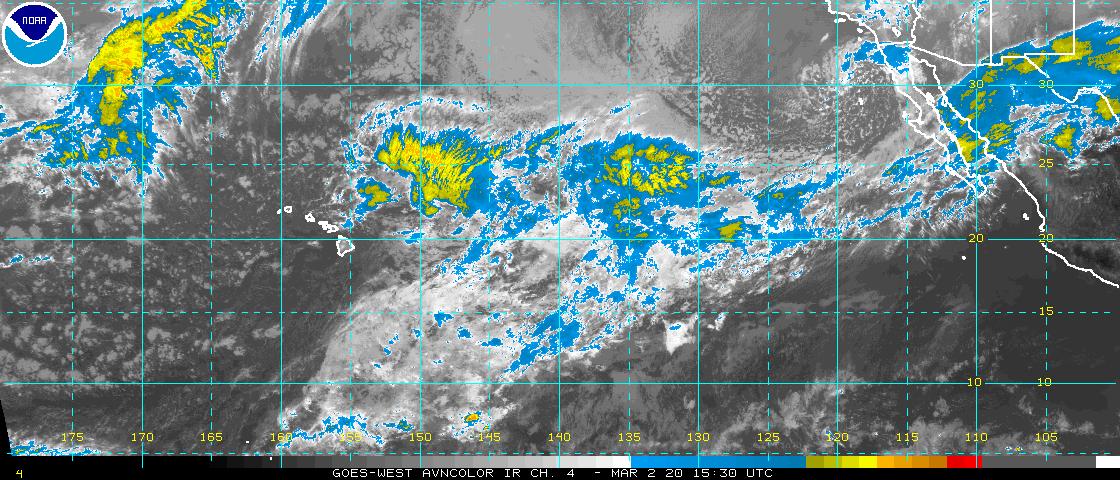
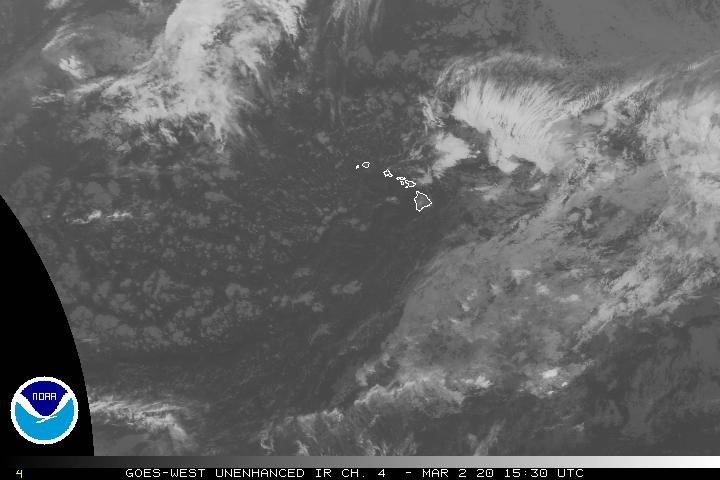
Satellite and Radar Images: To view the cloud conditions we have here in Hawaii, please use the following satellite links, starting off with this Infrared Satellite Image of the islands to see all the clouds around the state during the day and night. This next image is one that gives close images of the islands only during the daytime hours, and is referred to as a Close-up visible image. This next image shows a larger view of the Pacific…giving perspective to the wider ranging cloud patterns in the Pacific Ocean. Finally, here’s a Looping IR satellite image, making viewable the clouds around the islands 24 hours a day. To help you keep track of where any showers may be around the islands, here’s the latest animated radar image.
Hawaii’s Mountains – Here’s a link to the live webcam on the summit of near 14,000 foot Mauna Kea on the Big Island of Hawaii. The tallest peak on the island of Maui is the Haleakala Crater, which is near 10,000 feet in elevation. These two webcams are available during the daylight hours here in the islands…and when there’s a big moon rising just after sunset for an hour or two! Plus, during the nights and early mornings you will be able to see stars, and the sunrise too…depending upon weather conditions.
Tropical Cyclone activity in the eastern and central Pacific – Here’s the latest weather information coming out of the National Hurricane Center, covering the eastern north Pacific. You can find the latest tropical cyclone information for the central north Pacific (where Hawaii is located) by clicking on this link to the Central Pacific Hurricane Center. Here’s a tracking map covering both the eastern and central Pacific Ocean. A satellite image, which shows the entire ocean area between Hawaii and the Mexican coast…can be found here.
Aloha Paragraphs

Stalk of bananas, ready for harvest…Hawaii
The trade winds are softening just a touch now, although most folks won’t notice. The winds are however light enough, that the NWS forecast office in Honolulu has dropped the small craft wind advisories, in those windiest areas around Maui and the Big Island Wednesday evening. A 1028 millibar high pressure system, far to our north-northeast, as shown on this weather map…is the source of our gusty breezes. It appears that our trade winds will extend well into the month of August. August on average has the trade winds blowing 94% of the time here in Hawaii.
An upper level low pressure system will continue to enhance our incoming trade wind showers…and cause a locally heavy shower along the leeward slopes of the Big Island. This upper level trough of low pressure will be in our area over the next several days. This low prompted a localized thunderstorm on the leeward slopes of Mauna Loa, on the Big Island Wednesday afternoon. As the low moves away towards the weekend, we should settle back into a fairly normal trade wind weather pattern.
The computer models, both the GFS and the NOGAPS show a tropical low pressure system moving by to the south of the state later this coming Sunday into early next week on Monday. At this point, the low looks like it will have little influence on our weather. It may be close enough however, that it would enhance the speed of our local trade winds as it passed by. There’s also a fairly good chance that its northward edge would be able to carry some showers towards the Big Island. Here’s a picture of this area, to the southeast of the islands.
As indicated above, the most interesting aspect of our weather circumstances, is the upper low pressure system, with its associated cold air aloft. This cold air has had some destabilizing influence our air mass, with some enhancement of showers along the windward sides, and over the leeward slopes on the southern islands during the afternoons. A good indication of this was the 2.95" amount of rain that fell during the last 24 hours, at Mount Waialaele on Kauai…and the 2.65" total atop the West Maui Mountains…at the Puu Kukui rain gauge.
It’s Wednesday evening here in Kihei, Maui, as I begin writing this last part of today’s narrative. Looking out the window here in Kihei, before I take the drive back upcountry to Kula, it’s windy out there. Speaking of wind, at around 530pm, the strongest gust around the islands was 40 mph gust at Maalaea Bay here on Maui. In contrast, the lightest was 4 mph breeze at wind protected Barking Sands, on the leeward side of Kauai. There are some clouds out there too, although no cumulonimbus (thunderstorm clouds), like were reported on the Big Island this afternoon. I expect more or less similar weather conditions on Thursday as we saw Wednesday. ~~~ My neighbors invited me down for dinner tonight, this particular neighbor is the Director of the Astronomy Institute here on Maui, along with his Acupuncturist daughter. She is a good cook, so I’m sure I’ll be eating well…and partaking in good conversation too. Before I go over there, I’ll fit in a nice walk. I’ll meet you here early Thursday morning with your next new weather narrative from paradise. I hope you have a good night, and will plan on meeting me here again soon. Aloha for now…Glenn.
Interesting: The water at American beaches was seriously polluted and jeopardized the health of swimmers last year with the number of closing and advisory days at ocean, bay and Great Lakes beaches reaching more than 20,000 for the fourth consecutive year, according to the 19th annual beach water quality report released today by the Natural Resources Defense Council (NRDC). "Pollution from dirty storm water runoff and sewage overflows continues to make its way to our beaches.
This not only makes swimmers sick — it hurts coastal economies," said Nancy Stoner, NRDC Water Program Co-Director. "Americans should not suffer the consequences of contaminated beach water. From contracting the flu or pink eye, to jeopardizing millions of jobs and billions of dollars that rely on clean coasts, there are serious costs to inaction."
Using data from the U.S. Environmental Protection Agency, NRDC’s report — Testing the Waters: A Guide to Water Quality at Vacation Beaches — confirms that our nation’s beach waters continue to suffer from serious contamination — including human and animal waste — that can make people sick. NRDC’s report also provides a 5-star rating guide for 200 of the nation’s most popular beaches, based on indicators of beach water quality, monitoring frequency, and public notification of contamination.
Five-star beaches included Gulf Shores Public Beach (AL), Laguna Beach-Main Beach (CA), Bolsa Chica State Beach in Huntington Beach (CA), Newport Beach (CA), Ocean City (MD), Park Point — Community Club Beach in Duluth (MN) and Hampton Beach State Park in Hampton (NH). Some of the lowest ranking beaches (1-star) were Zach’s Bay at Jones Beach State Park in Wantagh (NY), Ocean Beach Park in New London (CT), Venice Public Beach (FL) and Central Beach in Point Pleasant (NJ).
Interesting2: Smokeless tobacco products, as used in Europe and North America, do not appear to increase cancer risk. A large meta-analysis, published in the open access journal BMC Medicine, has shown that snuff as used in Scandinavia has no discernible effect on the risk of various cancers. Products used in the past in the USA may have increased the risk, but any effect that exists now seems likely to be quite small.
Peter Lee and Jan Hamling, from P.N. Lee Statistics and Computing Ltd, carried out the analysis of 89 studies from the United States and Scandinavia. They found that, after adjustment for concurrent smoking, any effect of current US products or Scandinavian snuff seems very limited.
According to Lee, "It is clear that any effect of smokeless tobacco on risk of cancer, if it exists at all, is quantitatively very much smaller than the known effects of smoking". In 2005 in US men aged 35 or over, there were a total of 142,205 deaths from seven cancers considered to be caused by smoking.
If these people had never smoked, Lee and Hamling estimated that the numbers would have reduced by 104,737, with the reduction in lung cancer deaths, 79,195, being the major contributor.
If smokeless tobacco was introduced to a similar population of never smokers, this meta-analysis shows that any increase in risk would be negligible compared to the lives saved by reducing cigarette use.
Lee said, "Our paper shows very clearly that, in marked contrast to smoking, smokeless tobacco use carries little or no risk of cancer. Concerns about possible effects of smokeless tobacco on oral cancer are answered by our analyses showing a lack of relationship based on the combined evidence from those 14 studies published since 1990 which allow adequate control for effects of smoking."
Interesting3: Governments must act urgently to halt loss of habitats and invading species that are posing major threats to biodiversity and causing species extinctions across Australia, New Zealand and the Pacific Islands, according to a landmark new study. Published in the international journal Conservation Biology, the report is the first comprehensive review of more than 24,000 scientific publications related to conservation in the Oceanic region.
Compiled by a team of 14 scientists, it reveals a sorry and worsening picture of habitat destruction and species loss. It also describes the deficiencies of and opportunities for governmental action to lessen this mounting regional and global problem.
"Earth is experiencing its sixth great extinction event and the new report reveals that this threat is advancing on six major fronts," says the report’s lead author, Professor Richard Kingsford of the University of New South Wales.
"Our region has the notorious distinction of having possibly the worst extinction record on earth. This is predicted to continue without serious changes to the way we conserve our environments and dependent organisms.
We have an amazing natural environment in our part of the world but so much of it is being destroyed before our eyes. Species are being threatened by habitat loss and degradation, invasive species, climate change, overexploitation, pollution and wildlife disease."
Interesting4: NOAA-supported scientists, led by Nancy Rabalais, Ph.D., from the Louisiana Universities Marine Consortium (LUMCON), found the size of this year’s Gulf of Mexico dead zone to be smaller than forecasted, measuring 3,000 square miles. However the dead zone, which is usually limited to water just above the sea floor, was severe where it did occur, extending closer to the water surface then in most years.
Earlier this summer, NOAA-sponsored forecast models developed by R. Eugene Turner, Ph. D. of Louisiana State University and Donald Scavia, Ph.D. of the University of Michigan, predicted a larger than normal dead zone area of between 7,450 – 8,456 square miles.
The forecast was driven primarily by the high nitrate loads and high freshwater flows from the Mississippi and Atchafalaya rivers in spring 2009 as measured by the U.S. Geological Survey. Rabalais believes the smaller than expected dead zone is due to unusual weather patterns that re-oxygenated the waters, among other factors.
"The winds and waves were high in the area to the west of the Atchafalaya River delta and likely mixed oxygen into these shallower waters prior to the cruise, thus reducing the area of the zone in that region," said Rabalais.
"The variability we see within each summer highlights the continuing need for multiple surveys to measure the size of the dead zone in a more systematic fashion."
"The results of the 2009 cruise at first glance are hopeful, but the smaller than expected area of hypoxia appears to be related to short-term weather patterns before measurements were taken, not a reduction in the underlying cause, excessive nutrient runoff." said Robert Magnien, PhD., director of NOAA’s Center for Sponsored Coastal Ocean Research.
"The smaller area measured by this one cruise, therefore, does not represent a trend and in no way diminishes the need for a harder look at efforts to reduce nutrient runoff." The average size of the dead zone over the past five years, including this cruise, is now 6,000 square miles.
The interagency Gulf of Mexico/Mississippi River Watershed Nutrient Task Force has a goal to reduce or make significant progress toward reducing this dead zone average to 2,000 square miles or less by 2015. The Task Force uses a five year average due to relatively high interannual variability.
The dead zone is fueled by nutrient runoff, principally from agricultural activity, which stimulates an overgrowth of algae that sinks, decomposes, and consumes most of the life-giving oxygen supply in the water. The Gulf of Mexico dead zone is of particular concern because it threatens valuable commercial and recreational Gulf fisheries that generate about $2.8 billion annually.
Interesting5: We’ve all experienced it after long hours driving, the eyelids getting heavy, a deep yawn, neck muscles relaxing, the urge to sleep, the head nodding down… But, you’re hands are still on the wheel and you only just stopped yourself nodding off in time to avoid the oncoming traffic. But what if your car could keep an eye on you while you drive and nudge you when you starting yawning and warn you to pull over and take a break?
That’s the aim of a new in-car yawn-detection system being developed by an international team in the US and India. Aurobinda Mishra of Vanderbilt University, in Nashville, TN, and colleagues Mihir Mohanty of ITER, in Orissa and Aurobinda Routray of IIT, West Bengal, India, have developed a computer program that can tell when you are yawning and could prevent road traffic accidents.
The US National Highway Traffic Safety Administration estimates that at least 100,000 road crashes are caused by driver fatigue each year. The new program is based around an in-car camera hooked up to image-processing software that captures a sequence of images of the driver’s face. It then analyses changes in the face and accurately identifies yawning as distinct from other facial movements such as smiling, talking, and singing.
The yawn frequency is then correlated with fatigue behavior and could then be hooked up to a warning system to alert drivers to the need to take a break. The algorithm is effective at yawn detection regardless of image intensity and contrast, small head movements, viewing angle, spectacle wearing, and skin color.
Interesting6: As the climate warms in the coming decades, atmospheric scientists at Harvard’s School of Engineering and Applied Sciences (SEAS) and their colleagues expect that the frequency of wildfires will increase in many regions. The spike in the number of fires could also adversely affect air quality due to the greater presence of smoke.
The study, led by SEAS Senior Research Fellow Jennifer Logan, was published in the June 18th issue of Journal of Geophysical Research. In their pioneering work, Logan and her collaborators investigated the consequences of climate change on future forest fires and on air quality in the western United States.
Previous studies have probed the links between climate change and fire severity in the West and elsewhere. The Harvard study represents the first attempt to quantify the impact of future wildfires on the air we breathe.
"Warmer temperatures can dry out underbrush, leading to a more serious conflagration once a fire is started by lightning or human activity," says Logan. "Because smoke and other particles from fires adversely affect air quality, an increase in wildfires could have large impacts on human health."
Using a series of models, the scientists predict that the geographic area typically burned by wildfires in the western United States could increase by about 50% by the 2050s due mainly to rising temperatures. The greatest increases in area burned (75-175%) would occur in the forests of the Pacific Northwest and the Rocky Mountains.
In addition, because of extra burning throughout the western U.S., one important type of smoke particle, organic carbon aerosols, would increase, on average, by about 40 percent during the roughly half-century period.
Interesting7: Large trees have declined in Yosemite National Park during the 20th century, and warmer climate conditions may play a role. The number of large-diameter trees in the park declined 24 percent between the 1930s and 1990s.
U.S. Geological Survey and University of Washington scientists compared the earliest records of large-diameter trees densities from 1932–1936 to the most recent records from 1988–1999.
A decline in large trees means habitat loss and possible reduction in species such as spotted owls, mosses, orchids and fishers (a carnivore related to weasels). Fewer new trees will grow in the landscape because large trees are a seed source for the surrounding landscape.
Large-diameter trees generally resist fire more than small-diameter trees, so fewer large trees could also slow forest regeneration after fires. “Although this study did not investigate the causes of decline, climate change is a likely contributor to these events and should be taken into consideration,” said USGS scientist emeritus Jan van Wagtendonk.
“Warmer conditions increase the length of the summer dry season and decrease the snowpack that provides much of the water for the growing season. A longer summer dry season can also reduce tree growth and vigor, and can reduce trees’ ability to resist insects and pathogens.”
 Email Glenn James: