July 27-28, 2009
Air Temperatures – The following maximum temperatures were recorded across the state of Hawaii Monday afternoon:
Lihue, Kauai – 83
Honolulu, Oahu – 90
Kaneohe, Oahu – 84
Kahului, Maui – 87
Hilo, Hawaii – 83
Kailua-kona – 89
Air Temperatures ranged between these warmest and coolest spots near sea level – and on the highest mountains…at 4 p.m. Monday afternoon:
Barking Sands, Kauai – 87F
Lihue, Kauai – 81
Haleakala Crater – 57 (near 10,000 feet on Maui)
Mauna Kea summit – 59 (near 14,000 feet on the Big Island)
Precipitation Totals – The following numbers represent the largest precipitation totals (inches) during the last 24 hours on each of the major islands, as of Monday afternoon:
0.43 Mount Waialaele, Kauai
0.42 Oahu Forest NWR, Oahu
0.00 Molokai
0.00 Lanai
0.00 Kahoolawe
0.36 Oheo Gulch, Maui
0.38 Kamuela upper, Big Island
Marine Winds – Here’s the latest (automatically updated) weather map showing a 1032 millibar high pressure system far to the northeast of the islands Tuesday. This high pressure cell, along with its associated ridge to our north, will keep the trade winds blowing through Wednesday.
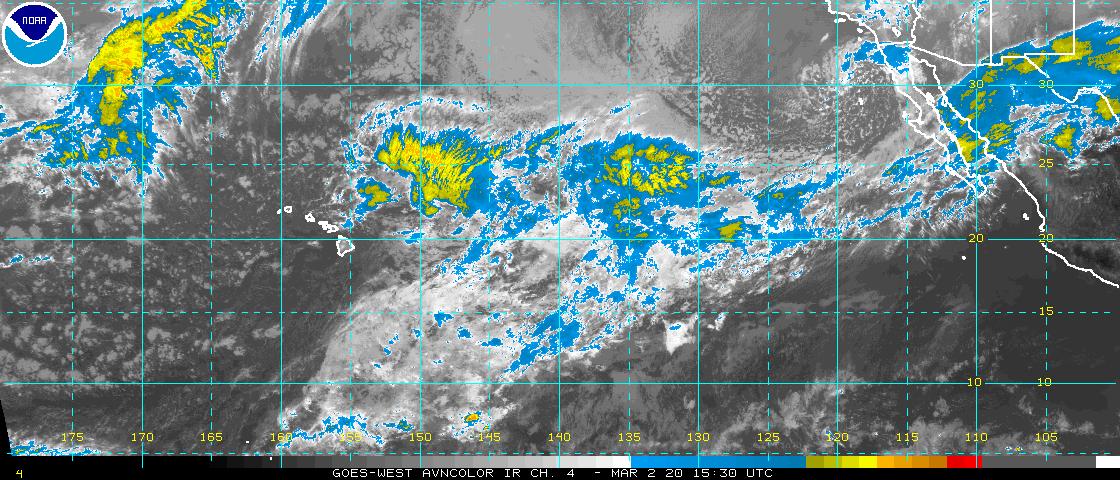
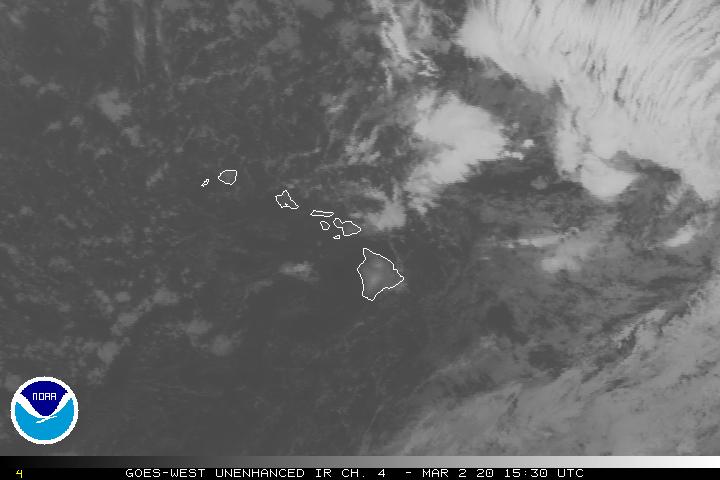
Satellite and Radar Images: To view the cloud conditions we have here in Hawaii, please use the following satellite links, starting off with this Infrared Satellite Image of the islands to see all the clouds around the state during the day and night. This next image is one that gives close images of the islands only during the daytime hours, and is referred to as a Close-up visible image. This next image shows a larger view of the Pacific…giving perspective to the wider ranging cloud patterns in the Pacific Ocean. Finally, here’s a Looping IR satellite image, making viewable the clouds around the islands 24 hours a day. To help you keep track of where any showers may be around the islands, here’s the latest animated radar image.
Hawaii’s Mountains – Here’s a link to the live webcam on the summit of near 14,000 foot Mauna Kea on the Big Island of Hawaii. The tallest peak on the island of Maui is the Haleakala Crater, which is near 10,000 feet in elevation. These two webcams are available during the daylight hours here in the islands…and when there’s a big moon rising just after sunset for an hour or two! Plus, during the nights and early mornings you will be able to see stars, and the sunrise too…depending upon weather conditions.
Tropical Cyclone activity in the eastern and central Pacific – Here’s the latest weather information coming out of the National Hurricane Center, covering the eastern north Pacific. You can find the latest tropical cyclone information for the central north Pacific (where Hawaii is located) by clicking on this link to the Central Pacific Hurricane Center. Here’s a tracking map covering both the eastern and central Pacific Ocean. A satellite image, which shows the entire ocean area between Hawaii and the Mexican coast…can be found here.
Aloha Paragraphs
Rainbow wave
Our normal trade winds will stick with us through this entire week…and likely right on into next week. We find small craft wind advisory flags still up in those windiest areas around Maui and the Big Island Monday evening. A strong 1034 millibar high pressure system, far to our northeast, as shown on this weather map…as the source of our gusty breezes. There will be some fluctuations in our wind speeds, but in general, they will remain moderately strong well into the future.
Showers will focus their efforts most effectively along the windward sides…falling most often during the night and early morning hours. The high cirrus clouds, and some middle level altocumulus clouds, have mostly moved to the south of the islands Monday evening. There will be lower level clouds, dropping a few showers along our windward sides. An upper level trough of low pressure will be to the north of the islands over the next several days. This low will likely enhance our windward showers. This low may also prompt some afternoon showers to develop along the leeward slopes of the Big Island and Maui too.
It’s Monday evening here in Kihei, Maui, as I begin writing this last part of this evening’s narrative. Our weather here in the islands pretty much stuck to the forecast script. This meant that the trade winds blew briskly, and daytime temperatures rose well into the 80F’s near sea level…and topped out at 90 degrees at the Honolulu airport. As noted on this satellite image, the sun dimming cirrus clouds edged south of the state, which was good news for our local sun worshippers. The trade winds were still on the stiff side at 5pm Monday evening, with the strongest gust, registering 40 mph, being recorded at Maalaea Bay…slightly down from the 42 mph gust earlier in the day.
~~~ If we look at this looping satellite image, we can see the counterclockwise rotating upper level low to our north. This low aloft is what’s expected to enhance our showers along the windward sides…starting later tonight. I would imagine that the windward sides, which have been quite dry lately, will finally get an increase in showers. Looking out the window before I leave for the drive upcountry to Kula, I see no obvious signs of those showers over towards Makawao, Paia and Haiku just yet.
~~~ I’ll be back with your next new weather narrative early Tuesday morning. I hope you have a great Monday night until then! Aloha for now…Glenn
Interesting: Icy comets – not rocky asteroids – launched a dramatic assault on the Earth and moon around 3.85 billion years ago, a new study of ancient rocks in Greenland suggests. The work suggests much of Earth’s water could have been brought to the planet by comets. "We can see craters on the moon’s surface with the naked eye, but nobody actually knew what caused them – was it rocks, was it iron, was it ice?" says Uffe Gråe Jørgensen, an astronomer at the Niels Bohr Institute in Copenhagen, Denmark.
"It’s exciting to find signs that it was actually ice." Evidence suggests that the Earth and moon had both formed around 4.5 billion years ago. But almost all the craters on the moon date to a later period, the "Late Heavy Bombardment" 3.8 to 3.9 billion years ago, when around 100 million billion tons of rock or ice crashed onto the lunar surface.
The Earth would have been pummeled by debris at the same time, although plate tectonics on our restless planet have since erased the scars. To find out whether asteroids or comets were the main culprits for the bombardment, Jørgensen decided to measure levels of the element iridium in ancient terrestrial rocks. Iridium is rare on the Earth’s surface because almost all of it bound to iron and sank into the Earth’s core soon after the planet had formed.
But iridium is relatively common in comets and meteorites. His team calculated the amount of iridium that asteroids would leave on the Earth and moon compared to comets. Because comets have more volatile elements and higher impact speeds due to their more elongated orbits around the sun, they would create giant plumes on impact, allowing more iridium to escape into space than during asteroid impacts.
The team predicted that asteroid bombardment would leave iridium levels of 18,000 and 10,000 parts per trillion in rocks on the Earth and moon respectively, while the same figures for comet bombardment would be about 130 and 10. Ancient moon rocks returned by NASA’s Apollo missions have already confirmed that the lunar iridium levels are 10 parts per trillion or less.
To find out the terrestrial value, Jørgensen’s team sampled some of the world’s oldest rocks from Greenland, aged 3.8 billion years, and asked a Japanese laboratory to assess their iridium levels more accurately than ever before. They contained iridium levels of 150 parts per trillion. That strongly suggests comets, rather than asteroids, caused the violent bombardment.
Interesting2: Pulse Technology has developed a new type of car battery charger that it claims can increase the life of a lead-acid battery by three to five times, the equivalent of eight to 10 years of extra life. The Xtreme Charger’s goal is to reduce lead sulfate deposits that build up on the battery plates.
This build up occurs naturally no matter how often the vehicle is used but is increased in extreme hot and cold weather or extended periods of engine idling. While car batteries are able to recharge while you’re driving, conditions such as sulfate build-up eventually prevent them from holding a charge.
Interesting3: The oil and gas that fuels our homes and cars started out as living organisms that died, were compressed, and heated under heavy layers of sediments in the Earth’s crust. Scientists have debated for years whether some of these hydrocarbons could also have been created deeper in the Earth and formed without organic matter.
Now for the first time, scientists have found that ethane and heavier hydrocarbons can be synthesized under the pressure-temperature conditions of the upper mantle —the layer of Earth under the crust and on top of the core.
The research was conducted by scientists at the Carnegie Institution’s Geophysical Laboratory, with colleagues from Russia and Sweden, and is published in the July 26, advanced on-line issue of Nature Geoscience.
Methane (CH4) is the main constituent of natural gas, while ethane (C2H6) is used as a petrochemical feedstock. Both of these hydrocarbons, and others associated with fuel, are called saturated hydrocarbons because they have simple, single bonds and are saturated with hydrogen.
Using a diamond anvil cell and a laser heat source, the scientists first subjected methane to pressures exceeding 20 thousand times the atmospheric pressure at sea level and temperatures ranging from 1,300 F° to over 2,240 F°. These conditions mimic those found 40 to 95 miles deep inside the Earth.
The methane reacted and formed ethane, propane, butane, molecular hydrogen, and graphite. The scientists then subjected ethane to the same conditions and it produced methane. The transformations suggest heavier hydrocarbons could exist deep down. The reversibility implies that the synthesis of saturated hydrocarbons is thermodynamically controlled and does not require organic matter.
Interesting4: Bangladeshi farmers are benefiting from research that allows farmers to harvest rice earlier, giving them more time to grow a second crop to provide desperately needed food and ease hunger during monga – the hunger months. Monga is a yearly famine that occurs in northwest Bangladesh from September to November after the previous season’s food has run out and before the harvest of transplanted rice in December.
According to the Bangladesh Bureau of Statistics, monga affects more than 2 million households in 5 districts that depend on rice for their food. Through the Irrigated Rice Research Consortium (IRRC), the International Rice Research Institute (IRRI), the Bangladesh Rice Research Institute (BRRI), and the local alliance Northwest Area Focal Forum are encouraging practices to reduce the time it takes to grow a rice crop.
“Adopting direct seeding so rice can be sown earlier and planting a shorter-duration rice variety can bring the harvest forward 25–40 days,” said Dr. David Johnson, IRRI scientist and IRRC work group leader.
“This can significantly improve the quality of people’s lives and reduce monga by creating early harvest jobs for the landless poor, delivering an early food supply, increasing the chances that a second crop can be grown, spreading the demand for harvest labor, and creating jobs for the landless and income for farmers,” he added.
New management techniques, and particularly weed management, must be simultaneously adopted with these new practices. According to Dr. M.A. Mazid, head of the BRRI Rangpur station, direct-seeded rice can reduce crop establishment costs and may slightly increase rice yields.
“With a better chance to grow a second crop after rice, such as maize, potato, mustard, wheat, chickpea, or vegetables, farmers will have more food and an opportunity to make some income,” he said. The Bangladeshi government is now also promoting the adoption of the shorter-duration rice variety and direct seeding as part of a national program and three-year action plan to mitigate monga.
Interesting5: Oxford scientists have created a transparent form of aluminium by bombarding the metal with the world’s most powerful soft X-ray laser. ‘Transparent aluminium’ previously only existed in science fiction, featuring in the movie Star Trek IV, but the real material is an exotic new state of matter with implications for planetary science and nuclear fusion.
In the journal Nature Physics an international team, led by Oxford University scientists, report that a short pulse from the FLASH laser ‘knocked out’ a core electron from every aluminium atom in a sample without disrupting the metal’s crystalline structure.
This turned the aluminium nearly invisible to extreme ultraviolet radiation. ”What we have created is a completely new state of matter nobody has seen before,’ said Professor Justin Wark of Oxford University’s Department of Physics, one of the authors of the paper.
‘Transparent aluminium is just the start. The physical properties of the matter we are creating are relevant to the conditions inside large planets, and we also hope that by studying it we can gain a greater understanding of what is going on during the creation of ‘miniature stars’ created by high-power laser implosions, which may one day allow the power of nuclear fusion to be harnessed here on Earth.’
Interesting6: Scientists from NOAA’s Coral Reef Watch Program say conditions are favorable for significant coral bleaching and infectious coral disease outbreaks in the Caribbean, especially in the Lesser Antilles. The forecast is based on the July NOAA Coral Reef Watch outlook, which expects continued high water temperatures through October 2009.
Scientists are concerned that bleaching may reach the same levels or exceed those recorded in 2005, the worst coral bleaching and disease year in Caribbean history. In parts of the eastern Caribbean, as much as 90 percent of corals bleached and over half of those died during that event."
“Just like any climate forecast, local conditions and weather events can influence actual temperatures. However, we are quite concerned that high temperatures may threaten the health of coral reefs in the Caribbean this year,” said C. Mark Eakin, Ph.D., coordinator of NOAA’s Coral Reef Watch.
Prolonged coral bleaching of more than a week can lead to coral death and the subsequent loss of coral reef habitats for a range of marine life. It also affects local economies and tourism. “By providing local officials with advance warning that a bleaching event is about to occur, some steps can be taken to protect the corals,” said Eakin.
“Possible responses include mobilizing monitoring resources to measure extent and impact of bleaching, and establishing temporary restrictions on other reef uses like diving, boating and recreational fishing, to keep these activities from adding to the stress of higher sea temperatures already affecting the coral reefs.”
There is also potential for similar conditions in the central Gulf of Mexico and a region stretching from the Lesser Antilles to Puerto Rico, across to the southern coast of Hispaniola and the Caribbean coast of Nicaragua. Other areas of concern are the central Pacific region including the equatorial Line Islands and Kiribati. Some heat induced stress may also develop between the Northern Mariana Islands and Japan.
 Email Glenn James: