July 21-22, 2009
Air Temperatures – The following maximum temperatures were recorded across the state of Hawaii Tuesday afternoon:
Lihue, Kauai – 84
Honolulu, Oahu – 88
Kaneohe, Oahu – 83
Kahului, Maui – 86
Hilo, Hawaii – 84
Kailua-kona – 86
Air Temperatures ranged between these warmest and coolest spots near sea level – and on the highest mountains…at 5 p.m. Tuesday evening:
Port Allen, Kauai – 86F
Kapalua, Maui – 77
Haleakala Crater – 55 (near 10,000 feet on Maui)
Mauna Kea summit – 68 (near 14,000 feet on the Big Island)
Precipitation Totals – The following numbers represent the largest precipitation totals (inches) during the last 24 hours on each of the major islands, as of Tuesday afternoon:
0.38 Mount Waialaele, Kauai
0.60 Manoa Valley, Oahu
0.21 Molokai
0.00 Lanai
0.00 Kahoolawe
0.33 Puu Kukui, Maui
0.13 Hilo airport, Big Island
Marine Winds – Here’s the latest (automatically updated) weather map showing that high pressure systems remain active to the north of the islands Wednesday. These high pressure cells will keep the trade winds blowing into Wednesday…although gradually becoming lighter as a trough of low pressure moves across the state through Thursday.
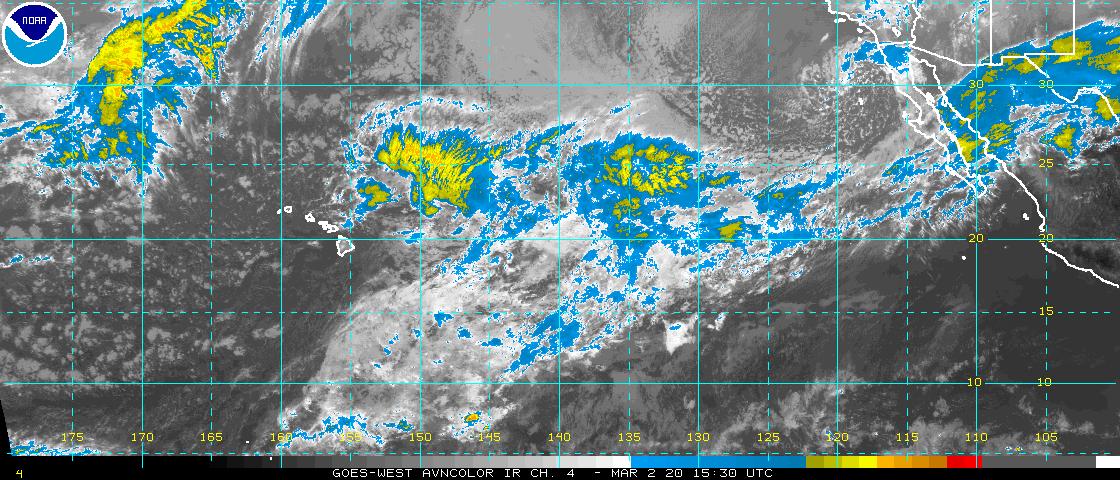
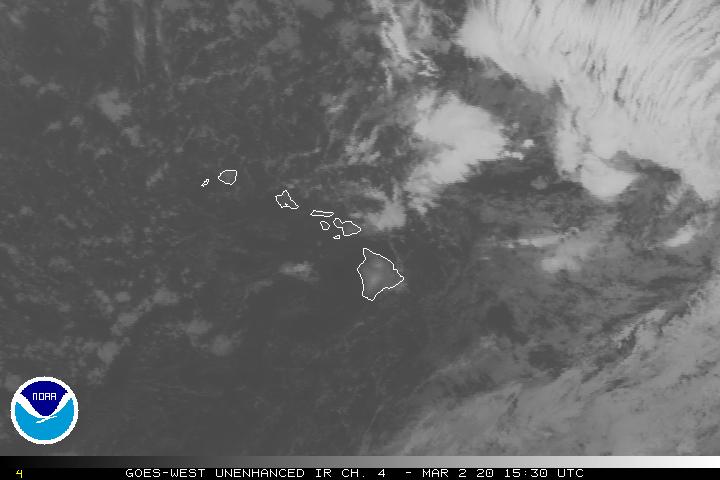
Satellite and Radar Images: To view the cloud conditions we have here in Hawaii, please use the following satellite links, starting off with this Infrared Satellite Image of the islands to see all the clouds around the state during the day and night. This next image is one that gives close images of the islands only during the daytime hours, and is referred to as a Close-up visible image. This next image shows a larger view of the Pacific…giving perspective to the wider ranging cloud patterns in the Pacific Ocean. Finally, here’s a Looping IR satellite image, making viewable the clouds around the islands 24 hours a day. To help you keep track of where any showers may be around the islands, here’s the latest animated radar image.
Hawaii’s Mountains – Here’s a link to the live webcam on the summit of near 14,000 foot Mauna Kea on the Big Island of Hawaii. The tallest peak on the island of Maui is the Haleakala Crater, which is near 10,000 feet in elevation. These two webcams are available during the daylight hours here in the islands…and when there’s a big moon rising just after sunset for an hour or two! Plus, during the nights and early mornings you will be able to see stars, and the sunrise too…depending upon weather conditions.
Tropical Cyclone activity in the eastern and central Pacific – Here’s the latest weather information coming out of the National Hurricane Center, covering the eastern north Pacific. You can find the latest tropical cyclone information for the central north Pacific (where Hawaii is located) by clicking on this link to the Central Pacific Hurricane Center. Here’s a tracking map covering both the eastern and central Pacific Ocean. A satellite image, which shows the entire ocean area between Hawaii and the Mexican coast…can be found here.
Aloha Paragraphs

Love that warm ocean…wow that color!
The trade winds remain rather blustery Tuesday, but will gradually get lighter over the next couple of days. We still find those two near 1029 millibar high pressure systems to the northwest of the islands Tuesday evening. Forecast charts continue to show our trades tapering off considerably during the second half of this week. This will bring us into a convective weather pattern, with humid conditions prevailing into the weekend. Fortunately, these sultry conditions won’t last long, as the trade winds fill back into our Hawaiian Islands weather picture thereafter. By the way, the NWS issued small craft wind advisory has been pared back again, now covering only the area from Maui County down to the Big Island.
Look for some increase in our shower activity, starting off first on the Big Island…then further into the state over the next several days. An area of moist air is coming our way, which will start off falling along our windward sides. Eventually though, as this moisture combines with the faltering trade winds, those showers will likely shift over to the mountains during the afternoon hours. The greatest likelihood of showers will be Thursday into the weekend, generally in the leeward upcountry areas. If the trade winds return as expected late this weekend or early next week, the emphasis for showers will return to the windward sides then. If we get back into alignment with climatology next week, we should see fairly normal trade wind weather conditions returning.
As noted above, showers will be at a minimum Tuesday, and probably into at least part of Wednesday in most areas. Later Wednesday into the upcoming weekend…should be a different story, as the aforementioned surge of moisture works its way over our islands from the deeper tropics. This will prime the pump so to speak, setting the stage for a possible increase in showers over and around the mountains generally. This last part of the work week will be a muggy one, with all that moisture around, and very little wind to provide relief from the heat. The winds may even take on a southeast orientation, which could carry some volcanic haze up over some parts of the island chain.
It’s Tuesday evening here in Kihei, Maui, as I begin writing this last part of today’s narrative. As expected, Tuesday was another nice day, albeit it on the windy side here and there. Case in point, at 5pm this evening, that windy Maalaea Bay on Maui was experiencing 44 mph wind gusts! Those gusts on the high side, were in contrast to the 9 mph winds at both the Hilo and Kona airports! As I was mentioning in one of the paragraphs above, we have a large area of tropical moisture making its way towards the islands, located to the east and southeast of the Big Island. Here’s a satellite image, showing this area. I’ll have more to say about that early Wednesday morning, when I come back online with your next new weather narrative. By the way, we’ll see larger surf rolling in along our leeward beaches Wednesday, and we have high surf advisory flags up now in anticipation of those potentially dangerous breakers…be careful! ~~~ I’m just about ready to take the drive back upcountry to Kula now. I hope you have a great Tuesday night from wherever you happen to be reading from! Aloha for now…Glenn.
Interesting: Dust clouds generated by a huge dust storm in China’s Taklimakan desert in 2007 made more than one full circle around the globe in just 13 days, a Japanese study using a NASA satellite has found. When the cloud reached the Pacific Ocean the second time, it descended and deposited some of its dust into the sea, showing how a natural phenomenon can impact the environment far away.
"Asian dust is usually deposited near the Yellow Sea, around the Japan area, while Sahara dust ends up around the Atlantic Ocean and coast of Africa," said Itsushi Uno of Kyushu University’s Research Institute for Applied Mechanics. "But this study shows that China dust can be deposited into the (Pacific Ocean)," he told Reuters by telephone.
"Dust clouds contain 5 percent iron that is important for the ocean." In a paper published in Nature Geoscience, scientists described how they used a NASA satellite and mathematical modeling to track and measure the movement of the dust cloud, which formed after the dust storm on May 8-9 in 2007. The desert is in the Chinese northwestern region of Xinjiang.
The researchers, led by Uno, found that the dust clouds were lifted 8-10 km (5-6 miles) above the earth’s surface, and transported more than one full circle around the earth. "The most important achievement is that we tracked this through one full circuit round the globe, nobody has done this before.
After half a circuit, usually the dust concentration gets very low and you can’t track it," Uno told Reuters. "This means that dust concentration, dust lifetime is very long, more than two weeks." The dust cloud measured about 3 km (1.9 miles) vertically and up to 2,000 km horizontally and it stayed that way even after one full trip around the globe.
"The reason why the cloud structure was very well maintained was because the dust was uplifted … where the atmosphere is very stable," Uno said. Researchers believe dust particles trigger the formation of high-altitude cirrus clouds — although experts have no idea whether such clouds warm or cool the earth.
Interesting2: Scientists in California have set up a unique experiment to track the life histories of some of the world’s oldest and tallest trees. The project is designed to follow up research, in the Yosemite National Park, which suggests that giant trees are perishing as a result of climate change.
An analysis of data collected over 60 years has led scientists from the University of Washington and the Yosemite Field Station of the US Geological Survey, to conclude that the density of large diameter trees fell by 24% between the 1930s and 1990s.
"We want to identify the reasons for tree mortality and if those are changing," says Dr James Lutz, a research associate at the university’s College of Forest Resources. Little research has been done on a long-term basis to monitor the lives of large trees.
Unlike studies with smaller plants and almost all animals, no individual scientist is able to track a forest giant for its entire lifespan – from germination to death. They live for hundreds of years and play a vital role in the ecosystem long after they have died.
Yosemite National Park is a vast area of wilderness covering 3,027 sq km (1,169 square miles), 321km (200 miles) from San Francisco. The park is best known for its breathtaking waterfalls, black bears and ancient giant sequoias, which are part of the redwood family of trees.
Interesting3: The Massachusetts Institute of Technology has launched a new program that calls on New York and Seattle residents to voluntarily tag their trash. Known as Trash Track, the program will distribute electronic garbage tags in order to track the journey of discarded products through the waste stream.
The tags will be wireless location markers and will be attached at random to thousands of products in the two cities. The system will record not only the current location of a product, but it will also track how long it has been in the waste stream.
In addition to analyzing the data, MIT will make the information available to the public in exhibits at the Architectural League in New York and the Seattle Public Library. These exhibits will begin in September.
Interesting4: Searing desert heat off the Sahara swept right to the normally cool Atlantic coast of Morocco on Monday and Tuesday. At the airport of Agadir, the temperature on Monday soared to a fiery 119 degrees, or nearly 30 degrees above the normal daily high. Farther north, the city of Casablanca sweltered.
The nearby town of Nouasser registered 117 degrees on Monday afternoon followed by readings into the 110s again on Tuesday. The capital city, Rabat, fared almost as badly. High temperatures on both Monday and Tuesday were 113 degrees, this notwithstanding a normal high temperature near 80 degrees.
Elsewhere, Marrakech was as hot as 114 degrees on Monday afternoon, and Fez reached 110 degrees on both Monday and Tuesday. Driving the withering blast was a southeasterly, off-shore wind off the Sahara. Not only did the hot winds block the usual cooling sea breeze, they were further heated in wafting down slope from the Atlas Mountains.
Interesting5: The National Oceanic and Atmospheric Administration (NOAA) has reported findings of preliminary analysis from the agency’s National Climatic Data Center in Asheville, North Carolina that shows global ocean surface temperatures for June broke the previous record set in 2005.
The combined average global/land and ocean surface temperature for June was the second warmest on record, 1.12 degrees Fahrenheit (0.62 degrees Celsius) above the 20th century average of 59.9 degrees F. Ocean surface temperatures for June ’09 were the warmest on record, 1.06 degrees F (0.59 degrees C) above the 20th century average of 61.5 degrees F.
The global land surface temperature for June was 1.26 degrees F above the 20th century average, and the sixth warmest June on record.
Interesting6: Two new sister lines of rice are defying rice’s reputation as a thirsty crop as they demonstrate their improved productivity in drought-prone regions of India and the Philippines. Rice Today’s July-September 2009 edition features the development of drought-tolerant rice and other research the International Rice Research Institute (IRRI) and its collaborators are doing to curb the devastating effects of drought.
With some degree of water shortages predicted to affect 15-20 million hectares of irrigated rice within 25 years, smart crop management and even genetically modified rice may also play a role in helping farmers cope with the crisis. Rice Today also reports that in Uganda rice production has increased 2.5 times from 2004 to 2008 through government initiatives, private investment, and farmer support.
Across the other side of the planet rice production, consumption, and prospects in Latin America are being explored. Rice is being promoted to consumers in Mexico and Central America and in Brazil production is improving. In light of further boosting production, IRRI takes a look at some practical solutions to help reduce grain losses and improve grain quality during postharvest. Between 15-20% of rice grains are often lost at this stage because of unsuitable drying techniques, pests, and other factors.
Interesting7: The dark bruise that appeared suddenly near the south pole of Jupiter several days ago, likely as the result of an impact by a comet or asteroid, is as big as the Pacific Ocean, astronomers report. The dark spot was first noticed by chance by amateur astronomer Anthony Wesley in Australia on Sunday, July 19.
The blemish is thought to be the result of an impact similar to that of Comet Shoemaker-Levy 9, which pummeled the gas giant 15 years ago. After he was convinced the spot was not just another storm or the shadow of one of Jupiter’s moons, Wesley alerted other astronomers around the world to the scar’s appearance.
University of California, Berkeley, astronomer Paul Kalas took advantage of previously scheduled observing time on the Keck II telescope in Hawaii to image the blemish in the early morning hours of Monday, July 20. The near-infrared image showed a bright spot in the clouds of Jupiter’s southern hemisphere, where the impact had propelled reflective particles high into the relatively clear stratosphere.
In visible light, the bruise appears dark against the bright surface of Jupiter. These observations mark only the second time that astronomers have been able to see the results of an impact on the planet, the first being Comet Shoemaker-Levy 9’s collision. Many theories were formed after that collision. "Now we have a chance to test these ideas on a brand new impact event," Kalas, said. Kalas and his colleagues hope their observations will shed light on the nature of the impact.
"The analysis of the shape and brightness of the feature will help in determining the energy and the origin of the impactor," said Marchis. "We don’t see other bright features along the same latitude, so this was most likely the result of a single asteroid, not a chain of fragments like for SL9 [Comet Shoemaker-Levy 9]."
Mike Wong, a UC Berkeley researcher currently on leave at the Space Telescope Science Institute in Baltimore, used the observations to calculate that the bruise is near the southern pole of Jupiter (305 degrees west longitude and 57 degrees south latitude in planetographic coordinates) and that the impact covers a 190-million-square-kilometer area, as big as the Pacific Ocean.
Because of the complex shape of the explosion, it is possible that tidal effects (the gravitational tugs of Jupiter and its moons) fragmented the impactor – a comet or asteroid – shortly before it collided with the planet.
 Email Glenn James: