July 19-20, 2009
Air Temperatures – The following maximum temperatures were recorded across the state of Hawaii Sunday afternoon:
Lihue, Kauai – 84
Honolulu, Oahu – 88
Kaneohe, Oahu – 82
Kahului, Maui – 87
Hilo, Hawaii – 83
Kailua-kona – 87
Air Temperatures ranged between these warmest and coolest spots near sea level – and on the highest mountains…at 4 p.m. Sunday afternoon:
Port Allen, Kauai – 86F
Kaneohe, Oahu – 81
Haleakala Crater – 55 (near 10,000 feet on Maui)
Mauna Kea summit – 41 (near 14,000 feet on the Big Island)
Precipitation Totals – The following numbers represent the largest precipitation totals (inches) during the last 24 hours on each of the major islands, as of Sunday afternoon:
0.79 Mount Waialaele, Kauai
0.21 Oahu Forest NWR, Oahu
0.00 Molokai
0.00 Lanai
0.00 Kahoolawe
0.18 West Wailuaiki, Maui
0.41 Glenwood, Big Island
Marine Winds – Here’s the latest (automatically updated) weather map showing two 1029 millibar high pressure systems merging to the northwest of the islands Monday. This high pressure cell will keep the trade winds blowing into Tuesday.
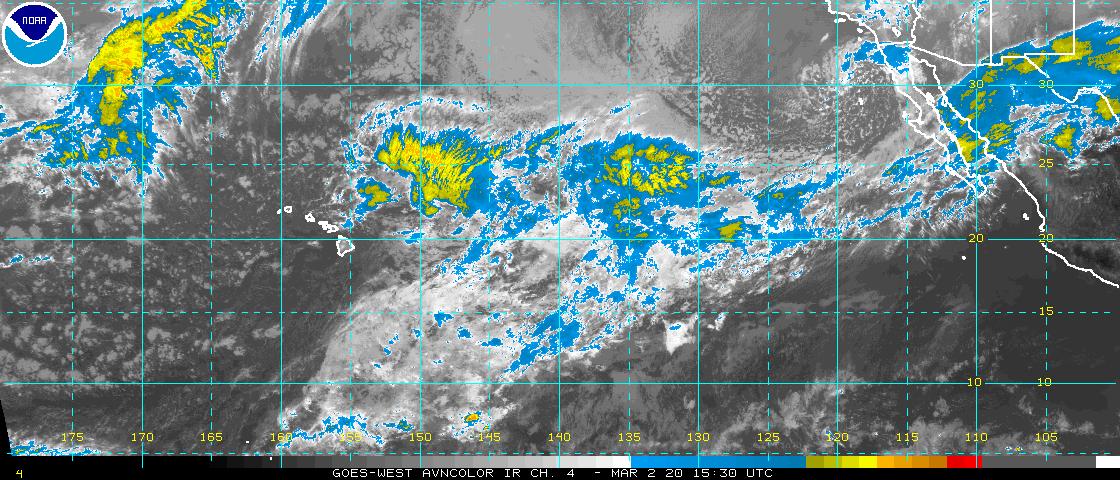
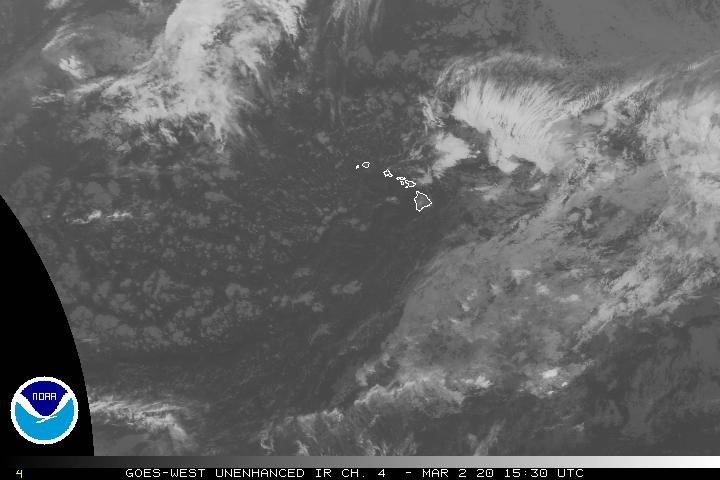
Satellite and Radar Images: To view the cloud conditions we have here in Hawaii, please use the following satellite links, starting off with this Infrared Satellite Image of the islands to see all the clouds around the state during the day and night. This next image is one that gives close images of the islands only during the daytime hours, and is referred to as a Close-up visible image. This next image shows a larger view of the Pacific…giving perspective to the wider ranging cloud patterns in the Pacific Ocean. Finally, here’s a Looping IR satellite image, making viewable the clouds around the islands 24 hours a day. To help you keep track of where any showers may be around the islands, here’s the latest animated radar image.
Hawaii’s Mountains – Here’s a link to the live webcam on the summit of near 14,000 foot Mauna Kea on the Big Island of Hawaii. The tallest peak on the island of Maui is the Haleakala Crater, which is near 10,000 feet in elevation. These two webcams are available during the daylight hours here in the islands…and when there’s a big moon rising just after sunset for an hour or two! Plus, during the nights and early mornings you will be able to see stars, and the sunrise too…depending upon weather conditions.
Tropical Cyclone activity in the eastern and central Pacific – Here’s the latest weather information coming out of the National Hurricane Center, covering the eastern north Pacific. You can find the latest tropical cyclone information for the central north Pacific (where Hawaii is located) by clicking on this link to the Central Pacific Hurricane Center. Here’s a tracking map covering both the eastern and central Pacific Ocean. A satellite image, which shows the entire ocean area between Hawaii and the Mexican coast…can be found here.
Aloha Paragraphs

A beach in Kihei…Maui
As expected the trade winds will remain on the blustery side of the wind scale through the first part of the upcoming new week…then become much lighter. We find near 1030 millibar high pressure systems to the northwest of the islands Sunday evening. These two high pressure cells are the source of our gusty winds…and will be merging together by Monday. The expectation is that these gusty trades will continue through at least the first half of the new week ahead…then taper off considerably around mid-week. This could put us into a convective weather pattern, with muggy conditions for several days thereafter.
Showers have backed off now, with relatively drier conditions prevailing until mid-week…when it may turn showery again. This satellite image shows a considerable amount of high cirrus clouds to our south…which could easily shift northward over us. The forecast calls for drier air arriving today into Monday, and remaining somewhat drier until around Tuesday night or Wednesday…when another possible area of showers arrives then for a couple of days. The leeward sides in particular will be nice and sunny for the time being, and ready for lots of sun bathing and beach walking during the days.
It’s Sunday evening here in Kula, Maui, as I begin writing the last part of today’s narrative. Sunday was such a sunny day here in the islands, and very warm too. Air temperatures around the state, at sea level locations, all were in the middle 80F’s…topping out at 88 in the big city of Honolulu during the afternoon hours. The trade winds were pretty gusty as well, and at around 5pm, the top gust around the state was 38 mph at that windy bay at Maalaea. I expect similar conditions through the next several days, with a change to lighter wind speeds, and more showers waiting until around mid-week coming up. ~~~ I’ll be back early Monday morning with your next new weather narrative from paradise, I hope you have a good Sunday night! Aloha for now…Glenn.
Interesting: It has been assumed that global warming would cause an expansion of the world’s deserts, but now some scientists are predicting a contrary scenario in which water and life slowly reclaim these arid places. They think vast, dry regions like the Sahara might soon begin shrinking. The evidence is limited and definitive conclusions are impossible to reach but recent satellite pictures of North Africa seem to show areas of the Sahara in retreat.
It could be that an increase in rainfall has caused this effect. Farouk el-Baz, director of the Centre for Remote Sensing at Boston University, believes the Sahara is experiencing a shift from dryer to wetter conditions. "It’s not greening yet.
But the desert expands and shrinks in relation to the amount of energy that is received by the Earth from the Sun, and this over many thousands of years," Mr el-Baz told the BBC World Service. "The heating of the Earth would result in more evaporation of the oceans, in turn resulting in more rainfall."
Interesting2: The findings of a major new study are consistent with gradual changes of current systems in the North Atlantic Ocean, rather than a more sudden shutdown that could lead to rapid climate changes in Europe and elsewhere. The research, based on the longest experiment of its type ever run on a "general circulation model" that simulated the Earth’s climate for 21,000 years back to the height of the last Ice Age, shows that major changes in these important ocean current systems can occur, but they may take place more slowly and gradually than had been suggested.
The newest findings, to be published July 17 in the journal Science, are consistent with other recent studies that are moving away from the theory of an abrupt "tipping point" that might cause dramatic atmospheric temperature and ocean circulation changes in as little as 50 years. "Research is now indicating that this phenomenon may happen, but probably not as a sudden threshold we’re crossing," said Peter Clark, a professor of geosciences at Oregon State University.
"For those who have been concerned about extremely abrupt changes in these ocean current patterns, that’s good news. "In the past it appears the ocean did change abruptly, but only because of a sudden change in the forcing," he said. "But when the ocean is forced gradually, such as we anticipate for the future, its response is gradual. That would give ecosystems more time to adjust to new conditions."
The findings do not change broader concerns about global warming. Temperatures are still projected to increase about four to 11 degrees by the end of this century, and the study actually confirms that some of the world’s most sophisticated climate models are accurate.
"The findings from this study, which also match other data we have on recorded climate change, are an important validation of the global climate models," Clark said. "They seem to be accurately reflecting both the type and speed of changes that have taken place in the past, and that increases our ability to trust their predictions of the future."
Interesting3: New evidence for ice-free summers with intermittent winter sea ice in the Arctic Ocean during the Late Cretaceous – a period of greenhouse conditions – gives a glimpse of how the Arctic is likely to respond to future global warming. Records of past environmental change in the Arctic should help predict its future behaviour.
The Late Cretaceous, the period between 100 and 65 million years ago leading up to the extinction of the dinosaurs, is crucial in this regard because levels of carbon dioxide (CO2) were high, driving greenhouse conditions.
But scientists have disagreed about the climate at this time, with some arguing for low Arctic late Cretaceous winter temperatures (when sunlight is absent during the Polar night) as against more recent suggestions of a somewhat milder 15°C mean annual temperature.
Writing in Nature, Dr Andrew Davies and Professor Alan Kemp of the University of Southampton’s School of Ocean and Earth Science based at the National Oceanography Centre, Southampton, along with Dr Jennifer Pike of Cardiff University take this debate a step forward by presenting the first seasonally resolved Cretaceous sedimentary record from the Alpha Ridge of the Arctic Ocean.
The scientists analyzed the remains of diatoms – tiny free-floating plant-like organisms – preserved in late Cretaceous marine sediments. In modern oceans, diatoms play a dominant role in the ‘biological carbon pump’ by which carbon dioxide is drawn down from the atmosphere through photosynthesis and a proportion of it exported to the deep ocean.
Unfortunately, the role of diatoms in the Cretaceous oceans has until now been unclear, in part because they are often poorly preserved in sediments. But the researchers struck lucky. "With remarkable serendipity," they explain, " successive US and Canadian expeditions that occupied floating ice islands above the Alpha Ridge of the Arctic Ocean, recovered cores containing shallow buried upper Cretaceous diatom ooze with superbly preserved diatoms."
This has allowed them to conduct a detailed study of the diatom fossils using sophisticated electron microscopy techniques. In the modern ocean, scientists use floating sediment traps to collect and study settling material. These electron microscope techniques that have been pioneered by Professor Kemp’s group at Southampton have unlocked a ‘palaeo-sediment trap’ to reveal information about Late Cretaceous environmental conditions.
Interesting4: June 2009 was the planet’s second-warmest June ever on record, the National Oceanographic and Atmospheric Administration (NOAA) reported Friday. Only 2005 was warmer. When just ocean areas are included, it was the warmest June ever. Global records began in 1880. "Large portions of each inhabited continent were substantially warmer than average during June 2009," NOAA’s National Climatic Data Center wrote in an online report
"The warmest anomalies were most notable in parts of Africa and most of Eurasia." The main cause for the warmth was the development of El Niño, a warming of tropical Pacific Ocean water that affects weather patterns worldwide. "If El Niño conditions continue to mature as projected by NOAA, global temperatures are likely to continue to threaten previous record highs," noted the report.
Overall, for the first half of the year, 2009 is the fifth-warmest year on record for the Earth, with an average global temperature nearly 1 degree above average. Only 1998, 2002, 2005, and 2007 had a higher average temperature for the first six months of the year.
In 2009, warmer-than-average conditions were recorded across much of the world’s land areas, with the exception of cooler-than-average temperatures across Canada. In the USA, the climate center reported earlier this week that the USA is having its 25th-warmest year on record, with only North Dakota experiencing below-average temperatures.
 Email Glenn James: