July 9-10, 2009
Air Temperatures – The following maximum temperatures were recorded across the state of Hawaii Thursday afternoon:
Lihue, Kauai – 83
Honolulu, Oahu – 87
Kaneohe, Oahu – 82
Kahului, Maui – 87
Hilo, Hawaii – 84
Kailua-kona – 86
Air Temperatures ranged between these warmest and coolest spots near sea level – and on the highest mountains…at 5 p.m. Thursday evening:
Barking Sands, Kauai – 86F
Molokai airport – 77
Haleakala Crater – 54 (near 10,000 feet on Maui)
Mauna Kea summit – 41 (near 14,000 feet on the Big Island)
Precipitation Totals – The following numbers represent the largest precipitation totals (inches) during the last 24 hours on each of the major islands, as of Thursday afternoon:
0.53 Mount Waialaele, Kauai
0.25 South Fork Kaukonahua, Oahu
0.03 Molokai
0.00 Lanai
0.00 Kahoolawe
0.49 Puu Kukui, Maui
1.03 Mountain View, Big Island
Marine Winds – Here’s the latest (automatically updated) weather map showing a 1027 millibar high pressure system to the northeast of the islands. This high pressure cell, with its associated high pressure ridge, will keep the trade winds blowing through Saturday.
Satellite and Radar Images: To view the cloud conditions we have here in Hawaii, please use the following satellite links, starting off with this Infrared Satellite Image of the islands to see all the clouds around the state during the day and night. This next image is one that gives close images of the islands only during the daytime hours, and is referred to as a Close-up visible image. This next image shows a larger view of the Pacific…giving perspective to the wider ranging cloud patterns in the Pacific Ocean. Finally, here’s a looping IR satellite image, making viewable the clouds around the islands 24 hours a day. To help you keep track of where any showers may be around the islands, here’s the latest animated radar image.
Hawaii’s Mountains – Here’s a link to the live webcam on the summit of near 14,000 foot Mauna Kea on the Big Island of Hawaii. The tallest peak on the island of Maui is the Haleakala Crater, which is near 10,000 feet in elevation. These two webcams are available during the daylight hours here in the islands…and when there’s a big moon rising just after sunset for an hour or two! Plus, during the nights and early mornings you will be able to see stars, and the sunrise too…depending upon weather conditions.
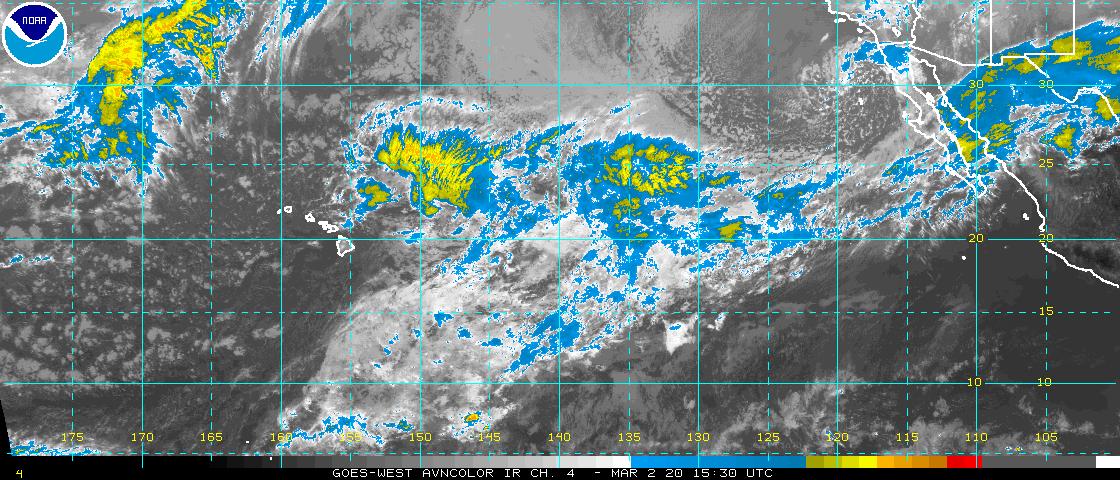
Tropical Cyclone activity in the eastern and central Pacific – Here’s the latest weather information coming out of the National Hurricane Center, covering the eastern north Pacific. You can find the latest tropical cyclone information for the central north Pacific (where Hawaii is located) by clicking on this link to the Central Pacific Hurricane Center. Here’s a tracking map covering both the eastern and central Pacific Ocean. A satellite image, which shows the entire ocean area between Hawaii and the Mexican coast…can be found here.
Aloha Paragraphs

Hanalei Beach…on Kauai
There’s still no end in sight for our blustery trade winds, we could almost say…never ending. These common trades will blow generally in the moderately strong levels, although those typically windier areas from the Big Island on up towards Oahu…will be a bit more blustery. Here’s a weather map showing the very familiar 1028 millibar high pressure system positioned to the northeast of Hawaii Thursday evening…the source of our breezy winds.
There’s nothing unusual about this common July rainfall pattern, with most of the showers falling along the windward sides. Some of those windward biased showers will be briefly heavy, but shortlived. The leeward sides in contrast will remain mostly dry, with warm to very warm daytime temperatures prevailing. We may see an increase in showers towards the upcoming weekend, when they may gain some intensity…especially on the windward sides.
It’s Thursday evening here in Kihei, Maui, as I begin writing this last part of this afternoon’s narrative. What else is there to say about this long lasting trade wind pattern…other than that it’s near perfect I suppose! Some of the windward beaches are pretty gusty, with the ocean surface just offshore…literally filled with countless white caps. Most of the leeward beaches in contrast, typically somewhat more protected from the wind flow, are very nice these days. The surf is down, actually near flat, in many of those south and west facing leeward beaches, which is making for really nice swimming conditions now. I see no reason to believe that Friday will be any different than what we’ve seen Thursday, or Wednesday and Tuesday for that matter. ~~~ It’s that time of day when I take the drive back upcountry to Kula. Looking out the window here in Kihei before I go, I see clear to partly cloudy conditions, although it looks a bit more cloudy up on the slopes of the Halaeakala Crater, where I’m heading. That’s fine with me, as I know that pretty much as soon as the sun goes down, those afternoon clouds will collapse. I’ll catch up with you again early Friday morning, and wish you a great Thursday night until then! Aloha for now…Glenn.
Interesting: Earth’s landmasses in the late Precambrian probably weren’t pleasant, but at least they were green. A new analysis of limestone rocks lain down between 1 billion and 500 million years ago suggests that there was extensive plant life on land much earlier than previously thought. The plants were only tiny mosses and liverworts, but they would have had a profound effect on the planet.
They turned the hitherto barren Earth green, created the first soils and pumped oxygen into the atmosphere, laying the foundations for animals to evolve in the Cambrian explosion that started 542 million years ago. It was already known from genetic evidence that mosses and liverworts probably evolved around 700 million years ago, but up till now there was little sign that they had colonized land to any great extent.
The assumption was that terrestrial life consisted of patchy bacterial mats and "algal scum" until the mid-Ordovician, 475 million years ago, when land was first invaded by modern-looking vascular plants. Paul Knauth of Arizona State University and Martin Kennedy of the University of California, Riverside, examined the chemical composition of all known lime stones dating from the Neoproterozoic era, which stretched from 1 billion years ago up to the start of the Cambrian. Knauth says the balance of carbon-12 to oxygen-18 in the lime stones is "screaming" that they were laid down in shallow seas that received extensive rainwater run-off from a land surface thick with vegetation.
Interesting2: Tire manufacturer Yokohama is now selling a model made with 80 percent non-petroleum material, substituting orange oil as the primary ingredient to make vulcanized rubber. The new tire is called the Super E-spec™ and has already received the Popular Mechanics Editor’s Choice Award in 2008. Yokohama will initially market the tire for hybrid car models such as the Toyota Prius.
"The eco-focused dB Super E-spec mixes sustainable orange oil and natural rubber to drastically cut the use of petroleum, without compromising performance," Yokohama vice president of sales Dan King said. "It also helps consumers save money at the gas pump by improving fuel efficiency via a 20-percent reduction in rolling resistance."
Orange oil is considered sustainable because it is produced from a renewable resource. The same philosophy of reducing petroleum use is utilized in producing plastics from corn starch or vegetable oil. Yokohama has yet to release the environmental impact of disposing these tires, which typically provides an environmental concern.
The petroleum in traditional tires can burn for months in a landfill and is difficult to extinguish. These fires also release black smoke and toxins into the air. Yokohama has not specified whether the orange oil will biodegrade over time.
The process for recycling tires involves devulcanizing the rubber, which would essentially remove the oil and extract natural rubber. Because this is an expensive process, used tires are often shredded and turned into playground surfacing or additives for the soil in sports turf. It can also be reused as artwork.
Interesting3: The giant monoliths of Easter Island are worn, but they have endured for centuries. New research suggests that a compound first discovered in the soil of the South Pacific island might help us stand the test of time, too. On July 8, in the journal Nature, The University of Texas Health Science Center at San Antonio and two collaborating centers reported that the Easter Island compound – called "rapamycin" after the island’s Polynesian name, Rapa Nui – extended the expected lifespan of middle-aged mice by 28 percent to 38 percent.
In human terms, this would be greater than the predicted increase in extra years of life if cancer and heart disease were both cured and prevented. The rapamycin was given to the mice at an age equivalent to 60 years old in humans. The studies are part of the National Institute on Aging (NIA) Interventions Testing Program, which seeks compounds that might help people remain active and disease-free throughout their lives.
The other two centers involved are the University of Michigan at Ann Arbor and Jackson Laboratory in Bar Harbor, Maine. The Texas study was led by scientists at two institutes at the UT Health Science Center: the Institute of Biotechnology (IBT) and the Barshop Institute for Longevity and Aging Studies.
"I’ve been in aging research for 35 years and there have been many so-called ‘anti-aging’ interventions over those years that were never successful," said Arlan G. Richardson, Ph.D., director of the Barshop Institute. "I never thought we would find an anti-aging pill for people in my lifetime; however, rapamycin shows a great deal of promise to do just that.
Interesting4: US scientists say that the El Nino warming trend of the Pacific Ocean waters has returned, bringing with it almost certain changes in weather patterns around the world. The El Nino climatological effect – the periodic warming of central and eastern tropical Pacific waters – occurs on average every two to five years and typically lasts about 12 months.
The US National Oceanic and Atmospheric Administration said the current El Nino was likely to develop further during the next several months, with additional strengthening possible and is expected to last through early 2010. In past years, El Nino has been known to suppress Atlantic hurricane activity and typically brings beneficial winter rain to the arid US southwest.
But the weather system also often brings damaging winter storms in California and turbulent weather across the southern United States. El Nino also has been associated with severe flooding and mudslides in Central and South America, and drought in Indonesia.
Jane Lubchenco, US undersecretary of commerce for oceans and atmosphere and NOAA administrator, said the agency plans to provide frequent updates to "industries, governments and emergency managers about weather conditions El Nino may bring, so these can be factored into decision-making and ultimately protect life, property and the economy".
 Email Glenn James: