Air Temperatures – The following maximum temperatures were recorded across the state of Hawaii Friday:
82 Lihue, Kauai
85 Honolulu, Oahu
84 Molokai
86 Kahului, Maui
87 Kona, Hawaii
82 Hilo, Hawaii
Air Temperatures ranged between these warmest and coolest spots near sea level – and on the highest mountain tops around the state… as of 530pm Friday evening:
Kailua Kona – 83
Hilo, Hawaii – 72
Haleakala Summit – 43 (near 10,000 feet on Maui)
Mauna Kea Summit – 57 (13,000+ feet on the Big Island)
Hawaii’s Mountains – Here’s a link to the live web cam on the summit of near 13,800 foot Mauna Kea on the Big Island of Hawaii. This web cam is available during the daylight hours here in the islands…and when there’s a big moon shining down during the night at times. Plus, during the nights you will be able to see stars, and the sunrise and sunset too… depending upon weather conditions. Here’s the Haleakala Crater webcam on Maui – if it’s working.
Aloha Paragraphs

High Surf Advisory…south shores
Trade winds, windward showers soon fading –
with lighter winds, afternoon showers…and
more vog in sight for the smaller islands
The following numbers represent the most recent top wind gusts (mph), along with directions as of Friday evening:
18 Mana, Kauai – NW
33 Kuaokala, Oahu – NE
28 Molokai – NE
40 Kahoolawe – NE
28 Kapalua, Maui – NE
27 South Point, Big Island – NE
Here are the latest 24-hour precipitation totals (inches) for each of the islands as of Friday evening:
0.28 Mount Waialeale, Kauai
0.45 Poamoho RG 1, Oahu
0.38 Molokai
0.00 Kahoolawe
0.90 Puu Kukui, Maui
0.81 Pahala, Big Island
We can use the following links to see what’s going on in our area of the north central Pacific Ocean. Here’s the latest NOAA satellite picture – the latest looping satellite image… and finally the latest looping radar image for the Hawaiian Islands.
~~~ Hawaii Weather Narrative ~~~
The trade winds will blow today into Saturday, then become lighter…into next week. Here’s a weather chart showing a high pressure centers to the northeast and far northwest. At the same time, we find several low pressure troughs over the ocean in our central Pacific. The winds will ease up this weekend, with the trades giving way to lighter and variable breezes, trending to the southeast in many areas, bringing voggy weather up over much of the state…for a prolonged period! It may take until around next Wednesday or Thursday before the trade winds return, helping to ventilate these hazy conditions out of our area.
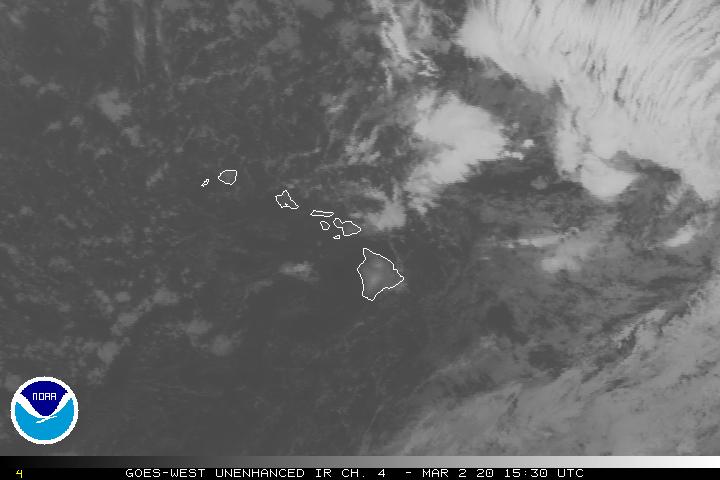
Satellite imagery shows large patches of low clouds around the islands, with higher level cirrus over the ocean to the northeast of the central islands…and to the south of the Big Island as well. Here’s the looping radar image, showing random showers being carried through the state…especially towards the Big Island and Maui at the time of this writing. As mentioned in the paragraph above, the forecast calls for a trough of low pressure to move over the islands this weekend, which would mean another increase in showers continuing into next week. These showers will be the kind that develop over and around the mountains during the afternoon hours…some of which may become quite generous in places. Here’s how the GFS weather model is showing this trough, with the various colors showing precipitation moving over us through Monday. It appears that this cloudy/showery afternoon convective weather pattern may last into the middle of the new work week ahead.
Here on Maui [505pm Friday, HST]: The gusty trade wind flow across our region of the north central Pacific…will falter this weekend. It will be replaced by a light wind regime, one called a convective weather pattern. We typically see clear to partly cloudy, and somewhat cooler than normal mornings during these periods. These pleasant conditions can stick around through the day along our beaches, although it will feel hotter than normal by the afternoons. It will be another story over and around the mountains, as daytime sea breezes carry moisture from the ocean, into those upcountry areas. This moisture then condenses into cumulus clouds, which get thicker and darker as the afternoons progress.
The low pressure over us this weekend, into the first part of next week, will make our overlying atmosphere somewhat unstable, leading to good afternoon downpours, at least locally. The computer models are suggesting that this unusual light wind pattern will last well into the new week ahead, which is hard to believe this late in the spring season. I’m sure that there will be some adjustments necessary along the way, although that’s how it looks from this point of view. By the way, the large south swell waves breaking along our leeward beaches, and will continue through the weekend, please use caution while entering our warm ocean. ~~~ Here at my Kula weather tower early this evening, it was 71.1F degrees (with a few little drops of water falling), while at the same time down at the Kahului airport, it was 83 degrees. The Hana airport was running 77, and the Kapalua airport on the upper west side was measuring in with 81…while the summit of the Haleakala Crater was cooler at 43 degrees. I’ll be back with a new weather narrative early Saturday morning, I hope you have a great Friday night wherever you happen to be spending it! Aloha for now…Glenn.
Friday evening film: This time round, I’ll see one of the many, many seemingly great films that are playing at the moment, namely The Great Gatsby, starring Leonardo DiCaprio, Carey Mulligan, Joel Edgerton, Tobey Maguire, Isla Fisher, and Elizabeth Debicki…among others of course. The synopsis: “The Great Gatsby” follows Fitzgerald-like, would-be writer Nick Carraway (Tobey Maguire) as he leaves the Midwest and comes to New York City in the spring of 1922, an era of loosening morals, glittering jazz, bootleg kings, and sky-rocketing stocks. Chasing his own American Dream, Nick lands next door to a mysterious, party-giving millionaire, Jay Gatsby (Leonardo DiCaprio), and across the bay from his cousin, Daisy (Carey Mulligan), and her philandering, blue-blooded husband, Tom Buchanan (Joel Edgerton). It is thus that Nick is drawn into the captivating world of the super rich, their illusions, loves and deceits. As Nick bears witness, within and without of the world he inhabits, he pens a tale of impossible love, incorruptible dreams and high-octane tragedy, and holds a mirror to our own modern times and struggles. ~~~ I’ve viewed the trailer several times, and it leaves me definitely wanting to see this film…so that I will. The critics aren’t exactly being generous in their praise for this new film, although I never let that stop me from seeing a film that attracts me. Here’s the trailer, take a look if you’re inclined.
World-wide tropical cyclone activity:
Atlantic Ocean/Caribbean Sea: There are no active tropical cyclones / Here’s a link to the National Hurricane Center in Miami…which covers tropical cyclone activity in the Atlantic, Caribbean Sea…and the Gulf of Mexico. The hurricane season in the Atlantic, Caribbean, and the Gulf of Mexico all begin as of June 1.
Gulf of Mexico: There are no active tropical cyclones
Eastern Pacific Ocean: There are no active tropical cyclones / AN AREA OF LOW PRESSURE…ASSOCIATED WITH THE REMNANTS OF ALVIN… CONTINUES ABOUT 850 MILES SOUTHWEST OF MANZANILLO MEXICO. ALTHOUGH SATELLITE DATA SUGGEST THAT THE LOW-LEVEL CIRCULATION OF THE LOW IS WELL DEFINED…SHOWER AND THUNDERSTORM ACTIVITY REMAINS DISORGANIZED. STRONG UPPER-LEVEL WESTERLY WINDS ARE EXPECTED TO INHIBIT ANY SIGNIFICANT DEVELOPMENT…AND THIS SYSTEM HAS A LOW CHANCE…20 PERCENT…OF BECOMING A TROPICAL CYCLONE AGAIN DURING THE NEXT 48 HOURS AS IT MOVES GENERALLY WESTWARD AROUND 10 MPH. Here’s a satellite image showing this area.
ELSEWHERE…TROPICAL CYCLONE FORMATION IS NOT EXPECTED DURING THE NEXT 48 HOURS.
Here’s a wide satellite image that covers the entire area between Mexico, out through the central Pacific…to the International Dateline.
Central Pacific Ocean: There are no active tropical cyclones / Here’s a link to the Central Pacific Hurricane Center (CPHC)…covering our central Pacific. The hurricane season in this part of the Pacific begins as of June 1st.
Western Pacific Ocean: There are no active tropical cyclones / Here’s a link to the Joint Typhoon Warning Center (JTWC), which covers tropical cyclone activity in the western Pacific, and the North and South Indian Ocean…and adjacent Seas.
South Pacific Ocean: There are no active tropical cyclones
North and South Indian Oceans: There are no active tropical cyclones
 Email Glenn James: