Air Temperatures – The following maximum temperatures were recorded across the state of Hawaii Saturday:
80 Lihue, Kauai
82 Honolulu, Oahu
81 Molokai
90 Kahului, Maui / record for the date 92F degrees – 1953
84 Kona, Hawaii
81 Hilo, Hawaii
Air Temperatures ranged between these warmest and coolest spots near sea level – and on the highest mountain tops around the state… as of 530am Sunday morning:
Kailua Kona – 74
Molokai airport – 60
Haleakala Summit – M (near 10,000 feet on Maui)
Mauna Kea Summit – 36 (13,000+ feet on the Big Island)
Hawaii’s Mountains – Here’s a link to the live web cam on the summit of near 13,800 foot Mauna Kea on the Big Island of Hawaii. This web cam is available during the daylight hours here in the islands…and when there’s a big moon shining down during the night at times. Plus, during the nights you will be able to see stars, and the sunrise and sunset too… depending upon weather conditions. Here’s the Haleakala Crater webcam on Maui – if it’s working.
Tropical Cyclone activity in the eastern and central Pacific – Here’s the latest weather information coming out of the National Hurricane Center, covering the eastern north Pacific. You can find the latest tropical cyclone information for the central north Pacific (where Hawaii is located) by clicking on this link to the Central Pacific Hurricane Center. A satellite image, which shows the entire ocean area between Hawaii and the Mexican coast… can be found here. The 2012 hurricane season is over in the eastern and central Pacific… resuming on May 15th and June 1st 2013.
Aloha Paragraphs

Our winds will become lighter from the south and southeast,
rather hot and muggy during the days…quite dry with just a few showers here and there – although Kauai will see some increased showers Sunday
Wave video called…Superbank & D’bah Gopro – Full Screen Viewing
The following numbers represent the most recent top wind gusts (mph), along with directions as of Saturday evening:
16 Mana, Kauai – SE
21 Kahuku Trng, Oahu – SE
12 Molokai – SW
29 Kahoolawe – NE
20 Lipoa, Maui – ENE
29 South Point, Big Island – NE
Here are the latest 24-hour precipitation totals (inches) for each of the islands as of Saturday evening:
0.04 Mount Waialeale, Kauai
0.02 Poamoho RG 1, Oahu
0.00 Molokai
0.00 Kahoolawe
0.00 Maui
0.37 Pahoa, Big Island
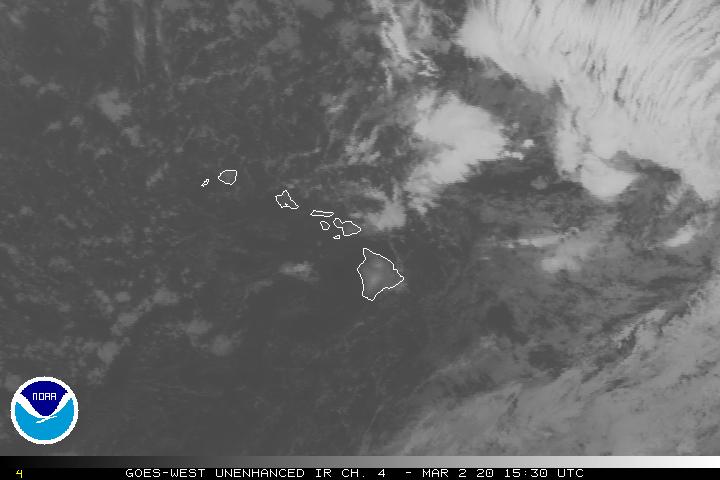
We can use the following links to see what’s going on in our area of the north central Pacific Ocean. Here’s the latest NOAA satellite picture – the latest looping satellite image… and finally the latest looping radar image for the Hawaiian Islands.
~~~ Hawaii Weather Narrative ~~~
Winds blowing from the south and southeast (at least in most areas) this weekend…through Tuesday. Here’s a weather chart showing a large, near 1031 millibar high pressure system, located well to the northeast of the islands. This high pressure cell has an associated ridge of high pressure extending southwest from its center, running across Oahu. An approaching cold front is edging in closer to the islands, causing our winds to become lighter. As these breezes lighten up, and turn to the south and southeast, we’ll see volcanic haze riding up over the smaller islands in places.
Satellite imagery shows clear to partly cloudy skies over the island chain, with a large area of thick high clouds over the ocean to southwest through northwest…moving into the state now. These high cirrus clouds will be migrating over the Aloha state tonight…as they edge further into our area. These will make for a cloudier day Sunday, with lots of sun dimming high clouds around. Here’s the looping radar image, showing very few showers, moving along in a southeast wind flow. We may begin to see some showery clouds approaching Kauai on Sunday, which may increase Sunday night into Monday.
We’re looking at a warm and sultry period…with little relief until later Tuesday or Wednesday of the new week. A late season cold front continues to slowly approach the state now, which in turn has pushed a high pressure ridge down over the islands now. This has keep us in a relatively dry convective weather pattern…especially from Oahu down through Maui County to the Big Island. There may be modest increases in afternoon showers Sunday, over the slopes of the islands. Meanwhile, the volcanic haze continues move over some parts of the island chain, and will stick around until the trade winds ventilate it away several days from now.
The computer models are now showing yet another late season cold front approaching the island chain in 4-5 days. This is definitely getting well into spring, although as we’re seeing, the fronts tend to stall before arriving this time of year. This front may very well stall before arriving later in the new work week ahead, around Thursday or Friday. If this occurs, and its still a question, we could see the same pattern as now. This would be lighter winds from the south or southeast, more voggy skies, and a chance of increased showers towards the end of the week. I’m personally going to hold this all lightly, as I’m not quite convinced yet. We’ll have to wait and see…and I’ll certainly keep you briefed-up on this possibility as we go forward.
Here on Maui [550pm HST]: Maui was mostly clear and warm Saturday…except over and around the Haleakala Crater, and the West Maui Mountains, where clouds gathered. A near record high temperature of 90F degrees occurred…at the Kahului airport! This temperature missed tying the old record (set in 1953), by only 2 degrees. Looking down into the central valley this evening, I still see a fairly modest amount of volcanic haze, although it’s definitely there. I’m expecting to see the leading edge of those approaching high cirrus clouds soon, perhaps in time for some color in our evening skies at sunset…we’ll definitely see more of that stuff Sunday. I’ll be back Sunday morning with you next new weather narrative, enjoy your Saturday night wherever you’re spending it! Aloha for now…Glenn.
World-wide tropical cyclone activity:
Atlantic Ocean/Caribbean Sea: There are no active tropical cyclones
Gulf of Mexico: There are no active tropical cyclones
Eastern Pacific Ocean: There are no active tropical cyclones
Central Pacific Ocean: There are no active tropical cyclones
Western Pacific Ocean: There are no active tropical cyclones
South Pacific Ocean: There are no active tropical cyclones
North and South Indian Oceans: There are no active tropical cyclones
 Email Glenn James: