











Air Temperatures – The following maximum temperatures were recorded across the state of Hawaii Tuesday:
Lihue, Kauai – 78
Honolulu airport, Oahu – 80
Molokai airport – 79
Kahului airport, Maui – 88
Kona airport, Hawaii – 86
Hilo airport, Hawaii – 83
Air Temperatures ranged between these warmest and coolest spots near sea level – and on the highest mountain tops around the state…as of 530am Wednesday morning:
Kailua Kona – 74
Kahului, Maui – 63
Haleakala Summit – 43 (near 10,000 feet on Maui)
Mauna Kea Summit – 30 (13,000+ feet on the Big Island)
Hawaii’s Mountains – Here’s a link to the live web cam on the summit of near 13,800 foot Mauna Kea on the Big Island of Hawaii. This web cam is available during the daylight hours here in the islands…and when there’s a big moon shining down during the night at times. Plus, during the nights you will be able to see stars, and the sunrise and sunset too…depending upon weather conditions. Here's the Haleakala Crater webcam on Maui – if it's working.
Tropical Cyclone activity in the eastern and central Pacific – Here’s the latest weather information coming out of the National Hurricane Center, covering the eastern north Pacific. You can find the latest tropical cyclone information for the central north Pacific (where Hawaii is located) by clicking on this link to the Central Pacific Hurricane Center. A satellite image, which shows the entire ocean area between Hawaii and the Mexican coast…can be found here. The 2012 hurricane season is over in the eastern and central Pacific…resuming on May 15th and June 1st 2013.
Aloha Paragraphs

Gradually returning trade winds…with
improving weather into Wednesday
~~~822pm HST Tuesday evening: mostly clear, less voggy, near
calm at my upcountry Kula, Maui weather tower, the
air temperature was 65.3F degrees~~~
The following numbers represent the most recent top wind gusts (mph), along with directions as of Tuesday evening:
15 Mana, Kauai – ESE
20 Kuaokala, Oahu – NNE
17 Molokai – NE
25 Kahoolawe – ESE
16 Hana, Maui – ESE
24 South Point, Big Island – NE
Here are the latest 24-hour precipitation totals (inches) for each of the islands as of Tuesday evening:
0.17 N Wailua ditch, Kauai
0.33 Oahu Forest NWR, Oahu
0.01 Molokai
0.00 Kahoolawe
0.00 Maui
0.24 Pahala, Big Island
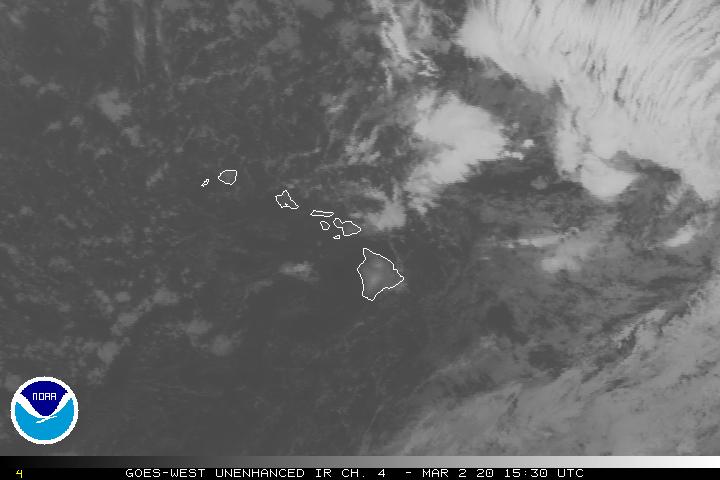
We can use the following links to see what’s going on in our area of the north central Pacific Ocean. Here's the latest NOAA satellite picture – the latest looping satellite image…and finally the latest looping radar image for the Hawaiian Islands.
~~~ Hawaii Weather Narrative ~~~
The trade winds are working their way back into our weather picture now…becoming stronger by mid-week through Friday. Here's a weather chart showing a near 1037 millibar high pressure system, located far to the northeast of the islands. This high pressure cell has an associated ridge of high pressure extending to the north of Kauai. Winds will gradually become trades again…which in turn will ventilate the locally voggy conditions away by Wednesday. The trades will stick around through Friday, and then shift back to the south and southeast by the weekend…as the next late season cold front approaches.
Satellite imagery shows that there are patches of high cirrus clouds over some parts of the island chain. As the trade winds return into Wednesday, and strengthen further through Thursday into Friday…we'll begin to see off and on showers falling along our windward sides statewide.
The long lasting period of southeast winds, caused by the recent cold front, is now through…with a trade wind weather pattern taking its place for several days. Volcanic haze (vog) is still evident in some parts of the state this evening, although the trade winds should take care of this problem on Wednesday. The trades will become quite breezy by mid-week, peaking in strength through Thursday into Friday. The computer models suggest that they will ease up late Friday or by Saturday morning, with southeast winds…and likely more voggy weather slated for the weekend. This will be caused by the approach of our next cold front, which will bring showers by later Saturday or Sunday. As this front gets near, a rather dynamic upper level trough is expected to enhance the associated shower activity, so that those showers may be quite generous Sunday into next Monday. ~~~ I'll be back with your next new weather narrative early Wednesday morning, I hope you have a great Tuesday night until then! Aloha for now…Glenn.
World-wide tropical cyclone activity:
Atlantic Ocean/Caribbean Sea: There are no active tropical cyclones
Gulf of Mexico: There are no active tropical cyclones
Eastern Pacific Ocean: There are no active tropical cyclones
Central Pacific Ocean: There are no active tropical cyclones
Western Pacific Ocean: There are no active tropical cyclones
South Pacific Ocean: There are no active tropical cyclones
North and South Indian Oceans: There are no active tropical cyclones
Interesting: According to government estimates, 138,500 whales and dolphins will soon be injured and possibly killed along the East Coast, if exploration companies are allowed to use dangerous blasts of noise to search for offshore oil and gas. The U.S. Department of the Interior (DOI) is considering allowing geophysical companies, working on behalf of oil and gas companies, to use seismic airguns to search for offshore oil and gas in the Atlantic Ocean, from Delaware to Florida.
These airguns use compressed air to generate intense pulses of sound, which are 100,000 times more intense than a jet engine. These loud blasts are used on a recurring basis, going off every ten seconds, for 24 hours a day, often for weeks on end.
They are so loud that they penetrate through the ocean, and miles into the seafloor, then bounce back, bringing information to the surface about the location of buried oil and gas deposits. Airgun blasts harm whales, dolphins, sea turtles and fish.
The types of impacts marine mammals may endure include temporary and permanent hearing loss, abandonment of habitat, disruption of mating and feeding, beach strandings and even death. Seismic airguns could devastate marine life, and harm fisheries and coastal economies along the Atlantic coast.
Seismic testing in the Atlantic would also be the first major step toward offshore drilling, which further harms the marine environment through leaks, oil spills, habitat destruction and greenhouse gas emissions.
 Email Glenn James:
buffalo Says:
Glenn: Excellent "drop-knee" photo in the surf report section today. Ah! Memories!.~~~Hi Buffalo, yes…fond memories for me as well! Thanks, Glenn