











Air Temperatures – The following maximum temperatures were recorded across the state of Hawaii Sunday:
Lihue, Kauai – 79
Honolulu airport, Oahu – 83
Molokai airport – 76
Kahului airport, Maui – 85
Kona airport, Hawaii – 84
Hilo airport, Hawaii – 87
Air Temperatures ranged between these warmest and coolest spots near sea level – and on the highest mountain tops around the state…as of 810pm Sunday evening:
Kailua Kona – 78
Lihue, Kauai – 70
Haleakala Summit – 41 (near 10,000 feet on Maui)
Mauna Kea Summit – 27 (13,000+ feet on the Big Island)
Hawaii’s Mountains – Here’s a link to the live web cam on the summit of near 13,800 foot Mauna Kea on the Big Island of Hawaii. This web cam is available during the daylight hours here in the islands…and when there’s a big moon shining down during the night at times. Plus, during the nights you will be able to see stars, and the sunrise and sunset too…depending upon weather conditions. Here's the Haleakala Crater webcam on Maui – if it's working.
Tropical Cyclone activity in the eastern and central Pacific – Here’s the latest weather information coming out of the National Hurricane Center, covering the eastern north Pacific. You can find the latest tropical cyclone information for the central north Pacific (where Hawaii is located) by clicking on this link to the Central Pacific Hurricane Center. A satellite image, which shows the entire ocean area between Hawaii and the Mexican coast…can be found here. The 2012 hurricane season is over in the eastern and central Pacific…resuming on May 15th and June 1st 2013.
Aloha Paragraphs

Wind Advisory…Big Island summits
~~~537am HST Monday morning: mostly clear, voggy,
calm at my upcountry Kula, Maui weather tower,
the air temperature was 55F degrees~~~
The following numbers represent the most recent top wind gusts (mph), along with directions as of Sunday evening:
18 Mana, Kauai – NW
18 Makua Range, Oahu – NW
18 Molokai – SE
18 Kahoolawe – SW
27 Kahului, Maui – SW
21 PTA Range 17, Big Island – NW
Here are the latest 24-hour precipitation totals (inches) for each of the islands as of Sunday evening:
0.77 Waialae, Kauai
1.44 Schofield South, Oahu
0.01 Molokai
0.08 Kahoolawe
0.13 Puu Kukui, Maui
0.05 Pali 2, Big Island
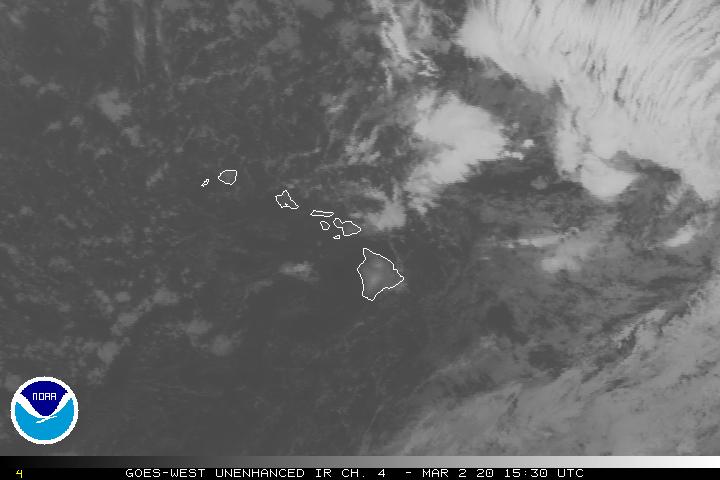
We can use the following links to see what’s going on in our area of the north central Pacific Ocean. Here's the latest NOAA satellite picture – the latest looping satellite image…and finally the latest looping radar image for the Hawaiian Islands.
~~~ Hawaii Weather Narrative ~~~
The cold front, although now stalling near Kauai, will bring rainfall to Oahu…easing up later tonight into Monday. Here's a weather chart showing a near 1030 millibar high pressure system, located well to the northeast of the islands. This high pressure cell has an associated ridge of high pressure, extending southwest to near the Big Island. The leading edge of the cold front is stalling near Kauai today. Winds will blow from the south to southeast for the time being…keeping voggy weather in place locally.
Satellite imagery shows a ragged area of rain producing clouds, over and around the Hawaiian Islands…which is associated with the cold front. Despite the easing threat of flooding over the western side of the island…there will likely be a few more locally heavy showers popping-up into the night. An upper level trough of low pressure, passing by to the north of the islands, should these additional showers falling in places. The eastern islands of Maui County and the Big Island, will see clouds and a few showers too…although they will be less intense.
The winds will be from the south to southeast near the stalled cold front, while southeast winds prevail elsewhere. Volcanic haze (vog) continues to move up from the Big Island vents, over Maui County, keeping hazy condition in place. This will remain true until the trade winds fill back into the area later Tuesday or Wednesday. As the trades arrive, more favorable weather conditions will return across the entire state. As the winds remain generally quite light over the next few days, there will be afternoon cloud buildups around the mountains each afternoon, leading to localized showers. ~~~ I'll be back early Monday morning with your next new weather narrative, I hope you have a great Sunday night wherever you happen to be reading from! Aloha for now…Glenn.
Friday evening film: Here I am just back from vacation, and already back in the groove, at least in terms of my Friday entertainment schedule. This time I saw the film called Olympus Has Fallen, starring Gerard Butler, Morgan Freeman, Dylan McDermott, Radha Mitchell, Ashley Judd, Aron Eckhart, Angela Bassett, and Melissa Leo…among others. The Synopsis: when the President is kidnapped by a terrorist who seizes control of the White House, disgraced former Presidential guard Mike Banning finds himself trapped within the building. As the national security team rushes to respond, they must rely on Banning’s insider knowledge to save the President and prevent an even greater catastrophe. The yahoo viewers are giving 4 on a scale of 5, while rotten tomatoes critics are giving a 48% rating. So, as we see, there's a fairly wide disparity between people's opinions…what else is new. As it turns out, I found this film to be very entertaining, although the subject matter was quite disturbing. As expected from this type of film, there was certainly no lack of shoot-um-up going on! As for my grade, well, it comes in somewhere between a B and a soft B+. Here's the trailer for this R rated action film.
World-wide tropical cyclone activity:
Atlantic Ocean/Caribbean Sea: There are no active tropical cyclones
Gulf of Mexico: There are no active tropical cyclones
Eastern Pacific Ocean: There are no active tropical cyclones
Central Pacific Ocean: There are no active tropical cyclones
Western Pacific Ocean: There are no active tropical cyclones
South Pacific Ocean: There are no active tropical cyclones
North and South Indian Oceans: Tropical cyclone 21S (Imelda) remains active in the south Indian Ocean, located approximately 360 NM east-northeast of La Reunion island in the South Indian Ocean. TC 21S has 65 knot sustained winds, with gusts to near 80 knots. Here's the Joint Typhoon Warning Center (JTWC) graphical track map, along with a satellite image.
Interesting: There's plenty of evidence that the climate has warmed up over the past century, and climate scientists know this has happened throughout the history of the planet. But they want to know more about how this warming is different. Now a research team says it has some new answers.
It has put together a record of global temperatures going back to the end of the last ice age — about 11,000 years ago — when mammoths and saber-tooth cats roamed the planet. The study confirms that what we're seeing now is unprecedented. What the researchers did is peer into the past.
They read ice cores from polar regions that show what temperatures were like over hundreds of thousands of years. But those only reveal changes in those specific regions; cores aren't so good at depicting what happened to the whole planet.
Tree rings give a more global record of temperatures, but only back about 2,000 years. Shaun Marcott, a geologist at Oregon State University, says "global temperatures are warmer than about 75 percent of anything we've seen over the last 11,000 years or so."
The other way to look at that is, 25 percent of the time since the last ice age, it's been warmer than now. You might think, so what's to worry about? But Marcott says the record shows just how unusual our current warming is.
"It's really the rates of change here that's amazing and atypical," he says. Essentially, it's warming up superfast. Here's what happened. After the end of the ice age, the planet got warmer. Then, 5,000 years ago, it started to get cooler — but really slowly. In all, it cooled 1.3 degrees Fahrenheit, up until the last century or so.
Then it flipped again — global average temperature shot up. "Temperatures now have gone from that cold period to the warm period in just 100 years," Marcott says. So it's taken just 100 years for the average temperature to change by 1.3 degrees, when it took 5,000 years to do that before.
The research team tracked temperature by studying chemicals in the shells of tiny, fossilized sea creatures called foraminifera. Their temperature record matches other techniques that look back 2,000 years, which supports the validity of their much longer record.
Climate scientists predict that the current warming will continue, given the amount of greenhouse gases going up into the atmosphere. "The climate changes to come are going to be larger than anything that human civilization and agriculture has seen in its entire existence," says Gavin Schmidt, a climate researcher at NASA's Goddard Institute for Space Studies. "And that is quite a sobering thought."
 Email Glenn James:







B. Hrast Says:
The looping radar images have not been working for days. glad you had another great vacation. aloha~~~Hi B.Hrast, I just checked all the looping radar images on my website, and there are currently three…they all are working just fine on my browser. Aloha, Glenn
Dwight Says:
Aloha Glenn,
Glad you're back! You have by far the best, most accessible weather site. I am curious about this weather pattern it seems odd at this time of year and am wondering if it portends a more active hurricane season for Hawaii? Do you have any thoughts about this extended Kona or variable weather we're having?
Thanks,
Dwight~~~Hi Dwight, your words are like music to my ears…thanks for your very positive feedback! It’s the middle of April, still a time that cold fronts can frequent our area of the north central Pacific…although this won’t be the case much longer into our spring season. As for our hurricane season: with and ENSO neutral condition expected into our summer season, I don’t see much of a deviation from normal in that regard. As for the unsettled weather, without the trade winds blowing now, it looks like it will be like this for another day or two. I’d expect returning trade winds, by Tuesday, then strengthening through the rest of the week. Good questions! Aloha, Glenn