











Air Temperatures – The following maximum temperatures were recorded across the state of Hawaii Friday:
Lihue, Kauai – 79
Honolulu airport, Oahu – 81
Molokai airport – 81
Kahului airport, Maui – 88
Kona airport, Hawaii – 84
Hilo airport, Hawaii – 83
Air Temperatures ranged between these warmest and coolest spots near sea level – and on the highest mountain tops around the state…as of 930pm Friday evening:
Kahului airport, Maui – 76
Hilo, Hawaii – 69
Haleakala Summit – 45 (near 10,000 feet on Maui)
Mauna Kea Summit – 28 (13,000+ feet on the Big Island)
Hawaii’s Mountains – Here’s a link to the live web cam on the summit of near 13,800 foot Mauna Kea on the Big Island of Hawaii. This web cam is available during the daylight hours here in the islands…and when there’s a big moon shining down during the night at times. Plus, during the nights you will be able to see stars, and the sunrise and sunset too…depending upon weather conditions. Here's the Haleakala Crater webcam on Maui – if it's working.
Tropical Cyclone activity in the eastern and central Pacific – Here’s the latest weather information coming out of the National Hurricane Center, covering the eastern north Pacific. You can find the latest tropical cyclone information for the central north Pacific (where Hawaii is located) by clicking on this link to the Central Pacific Hurricane Center. A satellite image, which shows the entire ocean area between Hawaii and the Mexican coast…can be found here. The 2012 hurricane season is over in the eastern and central Pacific…resuming on May 15th and June 1st 2013.
Aloha Paragraphs

Flash Flood Watch Niihau, Kauai and Oahu…
late tonight through Saturday night
Wind Advisory…Big Island summits
Here's the looping radar image showing the cold
front's rainfall as it slowly moves over Kauai
~~~10pm HST Friday evening: cloudy, voggy with
calm winds at my upcountry Kula, Maui weather
tower, the air temperature was 63.1F degrees~~~
The following numbers represent the most recent top wind gusts (mph), along with directions as of Friday evening:
24 Makaha Ridge, Kauai – SSE
28 Kuaokala, Oahu – SE
12 Molokai – ESE
25 Kahoolawe – E
16 Hana, Maui – SE
23 South Point, Big Island – NE
Here are the latest 24-hour precipitation totals (inches) for each of the islands as of Friday evening:
0.20 Waiakoali, Kauai
1.04 Oahu Forest NWR, Oahu
0.07 Molokai
0.00 Kahoolawe
0.02 Hana airport, Maui
0.13 Waiakea Uka, Big Island
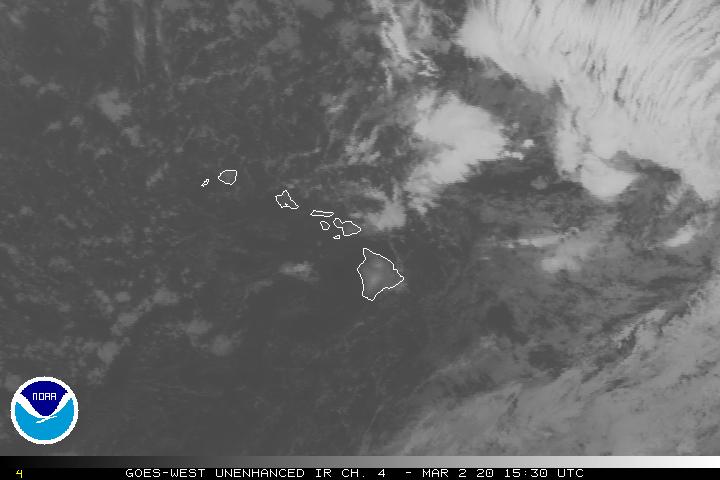
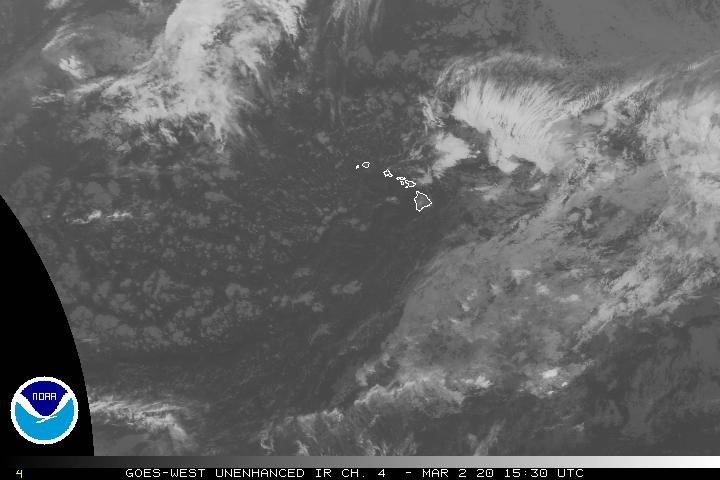
We can use the following links to see what’s going on in our area of the north central Pacific Ocean. Here's the latest NOAA satellite picture – the latest looping satellite image…and finally the latest looping radar image for the Hawaiian Islands.
~~~ Hawaii Weather Narrative ~~~
An active cold front is approaching the state from the west and northwest. Here's a weather chart showing a moderately strong, near 1030 millibar high pressure system, located well to the northeast of the islands. The cold front is moving towards Kauai, and will bring rather dramatic weather changes to the western part of the island chain later tonight into Sunday morning. The eastern islands will likely remain outside the expected heavy rains. Winds will increase from the southeast through south near Kauai and Oahu as well…as the front gets closer. Maui County and the Big Island will find southeasterly winds generally, which won't be as strong.
Satellite imagery shows an area of rain producing clouds near Kauai, which is associated with the cold front. This impressive area of inclement weather will push over Kauai tonight, which is why the NWS forecast office in Honolulu has issued a flash flood watch. The island of Oahu is expected to be on the receiving end of this heavy rainfall as well, thus the flood watch extends over that island as well. There are thunderstorm cells embedded in this cloud band, which will cause frequent lightning and thunder…and locally strong winds. These too are infamous for generating flood producing rainfall, so we should be prepared for poor visibilities while driving on Kauai and eventually Oahu too. Flash floods can be dangerous in other ways, so the folks on Kauai and Oahu should be careful over the next 24 hours or so.
This cold front won't be passing through the entire state, but rather stall over the western islands Saturday. Thus, the attendant rainfall pattern will be skewed, with Kauai and Oahu receiving the lion's share of the precipitation. Maui County and the Big Island are expected to remain just outside the primary rain shield of this dynamic cold front. This doesn't mean that the eastern islands won't pick up some showers, just that the heavy stuff will likely remain to the west. The computer models suggest that the stalled front will keep heavy weather conditions in place over the Kauai end of the chain through at least half the weekend.
The winds will be from the kona direction (south to southwest) near the cold front, while southeast winds prevail elsewhere. Volcanic haze (vog) will extend up from the Big Island vents, over Maui County, and perhaps keep things hazy until the trade winds fill back into the island weather picture. The trade winds aren't expected to return until early in the new week, probably around Tuesday or so. As the trades arrive, more favorable weather conditions will return across the entire state. ~~~ I'll be back early Saturday morning with more cutting edge news on this upcoming wet weather situation, at least locally. I hope you have a great Friday night wherever you happen to be reading from! Aloha for now…Glenn.
Friday evening film: Here I am back from vacation one day, and I'm already back in the groove, at least in terms of my Friday entertainment schedule. This time I'll see the film called Olympus Has Fallen, starring Gerard Butler, Morgan Freeman, Dylan McDermott, Radha Mitchell, Ashley Judd, Aron Eckhart, Angela Bassett, and Melissa Leo…among others. The Synopsis: When the President is kidnapped by a terrorist who seizes control of the White House, disgraced former Presidential guard Mike Banning finds himself trapped within the building. As the national security team rushes to respond, they must rely on Banning’s insider knowledge to save the President and prevent an even greater catastrophe. The yahoo viewers are giving 4 on a scale of 5, while rotten tomatoes critics are giving a 48% rating. So, as we see, there's a fairly wide disparity between people's opinions…what else is new. I'll be sure to give you my own thoughts on this film Saturday morning. Until then, here's the trailer for this R rated action film.
World-wide tropical cyclone activity:
Atlantic Ocean/Caribbean Sea: There are no active tropical cyclones
Gulf of Mexico: There are no active tropical cyclones
Eastern Pacific Ocean: There are no active tropical cyclones
Central Pacific Ocean: There are no active tropical cyclones
Western Pacific Ocean: There are no active tropical cyclones
South Pacific Ocean: There are no active tropical cyclones
North and South Indian Oceans: Tropical cyclone 21S (Imelda) remains active in the south Indian Ocean, located approximately 405 NM north-northeast of La Reunion. TC 21S has 35 knot sustained winds, with gusts to near 45 knots. Here's the Joint Typhoon Warning Center (JTWC) graphical track map, along with a satellite image.
Interesting: As both climate change and population growth continue to increase, there is reason to believe that food commodity prices will be both higher and more volatile in the decades to come. Continuing a decade-long increase, global food prices rose 2.7 percent in 2012, reaching levels not seen since the 1960s and 1970s but still well below the price spike of 1974.
Between 2000 and 2012, the World Bank global food price index increased 104.5 percent, at an average annual rate of 6.5 percent. The price increases reverse a previous trend when real prices of food commodities declined at an average annual rate of 0.6 percent from 1960 to 1999, approaching historic lows.
The sustained price decline can be attributed to farmers' success in keeping crop yields ahead of rising worldwide food demand. Although the global population grew by 3.8 billion or 122.9 percent between 1961 and 2010, net per capita food production increased by 49 percent over this period.
Advances in crop breeding and an expansion of agricultural land drove this rise in production, as farmers cultivated an additional 434 million hectares between 1961 and 2010. Food price volatility has increased dramatically since 2006.
According to the United Nations Food and Agriculture Organization (FAO), the standard deviation—or measurement of variation from the average – for food prices between 1990 and 1999 was 7.7 index points, but it increased to 22.4 index points in the 2000—12 period.
Although food price volatility has increased in the last decade, it is not a new phenomenon. According to World Bank data, the standard deviation for food prices in 1960—99 was 11.9 index points higher than in 2000-12.
Some price volatility is inherent in agricultural commodities markets, as they are strongly influenced by weather shocks. But the recent upward trend in food prices and volatility can be traced to additional factors including climate change, policies promoting the use of biofuels, rising energy and fertilizer prices, poor harvests, national export restrictions, rising global food demand, and low food stocks.
Perhaps most significant has been an increase in biofuels production in the last decade. Between 2000 and 2011, global biofuels production increased more than 500 percent, due in part to higher oil prices and the adoption of biofuel mandates in the United States and European Union (EU).
According to a 2012 study by the University of Bonn’s Center for Development Research, if biofuel production continues to expand according to current plans, the price of feedstock crops (particularly maize, oilseed crops, and sugar cane) will increase more than 11 percent by 2020.
Large-scale imports of agricultural commodities in 2007–08 and 2011 were important factors in the global food price spikes in those years. High Chinese imports of soybeans, for instance, contributed to the 2011 spike.
National export restrictions, including taxes and bans, also drove up food prices; policies enacted in 2007–08 in response to the price spike generated panic in net-food importing countries and raised grain prices by as much as 30 percent, according to some estimates.
In the last few decades, periods in which the cereals stock-to-use ratio (the level of carryover reserves of cereals as a percentage of total annual use) was near its minimum have correlated with a high price of calories from food commodities. When food stocks are high, shocks can be absorbed more easily than when stocks are low or nonexistent.
The world stock-to-use ratio for calories from wheat, maize, and rice was lower in the last decade than in the two preceding decades, which may be a main reason for higher global food prices. Rising energy and fertilizer prices drove up food prices as well, by adding to production, processing, transportation, and storage costs.
According to the World Bank commodity price index, the average price of energy during 2000–12 was 183.6 percent higher than the average price during 1990–99, while the average price of fertilizer increased 104.8 percent in the same period.
There is reason to believe that food commodity prices will be both higher and more volatile in the decades to come. As climate change increases the incidence of extreme weather events, production shocks will become more frequent.
Food prices will also likely be driven up by population growth, increasing global affluence, stronger linkages between agriculture and energy markets, and natural resource constraints. According to the FAO, although high food prices tend to aggravate poverty, food insecurity, and malnutrition, they also represent an opportunity to catalyze long-term investment in agriculture, which could boost resilience to climate change and augment global food security.
 Email Glenn James:







Eliza Says:
E komo mai, Glenn!
Glad you had an excellent batch of travels in Cali. Yes, sometimes it is good to visit the elders more often when they reach their twilight years.
Glad you are here for our changing weather.
Peace to you & yours ~ Eliza ~~~~ Hi Eliza, good to hear from you as always. I did have an excellent visit to California, as they always are. Yes, my Mom is doing great, thanks. I’m back, and enjoying our weather here in the islands, I love it! Aloha, Glenn
Mary Says:
Glenn,
Glad to have you back on Maui. Enjoyed your vacation travelogue.~~~Hi Mary, thanks for your welcome back, I appreciate that! Glad you enjoyed my vacation as well…I sure did too! Aloha, Glenn