











Air Temperatures – The following maximum temperatures were recorded across the state of Hawaii Saturday:
Lihue, Kauai – 76
Honolulu airport, Oahu – 82
Molokai airport – 77
Kahului airport, Maui – 82
Kona airport, Hawaii – 84
Hilo airport, Hawaii – 83
Air Temperatures ranged between these warmest and coolest spots near sea level – and on the highest mountain tops around the state…as of 530am Sunday morning:
Kaneohe, Oahu – 73
Lihue, Kauai – 64
Haleakala Summit – 37 (near 10,000 feet on Maui)
Mauna Kea Summit – 27 (13,000+ feet on the Big Island)
Hawaii’s Mountains – Here’s a link to the live web cam on the summit of near 13,800 foot Mauna Kea on the Big Island of Hawaii. This web cam is available during the daylight hours here in the islands…and when there’s a big moon shining down during the night at times. Plus, during the nights you will be able to see stars, and the sunrise and sunset too…depending upon weather conditions. Here's the Haleakala Crater webcam on Maui – if it's working.
Tropical Cyclone activity in the eastern and central Pacific – Here’s the latest weather information coming out of the National Hurricane Center, covering the eastern north Pacific. You can find the latest tropical cyclone information for the central north Pacific (where Hawaii is located) by clicking on this link to the Central Pacific Hurricane Center. A satellite image, which shows the entire ocean area between Hawaii and the Mexican coast…can be found here. The 2012 hurricane season is over in the eastern and central Pacific…resuming on May 15th and June 1st 2013.
Aloha Paragraphs

Wind Advisory for the Big Island Summits
Small Craft Wind Advisory…statewide
High Surf Advisory…north and west shores
from Kauai down through Maui
Locally gusty Kona winds from the south to
southwest…followed by slightly cooler north
to northeast winds
A cold front will bring rainfall over Oahu and Maui
County today…stalling somewhere near Maui later
this evening
Here's a looping radar image, so we can keep
track of where showers are falling – and the
location of the cold front right now –
and the closer view
~~~604am HST Sunday morning: cloudy, breezy,
at my upcountry Kula, Maui weather tower, the
air temperature was 57.4.1F degrees~~
The following numbers represent the most recent top wind gusts (mph), along with directions as of Saturday evening:
23 Port Allen, Kauai – SSW
27 Kuaokala, Oahu – SW
24 Molokai – SW
28 Kahoolawe – SW
29 Kahului, Maui – SW
35 Kaupulehu, Big Island – SW
Here are the latest 24-hour precipitation totals (inches) for each of the islands as of Saturday evening:
1.27 Waiakoali, Kauai
0.40 Waiahole, Oahu
0.20 Molokai
0.00 Lanai
0.00 Kahoolawe
0.18 Kaupo Gap, Maui
0.14 Pali 2, Big Island
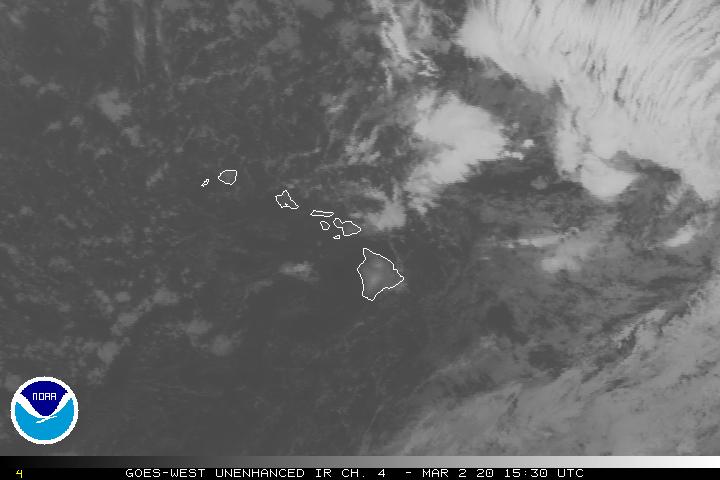
We can use the following links to see what’s going on in our area of the north central Pacific Ocean. Here's the latest NOAA satellite picture – the latest looping satellite image…and finally the latest looping radar image for the Hawaiian Islands.
~~~ Hawaii Weather Narrative ~~~
Our winds will be locally gusty from the south to southwest…then lighter northerly breezes in the wake of the passing cold front. Here's a weather chart showing a near 1033 millibar high pressure system far to the northeast of Hawaii. At the same time, we have a cold front moving over Kauai…whose parent low is a storm to the north-northwest of the islands. Our local winds are locally quite gusty from the south and southwest. These kona winds are blowing thanks to the approach of this late winter cold front, as it gets ready to push into our Aloha state. This front will move down through Kauai now, then onwards deeper into the island chain through the rest of this weekend. Slightly cooler northerly breezes will fill in behind the frontal passage…into the new week ahead.
Satellite imagery shows clear to partly cloudy skies in some areas, with locally cloudy areas…and the cold front now over Oahu. The overlying atmosphere is quickly becoming more shower prone. This change is happening, as a trough of low pressure aloft is accompanying the cold front into our area. This larger satellite picture shows the deep layered cloudiness associated with the frontal boundary. The heaviest showers along this front are located to the northeast, with a few embedded thunderstorms. The front will bring showers as it rides down through our area into Sunday evening or Monday morning. There's a good chance that some of these frontal, and even pre-frontal showers will be generous at times. This prefrontal shower band, at the time of this writing, was bringing showers to Maui County.
Look for showers, some of which will be locally heavy this weekend. As noted in the paragraphs above, a fairly impressive cold front has now begun its passage down into the state…although will slow down as it impacts the islands. It is bringing clouds and showers, some of which will be locally heavy. Ahead of the front, the gusty south to southwest kona winds, have prompted pre-frontal clouds and showers, which were passing slowly over Maui County. As for timing, the frontal passage has already occurred for Kauai, as it pushes across Oahu tonight. Thereafter, it is expected to stall around Maui County or the Big Island later Sunday into Monday.
Looking ahead, it appears that we'll have a continued period of unsettled weather, as we push into the new week ahead. A northerly wind flow, although not expected to be strong, will keep slightly cooler than normal air temperatures in place. Depending upon how much moisture is left over from the stalled front, the north and northeast coasts and slopes will continue to see passing shower activity. There will need to be an ongoing fine tuning of this weekend's weather conditions, stay tuned. I'll be back Sunday morning with your next new weather narrative, I hope you have a great Saturday night wherever you happen to be spending it! Aloha for now…Glenn.
Notice: This next Wednesday, March 13th, I'll be flying to northern California, beginning a visit with family and friends…through April 11th. As usual, the daily weather forecasts on this website will remain available in my absence. I'll have more to say about this trip before leaving, although I just wanted to give you a heads-up well before my departure.
Friday evening film: I typically don't go to see a film on its opening night, although this week I made an exception. This week's film was called Dead Man Down, starring Colin Farrell, Noomi Rapace, Dominic Cooper, Terrence Howard, and Isabelle Huppert. The synopsis: two strangers are irresistibly drawn to one another…by their mutual desire for revenge. It's being called a thriller, with definite criminal overtones. This film had its fair share, if not more than that…of violence. Given that I knew this going in, I was ready for it…with my seat belt cinched down tight! I'm slightly hesitant to say this, but I really liked it, even more than I thought I was going to. There was a very cool love story between the two main actors, which was endearing…in a very interesting way. As for a grade, it deserves somewhere between a B+ and an A- in my book, although I wouldn't recommend that most of you go rushing off to see it, no, no, no! Although, there will be some of you, you know who you are, that should be buying a ticket right now. I don't know how many of you would want to take a look at the trailer, but here it is…it's not a mild mannered viewing.
World-wide tropical cyclone activity:
Atlantic Ocean/Caribbean Sea: There are no active tropical cyclones
Gulf of Mexico: There are no active tropical cyclones
Eastern Pacific Ocean: There are no active tropical cyclones
Central Pacific Ocean: There are no active tropical cyclones
Western Pacific Ocean: There are no active tropical cyclones
South Pacific Ocean: Tropical cyclone 19P (Sandra) remains active in the southwest Pacific, located approximately 455 NM northwest of Noumea, New Caledonia. TC 19P has 110 knot sustained winds, with gusts to near 135 knots. Here's the Joint Typhoon Warning Center (JTWC) graphical track map, along with a satellite image.
North and South Indian Oceans: There are no active tropical cyclones
Interesting: How warm or cold is on Earth as compared to earlier times? Of course, going back far enough and one can find all sorts of extremes. How about the last ten thousand years? Using data from 73 sites around the world, scientists have been able to reconstruct Earth’s temperature history back to the end of the last Ice Age, revealing that the planet today is warmer than it has been during 70 to 80 percent of the time over the last 11,300 years.
Of even more concern are projections of global temperature for the year 2100, when virtually every climate model evaluated by the Intergovernmental Panel on Climate Change (IPCC) shows that temperatures will exceed the warmest temperatures during that 11,300-year period known as the Holocene — under all plausible greenhouse gas emission scenarios.
Results of the study, by researchers at Oregon State University and Harvard University, were published this week in the journal Science. It was funded by the National Science Foundation’s Paleoclimate Program. Lead author Shaun Marcott, a post-doctoral researcher in Oregon State’s College of Earth, Ocean, and Atmospheric Sciences, noted that previous research on past global temperature change has largely focused on the last 2,000 years.
Extending the reconstruction of global temperatures back to the end of the last Ice Age puts today’s climate into a larger context. "We already knew that on a global scale, Earth is warmer today than it was over much of the past 2,000 years," Marcott said. "Now we know that it is warmer than most of the past 11,300 years. This is of particular interest because the Holocene spans the entire period of human civilization."
The Neolithic Era, or Period, or New Stone age, was a period in the development of human technology, beginning about 10,200 BC,in some parts of the Middle East, and later in other parts of the world and ending between 4,500 and 2,000 BC. After that the modern era of man began. Peter Clark, an OSU paleoclimatologist and co-author on the Science article, said many previous temperature reconstructions were regional in nature and were not placed in a global context.
Marcott led the effort to combine data from 73 sites around the world, providing a much broader perspective. "When you just look at one part of the world, the temperature history can be affected by regional climate processes like El Niño or monsoon variations," noted Clark. "But when you combine the data from sites all around the world, you can average out those regional anomalies and get a clear sense of the Earth’s global temperature history."
What that history shows, the researchers say, is that over the past 5,000 years, the Earth on average cooled about 1.3 degrees (Fahrenheit) — until the past 100 years, when it warmed ? 1.3 degrees (F). The largest changes were in the northern hemisphere, where there are more land masses and greater human populations.
Climate models project that global temperature will rise another 2.0 to 11.5 degrees (F) by the end of this century, largely dependent on the magnitude of carbon emissions. "What is most troubling," Clark said, "is that this warming will be significantly greater than at any time during the past 11,300 years."
Marcott said that one of the natural factors affecting global temperatures over the past 11,300 years is gradual change in the distribution of solar insolation associated with Earth’s position relative to the sun. "During the warmest period of the Holocene, the Earth was positioned such that Northern Hemisphere summers warmed more," Marcott said.
"As the Earth’s orientation changed, Northern Hemisphere summers became cooler, and we should now be near the bottom of this long-term cooling trend — but obviously, we are not." Clark said that other studies, including those outlined in past IPCC reports, have attributed the warming of the planet over the past 50 years to anthropogenic, or human-caused activities — and not solar variability or other natural causes.
Slight variations in Earth's orbit lead to changes in the seasonal distribution of sun (solar)light reaching the Earth's surface and how it is distributed across the globe. There is very little change to the area-averaged annually averaged sunshine; but there can be strong changes in the geographical and seasonal distribution.
The three types of orbital variations are variations in Earth's eccentricity, changes in the tilt angle of Earth's axis of rotation, and precession of Earth's axis. Combined together, these produce Milankovitch cycles which have a large impact on climate and are notable for their correlation to glacial and interglacial periods, their correlation with the advance and retreat of the Sahara, and for their appearance in the stratigraphic record.
"The last century stands out as the anomaly in this record of global temperature since the end of the last ice age," said Candace Major, program director in the National Science Foundation’s Division of Ocean Sciences. "This research shows that we’ve experienced almost the same range of temperature change since the beginning of the industrial revolution as over the previous 11,000 years of Earth history — but this change happened a lot more quickly."
The research team, which included Jeremy Shakun of Harvard University and Alan Mix of Oregon State, primarily used fossils from ocean sediment cores and terrestrial archives to reconstruct the temperature history. The chemical and physical characteristics of the fossils — including the species as well as their chemical composition and isotopic ratios — provide reliable proxy records for past temperatures by calibrating them to modern temperature records.
Using data from 73 sites around the world allows a global picture of the Earth’s history and provides new context for climate change analysis. "The Earth’s climate is complex and responds to multiple forcings, including CO2 and solar insolation," Marcott said. "Both of those changed very slowly over the past 11,000 years. But in the last 100 years, the increase in CO2 through increased emissions from human activities has been significant. It is the only variable that can best explain the rapid increase in global temperatures."
 Email Glenn James: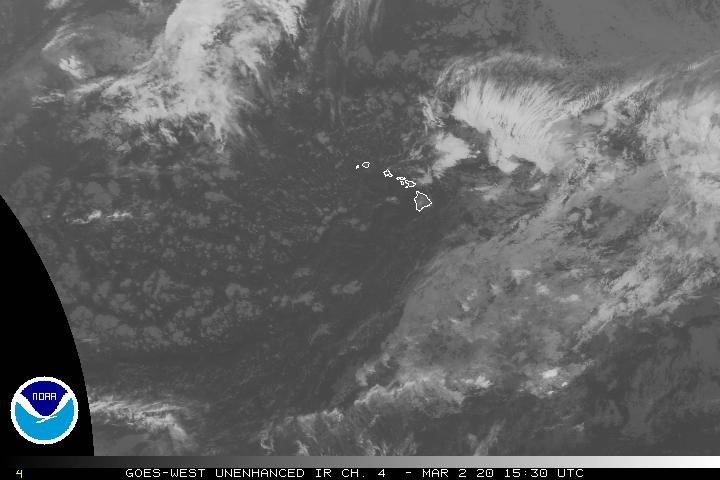




Frank Says:
Both the pre-frontal showers AND this morning's frontal passage DRENCHED West End Moloka'i —nearly 2 inches in little over 2 hours here in our front yard. Molo will stay GREEN!~~~Hi Frank, I thought I might hear from you today, what with all that rain you been gettin’. Good for you, greening up for spring. Be well my friend, Aloha, Glenn