











Air Temperatures – The following maximum temperatures were recorded across the state of Hawaii Wednesday:
Lihue, Kauai – 77
Honolulu airport, Oahu – 82
Molokai airport – 79
Kahului airport, Maui – 81
Kona airport, Hawaii – 81
Hilo airport, Hawaii – 77
Air Temperatures ranged between these warmest and coolest spots near sea level – and on the highest mountain tops around the state…as of 510am Thursday morning:
Kailua Kona – 69
Hilo, Hawaii – 62
Haleakala Summit – 41 (near 10,000 feet on Maui)
Mauna Kea Summit – 30 (13,000+ feet on the Big Island)
Hawaii’s Mountains – Here’s a link to the live web cam on the summit of near 13,800 foot Mauna Kea on the Big Island of Hawaii. This web cam is available during the daylight hours here in the islands…and when there’s a big moon shining down during the night at times. Plus, during the nights you will be able to see stars, and the sunrise and sunset too…depending upon weather conditions. Here's the Haleakala Crater webcam on Maui – if it's working.
Tropical Cyclone activity in the eastern and central Pacific – Here’s the latest weather information coming out of the National Hurricane Center, covering the eastern north Pacific. You can find the latest tropical cyclone information for the central north Pacific (where Hawaii is located) by clicking on this link to the Central Pacific Hurricane Center. A satellite image, which shows the entire ocean area between Hawaii and the Mexican coast…can be found here. The 2012 hurricane season is over in the eastern and central Pacific…resuming on May 15th and June 1st 2013.
Aloha Paragraphs

Nice weather continues, a few afternoon upcountry
showers, lighter trades turning southeast Thursday…
with volcanic haze into Friday
Showers arriving this weekend from a cold front…
first on Kauai late Saturday, Oahu that night, the
rest of the island chain during the day Sunday
~~~533am HST Thursday evening: mostly clear, calm
at my upcountry Kula, Maui weather tower, the
air temperature was 50.9F degrees~~~
The following numbers represent the most recent top wind gusts (mph), along with directions as of Wednesday evening:
22 Port Allen, Kauai – SE
27 Kahuku Trng, Oahu – ESE
21 Molokai – ENE
30 Kahoolawe – ENE
23 Lipoa, Maui – ENE
23 Pali 2, Big Island – ENE
Here are the latest 24-hour precipitation totals (inches) for each of the islands as of Wednesday evening:
0.05 Mount Waialeale, Kauai
0.14 Kamehame, Oahu
0.08 Molokai
0.00 Lanai
0.00 Kahoolawe
0.10 Puu Kukui, Maui
0.62 Kawainui Stream, Big Island
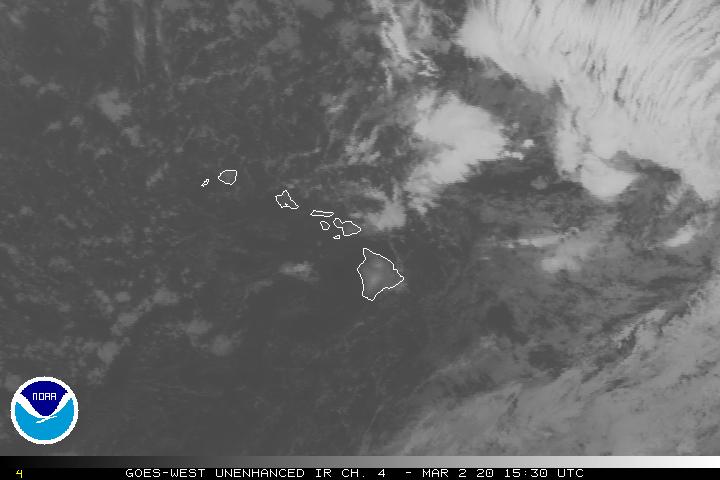
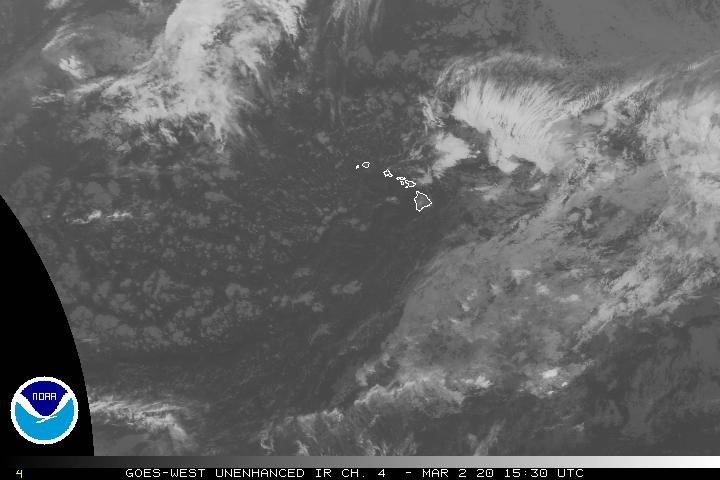
We can use the following links to see what’s going on in our area of the north central Pacific Ocean. Here's the latest NOAA satellite picture – the latest looping satellite image…and finally the latest looping radar image for the Hawaiian Islands.
~~~ Hawaii Weather Narrative ~~~
The trade winds will give way to lighter southeast breezes Thursday into Friday…veering to the south or southwest on the western islands this weekend. Here's a weather chart showing a large near 1026 millibar high pressure system to the northeast of Hawaii. At the same time, we see a long cold front to our northwest…extending out of a deep storm low pressure system. Our trade winds will prevail for the time being, then become lighter Thursday and Friday…into the weekend. We will find winds veering around to the southeast and south, as a late winter cold front gets closer to the islands. At the moment, it looks like the front will move down through the state later this weekend. Cooler north to northeast breezes will fill in behind the frontal passage…into early next week.
Satellite imagery shows a few low clouds around the islands, especially around the interior sections this evening. The overlying atmosphere has become slightly more moist now, as we've begun to see a few more showers falling locally. The leeward beaches will remain generally dry for the time being however. This larger satellite picture shows an area of bright white, high level cloudiness to the north. We're also now able to see the cold front that will reach the state later this weekend. It will remain quite dry in most areas over the next several days, although we're apt to see a few showers, especially in the upcountry areas during the afternoons locally. Until the trade winds ease up, and turn southeast Thursday, we'll see a few windward showers too…especially on Maui and the Big Island.
Looking ahead, our winds will become lighter and turn southeast…bringing volcanic haze (vog) into our Hawaiian weather picture. This change will occur thanks to an advancing cold front, as shown in the satellite picture above. As this frontal boundary gets closer, it will cause a corresponding wind shift to the southeast…and then the south or southwest preceding the fronts close approach to Kauai later Saturday. It appears that this frontal cloud band will drop down through the rest of the state, during the second half of the weekend, bringing showers with it. As usual, there will be quite a bit of fine tuning, as we track this approaching cold front…and its associated influences here in the Aloha state.
The models, at least some of them, are now trying to stall the front over Maui and the Big Island. If this were to happen, those eastern islands in the chain would remain showery longer. The Kauai end of the chain would be drier, which could include Oahu as well. Thereafter, the winds will turn slightly cooler from the north in the wake of the frontal passage, ending up trade winds from the northeast. I'll have more information on all of the above early Thursday morning, when I'll be back with your next new weather narrative. I hope you have a great Wednesday night wherever you happen to be spending it! Aloha for now…Glenn.
World-wide tropical cyclone activity:
Atlantic Ocean/Caribbean Sea: There are no active tropical cyclones
Gulf of Mexico: There are no active tropical cyclones
Eastern Pacific Ocean: There are no active tropical cyclones
Central Pacific Ocean: There are no active tropical cyclones
Western Pacific Ocean: There are no active tropical cyclones
South Pacific Ocean: Newly formed tropical cyclone 19P is now active in the southwest Pacific, located approximately 660 NM northwest of Noumea, New Caledonia. It has 45 knot sustained winds, with gusts to near 55 knots. Here's the Joint Typhoon Warning Center (JTWC) graphical track map, along with a satellite image.
North and South Indian Oceans: There are no active tropical cyclones
Interesting: It is evident that drought can create massive problems for ecosystems, especially for trees and plants, but no research has been done to determine which drought characteristics actually cause trees to die-off. It has been difficult for scientists to understand how seasonal differences, severity, and duration of droughts have affected tree mortality and even more difficult to predict how climate change can affect different ecosystems.
However, a team of scientists, led by researchers at Carnegie's Department of Global Ecology, has determined that decreased precipitation exacerbated by high summer temperatures has caused the widespread die-off of Colorado trembling aspen trees.
The die-off, triggered by the drought from 2000-2003, is estimated to have affected up to 17% of Colorado aspen forests. To study this die-off, a team led by brothers Leander and William Anderegg, looked at the dynamics of water availability to the trees by examining the ratio of oxygen isotopes in the sap contained in the tree "veins" that transport water.
The ratio provides insight into the type of water that is available to the trees (i.e. is the water from summer rain or winter snow?) Scientists then use these markers to figure out where and when the water found in tree veins was taken up, which consequently determines drought impacts.
Drought affects the ability of trees to provide water to their leaves, leading to a decline in growth and increased mortality that can continue years after the initial drought. The scientists focused on aspen sap during natural and experimental drought in an area in Colorado that had heavy tree casualties.
Aspens generally use shallow soil moisture, which evaporated quickly with increased temperatures during the summer drought of 2002. Scientists looked at climate data and found that these high temperatures were part of a long-term increasing trend, likely linked with climate change, and therefore explains why this drought was more damaging that previous ones.
William Anderegg stated: "Widespread tree death can radically transform ecosystems, affecting biodiversity, posing fire risks, and even harming local economies. Rapid shifts in ecosystems, particularly through vegetation die-offs could be among the most striking impacts of increased drought and climate change around the globe."
This study confirms that summer temperature was the most important climate variable for explaining aspen death by drying out surface soil and stressing the trees' water-transport system.
 Email Glenn James:


arthur Says:
Hi Glenn, I've been a periodic visitor to your site for a number of years. When a trip to the islands is in the works periodic becomes daily as departure day looms. I really appreciate the weather synopsis and explanations of weather phenomena. Our departure for Maui is only days away and with March being wintry this week we're looking forward to seeing and smelling the flowers. Can your make any suggestions of what blooms to look for and where to find them? ~~~ Hi Arthur, thanks for using my website as your guide, as you zero in on the weather to expect on your arrival back to the islands. You know, I love flowers, am constantly looking at them, and smelling them too. However, I don’t know the names of those wonderful blossoms that you speak of. I’m sure a quick google search for “flower blossoms in Hawaii” would bring you all kinds of information. Try this: https://www.google.com/search?q=flower+blossoms+hawaii&hl=en&safe=off&client=firefox-a&hs=ATn&rls=org.mozilla:en-US:official&source=lnms&sa=X&ei=5Ac4UabtA-7KyQGDw4DwDg&ved=0CAkQ_AUoAA&biw=1280&bih=892
At any rate, I hope you find lots of blooms, I particularly love Pikaki flowers / http://farm3.staticflickr.com/2431/3730584272_11d1ecc41e_z.jpg?zz=1 – they have the MOST heavenly scent! Have a great vacation this time around, Aloha, Glenn
Olivia Says:
Hi there!
So I'm sure this is the question you get all of the time, however I can't help myself from asking. I apologize…
We get to Kauai on Friday for a 3 week vacation. Any long range forecast or ideas? Rainy? cloudy? sunny?
Thanks!! I appreciate it! I love reading your website updates every morning! 🙂
Olivia~~~Hi Olivia, love the fact that you love reading my narrative in the mornings! As for a long range outlook for Kauai, three weeks is a bit too long I’m afraid. However, you will be here for our transition from late winter to early spring. This takes me to thinking that the trade winds will be what you’ll be seeing most of. Trades are a good thing, especially if you are on the leeward side of Kauai, as they generally make for good, warm, sunny weather during the days. Can you handle that? I think so…have a great vacation! Aloha, Glenn