











Air Temperatures – The following maximum temperatures were recorded across the state of Hawaii Monday:
Lihue, Kauai – 76
Honolulu airport, Oahu – 80
Molokai airport – 77
Kahului airport, Maui – 80
Kona airport, Hawaii – 81
Hilo airport, Hawaii – 80
Air Temperatures ranged between these warmest and coolest spots near sea level – and on the highest mountain tops around the state…as of 530am Tuesday morning:
Kaneohe, Oahu – 72
Barking Sands, Kauai – 64
Haleakala Summit – 41 (near 10,000 feet on Maui)
Mauna Kea Summit – 30 (13,000+ feet on the Big Island)
Hawaii’s Mountains – Here’s a link to the live web cam on the summit of near 13,800 foot Mauna Kea on the Big Island of Hawaii. This web cam is available during the daylight hours here in the islands…and when there’s a big moon shining down during the night at times. Plus, during the nights you will be able to see stars, and the sunrise and sunset too…depending upon weather conditions. Here's the Haleakala Crater webcam on Maui – if it's working.
Tropical Cyclone activity in the eastern and central Pacific – Here’s the latest weather information coming out of the National Hurricane Center, covering the eastern north Pacific. You can find the latest tropical cyclone information for the central north Pacific (where Hawaii is located) by clicking on this link to the Central Pacific Hurricane Center. A satellite image, which shows the entire ocean area between Hawaii and the Mexican coast…can be found here. The 2012 hurricane season is over in the eastern and central Pacific…resuming on May 15th and June 1st 2013.
Aloha Paragraphs

Modest increase in windward showers locally
Tuesday into Wednesday morning…
continued gusty trade winds
,
Small Craft Advisory for all coastal and channel waters
High Surf Advisory for north and west facing shores of
Niihau, Kauai, Oahu, Molokai…north shores of Maui…and
north and east shores of the Big Island
~~~548am HST Tuesday morning: clear and calm…
at my upcountry Kula, Maui weather tower:
the air temperature was 46F~~~
The following numbers represent the most recent top wind gusts (mph), along with directions as of Monday evening:
28 Port Allen, Kauai – E
37 Kuaokala, Oahu – NE
29 Molokai – NE
37 Kahoolawe – NE
22 Lipoa, Maui – NE
35 Kealakomo, Big Island – NE
Here are the latest 24-hour precipitation totals (inches) for each of the islands as of Monday evening:
0.07 Mount Waialeale, Kauai
0.02 Manoa Lyon Arboretum, Oahu
0.00 Molokai
0.00 Lanai
0.00 Kahoolawe
0.00 Maui
0.30 Kawainui Stream, Big Island
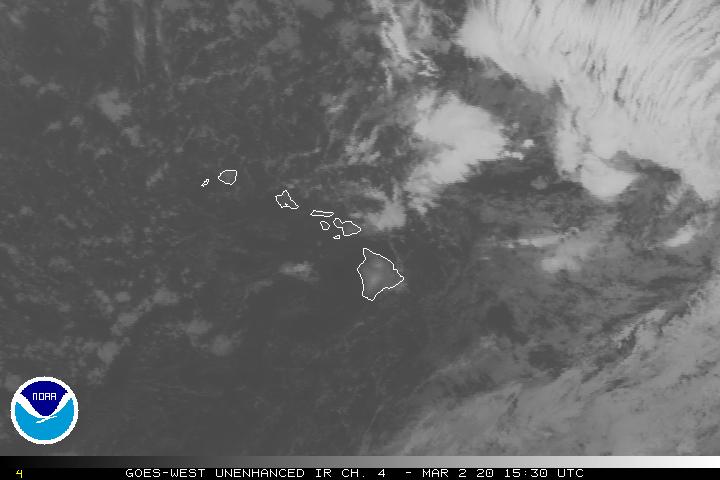
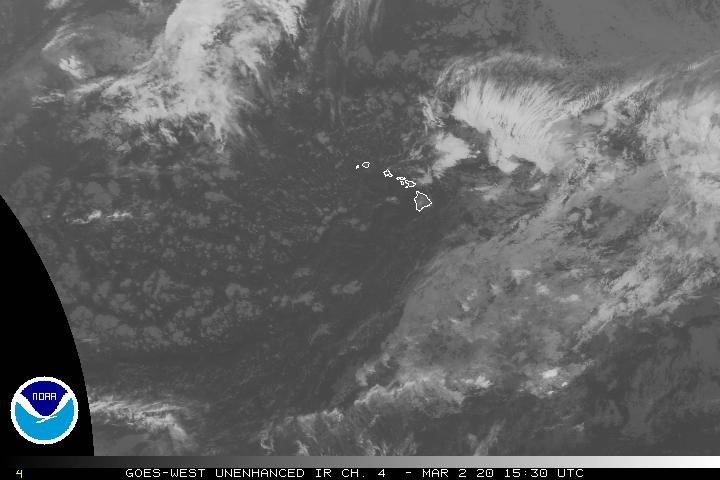
We can use the following links to see what’s going on in our area of the north central Pacific Ocean. Here's the latest NOAA satellite picture – the latest looping satellite image…and finally the latest looping radar image for the Hawaiian Islands.
~~~ Hawaii Weather Narrative ~~~
Our trade winds will remain strong into Tuesday, reaching up close to 40 mph in gusts…over those windiest areas at times. Here's a weather chart showing high pressure systems to the north through northwest of Hawaii. The closest one to us, which is our current trade wind producer, is weighing-in at near 1029 millibar high pressure cell to our north. Our gusty trade winds will prevail through mid-week, then begin to ease up Thursday and Friday into the weekend. We may even see light and variable winds, veering around to the southeast, as a late winter cold front gets close to the state by Friday.
Satellite imagery shows a fairly minor amount of low clouds surrounding the islands offshore in places…for the most part. The overlying atmosphere remains quite dry and stable however, which should limit our incoming windward showers through the night. We are likely to see at least some increase in windward showers locally in places on Tuesday. This will occur thanks to an upper level trough of low pressure, that will be edging in closer to the state soon. This larger satellite picture shows areas of brighter white, high level cloudiness far to the south and southeast, along with scattered minor patches of cirrus closer…to our southwest.
Looking ahead, Wednesday and Thursday should be just fine, with those expected weather changes…still looking likely Friday into the weekend. The first sign of change will be an approaching cold front Thursday and Friday. This will cause a ridge of high pressure to migrate close to Hawaii. As this ridge gets close, our winds will finally diminish, and gradually turn more easterly…and eventually all the way around the compass to southeast. As many of you know, when the winds swing around to the southeast, we're apt to get increasing volcanic haze (vog), coming up from the vents on the Big Island. The models are still vague about letting us know exactly how far into the state this cold front might get.
The available weather information does show this frontal cloud band reaching Kauai on Friday, but thereafter its still in the realm of guess work…at least for the moment. Personally, although as I think about what I'm going to write, not everyone is going to agree with me. This is because, well, folks would typically rather have showers arriving during the week, while they are at work, rather on the weekends. So, let's just hold this weekend outlook lightly for the time being, and hope for the best, whichever side of the coin you happen to be on. ~~~ I'll be back early Tuesday morning with more weather updates on all of the above, I hope you have a great Monday night wherever you happen to be spending it! Aloha for now…Glenn.
World-wide tropical cyclone activity:
Atlantic Ocean/Caribbean Sea: There are no active tropical cyclones
Gulf of Mexico: There are no active tropical cyclones
Eastern Pacific Ocean: There are no active tropical cyclones
Central Pacific Ocean: There are no active tropical cyclones
Western Pacific Ocean: There are no active tropical cyclones
South Pacific Ocean: There are no active tropical cyclones
North and South Indian Oceans: There are no active tropical cyclones
Interesting: Overfishing has been an important environmental issue recently as catching too many fish in one area can lead to food chain imbalances and the overall degradation of that system. Christian Schwagerl for YaleEnvironment360 discusses Europe's over-subsidized fishing industry and what members of the European Union (EU) are doing to change and protect Europe's marine environment.
Lately, European fisheries policy has been a slowly unfolding environmental disaster. Pumped up by tens of billions of euros in European Union subsidies, fishing fleets ballooned to 100,000 vessels, including many industrial-scale ships that are depleting European waters of fish. The goal for these subsidies was to create a politically powerful fishing industry.
However, the results of fishing stocks what are in peril is predictable as numerous studies have shown that roughly 80 to 90 percent of many European fish stocks are being fished unsustainably.
Now, however, serious reforms are being launched, thanks to Maria Damanaki, an EU Commissioner for Maritime Affairs and Fisheries, and the rest of the European Parliament.
Earlier this month, Parliament voted on various agendas including: reduce catch quotas to sustainable levels; cut subsidies and target them at fisheries that stay within the "maximum sustainable yield"; end the practice of fishing boats discarding a quarter of their catch, for more profitable and desirable species; and tighten lax enforcement of fisheries regulations.
"What we had in the past was an aggressive policy against fish stocks, the oceans, and the environment," Damanaki said in an interview with Yale Environment 360. "We need to change our policy if we want to continue to eat fish."
Joining Damanaki in the push for a radical overhaul of EU fisheries policies have been Ulrike Rodust, a Social Democrat from Germany, and Isabella Lövin, a Green Party member from Sweden. "Damanaki, Rodust, and Lövin are the three strong women behind fisheries reform," says Rainer Froese, a prominent marine biologist with the Geomar-Helmholtz-Center for Ocean Research in Germany.
In the coming weeks, the parliament, the Council of Europe, and the EU Commission will attempt to forge a joint strategy. The parliament wants to introduce a ban of discards starting in 2014. It sets 2015 as a deadline for managing fish stocks within the bounds of "maximum sustainable yield," with the aim of beginning to regenerate fish stocks by 2020.
However, strong opposition and push-back from fishing interests will tie up the decisions as European countries are already experiencing widespread unemployment, guarantees a battle to weaken Damanaki's and the Parliament’s proposed reforms.
 Email Glenn James:
Juleann Says:
Good morning Glenn,
Tomorrow we will be with you on the valley isle for the 6th time. I just want to thank you for your daily weather narrative. I really enjoy your weather commentary and the sprinkling of personal comments too. So glad to see that the wild rainy weather is over, at least for now. Oh and I enjoy the "interesting" addition at the end of your commentary too. Aloha for now,
Juleann~~~Hi Juleann, thanks for your positive comments, I certainly appreciate them! So happy to hear that you will be here now, obviously you love it here…coming back six times! The weather looks good for your visit, I trust you will have yet another amazing vacation here in paradise! Aloha, Glenn
Miker Says:
Glenn; I've been to Maui a dozen times over the past few years including all months except January and June through September. Usually we stay 1-2 months mostly in the February-April time period. We are coming on March 30 this year for a 5-week stay and was wondering the likelihood for vog during this period. I realize that cold fronts passing north of the islands is the usual culprit to turn the winds southeasterly. Thanks for all the commentary on your website. I visit it almost daily. Mike~~~Hi Mike, good to hear from you. Glad to know you have been a regular visitor to our fair island over the past several years. The likelihood of vog? That’s a good question of course, although to put a % chance of vog that far into the future, is virtually impossible. However, with that said, you can track this yourself. As you mentioned, when a cold front bears down on the islands, like this next one will see later this week, and the winds swing around to the southeast, that’s when you can begin looking for volcanic haze in our local skies. Southeast winds is your cue, whatever causes them to occur. It’s difficult to say much more than that ahead of time. I hope you have a great vacation this time around! BTW, thanks for using my website so extensively, I’m glad that it provides you with value. Aloha, Glenn