Air Temperatures – The following maximum temperatures were recorded across the state of Hawaii Sunday:
Lihue, Kauai – 75
Honolulu airport, Oahu – 80
Molokai airport – 77
Kahului airport, Maui – 80
Kona airport, Hawaii – 82
Hilo airport, Hawaii – 79
Air Temperatures ranged between these warmest and coolest spots near sea level – and on the highest mountain tops around the state…as of 530am Monday morning:
Hana airport, Maui – 72
Barking Sands, Kauai – 66
Haleakala Summit – 41 (near 10,000 feet on Maui)
Mauna Kea Summit – 27 (13,000+ feet on the Big Island)
Hawaii’s Mountains – Here’s a link to the live web cam on the summit of near 13,800 foot Mauna Kea on the Big Island of Hawaii. This web cam is available during the daylight hours here in the islands…and when there’s a big moon shining down during the night at times. Plus, during the nights you will be able to see stars, and the sunrise and sunset too…depending upon weather conditions. Here's the Haleakala Crater webcam on Maui – if it's working.
Tropical Cyclone activity in the eastern and central Pacific – Here’s the latest weather information coming out of the National Hurricane Center, covering the eastern north Pacific. You can find the latest tropical cyclone information for the central north Pacific (where Hawaii is located) by clicking on this link to the Central Pacific Hurricane Center. A satellite image, which shows the entire ocean area between Hawaii and the Mexican coast…can be found here. The 2012 hurricane season is over in the eastern and central Pacific…resuming on May 15th and June 1st 2013.
Aloha Paragraphs

Just a few showers…continued strong trade winds
,
Small Craft Advisory for those windiest coasts and
channel waters around Maui County and the Big Island
High Surf Advisory for east facing shores of Kauai,
Oahu, Molokai, Maui…and the Big Island
~~~603am HST Monday morning: clear and calm…
at my upcountry Kula, Maui weather tower: the
air temperature was 46.8F degrees~~~
The following numbers represent the most recent top wind gusts (mph), along with directions as of Sunday evening:
27 Waimea Heights, Kauai – NE
42 Kuaokala, Oahu – NE
33 Molokai – NE
36 Kahoolawe – NE
31 Kahului, Maui – NE
37 Kawaihae, Big Island – NW
Here are the latest 24-hour precipitation totals (inches) for each of the islands as of Sunday evening:
0.07 Mount Waialeale, Kauai
0.02 Kahuku Trng, Oahu
0.00 Molokai
0.00 Lanai
0.00 Kahoolawe
0.19 Puu Kukui, Maui
1.24 Kawainui Stream, Big Island
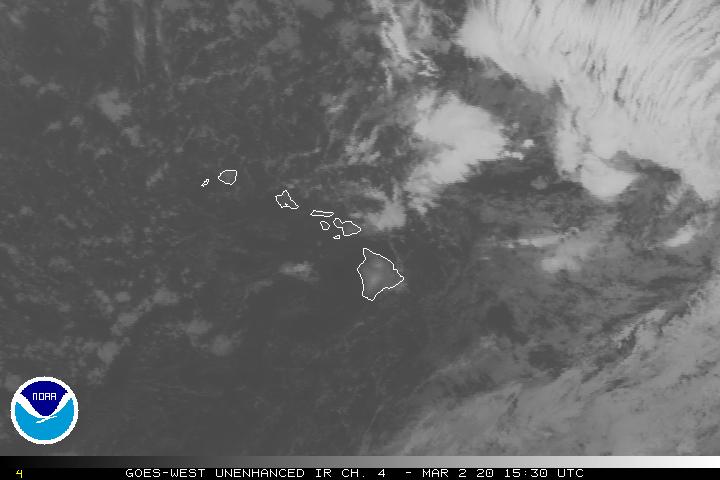
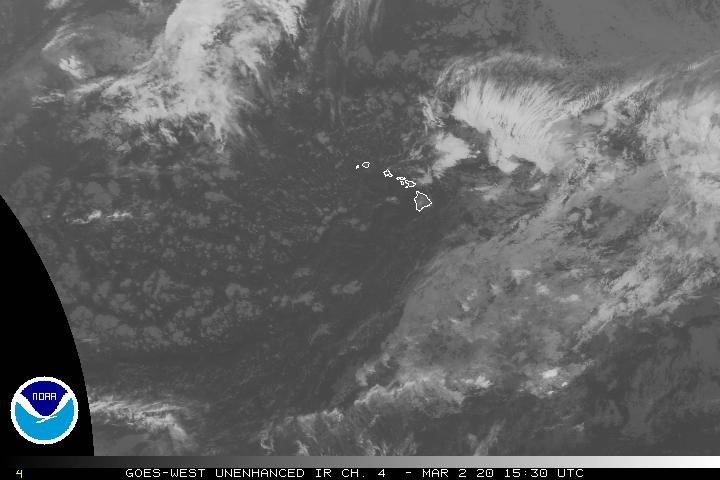
We can use the following links to see what’s going on in our area of the north central Pacific Ocean. Here's the latest NOAA satellite picture – the latest looping satellite image…and finally the latest looping radar image for the Hawaiian Islands.
~~~ Hawaii Weather Narrative ~~~
Our trade winds will remain strong Monday…reaching 40 mph or so in gusts over those windiest areas at times. Here's a weather chart showing high pressure systems to the northeast through northwest of Hawaii. At the same time, we see deep storm and gale low pressure systems far to the north-northeast and northwest. Our trade wind weather pattern will prevail, with the winds continuing to be stronger than normal over the next few days, with a slow down occurring around Friday into next weekend. We may even see light and variable winds, veering around to the southeast, as a late winter cold front gets close to the state then.
Satellite imagery shows low clouds across parts of our islands, although most of them are upstream to the northeast through east. The overlying atmosphere remains quite dry and stable at the moment, which should limit our incoming windward showers through most of Monday. We are likely to see at least some increase in windward showers late Monday into Tuesday. This larger satellite picture shows areas of brighter white, high level cloudiness, far to the south, along with scattered patches of cirrus to our north and west, which are filtering into the state locally…although continue to remain thin at the time of this writing.
The trade winds will continue to be rather robust…into the new week. High pressure stretched out from the northwest to northeast, will be the source of this breezy trade flow. It appears that the strongest gusts are behind us now, although they will continue to top 40 mph at times locally over the next few days. As for rainfall, it won't be much of a concern through Monday, with just a few windward biased showers falling at times. The leeward beaches will bask in sunshine during the days, with warm, near 80-82F degree high temperatures prevailing. We should see an increase in showers along our north and east facing beaches and slopes, as we reach Monday evening into Tuesday. Otherwise, just normal, or somewhat below normal precipitation through the rest of the new week ahead. A cold front will approach the state late in the week, with its resultant influence becoming more clear over the next day or two. The one main effect, that looks very likely, will be the softer winds that will finally return by the weekend. ~~~ I'll be back again early Monday with your next new weather narrative, I hope you have a great Sunday night wherever you're spending it! Aloha for now…Glenn.
World-wide tropical cyclone activity:
Atlantic Ocean/Caribbean Sea: There are no active tropical cyclones
Gulf of Mexico: There are no active tropical cyclones
Eastern Pacific Ocean: There are no active tropical cyclones
Central Pacific Ocean: There are no active tropical cyclones
Western Pacific Ocean: There are no active tropical cyclones
South Pacific Ocean: There are no active tropical cyclones
North and South Indian Oceans: There are no active tropical cyclones
Interesting: Planet Earth did not warm as much in response to increases in green house gas emissions as expected. There appear to be other factors that influence global temperatures than green house gasses. A team led by the University of Colorado Boulder looking for clues about why Earth did not warm as much as scientists expected between 2000 and 2010 now thinks the culprits are hiding in plain sight — dozens of volcanoes spewing sulfur dioxide.
The study results essentially exonerate Asia, including India and China, two countries that are estimated to have increased their industrial sulfur dioxide emissions by about 60 percent from 2000 to 2010 through coal burning, said lead study author Ryan Neely, who led the research as part of his CU-Boulder doctoral thesis.
Small amounts of sulfur dioxide emissions from Earth’s surface eventually rise 12 to 20 miles into the stratospheric aerosol layer of the atmosphere, where chemical reactions create sulfuric acid and water particles that reflect sunlight back to space, cooling the planet.
The study results essentially exonerate Asia, including India and China, two countries that are estimated to have increased their industrial sulfur dioxide emissions by about 60 percent from 2000 to 2010 through coal burning, said lead study author Ryan Neely, who led the research as part of his CU-Boulder doctoral thesis.
Small amounts of sulfur dioxide emissions from Earth’s surface eventually rise 12 to 20 miles into the stratospheric aerosol layer of the atmosphere, where chemical reactions create sulfuric acid and water particles that reflect sunlight back to space, cooling the planet.
Neely said previous observations suggest that increases in stratospheric aerosols since 2000 have counterbalanced as much as 25 percent of the warming scientists blame on human greenhouse gas emissions.
"This new study indicates it is emissions from small to moderate volcanoes that have been slowing the warming of the planet," said Neely, a researcher at the Cooperative Institute for Research in Environmental Sciences, a joint venture of CU-Boulder and the National Oceanic and Atmospheric Administration.
 Email Glenn James: