











Air Temperatures – The following maximum temperatures were recorded across the state of Hawaii Wednesday:
Lihue, Kauai – 77
Honolulu airport, Oahu – 82
Molokai airport – 77
Kahului airport, Maui – 79
Kona airport, Hawaii – 81
Hilo airport, Hawaii – 76
Air Temperatures ranged between these warmest and coolest spots near sea level – and on the highest mountain tops around the state…as of 530am Thursday morning:
Honolulu, Oahu – 71
Hilo airport, Hawaii – 61
Haleakala Summit – 41 (near 10,000 feet on Maui)
Mauna Kea Summit – 27 (13,000+ feet on the Big Island)
Hawaii’s Mountains – Here’s a link to the live web cam on the summit of near 13,800 foot Mauna Kea on the Big Island of Hawaii. This web cam is available during the daylight hours here in the islands…and when there’s a big moon shining down during the night at times. Plus, during the nights you will be able to see stars, and the sunrise and sunset too…depending upon weather conditions. Here's the Haleakala Crater webcam on Maui – if it's working.
Tropical Cyclone activity in the eastern and central Pacific – Here’s the latest weather information coming out of the National Hurricane Center, covering the eastern north Pacific. You can find the latest tropical cyclone information for the central north Pacific (where Hawaii is located) by clicking on this link to the Central Pacific Hurricane Center. A satellite image, which shows the entire ocean area between Hawaii and the Mexican coast…can be found here. The 2012 hurricane season is over in the eastern and central Pacific…resuming on May 15th and June 1st 2013.
Aloha Paragraphs

Just a few windward showers…lots of sunshine
at most leeward beaches – gusty trade winds
,
Small Craft Advisory for all marine zones of Hawaii
High Surf Advisory along north and west shores of Niihau,
Kauai, Oahu, Molokai, and north shore of Maui
Wind Advisory for the Big Island summits
~~~535am HST Thursday morning: clear and calm…
at my upcountry Kula, Maui weather tower:
the air temperature was 47.8F degrees~~~
The following numbers represent the most recent top wind gusts (mph), along with directions as of Wednesday evening:
27 Waimea Heights, Kauai – NE
38 Kuaokala, Oahu – NE
32 Molokai – NE
42 Kahoolawe – ENE
38 Kahului, Maui – NE
42 Puhe CS, Big Island – NE
Here are the latest 24-hour precipitation totals (inches) for each of the islands as of Wednesday evening:
0.26 Mount Waialeale, Kauai
0.29 Wheeler Field, Oahu
0.06 Molokai
0.00 Lanai
0.00 Kahoolawe
1.18 Puu Kukui, Maui
1.52 Kawainui Stream, Big Island
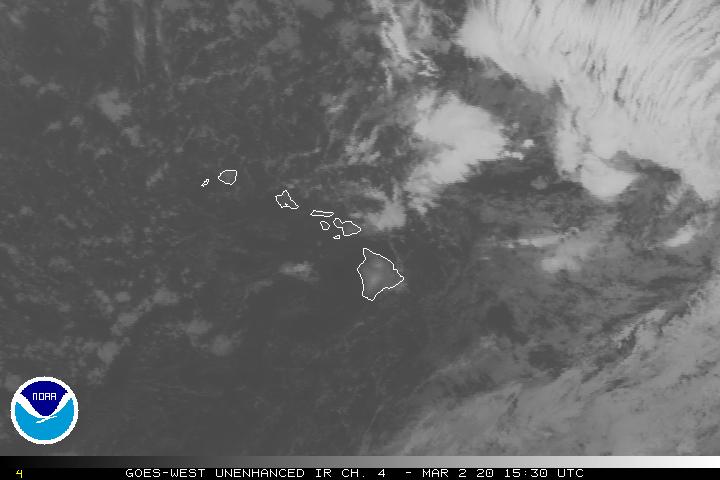
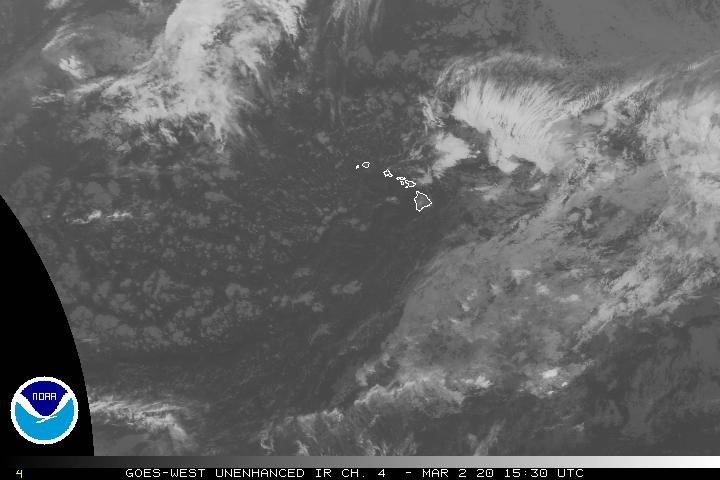
We can use the following links to see what’s going on in our area of the north central Pacific Ocean. Here's the latest NOAA satellite picture – the latest looping satellite image…and finally the latest looping radar image for the Hawaiian Islands.
~~~ Hawaii Weather Commentary ~~~
Our trade winds will remain strong and gusty…reaching 30-40 mph in gusts at times Thursday. Here's a weather chart showing large, near 1030 millibar high pressure systems far to the northeast and northwest of Hawaii. At the same time, we see storm and gale low pressure systems far to the north-northeast and north-northwest…with a couple of cold fronts to our north and northwest. Our trade wind weather pattern will prevail, with the winds continuing to be on the gusty side this week.
Small craft wind advisory flags remain up over all coastal and channel waters…statewide. At the same time, we have a new high surf advisory for most north and west shores from Kauai to Maui. There are strong winds still occurring over the summit of the Haleakala Crater on Maui, and the Big Island summits as well. As you can see, there's lots of activity, in relation to the gusty trade winds, and rising surf across our Hawaiian island chain. Looking ahead, a little lighter trade wind flow Thursday perhaps, followed by another boost Friday and Saturday…then down a notch Sunday into early next week. Despite these minor fluctuations, the breezy trade winds will prevail throughout.
Satellite imagery shows low clouds impacting our windward sides in places, although quite dry conditions will continue into Thursday. The leeward sides look to remain generally clear, with dry conditions prevailing. This larger satellite picture continues to show that large area of bright white, high level cloudiness, well to the east of the state. The lower level moisture to our east and northeast, being carried our way on the gusty trades, will bring just a few passing showers to our islands at times…with the best chance over Kauai tonight. Further to our northwest, we see a weakening cold front looming, which isn't expected to arrive. The overall trend in terms of precipitation, will continue to be limited, even along our windward sides Thursday and Friday.
It looks like showers may pick back up, modestly at some point later Friday, into the weekend time frame. As we push into the first two or three days of next week, an upper level low pressure system may prompt a somewhat more substantial increase in showers then…stay tuned. Meanwhile, the leeward sides should continue to bask in lots of warm daytime sunshine into the weekend, as they have been lately. The main thing will be the trade winds, which will ease slightly Thursday, and then get a new boost later Friday into Saturday. The long range outlook shows more gusty trade winds sticking around into next week, so we'd better get used to it, if we haven't already. I hope you have a great Wednesday night wherever you're spending it! Aloha for now…Glenn.
Extra: I just read something that I'd like to share with you:
Experts say there are steps people can take to improve their sense of well-being.
"Surprisingly, the fastest way to increase our level of happiness is to spend time with a friend, offer service to someone else, take a walk, or simply sit and ponder five things we're grateful for.
All of these create an immediate shift in our mental state."
World-wide tropical cyclone activity:
Atlantic Ocean/Caribbean Sea: There are no active tropical cyclones
Gulf of Mexico: There are no active tropical cyclones
Eastern Pacific Ocean: There are no active tropical cyclones
Central Pacific Ocean: There are no active tropical cyclones
Western Pacific Ocean: There are no active tropical cyclones
South Pacific Ocean: There are no active tropical cyclones
North and South Indian Oceans: There are no active tropical cyclones
Interesting: From 2010 to 2012, Oceana conducted one of the largest seafood fraud investigations in the world to date, collecting more than 1,200 seafood samples from 674 retail outlets in 21 states to determine if they were honestly labeled. DNA testing found that one-third (33 percent) of the 1,215 samples analyzed nationwide were mislabeled, according to U.S. Food and Drug Administration (FDA) guidelines.
Of the most commonly collected fish types, samples sold as snapper and tuna had the highest mislabeling rates (87 and 59 percent, respectively), with the majority of the samples identified by DNA analysis as something other than what was found on the label.
In fact, only seven of the 120 samples of red snapper purchased nationwide were actually red snapper. The other 113 samples were another fish.
Our findings demonstrate that a comprehensive and transparent traceability system — one that tracks fish from boat to plate — must be established at the national level.
At the same time, increased inspection and testing of our seafood, specifically for mislabeling, and stronger federal and state enforcement of existing laws combating fraud, are needed to reverse these disturbing trends.
Interesting2: Can man and bird live side by side? If not, how far apart should they be. Are some friendlier than others? According to a study by the Wildlife Conservation Society (WCS), impacts to bird communities from a single rural, exurban residence can extend up to 200 meters into the surrounding forest.
The study also determined that sensitive bird species such as the hermit thrush and scarlet tanager prefer unbroken forests with no houses. Others, like the blue jay and black-capped chickadee, seem to like having, and often thrive with, human neighbors.
As part of the study, scientists sampled the presence of 20 species of birds both near and far from 30 rural residences in the Adirondack Park. Calculating their occurrence at increasing distances from the residences, they determined that human-adapted species are 36 percent more likely to occur near the homes than in the surrounding mixed hardwood-conifer forests, and that human-sensitive species were 26 percent less likely.
Beyond 200 meters, occupancy rates were similar to the surrounding forest. The Blue Jay is one of the commonly known human friendlies and is a resident through most of eastern and central United States and southern Canada. It breeds in both deciduous and coniferous forests, and is common near and in residential areas.
It is predominately blue with a white chest and underparts, and a blue crest. The Adirondack Mountains are contained within the 6.1 million acres of the Adirondack Park, which includes a constitutionally protected Forest Preserve of approximately 2,300,000 acres. About 43% of the land is owned by the state, with 57% private in holdings, heavily regulated by the Adirondack Park Agency.
The Adirondack Park contains thousands of streams, brooks and lakes, most famously Lake Placid. The report appears in the current online edition of the Journal of Landscape and Urban Planning. Authors of the study are Drs. Michale Glennon and Heidi Kretser of the Wildlife Conservation Society.
Rural exurban development is residential development existing outside of cities and towns, and is generally characterized by larger lot sizes (5-40 acres or more) and lower density than suburban development. Exurban residences exist within an otherwise unaltered ecosystem.
Exurban homes change the environment by bringing vehicles, noise, lights, pets, people, and food sources into the forest, as well as by physically altering and fragmenting habitat. These changes can have myriad impacts, including altered species behavior and composition, increased human wildlife conflicts, new predator-prey dynamics, and decreased biotic integrity.
Biological integrity is associated with how pristine an environment is and its function relative to the potential or original state of an ecosystem before human alterations were imposed. the accepted definition is "the capability of supporting and maintaining a balanced, integrated, adaptive community of organisms having a species composition, diversity, and functional organization comparable to that of the natural habitat of the region."
The implications of this definition are that living systems have a variety of scales relative to which they exist, that one can quantify the parts that sustain or contribute to a system's functioning and that all systems must be seen in the context of their environments and evolutionary history.
"Adirondackers take great pride in their surroundings and try not to unduly disturb the natural setting in which they live," said WCS Adirondack Program Science Director Michale Glennon. "A key finding of the study is that the ecological footprint of development can be much larger than its physical footprint.
We found that even a small home and lawn can change bird communities some 200 meters away, which means more than 30 acres of the surrounding landscape, depending on what types of activities are occurring on the residential property.
It is important that we learn how birds and other wildlife react to particular kinds of human activities, and find ways to minimize the negative impacts for wildlife in exurban areas." The study found that species sensitive to human impacts include the black-throated blue warbler, black-throated green warbler, hairy woodpecker, hermit thrush, ovenbird, scarlet tanager and the winter wren.
The presence of some species, like the scarlet tanager (adult males are bright red with black wings and tail while females are yellowish on the underparts and olive on top) are a good indicator of undisturbed forest health.
The study was modeled after one conducted in a shrub-oak ecosystem in Colorado where scientists calculated a 180-meter ecological effect zone based on their results. Glennon and Kretser believe that the similar results in two different ecosystem types may indicate that human behaviors associated with exurban homes play a larger role in shaping avian community characteristics nearby than do habitat alterations created by construction and clearing.
While breeding bird communities were used to measure the impacts of exurban development in the study, the authors note that birds can serve as valuable indicators of overall biodiversity.
 Email Glenn James:
Zoe Says:
Hi Glenn,
I know the katkam well. I have seen the most amazing sunsets from that webcam. At the moment those are few and far between but summer is coming. Thanks again for a great job on your website.
Zoe~~~You’re very welcome Zoe, my pleasure to keep you informed about our Hawaiian weather. Aloha, Glenn
Zoe Says:
Hi Glenn,
My husband and daughter and I were in Maui late November, early December and would check the weather on your website every day but I got hooked by your interesting facts, movie reviews and your snapshot of life on Maui. It helps get us through the bleak winter months in Vancouver. Keep up the good work! :o) ~~~Hi Zoe, how nice to receive you great comment! You got hooked on my website, how wonderful…that certainly feels good to hear! Stay warm and dry there in Vancouver, as I know it is chilly and cloudy, with light rain lots. You know, there’s a webcam that I go to everyday, often many times a day, called katkam.ca (http://www.katkam.ca/)
I’m not sure why, but I just really like keeping tabs on the weather in your city, have been doing this for years. It goes back to several times when I visited there with a good friend many years ago. This lady friend of mine, who I thought I would be traveling with through the rest of my life, has since passed away. Although, each time I look at that cam, with its clouds, and occasional totally clear days too, kind of keeps me in touch with her some how. At any rate, thanks for checking in, I’m so glad it brings you some nice warm feelings, kind of an afterglow to your trip here to Maui. Aloha, Glenn