











Air Temperatures – The following maximum temperatures were recorded across the state of Hawaii Thursday:
Lihue, Kauai – 75
Honolulu airport, Oahu – 79
Molokai airport – 75
Kahului airport, Maui – 75
Kona airport – 81
Hilo airport, Hawaii – 79
Air Temperatures ranged between these warmest and coolest spots near sea level – and on the highest mountain tops around the state…as of 530am Friday morning:
Kailua Kona – 74
Hilo, Hawaii – 66
Haleakala Summit – 33 (near 10,000 feet on Maui)
Mauna Kea Summit – 27 (13,000+ feet on the Big Island)
Hawaii’s Mountains – Here’s a link to the live web cam on the summit of near 13,800 foot Mauna Kea on the Big Island of Hawaii. This web cam is available during the daylight hours here in the islands…and when there’s a big moon shining down during the night at times. Plus, during the nights you will be able to see stars, and the sunrise and sunset too…depending upon weather conditions. Here's the Haleakala Crater webcam on Maui – if it's working.
Tropical Cyclone activity in the eastern and central Pacific – Here’s the latest weather information coming out of the National Hurricane Center, covering the eastern north Pacific. You can find the latest tropical cyclone information for the central north Pacific (where Hawaii is located) by clicking on this link to the Central Pacific Hurricane Center. A satellite image, which shows the entire ocean area between Hawaii and the Mexican coast…can be found here. The 2012 hurricane season is over in the eastern and central Pacific…resuming on May 15th and June 1st 2013.
Aloha Paragraphs

Wet Trade Wind Weather Pattern
Flash Flood Watch for Maui and the Big Island
Flood Advisory for the Big Island…over parts of
Hilo and Puna Districts
Flash Flood Warning over the Waikane Stream near
Hauula, on windward Oahu…including Punaluu and Laie
Here's the Looping Radar Image for the islands
Winter Storm Warning for the Big Island summits
through Friday evening…periods of heavy snow
Mauna Kea webcam – showing again
when the sun comes up Friday morning
,
Small Craft Advisory for gusty trade winds for
all marine zones across the Hawaiian Islands
Wind Advisory for the Big Island, along and southwest
of the crest of the Kohala Mountains
High Surf Advisory along all east facing shores
~~~555am HST Friday morning: cloudy, breezy…at my
upcountry Kula, Maui weather tower: the
air temperature was 57F degrees~~~
The following numbers represent the most recent top wind gusts (mph), along with directions as of Thursday evening:
31 Lihue, Kauai – NE
50 Kuaokala, Oahu – NE
30 Molokai – NE
36 Kahoolawe – NE
32 Lipoa, Maui – NE
28 Upolu airport, Big Island – NE
Here are the latest 24-hour precipitation totals (inches) for each of the islands as of Thursday evening:
3.82 Kilohana, Kauai
1.41 Makaha Stream, Oahu
0.10 Molokai
0.00 Lanai
0.00 Kahoolawe
4.64 Puu Kukui, Maui
1.26 Waiakea Uka, Big Island
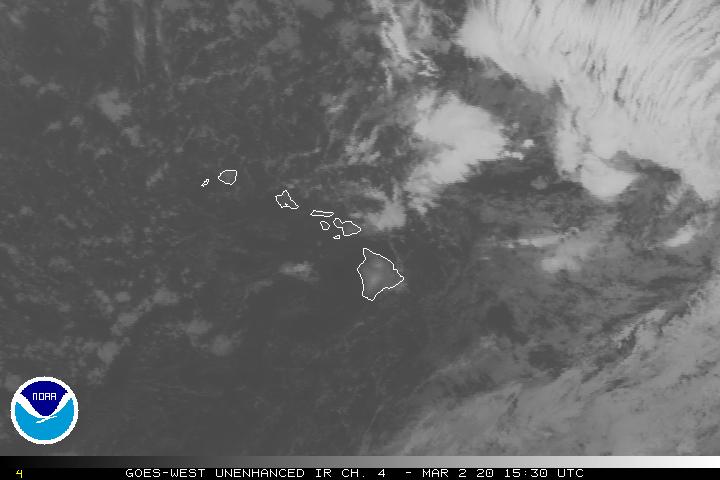
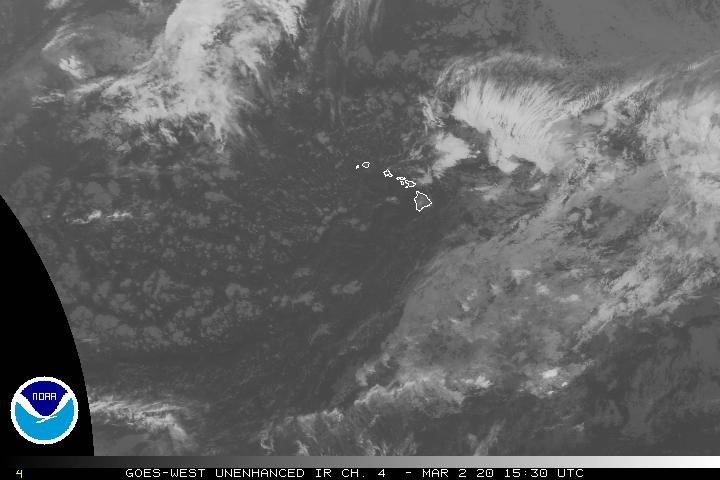
We can use the following links to see what’s going on in our area of the north central Pacific Ocean. Here's the latest NOAA satellite picture – the latest looping satellite image…and finally the latest looping radar image for the Hawaiian Islands.
~~~ Hawaii Weather Commentary ~~~
Our trade winds will continue to be strong and gusty, especially around the Big Island and parts of Maui County…reaching 30-50 mph in gusts locally at times. Here's a weather chart showing a broad area of high pressure, anchored by a strong 1037 millibar high pressure cell to the north-northeast of Hawaii. At the same time, we see many deep storm and gale low pressure systems far to the north and northwest. Our trade wind weather pattern will prevail, with the winds continuing to be stronger than normal through the weekend…into the first day or two of the new week ahead. The longer range outlook now shows, that these long lasting trade winds will finally drop back down into the more normal realms…by around next Tuesday or Wednesday.
Satellite imagery shows multi-layered clouds covering the islands, with lots of additional moisture upstream of our windward sides. As the trades remain gusty, they will bring us considerable amounts of windward biased showers, and I mean considerable! The leeward sides will see clouds too, with showers flying over into those areas here and there as well. An upper level trough of low pressure, will enhance our incoming showers at times through Friday. This larger satellite picture shows a large area of bright white, high level clouds now over the state…with more of those looming to our southwest and west. The lower level moisture to our east and northeast, will bring locally heavy rains to our islands, with flooding likely over parts of Maui and the Big Island! Snow will pile up on the Big Island summits with time, while there's a slight chance of some of this white stuff falling over the Haleakala Crater tonight too. It wouldn't be surprising to hear thunder, and see lightning over the next 24 hours or so.
This windy, and locally heavy rain situation, will remain active through Friday…with fewer showers by the weekend. We have an interesting, although that may not be quite the right word here, set of circumstances taking shape in our overlying atmosphere now. Aloft, we have cold air, colder than normal by far, and a serious amount of high level cirrus clouds too. This cold air will keep the chance of heavy snow over the Big Island, with a slim chance of snow over the Haleakala summit on Maui too. The snow level is expected to drop to near 10,500 feet, which is just above Haleakala, and well below the summits of the Big Island…thus the snow forecast.
At the lower levels, the trade winds are still solidly blowing, what else is new! There have been wind gusts over 40 mph Thursday, with at least one gust having reached 50 mph on Oahu early this evening. These trade winds are doing a marvelous job, again, this may not be the very best word to use…in carrying what seems like an endless stream of showers to the windward sides of Maui and the Big Island! I'd like to be able to report that this is coming to an end, although, that would be far from the truth. I'm afraid we're looking at another 24 hours worth of passing showers, many of which will be heavy duty. These heavy showers, and a possible thunderstorm, will keep the prospect of flooding very much alive.
You may be wondering…is there any light at the end of this wet and windy tunnel? Well, yes there is, and we should begin to see some relief this weekend, in the rainfall department at least. It will take longer for our winds to abate however, as they remain uppity through the weekend, into early next week. I'll continue to monitor this unusual situation, and be back many times during the evening with more updates. Be safe, and drive carefully if you have to go out! Aloha for now…Glenn.
World-wide tropical cyclone activity:
Atlantic Ocean/Caribbean Sea: There are no active tropical cyclones
Gulf of Mexico: There are no active tropical cyclones
Eastern Pacific Ocean: There are no active tropical cyclones
Central Pacific Ocean: There are no active tropical cyclones
Western Pacific Ocean: There are no active tropical cyclones
South Pacific Ocean: There are no active tropical cyclones
North and South Indian Oceans: Tropical cyclone 16S (Haruna) remains active in the Madagascar Channel…located approximately 300 NM southwest of Antananarivo, Madagascar. Sustained winds are 80 knots, with gusts to 100 knots (92-115 mph). Here's the Joint Typhoon Warning Center (JTWC) graphical track map, and a satellite image.
Interesting: As the Arctic ice melts it will raise the sea level. But as it removes the enormous weight of the ice…the land will rise too. Sophisticated computer modeling has shown how sea-level rise over the coming century could affect some regions far more than others.
The model shows that parts of the Pacific will see the highest rates of rise while some polar regions will actually experience falls in relative sea levels due to the ways sea, land and ice interact globally. Reporting in the journal Geophysical Research Letters researchers have looked ahead to the year 2100 to show how ice loss will continue to add to rising sea levels.
Scientists have known for some time that sea level rise around the globe will not be uniform, but in this study the team of Ice2sea researchers show in great detail the global pattern of sea-level rise that would result from two scenarios of ice-loss from glaciers and ice sheets.
The team, from the University of Urbino, and the University of Bristol, found that ice melt from glaciers, and the Greenland and Antarctic ice sheets, is likely to be of critical importance to regional sea-level change in the Equatorial Pacific Ocean where the sea level rise would be greater than the average increase across the globe.
This will affect in particular, Western Australia, Oceania and the small atolls and islands in this region, including Hawaii. The study focused on three effects that lead to global mean sea-level rise being unequally distributed around the world.
Firstly, land is subsiding and emerging due to a massive loss of ice at the end of the last ice age 10,000 years ago when billions of tons of ice covering parts of North America and Europe melted. This caused a major redistribution of mass on the Earth, but the crust responds to such changes so slowly that it is still deforming.
Post-glacial rebound is the rise of land masses that were depressed by the huge weight of ice sheets during the last glacial period, through a process known as isostasy. It affects northern Europe (especially Scotland, Fennoscandia and northern Denmark), Siberia, Canada, the Great Lakes of Canada and the United States, the coastal region of the US state of Maine, parts of Patagonia, and Antarctica.
Studies have shown that the uplift has taken place in two distinct stages. The initial uplift following deglaciation was near-instantaneous due to the elastic response of the crust as the ice load was removed. After this elastic phase, uplift proceeded by slow viscous flow so the rate of uplift decreased exponentially after that.
Today, typical uplift rates are of the order of 1 cm/year or less. In northern Europe, this is clearly shown by the GPS data obtained by the BIFROST GPS network. Studies suggest that rebound will continue for about at least another 10,000 years. The total uplift from the end of deglaciation depends on the local ice load and could be several hundred meters near the center of rebound.
Secondly, the warming of the oceans leads to a change in the distribution of water across the globe. Thirdly the sheer mass of water held in ice at the frozen continents like Antarctica and Greenland exerts a gravitational pull on the surrounding liquid water, pulling in enormous amounts of water and raising the sea-level close to those continents.
As the ice melts its pull decreases and the water previously attracted rushes away to be redistributed around the globe. Co-author Professor Giorgio Spada of the University of Urbino said: "In the paper we are successful in defining the patterns, known as sea level fingerprints, which affect sea levels." "This is paramount for assessing the risk due to inundation in low-lying, densely populated areas.
The most vulnerable areas are those where the effects combine to give the sea-level rise that is significantly higher than the global average." He added that in Europe the sea level would rise but it would be slightly lower than the global average. "We believe this is due to the effects of the melting polar ice relatively close to Europe — particularly Greenland’s ice.
This will tend to slow sea-level rise in Europe a little, but at the expense of higher sea-level rise elsewhere." The team considered two scenarios in its modelling. One was the most likely or mid-range and the other closer to the upper limit of what could happen.
Professor Spada said, "The total rise in some areas of the equatorial oceans worst affected by the terrestrial ice melting could be 60cm if a mid-range sea-level rise is projected, and the warming of the oceans is also taken into account."
David Vaughan, ice2sea program coordinator, said: "In the last couple of years programs like ice2sea have made great strides in predicting global average sea-level rise. The urgent job now is to understand how global the sea-level rise will be shared out around the world’s coastlines. Only by doing this can we really help people understand the risks and prepare for the future."
 Email Glenn James:


Ren V Says:
when was the flash flood warning issued? we witnessed first hand while playing in the streams. It will be on youtube soon enough. Lol.
Ren.~~~Hi Ren, Flash Flood Warning late this afternoon…send the URL when it gets on youtube please. Thanks, Aloha…Glenn
David Hume Says:
Well, if you can believe it, here on the leaward side of the Big Island we have no rain and are in the grips of a very serious drought. Trees are dying and the soil is being blown away. Plenty of sunshine though. Thank you Glenn for all your efforts. Aloha David~~~Hi David, good to hear from you again! No rain, geez, unlike the other side of your Big Island! Good luck in finally tapping into some of this moisture soon, hopefully before its all gone. Be well my friend. Aloha, Glenn
Tim Says:
Geologists from the Great Plains….isostatic rebound does induce quakes, but very small because of the diffuse nature of the movement and the lack of faults with displacement. Quakes in the 2-3 magnitude are not uncommon, especially along the former ice margins…such as In the Missouri River valley, where is generally e southern margin of the Pleistocene ice sheets. The rebound, especially in marine areas, is why measuring sea levels is so challenging, as the benchmark of the land is moving also.~~~Thanks for your comments Tim! Aloha, Glenn
Howard Says:
Found an expert: http://www.billmcguire.co.uk/books/waking-the-giant.html
Haven't read the book, but it sounds like the answer is yes.~~~Thanks Howard, I’ll check out that when I get a second, big rains here on Maui now! Aloha, Glenn
Maggie Says:
I think Haiku is about to wash away. Over 3" since dawn here on Maliko Gulch and much more training in according to the radar.. ~~~Thanks for your report Maggie, flash flood warning at the time of this writing. Big rains, more to come, be careful! Aloha, Glenn