Air Temperatures – The following maximum temperatures were recorded across the state of Hawaii Tuesday:
Lihue, Kauai – 76
Honolulu airport, Oahu – 78
Molokai airport – 76
Kahului airport, Maui – 79
Kona airport – 82
Hilo airport, Hawaii – 78
Air Temperatures ranged between these warmest and coolest spots near sea level – and on the highest mountain tops around the state…as of 530am Wednesday morning:
Kaneohe, Oahu – 72
Hilo airport, Hawaii – 64
Haleakala Summit – 34 (near 10,000 feet on Maui)
Mauna Kea Summit – 25 (13,000+ feet on the Big Island)
Hawaii’s Mountains – Here’s a link to the live web cam on the summit of near 13,800 foot Mauna Kea on the Big Island of Hawaii. This web cam is available during the daylight hours here in the islands…and when there’s a big moon shining down during the night at times. Plus, during the nights you will be able to see stars, and the sunrise and sunset too…depending upon weather conditions. Here's the Haleakala Crater webcam on Maui.
Tropical Cyclone activity in the eastern and central Pacific – Here’s the latest weather information coming out of the National Hurricane Center, covering the eastern north Pacific. You can find the latest tropical cyclone information for the central north Pacific (where Hawaii is located) by clicking on this link to the Central Pacific Hurricane Center. A satellite image, which shows the entire ocean area between Hawaii and the Mexican coast…can be found here. The 2012 hurricane season is over in the eastern and central Pacific…resuming on May 15th and June 1st 2013.
Aloha Paragraphs

Flood Advisory for windward Haleakala and
much of east Maui…until 830am HST – and
for the lower windward slopes from Upolu
Point to Honokaa to Hilo to Volcano on the
Big Island…until 730am HST
Small Craft Advisory for gusty trade winds for all
marine zones across the Hawaiian Islands
Gale Warning for Maalaea Bay, Pailolo and Alenuihaha
Channels…and Big Island leeward and southeast waters
High Surf Advisory along east facing shores of Kauai,
Oahu, Molokai, Maui and the Big Island
Wind Advisory for portions of Maui and
Hawaii Counties…winds 20-35 mph –
with gusts 40-50 mph
Winter Weather Advisory for the Big Island
summits…Mauna Kea webcam
Windward showers, at times this week, drifting
into the leeward sections here and there
~~~550am HST Wednesday morning: mostly clear,
near calm…at my upcountry Kula, Maui
weather tower: 52.5F degrees~~~
The following numbers represent the most recent top wind gusts (mph), along with directions as of Tuesday evening:
31 Port Allen, Kauai – ENE
43 Kuaokala – NE
33 Molokai – NE
39 Kahoolawe – NE
35 Lipoa – NE
44 Kohala Ranch, Big Island – NE
Here are the latest 24-hour precipitation totals (inches) for each of the islands as of Tuesday evening:
1.17 Mount Waialeale, Kauai
0.62 Manoa Lyon Arboretum, Oahu
0.01 Molokai
0.00 Lanai
0.00 Kahoolawe
0.94 Puu Kukui, Maui
1.71 Kawainui Stream, Big Island
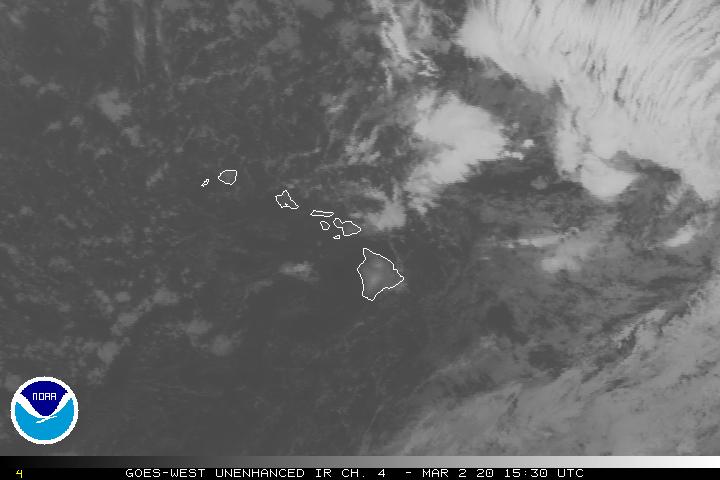
We can use the following links to see what’s going on in our area of the north central Pacific Ocean. Here's the latest NOAA satellite picture – the latest looping satellite image…and finally the latest looping radar image for the Hawaiian Islands.
~~~ Hawaii Weather Commentary ~~~
Our trade winds will continue to be strong and gusty into mid-week, reaching 30-40+ mph in gusts locally at times. Here's a weather chart showing a broad, east-west area of moderately strong high pressure to the north of Hawaii. At the same time, we see many deep storm and gale low pressure system systems far to the north and northwest…one of which has a cold front draping down into the sub-tropics to our northwest. Our trade wind weather pattern will prevail, with the winds continuing to be stronger than normal into Thursday. The outlook through the rest of this week, calls for the trade winds to finally begin to ease up slowly Friday into the weekend.
Satellite imagery shows low clouds along our windward sides in places…with clear to partly cloudy conditions along our leeward sides for the most part. At the same time, we see those brighter and whiter higher clouds that are over the ocean well to the northeast through southeast. As the gusty trades remain blustery over the next few days, they will bring us periodic windward biased showers. The next area of showery clouds appears just upstream of the islands this evening…which will bring increasing showers to our windward sides tonight into Wednesday morning. The leeward sides will see some clouds too, with a few showers flying over into those areas here and there.
The current trade weather pattern will extend through the rest of this week, although the winds will finally mellow-out starting Friday. We continue to have small craft wind advisories stretching across the entire state now, with gale warnings up around Maui and the Big Island. Wind advisories are also in force across just parts of the eastern islands…with high surf advisories active over east facing shores as well.
As for rainfall, there will be off and on showers along the windward sides. Low pressure aloft will prompt active windward shower activity into the weekend, enhancing shower intensity at times. As the trade winds remain strong and gusty, some of these showers will drift over into the leeward sides here and there. The weather models are pointing out the chance of low pressure edging over the state during the upcoming weekend, perhaps increasing showers then along our windward sides. ~~~ I'll be back with more updates this evening, along with a new weather narrative early Wednesday morning. I hope you have a great Tuesday night wherever you happen to be spending it! Aloha for now…Glenn.
World-wide tropical cyclone activity:
Atlantic Ocean/Caribbean Sea: There are no active tropical cyclones
Gulf of Mexico: There are no active tropical cyclones
Eastern Pacific Ocean: There are no active tropical cyclones
Central Pacific Ocean: There are no active tropical cyclones
Western Pacific Ocean: Tropical cyclone 02W remains active in the southern Philippines…located approximately 135 NM west-northwest of Zamboanga, Philippines. Sustained winds are 25 knots, with gusts to 35 knots (29-40 mph). Here's the Joint Typhoon Warning Center (JTWC) graphical track map, and a satellite image.
South Pacific Ocean: There are no active tropical cyclones
North and South Indian Oceans: Tropical cyclone 16S (Haruna) remains active in the Madagascar Channel…located approximately 400 NM west-southwest of Antananarivo, Madagascar. Sustained winds are 70 knots, with gusts to 85 knots (81-98 mph). Here's the Joint Typhoon Warning Center (JTWC) graphical track map, and a satellite image.
Interesting: The North Atlantic right whale, along with many other whale species, is set to benefit from work by scientists to reduce the noise levels caused along shipping routes. One of the rarest of the large whales, the North Atlantic right whale is thought to have a population of just 500 individuals, and it is believed that excessive noise along shipping routes is likely to negatively affect this threatened species.
The din from commercial ships makes it extremely difficult for the marine mammals to communicate with one another, which in turn means that their ability to locate food and mates, and therefore their ability to sustain a viable population, is greatly diminished.
Research indicates that noise levels in the New England region of North America have doubled each decade over the past 30 years. To counteract this problem, scientists have persuaded shipping companies to alter their routes in and around the Boston area, which plays host to several species of whale, many of which are suffering as a result of increased noise levels.
An iPad application has been developed which enables sea captains to visualize the locations of whales across the USA's entire East Coast, and to know when to slow their ships down. Results indicate that this change in operations has already helped to significantly lower the amount of noise pollution in the area.
To a whale, it is thought that the sound of a passing container ship could be like a 'thunderous, unchanging drone'. "It's as if you are talking at a cocktail party and all of a sudden it is hard to hear because there is all this background noise," said Dr Mark Baumgartner of the Woods Hole Oceanographic Institution.
"A couple of words get dropped, you don't get the meaning of everything that is said to you. That is what it is like for a lot of whales in the ocean right now." In addition to the problems caused by the disruption in whale communication, ships are also known to physically collide with whales on occasion.
While such incidents are limited to just one or two a year, this presents a serious problem for a species of which only 500 or so individuals remain. Worryingly, research also indicates that mothers with calves get hit more frequently.
"Our scientists found shattered bone and large hematomas which are indicative of a ship strike," said Dr Dave Wiley of the National Oceanic and Atmospheric Administration. It is hoped that the new iPad app will go some way to limiting the frequency of such accidents.
 Email Glenn James: