











Air Temperatures – The following maximum temperatures were recorded across the state of Hawaii Sunday:
Lihue, Kauai – 75
Honolulu airport, Oahu – 81
Molokai airport – 73
Kahului airport, Maui – 70
Kona airport – 81
Hilo airport, Hawaii – 75
Air Temperatures ranged between these warmest and coolest spots near sea level – and on the highest mountain tops around the state…as of 610am Monday morning:
Barking Sands, Kauai – 73
Kapalua, Maui – 64
Haleakala Summit – 36 (near 10,000 feet on Maui)
Mauna Kea Summit – 23 (13,000+ feet on the Big Island)
Hawaii’s Mountains – Here’s a link to the live web cam on the summit of near 13,800 foot Mauna Kea on the Big Island of Hawaii. This web cam is available during the daylight hours here in the islands…and when there’s a big moon shining down during the night at times. Plus, during the nights you will be able to see stars, and the sunrise and sunset too…depending upon weather conditions. Here's the Haleakala Crater webcam on Maui.
Tropical Cyclone activity in the eastern and central Pacific – Here’s the latest weather information coming out of the National Hurricane Center, covering the eastern north Pacific. You can find the latest tropical cyclone information for the central north Pacific (where Hawaii is located) by clicking on this link to the Central Pacific Hurricane Center. A satellite image, which shows the entire ocean area between Hawaii and the Mexican coast…can be found here. The 2012 hurricane season is over in the eastern and central Pacific…resuming on May 15th and June 1st 2013.
Aloha Paragraphs

Small Craft Advisory for gusty trade winds for all marine
zones across the Hawaiian Islands
Gale Warning for Maalaea Bay, Pailolo and Alenuihaha
Channels…and Big Island leeward and southeast waters
High Surf Advisory along east facing shores of Kauai, Oahu,
Molokai, Maui and the Big Island – north and west facing shores
of Niihau, Kauai, Oahu and Molokai – north shores of Maui..and
the west shores of the Big Island
Wind Advisory for all islands through Monday evening…
winds east 20-35 mph – with gusts over 50 mph
Windward showers, with some showers
drifting into the leeward sections at times
~~~630am HST Monday morning: cloudy with light showers, windy…
at my upcountry Kula, Maui weather tower: 56.7F degrees~~~
The following numbers represent the most recent top wind gusts (mph), along with directions as of Sunday evening:
30 Port Allen, Kauai – NE
53 Kuaokala, Oahu – NE
38 Molokai – NE
48 Kahoolawe – NE
52 Kaupo Gap – NNE
54 Kohala Ranch, Big Island – NE
Here are the latest 24-hour precipitation totals (inches) for each of the islands as of Sunday evening:
0.72 Kilohana, Kauai
0.28 Wheeler Airfield, Oahu
0.30 Molokai
0.00 Lanai
0.00 Kahoolawe
2.35 Puu Kukui, Maui
1.42 Saddle Quarry, Big Island
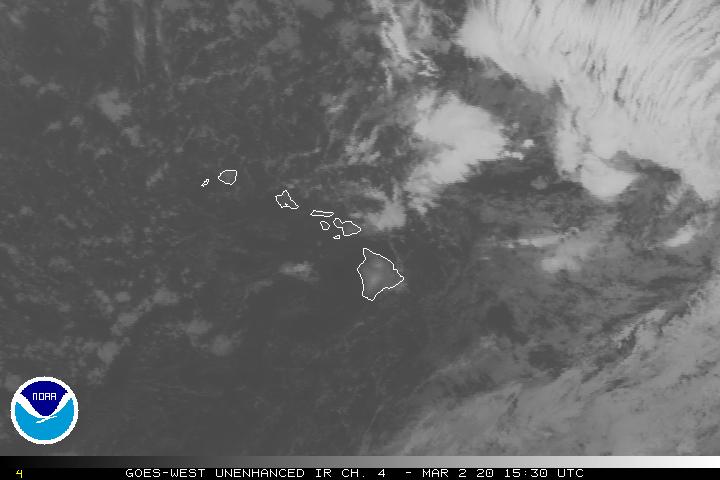
We can use the following links to see what’s going on in our area of the north central Pacific Ocean. Here's the latest NOAA satellite picture – the latest looping satellite image…and finally the latest looping radar image for the Hawaiian Islands.
~~~ Hawaii Weather Commentary ~~~
Our trade winds will continue to be strong and gusty, reaching 30-50+ mph in gusts over the next 24 hours or so…locally at times. Here's a weather chart showing strong near 1036 millibar high pressure systems to the north of Hawaii. At the same time, we see deep storm and gale low pressure systems far to the northwest. Our trade wind weather pattern will prevail, with the winds continuing to be stronger than normal. The outlook for the new week calls for blustery trade wind weather to remain active…and perhaps even increase a bit more.
Satellite imagery shows low clouds along our windward sides in places…with clear to partly cloudy conditions along our leeward sides. At the same time, we see those brighter and whiter high cirrus clouds that are over the ocean to the south. As these high icy cirrus continue to migrate further north, they may be close enough to provide a nice sunset this evening over the southern islands. As the trades hold steady, they will bring us windward biased showers at times. The leeward sides will see some clouds too, although with fewer showers there.
The current trade weather pattern will continue, with strong and gusty trade winds…through the new week. As we push into the new week, we'll see the trade winds increase yet another notch, or at least remain unusually strong. We already have small craft wind advisories stretching across the entire state now, with gale warnings up around Maui and the Big Island. Wind advisories are also in force across all of the island chain now…with high surf advisories active over many north, west, and east facing shores as well.
As for rainfall, there will be off and on showers along the windward sides. Low pressure aloft will prompt active windward shower activity, enhancing shower intensity at times. As the trade winds remain strong and gusty, some of these showers will drift over into the leeward sides here and there. The high clouds coming into our area from the northwest will filter and dim our sunshine at times on the holiday Monday. This trade wind weather pattern will prevail well into the new week, with still no let up in sight at the time of this writing. The weather models are pointing out the chance of low pressure edging over the state during the upcoming weekend, prompting possible wet weather then. ~~~ I'll be back with more updates on this windy, and locally showery episode this evening. I hope you have a great Sunday night wherever you happen to be spending it! Aloha for now…Glenn.
Saturday activities: my neighbors and I were out for breakfast at our favorite little French restaurant Saturday morning, and were out for dinner during the evening…followed by a new film. This film was called Side Effects, which is getting very good reviews by the critics. I've been waiting for this film patiently, as its finally arrived here on Maui. The synopsis: Emily and Martin are a successful New York couple whose world unravels when a new drug prescribed by Emily's psychiatrist – intended to treat anxiety – has unexpected side effects. This film stars Jude Law, Channing Tatum, Catherine Zeta Jones, Rooney Mara, and Vinessa Shaw…among many others. It was intense, and what I would easily call captivating. One critic put it this way, "Side Effects virtually demands a three-word review: Just see it." This film is a bit much for everyone to see, although if you're the kind of person that enjoys a thriller, it addresses that reality from start to finish, with multiple edgy twists and turns. As for a grade, I gave it an easy A-, the other six people in our group weren't quite so generous. ~~~ After we see this film in Kahului, we drove over to Kihei for some dancing, which was very fun. Oh yea, here's the trailer for this film – again, this is by no means a light weight experience!
World-wide tropical cyclone activity:
Atlantic Ocean/Caribbean Sea: There are no active tropical cyclones
Gulf of Mexico: There are no active tropical cyclones
Eastern Pacific Ocean: There are no active tropical cyclones
Central Pacific Ocean: There are no active tropical cyclones
Western Pacific Ocean: There are no active tropical cyclones
South Pacific Ocean: There are no active tropical cyclones
North and South Indian Oceans: There are no active tropical cyclones
Interesting: The dialog about climate change, man's role in causing it, and possible responses to limit it or even reverse it, takes on a crisis tone for many. Is this the best way to look at it, and is it the best way to achieve results? For some, this sort of dialog hardens positions and limits our collective ability to do anything. Is there an explanation for why this seems to be happening?
An Ohio State University statistician says that the natural human difficulty with grasping probabilities is preventing Americans from dealing with climate change. In a panel discussion at the American Association for the Advancement of Science meeting on Feb. 15, Mark Berliner said that an aversion to statistical thinking and probability is a significant reason that we haven’t enacted strategies to deal with climate change right now.
Berliner, professor and chair of statistics at Ohio State, is the former co-chair of the American Statistical Association’s Advisory Committee on Climate Change Policy, and as such, he spent two years talking with U.S. Congressional staffers about climate change.
As a result, he's come to the conclusion that Americans need to understand that climate change is a range of possible events that are more or less likely. However, the negative impacts of climate change can be reduced by taking some moderate actions today, he said.
"The general public has an understanding of tipping points, the moment beyond which things become inevitable. But as soon as you start thinking of climate change as inevitable, it's easy to throw up your hands and say, 'it's too late, so why bother to do anything?'" Berliner said. "It's like a two-pack-a-day smoker deciding not to cut back on the cigarettes, because he's as good as gone."
“The situation is not hopeless. Instead of taking an extreme all-or-nothing view about climate change, we can think of it as a spectrum of possible problems, and look for a spectrum of practical solutions that will do the most good,” he said.
From his own career in climate research, Berliner sees climate change as a collection of possible events: some extreme disasters that are unlikely to happen, but still possible; and less extreme events that are much more likely.
It’s the difference, he said, between the low possibility that a coastal town will flood permanently, versus the high possibility that high tides and periodic floods will force the town to close its beaches for more days during the year—a loss to valuable tourism.
It’s human nature to abhor uncertainty, he said, and climate research, like all research, is full of uncertainty. He hopes that opinion leaders will help the public understand the nature of science, and the idea that uncertainties diminish as data accumulates. There will never be a single right answer to the question “what will happen to Earth’s climate?”
“One of the criticisms of climate change research is that different computer models give different answers,” Berliner said. “But the key is not to pick the right climate model, but to pick the right elements out of each of the models.”
As he calculates the effectiveness of potential climate change mitigation strategies, Berliner has determined one thing for sure. “Compromise—if it leads to doing something—is better than doing nothing,” he said.
 Email Glenn James:




peter mac Says:
Hey Amandaonmaui, did you mean to leave a link to your psych study paper ? I hope. Would you try again. Aloha.
Eliza Says:
So far, Glenn, over 12 hours of rain showers in upper Pukalani! Wheee! Nice to have all this moisture gently soak into the ground. Winds, wow… not quite making the louvers dance all the time but a few gusts do. LOL Have a great 'auinala (afternoon – 2 to 6pm). Eliza~~~Hi Eliza, nice! Here in Kula we have little showers being blown over, and ranging between calm and windy…depending up the time. Thanks for your well wishes on this great Sunday afternoon, with a holiday coming up tomorrow. Be well, Aloha, Glenn