











Air Temperatures – The following maximum temperatures were recorded across the state of Hawaii Tuesday afternoon:
Lihue, Kauai – 76
Honolulu airport, Oahu – 78
Molokai airport – 75
Kahului airport, Maui – 78
Kona airport – 80
Hilo airport, Hawaii – 78
Air Temperatures ranged between these warmest and coolest spots near sea level – and on the highest mountain tops around the state…as of 430am Wednesday morning:
Port Allen, Kauai – 70
Hana airport, Maui – 63
Haleakala Summit – 39 (near 10,000 feet on Maui)
Mauna Kea Summit – 28 (13,000+ feet on the Big Island)
Hawaii’s Mountains – Here’s a link to the live web cam on the summit of near 13,800 foot Mauna Kea on the Big Island of Hawaii. This web cam is available during the daylight hours here in the islands…and when there’s a big moon shining down during the night at times. Plus, during the nights you will be able to see stars, and the sunrise and sunset too…depending upon weather conditions. Here's the Haleakala Crater webcam on Maui.
Tropical Cyclone activity in the eastern and central Pacific – Here’s the latest weather information coming out of the National Hurricane Center, covering the eastern north Pacific. You can find the latest tropical cyclone information for the central north Pacific (where Hawaii is located) by clicking on this link to the Central Pacific Hurricane Center. A satellite image, which shows the entire ocean area between Hawaii and the Mexican coast…can be found here. The 2012 hurricane season is over in the eastern and central Pacific…resuming on May 15th and June 1st 2013.
Aloha Paragraphs

Natural beauty of Molokai
Small Craft Advisory for gusty trade winds…just
around parts of Maui County and the Big Island
Wind Advisory for Big Island summits, and the
Haleakala summit on Maui..until 10am HST
Just a few windward showers, with generally
dry conditions leeward…lots of sunshine
~~~538am HST Wednesday morning: partly cloudy and calm…at my
upcountry Kula, Maui weather tower: 51.1F degrees~~~
The following numbers represent the most recent top wind gusts (mph), along with directions as of Tuesday evening:
28 Port Allen, Kauai – NE
31 Kuaokala, Oahu – NE
22 Molokai – NE
29 Kahoolawe – NNE
23 Lipoa, Maui – NE
30 Waikoloa, Big Island – NE
Here are the latest 24-hour precipitation totals (inches) for each of the islands as of Tuesday evening:
0.15 Mount Waialeale, Kauai
0.91 Oahu Forest NWR, Oahu
0.02 Molokai
0.00 Lanai
0.00 Kahoolawe
0.61 Puu Kukui, Maui
0.73 Kawainui Stream, Big Island
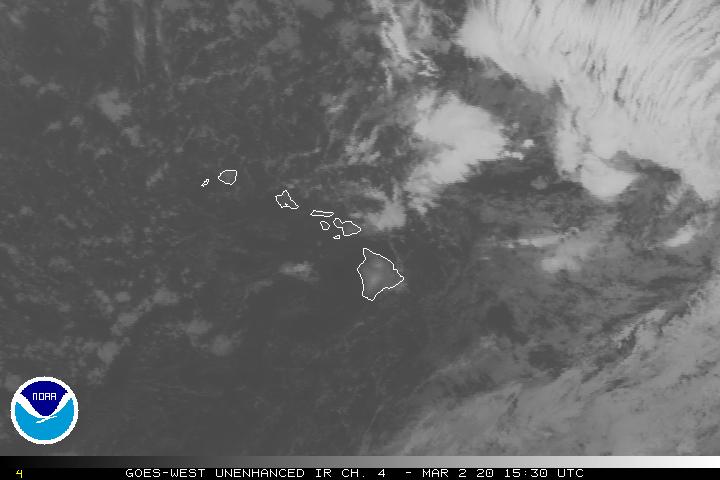
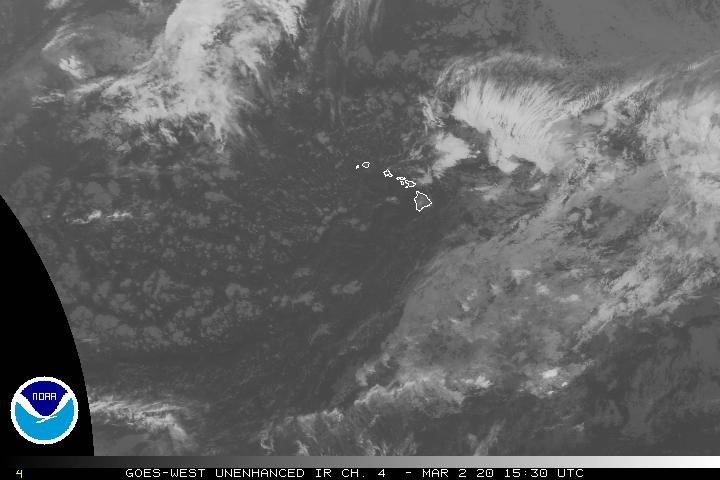
We can use the following links to see what’s going on in our area of the north central Pacific Ocean. Here's the latest NOAA satellite picture – the latest looping satellite image…and finally the latest looping radar image for the Hawaiian Islands.
~~~ Hawaii Weather Commentary ~~~
Our trade winds will remain active through this week into next week, with some fairly minor ups and downs in strength. Here's a weather chart showing a near 1036 millibar high pressure system located far to the northeast of Hawaii. At the same time, we see a near 1019 millibar low pressure system just to our east-northeast…with a deep near 974 storm low pressure system far northwest. Our trade wind weather pattern will continue. These winds are expected to become slightly lighter Wednesday and Thursday…then increasing again Friday into the weekend. The extended outlook calls for blustery trade wind weather right on into next week.
Satellite imagery shows a low clouds stretched out along our windward sides…with partly cloudy conditions along our leeward sides. As the trades hold firm, they will be bring us windward biased showers. These clouds being carried our way, although should be winding down to some degree over the next several days. Here's a larger view of the clouds, showing a counterclockwise rotating, upper level low pressure system over the ocean to our northeast…along with a swath of high clouds well to our south and southeast.
The trade winds will ease up slightly Wednesday and Thursday, as will the passing shower activity. As we push into Friday and the upcoming weekend however, both will increase again. In sum: continued trade wind flow, with typical winter temperatures, most abundant sunshine available along our south and west facing leeward beaches, along with small to very small surf along our south facing beaches…very user friendly. I'll be back again early Wednesday morning with your next new weather narrative from paradise. I hope you have a great Tuesday night wherever you happen to be spending it! Aloha for now…Glenn.
World-wide tropical cyclone activity:
Atlantic Ocean/Caribbean Sea: There are no active tropical cyclones
Gulf of Mexico: There are no active tropical cyclones
Eastern Pacific Ocean: There are no active tropical cyclones
Central Pacific Ocean: There are no active tropical cyclones
Western Pacific Ocean: There are no active tropical cyclones
South Pacific Ocean: There are no active tropical cyclones
North and South Indian Oceans: Tropical cyclone 15S (Gino) remains active in the south Indian Ocean…located approximately 875 NM south-southeast of Diego Garcia. Sustained winds are 85 knots, with gusts to 105 knots (98-121 mph). Here's the Joint Typhoon Warning Center (JTWC) graphical track map, and a satellite image.
Interesting: Rising gas prices have been in the news the past couple of years, as it seems the price of gas will never fall back down to what it used to be. "The last time I filled up my tank, it cost me around $50 (on empty) and regardless of the fuel efficiency of my car, I know I am not the only person who is frustrated by how much money we are spending on personal transportation."
According to a new report, the Union of Concerned Scientists (UCS), explain exactly what our gas dollars actually goes to. "In my case of a $50 fill up, the UCS show that $33 of my total went to crude oil, $20 of which went to private oil companies, and $13 to government-run oil companies, the remaining dollars to the gas station — a break-down that I would not have expected."
The UCS has examined how our gas dollars are distributed among all parties involved and conclude that a huge percentage of money spent at the pump go to oil companies, not our local gas station businesses, which one might assume.
Three of the biggest oil companies are British Petroleum, ExxonMobil, and Royal Dutch Shell who reaped more than $130 billion in profits for 2011. Gas stations, on the other hand, have averaged only three to five cents of profit from each gallon of gasoline sold over the past five years.
So these "local" businesses are not really making that much- instead they make more profit from other services that they might provide like having an attached convenient store, car wash, or auto body shop.
The United States is the largest consumer of crude oil in the world processing over 5.4 billion barrels of crude oil just last year. This will subsequently be on the rise if alternative energy use is not accepted. With gas becoming increasingly expensive, the Union of Concerned Scientists urges us to reduce our oil consumption as part of a smart fiscal strategy.
The study concludes that when it comes to oil, we have a right to choose efficiency. Reducing oil use is not only about choosing a fuel-efficient vehicle, but it is about car maintenance as well. When cars are well-maintained and have properly inflated and aligned tires, fuel is conserved.
Also following speed limits can also cut fuel use where driving at 65 miles per hour as opposed to 75 mph can further cut fuel use up to 20%.
 Email Glenn James:


Kerstin Says:
Aloha Glen. Thanks for your daily reports- both my charter boat & personal boat are thankful for your work as well : ) So, where is that amazing freshwater pool??? Its not the Venus Pools, is it???~~~Hi Kerstin, thanks for letting me know you keep track of the weather through my website, I like that! As for that fresh water pool, I’m willing to say that it’s on the windward side of east Maui, no more than that. It would be a shame to inundate that amazing place with too many folks, don’t you agree? Aloha, Glenn