Air Temperatures – The following maximum temperatures were recorded across the state of Hawaii Sunday afternoon:
Lihue, Kauai – 78
Honolulu airport, Oahu – 81
Molokai airport – 78
Kahului airport, Maui – 81
Kona airport – 81
Hilo airport, Hawaii – 80
Air Temperatures ranged between these warmest and coolest spots near sea level – and on the highest mountain tops around the state…as of 510am Monday morning:
Honolulu, Oahu – 72
Hilo, Hawaii – 65
Haleakala Summit – 39 (near 10,000 feet on Maui)
Mauna Kea Summit – 25 (13,000+ feet on the Big Island)
Hawaii’s Mountains – Here’s a link to the live web cam on the summit of near 13,800 foot Mauna Kea on the Big Island of Hawaii. This web cam is available during the daylight hours here in the islands…and when there’s a big moon shining down during the night at times. Plus, during the nights you will be able to see stars, and the sunrise and sunset too…depending upon weather conditions. Here's the Haleakala Crater webcam on Maui.
Tropical Cyclone activity in the eastern and central Pacific – Here’s the latest weather information coming out of the National Hurricane Center, covering the eastern north Pacific. You can find the latest tropical cyclone information for the central north Pacific (where Hawaii is located) by clicking on this link to the Central Pacific Hurricane Center. A satellite image, which shows the entire ocean area between Hawaii and the Mexican coast…can be found here. The 2012 hurricane season is over in the eastern and central Pacific…resuming on May 15th and June 1st 2013.
Aloha Paragraphs

Small Craft Advisory for northwest swells…
and stronger trade winds
Nice weather for our leeward sides, for the most
part…with windward showers at times
~~~530am HST Monday morning: clear, light breezes…at my
upcountry Kula, Maui weather tower: 53.4F degrees~~~
The following numbers represent the most recent top wind gusts (mph), along with directions as of Sunday evening:
28 Port Allen, Kauai – NE
38 Kahuku Trng, Oahu – E
32 Molokai – NE
40 Kahoolawe – E
33 Kahului, Maui – NE
37 PTA Keamuku, Big Island – NE
Here are the latest 24-hour precipitation totals (inches) for each of the islands as of late Sunday evening:
0.22 Mount Waialeale, Kauai
0.52 Oahu Forest NWR, Oahu
0.05 Molokai
0.00 Lanai
0.00 Kahoolawe
0.23 Puu Kukui, Maui
0.88 Kawainui Stream, Big Island
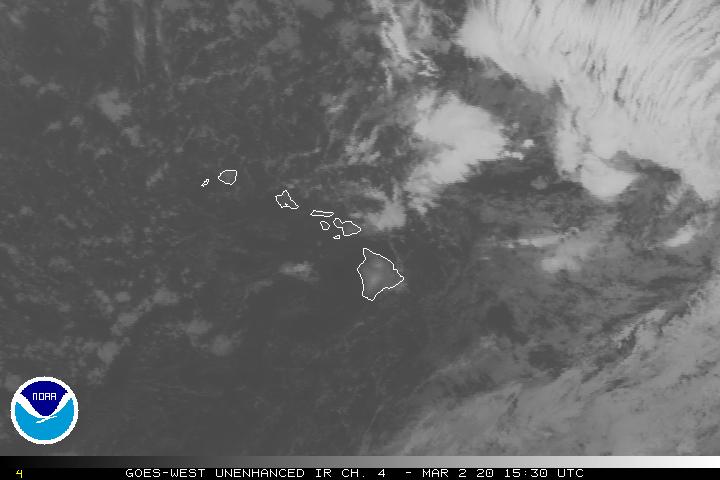
We can use the following links to see what’s going on in our area of the north central Pacific Ocean. Here's the latest NOAA satellite picture – the latest looping satellite image…and finally the latest looping radar image for the Hawaiian Islands.
~~~ Hawaii Weather Commentary ~~~
Our trade winds will remain active, increasing today…into the middle of the new week ahead. Here's a weather chart showing a large, near 1033 millibar high pressure system located far to the northeast of Hawaii, with another near 1031 millibar high pressure cell to our north…moving northeastward. At the same time, we see a near 1020 millibar low pressure system to our northeast. This low has a weak comma shaped cold front draping south and southwest from its center, the tail-end of which is just offshore to the northeast of the state. Our trade wind weather pattern, with the rather strong wind speeds will continue, with the winds becoming a bit lighter Thursday and Friday…then increasing again by next weekend. In other words, a prolonged period of winter trades are on tap well into the future.
Satellite imagery shows low clouds scattered across the ocean, mostly offshore to the northeast, north, and northwest…higher level clouds to our southwest. As the trades hold firm, they will be bring us windward biased showers…mostly for Kauai and Oahu for the time being. Those clouds to our north are associated with a dissipating cold front, just to the north of Kauai. There are a few heavier showers offshore to the south and southwest of the leeward sides. Looking ahead further, the models show another cold front approaching the state around Thursday-Friday, although it is expected to stall before arriving as well.
This blustery trade flow, will help to carry whatever moisture is still associated with this frontal boundary our way…first on Kauai and last on the Big Island. As these trades will become a bit stronger, they will be able to transport some of this moisture over into the leeward sides of the smaller islands at times too. Finally, the high surf that we've seen lately along our north and west shores, is now starting to become slowly smaller. It will still be active Monday, and will now be a better size for our local surf community to ride. The leeward south shores will be where everyone should be going, as it is flat, or close to it now. I'll be back early Monday morning with your next new weather narrative. I hope you have a great Sunday night wherever you happen to be spending it! Aloha for now…Glenn.
World-wide tropical cyclone activity:
Atlantic Ocean/Caribbean Sea: There are no active tropical cyclones
Gulf of Mexico: There are no active tropical cyclones
Eastern Pacific Ocean: There are no active tropical cyclones
Central Pacific Ocean: There are no active tropical cyclones
Western Pacific Ocean: There are no active tropical cyclones
South Pacific Ocean: Tropical cyclone 14P (Haley) is now dissipating in the southwest Pacific…located approximately 500 NM south-southwest of Bora Bora, Society Islands, French Polynesia. Here's the Joint Typhoon Warning Center (JTWC) graphical track map, along with a satellite image. – Final Warning
North and South Indian Oceans: Tropical cyclone 15S (Gino) remains active in the south Indian Ocean…located approximately 630 NM east-southeast of Diego Garcia. Here's the Joint Typhoon Warning Center (JTWC) graphical track map, and a satellite image.
Interesting: A Laysan albatross known as Wisdom — believed to be at least 62 years old — has hatched a chick on Midway Atoll National Wildlife Refuge for the sixth consecutive year. This is pretty old to give birth for any species. During the morning hours on Sunday, the chick was observed pipping its way into the world by U.S. Fish and Wildlife Service biologist Pete Leary, who said the chick appears healthy.
Wisdom was first banded in 1956, when she was incubating an egg in the same area of the refuge. She was at least five years old at the time. 5 to 62 and still giving birth to youngsters. That is a dedicated mom. The Laysan Albatross is a large seabird that ranges across the North Pacific. 99.7% of the population is found on the Northwestern Hawaiian Islands.
This small (for its family) two-tone gull-like albatross is the second most common seabird in the Hawaiian Islands, with an estimated population of 2.5 million birds, and is currently expanding (or possibly re-expanding) its range to new islands.
"Everyone continues to be inspired by Wisdom as a symbol of hope for her species," said Doug Staller, the Fish and Wildlife Service superintendent for the Papah?naumoku?kea Marine National Monument (Monument), which includes Midway Atoll NWR. Staff and volunteers stationed on Midway are responsible for monitoring the health of the beautiful seabirds that arrive every year by the hundreds of thousands to nest.
Upon the seabirds' arrival, field staff monitor them and gather information for one of the longest and oldest continuous survey data sets for tropical seabirds in the world. Wisdom has worn out five bird bands since she was first banded by U.S. Geological Survey scientist Chandler Robbins in 1956. Robbins estimated Wisdom to be at least 5 years old at the time, since this is the earliest age at which these birds breed.
Typically, they breed at 8 or 9 years of age after a very involved courtship lasting over several years so Wisdom could be even older than 62. Bruce Peterjohn, chief of the North American Bird Banding Program at the USGS Patuxent Wildlife Research Center in Laurel, MD, said Wisdom has likely raised at least 30 to 35 chicks during her breeding life, though the number may well be higher because experienced parents tend to be better parents than younger breeders.
Albatross lay only one egg a year, but it takes much of a year to incubate and raise the chick. After consecutive years in which they have successfully raised and fledged a chick, the parents may take the occasional next year off from parenting. Wisdom is known to have nested in 2006 and then every year since 2008.
Life expectancy in birds is closely correlated with size — the larger the species, the longer it is likely to live. But the relationship is far from exact. Some groups of birds tend to have long lives for their sizes, especially the — albatrosses,and shorebirds(gulls and terns, and auks).
Other groups, for instance titmice and chickadees, wrens, and game birds, are shorter-lived than their sizes would predict. Birds can be very long-lived in captivity. One Sulphur-crested Cockatoo lived most of his 80-plus years in a zoo. Captive Canada Geese have lived for 33 years, House Sparrows 23 years, and Northern Cardinals 22 years.
In nature, the life-spans of these species are much shorter. "As Wisdom rewrites the record books, she provides new insights into the remarkable biology of seabirds," Peterjohn said. "It is beyond words to describe the amazing accomplishments of this wonderful bird and how she demonstrates the value of bird banding to better understand the world around us.
If she were human, she would be eligible for Medicare in a couple years yet she is still regularly raising young and annually circumnavigating the Pacific Ocean. Simply incredible." Sue Schulmeister, manager of the Midway Atoll NWR, said, "Wisdom is one is one of those incredible seabirds that has provided the world valuable information about the longevity of these beautiful creatures and reinforces the importance of breeding adults in the population.
This information helps us measure the health of our oceans that sustain albatross." Almost as amazing as being a parent at 62 is the number of miles this bird has likely logged — about 50,000 miles a year as an adult — which means that Wisdom has flown at least 2 to 3 million miles since she was first banded.
Or, to put it another way, that's 4 to 6 trips from the Earth to the Moon and back again with plenty of miles to spare.
 Email Glenn James: