











Air Temperatures – The following maximum temperatures were recorded across the state of Hawaii Tuesday afternoon:
Lihue, Kauai – 76
Honolulu airport, Oahu – 81
Molokai airport – 76
Kahului airport, Maui – 78
Kona airport – 81
Hilo airport, Hawaii – 78
Air Temperatures ranged between these warmest and coolest spots near sea level – and on the highest mountain tops around the state…as of 430am Wednesday morning:
Kaneohe, Oahu – 72
Hilo, Hawaii – 66
Haleakala Summit – 36 (near 10,000 feet on Maui)
Mauna Kea Summit – 34 (13,000+ feet on the Big Island)
Hawaii’s Mountains – Here’s a link to the live web cam on the summit of near 13,800 foot Mauna Kea on the Big Island of Hawaii. This web cam is available during the daylight hours here in the islands…and when there’s a big moon shining down during the night at times. Plus, during the nights you will be able to see stars, and the sunrise and sunset too…depending upon weather conditions. Here's the Haleakala Crater webcam on Maui.
Tropical Cyclone activity in the eastern and central Pacific – Here’s the latest weather information coming out of the National Hurricane Center, covering the eastern north Pacific. You can find the latest tropical cyclone information for the central north Pacific (where Hawaii is located) by clicking on this link to the Central Pacific Hurricane Center. A satellite image, which shows the entire ocean area between Hawaii and the Mexican coast…can be found here. The 2012 hurricane season is over in the eastern and central Pacific…resuming on May 15th and June 1st 2013.
Aloha Paragraphs

Small Craft Advisory for gusty trade winds…over the
waters around parts of Maui and the Big Island
Increased showers at times into Thursday morning – with
some easing Friday…more windward showers this weekend
~~~533am HST Wednesday morning: clear, calm…at my
upcountry Kula, Maui weather tower: 53.4F degrees~~~
The following numbers represent the most recent top wind gusts (mph), along with directions as of Tuesday evening:
23 Waimea Heights, Kauai – NE
29 Kuaokala, Oahu – ENE
28 Molokai – ENE
35 Kahoolawe -NE
30 Kahului, Maui – ENE
31 Pali 2, Big Island – NE
Here are the latest 24-hour precipitation totals (inches) for each of the islands as of Tuesday evening:
1.31 Mount Waialeale, Kauai
0.13 Mililani, Oahu
0.06 Molokai
0.00 Lanai
0.00 Kahoolawe
1.75 Puu Kukui, Maui
2.62 Kawainui Stream, Big Island
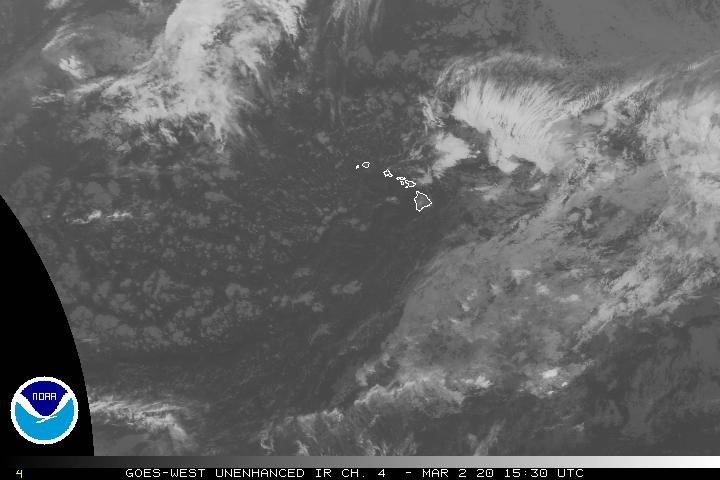
We can use the following links to see what’s going on in our area of the north central Pacific Ocean. Here's the latest NOAA satellite picture – the latest looping satellite image…and finally the latest looping radar image for the Hawaiian Islands.
~~~ Hawaii Weather Commentary ~~~
Our trade winds will remain moderately strong, although a bit stronger in places. Here's a weather chart showing a trade wind producing, high pressure system located to the north of Hawaii. At the same time, we see storm low pressure systems far to our northwest through northeast. Small craft wind advisories continue over all of the marine zones in the state Tuesday evening. These trade winds will continue through the remainder of this week…becoming gradually lighter as we go.
Satellite imagery shows clouds surrounding the islands in all directions…with somewhat more showery clouds out to our east. Showers here in the islands will slowing increase in frequency along our north and east facing windward coasts and slopes over the next few days…through perhaps Thursday morning or so. The south and west facing leeward beaches will remain in pretty good shape, although with showers falling here and there too.
Increased low level moisture will arrive late tonight, helping to fuel these increasing showers into Thursday morning. While this moisture is streaming over us from the east, a trough of low pressure will edge in our direction from the west and northwest at the same time. These two weather elements will couple up, to provide increased showers…some of which will be locally heavy along our windward coasts and slopes over the next few days.
As Friday and Saturday rolls around, we may find a cold front approaching Kauai. If this front reaches the islands later in the day Saturday, we would see showers arriving…mostly along the windward sides of our islands into Sunday. At this point it looks like we'll find a fairly typical trade wind weather pattern thereafter, as we push into early next week. ~~~ I'll be back again early Wednesday morning with your next new weather narrative from paradise. I hope you have a great Tuesday night wherever you're spending it! Aloha for now, Glenn.
World-wide tropical cyclone activity:
Atlantic Ocean/Caribbean Sea: There are no active tropical cyclones
Gulf of Mexico: There are no active tropical cyclones
Eastern Pacific Ocean: There are no active tropical cyclones
Central Pacific Ocean: There are no active tropical cyclones
Western Pacific Ocean: There are no active tropical cyclones
South Pacific Ocean: There are no active tropical cyclones
North and South Indian Oceans: There are no active tropical cyclones
Interesting: Understanding the past is always useful in predicting the future. In this case, how climate fluctuates over time due to natural effects before and and his industry affected it. Tree-rings, ice-cores, and speleothems can all be used to reconstruct climate of the past millennia. But these records may be of local effects and not global as well as being impacted by other events not clear in the mists of time.
Researchers of the Swiss Federal Research Institute WSL, the University of Bern’s Oeschger Center, and the University of Mainz have found out that yearly temperature and precipitation variation and extremes have previously been underestimated in comparison to longer-term climatic trends. These findings were just published in an early release issue from the renowned journal Nature Climate Change.
In the study of past climates, known as paleo-climatology, climate proxies are preserved physical characteristics of the past that stand in for direct measurements (as statistical proxies), to enable scientists to reconstruct the climatic conditions that prevailed in the past. As reliable modern records of climate only began in the 1880s, proxies provide a means for scientists to determine climatic patterns before record-keeping began.
Examples of proxies include ice cores, tree rings, sub-fossil pollen, boreholes, corals, and lake and ocean sediments. The character of deposition or rate of growth of the proxies' material would have been influenced by the climatic conditions of the time in which they were laid down or grew. Chemical traces produced by climatic changes, such as quantities of particular isotopes, can be recovered from proxies.
Some proxies, such as gas bubbles trapped in ice, enable traces of the ancient atmosphere to be recovered and measured directly to provide a history of fluctuations in the composition of the Earth's atmosphere. Climate extremes not always recognized in proxy archives. The scientists learned that these proxy archives provide an incomplete record of climate variation.
The annual width or density of tree-rings is not only influenced by temperature while the ring is developing, but also from the climate of the past years and other factors like tree age. This makes it difficult to extract pure temperature signals from these natural archives.
Importantly, the researchers found out that proxy data underestimate climate fluctuations of, for example, air temperature over the land surface where large year-to-year variability is common. In contrast, long-term trends in precipitation tend to be exaggerated by the proxy records. These findings indicate that the proxy data often result in a "blurry picture" of climate variation.
The researchers were able to conclude from their work that short-term extreme climate events, such as individual years with hot summers, are not well captured by the proxy reconstructions. Temperature trends can’t be used to understand rainfall. Investigations on the individual factors and processes fingerprinted in tree-ring, ice-core and similar records are needed to develop a more accurate history and understanding of the climate system.
The authors explicitly warn that proxy records that predominately reflect temperature variation should not be used to make conclusions about precipitation change and vice-versa. "Our results point to uncertainties in the global climate system that were previously not recognized," says David Frank, co-author of this study.
He continues "This might be surprising because we know more about the Earth’s climate now than say 20-years ago. Part of the scientific process is to confront and uncover these unknowns while developing climate reconstructions." There is still a lot of basic research needed to reduce uncertainties about how the Earth’s climate system operated prior to the industrial era and how it may operate in the future.
 Email Glenn James:
Steve Says:
Aloha Glenn,
Many Mahalos to our favorite weatherman! We follow you wherever we are in the world! Tonight from San Diego, and want you to know you are most appreciated. We look forward to your cinema reviews too!
Love and appreciation, Steve and Diane~~~What a great way to end my day here on Maui, with your heart felt praise from San Diego…thank you both very much! Being appreciated is a great thing, especially when what I do for you, is what I love as well. I’m going to see Zero Dark Thirty this Friday evening, and will give you my true impressions as usual early Saturday morning. Thank you both, Steve and Diane! Aloha, Glenn
Mary Says:
Happy Weatheman's Day, Glenn! Your work is such a positive force for Maui, and you are appreciated very much. Mahalo nui loa!~~~Hi Mary, I’m receiving all these nice notes today, makes me feel happy…and appreciated too! Thank you, I take it to heart. Aloha, Glenn
Barbara Duvall Says:
Happy National Weatherman's Day Glenn. Mahalo for your wonderful website!~~~Thank you Barbara, I greatly appreciate your positive feedback on my website, and this sort of holiday for me! Aloha…Glenn
J.J. Says:
Aloha Glenn…
Happy Weatherman Day !!
May all the winds blow in the right direction…
JJ~~~Hi JJ, thanks very much, lets let the trade winds blow in exactly the right direction, as you say…the perfect way. Looking forward to hearing your radio show this evening on Manao Radio / 5-8pm. Aloha, Glenn