Air Temperatures – The following maximum temperatures were recorded across the state of Hawaii Sunday afternoon:
Lihue, Kauai – 81
Honolulu airport, Oahu – 83
Molokai airport – 81
Kahului airport, Maui – 85
Kona airport – 83
Hilo airport, Hawaii – 77
Air Temperatures ranged between these warmest and coolest spots near sea level – and on the highest mountain tops around the state…as of 510pm Sunday evening:
Barking Sands, Kauai – 80
Hilo, Hawaii – 75
Haleakala Summit – M (near 10,000 feet on Maui)
Mauna Kea Summit – 41 (near 13,800 feet on the Big Island)
Hawaii’s Mountains – Here’s a link to the live web cam on the summit of near 13,800 foot Mauna Kea on the Big Island of Hawaii. This web cam is available during the daylight hours here in the islands…and when there’s a big moon shining down during the night at times. Plus, during the nights you will be able to see stars, and the sunrise and sunset too…depending upon weather conditions. Here's the Haleakala Crater webcam on Maui.
Tropical Cyclone activity in the eastern and central Pacific – Here’s the latest weather information coming out of the National Hurricane Center, covering the eastern north Pacific. You can find the latest tropical cyclone information for the central north Pacific (where Hawaii is located) by clicking on this link to the Central Pacific Hurricane Center. A satellite image, which shows the entire ocean area between Hawaii and the Mexican coast…can be found here. The 2012 hurricane season is over in the eastern and central Pacific…resuming on May 15th and June 1st 2013.
Aloha Paragraphs

Clear to partly cloudy, cloudy periods,
passing showers at times windward
sides…a few leeward in places too
Strengthening trade winds into the new week
The following numbers represent the most recent top wind gusts (mph), along with directions as of Sunday evening:
22 Port Allen, Kauai – ESE
31 Kahuku Trng, Oahu – ESE
35 Molokai – ENE
42 Kahoolawe – ENE
35 Lipoa, Maui – SE
21 Lanai – NE
33 South Point, Big Island – NE
Here are the latest 24-hour precipitation totals (inches) for each of the islands as of Sunday evening:
0.62 Mount Waialeale, Kauai
0.19 Poamoho RG 1, Oahu
0.40 Molokai
0.00 Kahoolawe
0.28 Puu Kukui, Maui
0.73 Kawainui, Big Island
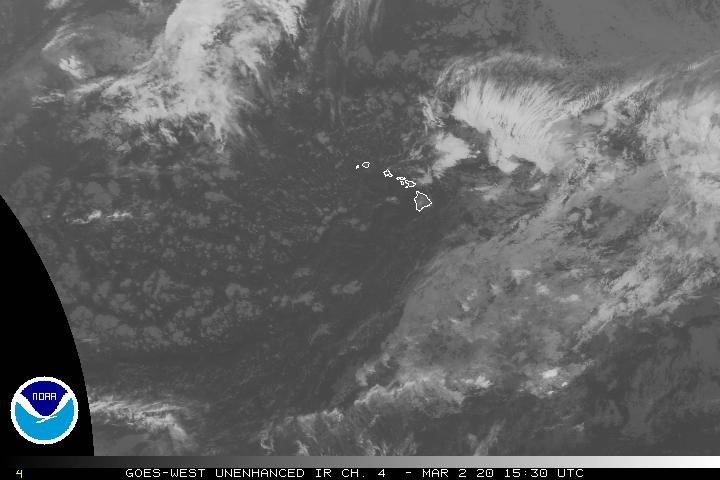
We can use the following links to see what’s going on in our area of the north central Pacific Ocean. Here's the latest NOAA satellite picture – the latest looping satellite image…and finally the latest looping radar image for the Hawaiian Islands.
~~ Hawaii weather commentary ~~
Trade winds will prevail through most of the new week ahead…becoming stronger and gusty at times. We currently have near 1034 millibar high pressure systems (weather map), located far to the northeast of Hawaii, with a ridge running southwest to the north and northwest of the islands. Meanwhile, we find low pressure systems to our northwest through west. Here's a satellite image, showing high cirrus, and middle level clouds to our southeast, and west through northwest…with a few embedded thunderstorms to the west of Kauai. These clouds are associated with a deep low pressure system to the northwest of Kauai. At the same time we have just a few lower level clouds riding in on the trade winds…which will provide passing showers at times along our windward coasts and slopes in the near term.
The overall plan calls for a long lasting trade wind weather pattern…with generally good late autumn conditions for the time being. There will be low pressure aloft at times this week, which may act to enhance showers locally then. The windward sides will benefit from these showers the most, although there will be limited moisture in our atmosphere at times too…which would act to limit this activity. Meanwhile, the leeward sides should be in good shape, albeit windy in places. Speaking of winds, they have been gusting up to 40 mph and over Sunday…which is continuing Sunday evening. These winds will gradually become a bit stronger, with some possible gusts approaching the 50 mph mark at times Monday and Tuesday. I'll be back early Monday morning with your next new weather narrative, I hope you have a great Sunday night wherever you're spending it! Aloha for now…Glenn.
Friday evening film: There are many good films showing, which makes it a little difficult to pick just one. Although I ended up picking Killing Them Softly, starring Brad Pitt, Casey Affleck, Sam Rockwell, Mark Ruffalo, Ray Liotta, and Linara Washington…among many others. The synopsis: Killing Them Softly is a darkly comic, visceral thriller that doubles as a cautionary tale on capitalism, whose message is delivered with sledgehammer force. ~~~ It's a mixed bag in terms of what the critics are saying about this film, from good to bad. In my way of thinking, there are so many good actors, that I've always liked, how could it be anything but good. As it turned out, I did like it, although it was so rough! It was the first film in a long time that I had to avert my eyes through this one stretch, where the Ray Liotta character was getting beat up so badly. This film was over the top in some ways, although it kept my attention throughout. It was absolutely a dark film, really dark, although there's a part of that kind of stuff that I find strangely very interesting, don't ask me why…as I'm not exactly sure. At any rate, as far as a grade goes, it falls somewhere between a B and B+. Here's the trailer, and by the way…its not for everyone's eyes!
World-wide tropical cyclone activity:
Atlantic Ocean/Caribbean Sea: There are no active tropical cyclones
Gulf of Mexico: There are no active tropical cyclones
Eastern Pacific Ocean: There are no active tropical cyclones
Central Pacific Ocean: There are no active tropical cyclones
Western Pacific Ocean: There are no active tropical cyclones
South Pacific Ocean: There are no active tropical cyclones
North and South Indian Oceans: Typhoon Claudia (03S) remains active in the South Indian Ocean…located approximately 625 NM south of Diego Garcia. Sustained winds are near 105 knots, with gusts to near 130 knots. 03S will gradually decrease in strength throughout the remainder of her life cycle. Here's the JTWC graphical track map…along with a satellite image.
Interesting: Are all the environmental laws and regulations accomplishing anything? Sometimes progress is not apparent, so it is good news that a new study led by researchers at Harvard School of Public Health (HSPH) has found an association between reductions in fine particulate matter and improved life expectancy in 545 counties in the U.S. from 2000 to 2007. It is the largest study to date to find beneficial effects to public health of continuing to reduce air pollution levels in the U.S. The study appears in the December 3, 2012 online edition of the journal Epidemiology.
"Despite the fact that the U.S. population as a whole is exposed to much lower levels of air pollution than 30 years ago—because of great strides made to reduce people’s exposure—it appears that further reductions in air pollution levels would continue to benefit public health," said lead author Andrew Correia, a PhD candidate in the Department of Biostatistics at HSPH".
The study looked at the effects on health of fine particulate matter, small particles of 2.5 micrometers or less in diameter—referred to as PM2.5. Numerous studies have shown associations between acute and chronic exposure to fine particle air pollution and cardiopulmonary disease and mortality.
Studies have also shown that reductions in air pollution are associated with reductions in adverse health effects and improved life expectancy. Air pollution has been declining steadily in the U.S. since 1980, but the rate has slowed in the years since 2000. The HSPH researchers wanted to know whether the relatively smaller decreases in PM2.5 levels since 2000 are still improving life expectancy.
Controlling for socioeconomic status, smoking prevalence, and demographic characteristics, the results showed that a decrease of 10 micrograms per cubic meter in the concentration of PM2.5 during the period 2000 to 2007 was associated with an average increase in life expectancy of 0.35 years in 545 U.S. counties.
The research expanded on a 2009 study published in the New England Journal of Medicine by some of the same authors (Pope, Ezzati, and Dockery) that found that reduced air pollution was associated with increased life expectancy in 211 urban counties. This new study looked at more recent data, more than two-and-a-half times as many counties, and included both rural and urban areas.
The findings showed that there’s a stronger association between declining air pollution and increased life expectancy in more urban, densely populated areas than in rural areas. The results also suggested that reduced levels of air pollution may be more beneficial to women than to men.
 Email Glenn James: