Air Temperatures – The following maximum temperatures were recorded across the state of Hawaii Wednesday afternoon:
Lihue, Kauai – 78
Honolulu airport, Oahu – 81
Molokai airport – 82
Kahului airport, Maui – 81
Kona airport – 84
Hilo airport, Hawaii – 81
Air Temperatures ranged between these warmest and coolest spots near sea level – and on the highest mountain tops around the state…as of :
Kahului, Maui – M
Kapalua, Maui – M
Haleakala Summit – M (near 10,000 feet on Maui)
Mauna Kea Summit – M (near 13,800 feet on the Big Island)
Hawaii’s Mountains – Here’s a link to the live web cam on the summit of near 13,800 foot Mauna Kea on the Big Island of Hawaii. This web cam is available during the daylight hours here in the islands…and when there’s a big moon shining down during the night at times. Plus, during the nights you will be able to see stars, and the sunrise and sunset too…depending upon weather conditions. Here's the Haleakala Crater webcam on Maui.
Tropical Cyclone activity in the eastern and central Pacific – Here’s the latest weather information coming out of the National Hurricane Center, covering the eastern north Pacific. You can find the latest tropical cyclone information for the central north Pacific (where Hawaii is located) by clicking on this link to the Central Pacific Hurricane Center. A satellite image, which shows the entire ocean area between Hawaii and the Mexican coast…can be found here. The 2012 hurricane season is over in the eastern and central Pacific…resuming on May 15th and June 1st 2013.
Aloha Paragraphs

Partly to mostly cloudy, just a few showers here
and there…generally light
Light breezes…although locally stronger
Locally hazy…quite thick at times
Chance of stormy weather next week
The following numbers represent the most recent top wind gusts (mph), along with directions as of Wednesday evening:
22 Waimea Heights, Kauai – ESE
14 Kahuku Trng, Oahu – SE
21 Molokai – ENE
25 Kahoolawe – ENE
18 Lipoa, Maui – ESE
13 Lanai – SE
31 South Point, Big Island – NE
Here are the latest 24-hour precipitation totals (inches) for each of the islands as of late Wednesday evening:
2.99 Puu Opae, Kauai
1.42 Hawaii Kai, Oahu
0.01 Molokai
0.00 Lanai
0.00 Kahoolawe
0.04 Kula Branch Station, Maui
0.39 Puhe CS, Big Island
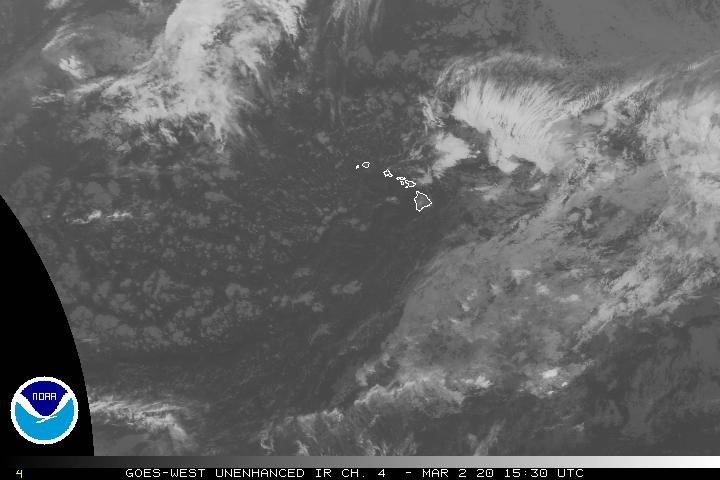
We can use the following links to see what’s going on in our area of the north central Pacific Ocean. Here's the latest NOAA satellite picture – the latest looping satellite image…and finally the latest looping radar image for the Hawaiian Islands.
~~ Hawaii weather commentary ~~
Generally light and variable breezes will prevail through the rest of the week, locally stronger…especially on the Big Island. We currently have high pressure systems (weather map), located over the ocean far to the northeast of Hawaii…with an associated ridge extending westward…offshore to the northeast of the islands. Meanwhile, we find a storm low pressure system to our northwest, with an associated cold front approaching. Here's a satellite image, showing a large area of clouds, at all levels of the atmosphere over the state…along with a looping radar image.
A trough of low pressure has moved by to the north of the state, and is now far enough away…to have ended the threat of heavy showers and thunderstorms. Moving forward, our next cold front will approach the state Friday…although it will stall northwest of Kauai. It's location will keep our islands in a southeast to easterly wind flow, keeping volcanic haze over most of the state. The cold front may finally push down into the state by next Monday and Tuesday. This in turn could bring a wet and stormy pattern for the Hawaiian Islands, perhaps even severe…stay tuned.
In sum, a few showers falling at times, although generally light stuff. Light winds, although locally stronger…with volcanic haze persisting through Friday, and perhaps longer. This light to moderately strong wind regime will have clouds forming over and around the mountains during the afternoon hours, although with not much rain for the time being. A cold front approaching to the northwest later Friday into the weekend, will prompt east to southeast breezes here in the islands. This front may get pushed down through the state after the weekend, with possible locally rainy and windy conditions then. This chance of severe weather should be held lightly for now, although some of the models are showing just that. ~~~ Since we're in our late autumn period of the year, our weather will continue changing quite a bit, necessitating frequent updates to the outlook. I'll be back early Thursday morning with those new weather outlooks. I hope you have a great Wednesday night wherever you're spending it! Aloha for now…Glenn.
World-wide tropical cyclone activity:
Atlantic Ocean/Caribbean Sea: There are no active tropical cyclones
Gulf of Mexico: There are no active tropical cyclones
Eastern Pacific Ocean: There are no active tropical cyclones
Central Pacific Ocean: There are no active tropical cyclones
Western Pacific Ocean: Tropical storm Bopha (26W) remains active in the South China Sea…located approximately 295 NM west-southwest of Manila, Philippines. Sustained winds are at 45 knots, with gusts to near 55 knots. Bopha will decrease in strength going forward. Here's the JTWC graphical track map…along with a satellite image. Here's morphed integrated microwave imagery from CIMSS…as Bopha moves through the southern Philippine Islands into the South China Sea.
South Pacific Ocean: There are no active tropical cyclones
North and South Indian Oceans: Tropical cyclone 03S is now active in the South Indian Ocean…located approximately 385 NM southeast of Diego Garcia. Sustained winds are at 35 knots, with gusts to near 45 knots. 03S will increase in strength going forward…becoming a typhoon within 72 hours. Here's the JTWC graphical track map…along with a satellite image.
Interesting: A team of paleontologists thinks it may have identified the earliest known dinosaur—a creature no bigger than a Labrador retriever that lived about 243 million years ago. That's at least 10 million years earlier than the oldest known dinos and could change researchers' views of how they evolved. But some scientists, including the study's authors, caution that the fossils could instead represent a close dino relative.
A team of paleontologists thinks it may have identified the earliest known dinosaur—a creature no bigger than a Labrador retriever that lived about 243 million years ago. That's at least 10 million years earlier than the oldest known dinos and could change researchers' views of how they evolved.
But some scientists, including the study's authors, caution that the fossils could instead represent a close dino relative. Nesbitt says that this combination of characteristics, rather than any one taken alone, makes a strong case that Nyasasaurus was "either a dinosaur or the closest relative."
Moreover, by the time early dinosaurs such as Eoraptor and Eodromaeus show up in Argentina at least 10 million years later, they already represent diverse groups that must have been evolving for millions of years. That means that dinosaur evolution must have begun a considerable time before that, Nesbitt says.
And it makes Nyasasaurus a good candidate for an early dino, especially as a very close dinosaur relative, Asilisaurus, was also living in the Manda Beds some 243 million years ago. The team stresses that its findings don't suggest that the earliest dinosaurs evolved in Africa, despite the Tanzanian location of the fossils: At that time, Africa was part of a supercontinent called Pangaea, which also included present-day South America, Antarctica, and Australia.
But the results may contradict the views of some researchers that the first dinosaurs diversified in an "early burst" of rapid evolution soon after they appeared. The authors are "properly careful" in saying that Nyasasaurus is probably, but not definitely, a dinosaur, because the arm bone is not complete, says Michael Benton, a paleobiologist at the University of Bristol in the United Kingdom.
But even if the team is not "100% certain" that it's a true dinosaur, Benton adds, the existence of a close dinosaur relative that early "guarantees [dinosaurs] must have originated then also." Max Langer, a paleontologist at the University of São Paulo in Brazil, agrees that the fragmentary nature of the arm bone makes estimates of the length of its crest "highly speculative" and argues against making any "bold claims" about finding the earliest dinosaur.
As for the discovery's implications for the "early burst" hypothesis, Stephen Brusatte, a paleontologist at the American Museum of Natural History in New York City, insists that it "doesn't nix the early burst idea at all."
If Nyasasaurus is only a sister taxon to dinosaurs, Brusatte says, then the early burst hypothesis "would only be falsified if true dinosaurs lived between the time of Nyasasaurus and the time that we see several species of unequivocal true dinosaurs in Argentina" 230 million years ago.
Nevertheless, Brusatte says, "within the next decade I expect the Manda finds to greatly change our understanding" of the rise of the mighty dinosaurs.
 Email Glenn James: