











Air Temperatures – The following maximum temperatures were recorded across the state of Hawaii Tuesday afternoon:
Lihue, Kauai – 81
Honolulu airport, Oahu – 82
Molokai airport – 83
Kahului airport, Maui – 84
Kona airport – 81
Hilo airport, Hawaii – 85
Air Temperatures ranged between these warmest and coolest spots near sea level – and on the highest mountain tops around the state…as of 1210pm Tuesday afternoon:
Kahului, Maui – 83
Kapalua, Maui – 77
Haleakala Summit – M (near 10,000 feet on Maui)
Mauna Kea Summit – 41 (near 13,800 feet on the Big Island)
Hawaii’s Mountains – Here’s a link to the live web cam on the summit of near 13,800 foot Mauna Kea on the Big Island of Hawaii. This web cam is available during the daylight hours here in the islands…and when there’s a big moon shining down during the night at times. Plus, during the nights you will be able to see stars, and the sunrise and sunset too…depending upon weather conditions. Here's the Haleakala Crater webcam on Maui.
Tropical Cyclone activity in the eastern and central Pacific – Here’s the latest weather information coming out of the National Hurricane Center, covering the eastern north Pacific. You can find the latest tropical cyclone information for the central north Pacific (where Hawaii is located) by clicking on this link to the Central Pacific Hurricane Center. A satellite image, which shows the entire ocean area between Hawaii and the Mexican coast…can be found here. The 2012 hurricane season is over in the eastern and central Pacific…resuming on May 15th and June 1st 2013.
Aloha Paragraphs

Rainy periods for Kauai, with potential thunderstorms…
cloudy with fewer showers over the rest of the island chain
The following numbers represent the most recent top wind gusts (mph), along with directions as of Tuesday evening:
08 Waimea Heights, Kauai – SSW
15 Waianae Harbor, Oahu – SSW
13 Molokai – ESE
12 Kahoolawe – NE
15 Lipoa, Maui – ENE
09 Lanai – NNE
25 South Point, Big Island – ENE
Here are the latest 24-hour precipitation totals (inches) for each of the islands as of late Tuesday evening:
0.24 Mount Waialeale, Kauai
0.62 Schofield South, Oahu
0.09 Molokai
0.00 Lanai
0.00 Kahoolawe
0.09 Kula Branch Station, Maui
0.69 Puuanahulu, Big Island
We can use the following links to see what’s going on in our area of the north central Pacific Ocean. Here's the latest NOAA satellite picture – the latest looping satellite image…and finally the latest looping radar image for the Hawaiian Islands.
~~ Hawaii weather commentary ~~
Generally light and variable breezes will prevail through Friday. We currently have high pressure systems (weather map), located over the ocean far to the north and east of Hawaii…with an associated ridge extending westward from the eastern high pressure cell…to near Maui County this evening. Meanwhile, we find series of weakening low pressure systems to our north-northwest through northeast. At the same time, we find an old frontal boundary, which is fading away offshore to the west of Kauai, it may act as a focus for a few additional showers. Here's a satellite image, showing a large area of clouds approaching the state from the southwest…along with a looping radar image.
A weather change will occur tonight, as rain and thunderstorms, associated with a trough of low pressure…edges up close to Kauai from the northwest and west. The forecast calls for generous, or even heavy rainfall over that western island, with some localized flooding possible into Wednesday. This potentially very rainy night should put the residents of Kauai on alert. The rest of the state from Maui County down through the Big Island, and perhaps even Oahu…will be too far south and east to get into this rainfall event over Kauai.
Moving forward, our weather will settle down again later Wednesday and Thursday. It looks as if our current light wind regime will continue. This in turn will keep us in a convective weather pattern, with generally clear mornings, (unless there are high or middle level clouds around…like there will be Wednesday)…giving way to afternoon clouds around the mountains, with a few upcountry showers here and there. Later Friday will be another turning point, as the next late autumn cold front approaches from the northwest. The models are showing this front stalling just before arriving on Kauai, but time will tell. Our winds will pick up from the southeast through south this weekend, which could mean more volcanic haze coming our way then. I'll be back early Wednesday morning with your next new weather narrative, I hope you have a great Tuesday night wherever you happen to be spending it! Aloha for now…Glenn.
World-wide tropical cyclone activity:
Atlantic Ocean/Caribbean Sea: There are no active tropical cyclones
Gulf of Mexico: There are no active tropical cyclones
Eastern Pacific Ocean: There are no active tropical cyclones
Central Pacific Ocean: There are no active tropical cyclones
Western Pacific Ocean: Typhoon Bopha (26W) remains active in the South China Sea…located approximately 270 NM southwest of Manila, Philippines. Sustained winds remain at 75 knots, with gusts to near 90 knots. Bopha will slowly increase in strength over the warm waters of the South China Sea, after having been weakened by its passage over the Philippines. Here's the JTWC graphical track map…along with a satellite image. Here's morphed integrated microwave imagery from CIMSS…as Bopha moved by just south of Palau, then through the southern Philippine Islands.
South Pacific Ocean: There are no active tropical cyclones
North and South Indian Oceans: There are no active tropical cyclones
Interesting: With all the stories of the struggles of mountain gorillas and the illegal poaching they are suffering, it is a welcome relief to hear some good news. That news has come from a recent survey supported by the Wildlife Conservation Society of the great apes in one of Uganda's national parks.
The survey revealed that their population has actually risen since the last count in 2006, an increase of roughly 33 percent to a minimum total of 400. When added to the famous mountain gorilla population of the Virunga Volcanoes to the south (the only other place where they exist), the entire global population of mountain gorillas now stands at 880.
The Bwindi Impenetrable National Park (maybe the coolest named national park) is located in southwestern Uganda along the border of the DRC (Democratic Republic of Congo). It comprises 331 square kilometers (128 square miles) of thick jungle that is only accessible by foot.
It is known as being home to astonishing rich biodiversity and has been recognized as a World Heritage Site by UNESCO. The park's population of critically endangered mountain gorillas is a huge draw for tourism. This provides ample reason for the nation to protect them and ensure a growing population.
Tourists who wish to view the gorillas have to endure a long journey on difficult roads to the jungle, paying for transportation, food, and lodging provided by the local community. They then have to pay a permit to track the gorillas, generating great revenue for the Uganda Wildlife Authority (UWA).
The recent census was conducted by the Uganda Minister for Tourism, Wildlife, and Antiquities along with the UWA. They found the Bwindi mountain gorilla population had increased to a minimum of 400 from 302 back in 2006, a 33 percent increase in only 6 years.
"The latest census of mountain gorillas in Bwindi provides the conservation community with much needed good news," said Dr. Liz Macfie, Gorilla Coordinator for the Wildlife Conservation Society. "The results also show us that enforcement efforts by the Uganda Wildlife Authority there are paying off."
To more accurately count the reclusive animals, they census participants combed through the forest twice, not just once like most wildlife surveys. They also supplemented the usual method of counting nests and collecting dung with actual genetic analysis of the fecal matter collected.
"We commend the census organizers for a well-organized field effort," said Dr. James Deutsch, WCS's Executive Director for Africa Programs. "WCS is proud to be part of what has become the gold standard of effective conservation teamwork in the effort to save our closest of kin."
Interesting2: Few of the world's ecosystems are more iconic than Africa's sprawling savannahs home to elephants, giraffes, rhinos, and the undisputed king of the animal kingdom: lions. This wild realm, where megafauna still roam in abundance, has inspired everyone from Ernest Hemingway to Karen Blixen, and David Livingstone to Theodore Roosevelt. Today it is the heart of Africa's wildlife tourism and includes staunch defenders such as Richard Leakey, Michael Fay, and the Jouberts.
Despite this, the ecosystem has received less media attention than imperiled ecosystems like rainforests. But a ground-breaking study in Biodiversity Conservation finds that 75 percent of these large-scale intact grasslands have been lost, at least from the lion's point of view. "These savannahs conjure up visions of vast open plains.
The reality is that from an original area a third larger than the continental United States, only 25 percent remains," co-author Stuart Pimm, with Duke University, said in a statement. Currently around 30 percent of the world's rainforest remains.
The study's authors write that while "global assessments of how much tropical moist forest remains are made routinely, and, in the case of the Brazilian Amazon, monthly […] comparable assessments of tropical dry woodlands and savannahs are few." In order to determine how much intact savannah remains, the study took a "lion's view."
In other words they focused on habitat that would be intact enough for the region's top predator, the African lion (Panthera leo leo), to survive. "If areas retain lions, the continent’s top predator, they are likely to be reasonably intact ecosystems," the scientists explain in their paper.
"By considering the size of savannah Africa from the lion's perspective, we can assess how much of it remains in large, relatively intact areas, not yet heavily modified by human influence. Clearly, smaller areas will still support less complete sets of species."
Researchers then used high-resolution satellite imagery to measure the extent of Africa's grasslands, defined as areas that receive 300 to 1,500 millimeters of rain annually. "Based on our fieldwork, we knew that most of the information out there from low-resolution satellite-based studies was wrong," explains lead author Jason Riggio of Duke University’s Nicholas School of the Environment.
"Existing global maps are quite coarse and show large areas of African woodlands as being intact. Only by utilizing very high-resolution imagery, were we able to identify many of these areas as being riddled with small fields and extensive, if small, human settlements that make it impossible for lions to survive."
 Email Glenn James: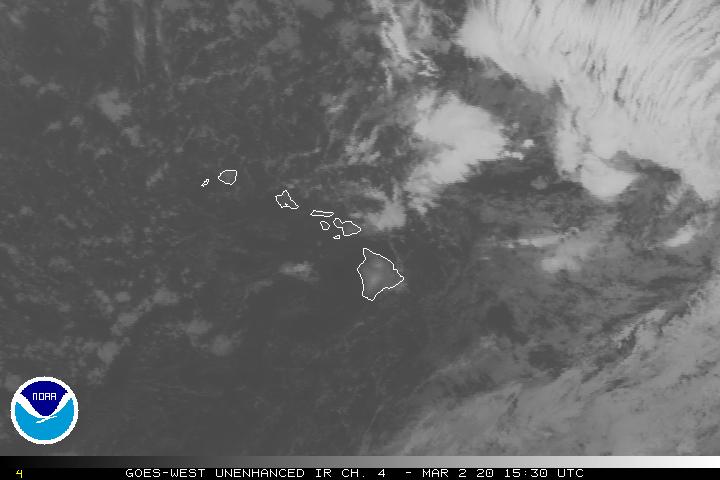


Vicky Says:
Hey Glenn, love your page and read it often. I just wanted to know where in the islands that beautiful picture of the girl in the lagoon was taken? It looks so inviting! Mahalo.~~~Hi Vicky, thanks for your positive feedback! I’m not exactly sure, although I assumed it was someplace between Hilo Bay and to the south of there on the Big Island. It is a wonderful picture, I agree! Aloha, Glenn
Ben Says:
Hey Glenn, last night's sunset, at least from Pukalani, was spectacular. I have photos at https://picasaweb.google.com/lh/photo/s6sUOepKFMwGdII1d5CbzNMTjNZETYmyPJy0liipFm0?feat=directlink . You can see the sun highlighting tall cumulus clouds far to the west (maybe near Oahu?). Feel free to use any pics. Aloha – Ben~~~Hi Ben, I saw that sunset…and it was spectacular as you say! Thanks for forwarding the photo, its a bright one! Aloha, Glenn