











Air Temperatures – The following maximum temperatures were recorded across the state of Hawaii Saturday afternoon:
Lihue, Kauai – 77
Honolulu airport, Oahu – 82
Molokai airport – 81
Kahului airport, Maui – 82
Kona airport – 82
Hilo airport, Hawaii – 78
Air Temperatures ranged between these warmest and coolest spots near sea level – and on the highest mountain tops around the state…as of 730pm Saturday evening:
Kailua Kona – 77
Kahului, Maui – 72
Haleakala Summit – 43 (near 10,000 feet on Maui)
Mauna Kea Summit – 36 (near 13,800 feet on the Big Island)
Hawaii’s Mountains – Here’s a link to the live web cam on the summit of near 13,800 foot Mauna Kea on the Big Island of Hawaii. This web cam is available during the daylight hours here in the islands…and when there’s a big moon shining down during the night at times. Plus, during the nights you will be able to see stars, and the sunrise and sunset too…depending upon weather conditions. Here's the Haleakala Crater webcam on Maui.
Tropical Cyclone activity in the eastern and central Pacific – Here’s the latest weather information coming out of the National Hurricane Center, covering the eastern north Pacific. You can find the latest tropical cyclone information for the central north Pacific (where Hawaii is located) by clicking on this link to the Central Pacific Hurricane Center. A satellite image, which shows the entire ocean area between Hawaii and the Mexican coast…can be found here. The 2012 hurricane season is over in the eastern and central Pacific…resuming on May 15th and June 1st 2013.
Aloha Paragraphs

Artist credit…John Severson
Clear to partly cloudy, cloudy periods with passing
showers at times windward sides…a few
along the leeward sides
Winds becoming lighter and turning
east-southeast or southeast
Small craft wind advisory…parts of Maui
County and the Big Island
High surf advisory for north shores of Kauai,
Oahu, Molokai and the Big Island
High surf warning east shores of Kauai, Oahu,
Molokai, Maui and the Big Island of Hawaii
Surges expected in the Hilo and Kahului harbors
The following numbers represent the most recent top wind gusts (mph), along with directions as of Saturday evening:
21 Port Allen, Kauai – SE
28 Kahuku Trng, Oahu – NE
25 Molokai – ESE
33 Kahoolawe – ESE
31 Kahului, Maui – ENE
M Lanai – NE
27 Kealakomo, Big Island – ENE
Here are the latest 24-hour precipitation totals (inches) for each of the islands as of Saturday evening:
0.87 Mount Waialeale, Kauai
0.21 Punaluu Pump, Oahu
0.20 Molokai
0.00 Kahoolawe
0.34 Puu Kukui, Maui
0.26 Mountain View, Big Island
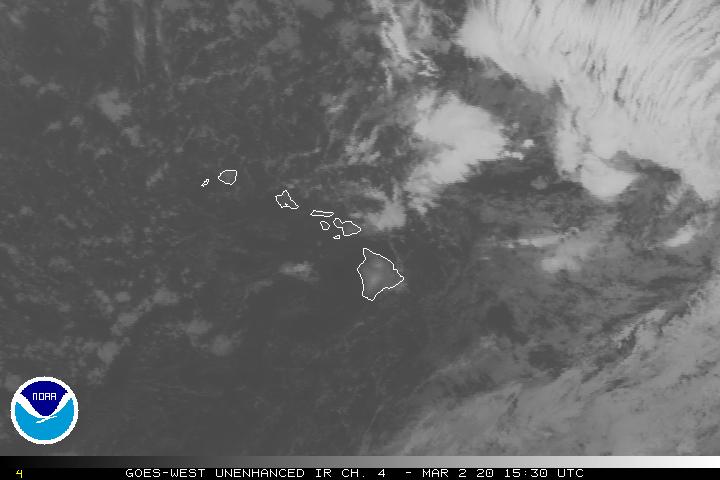
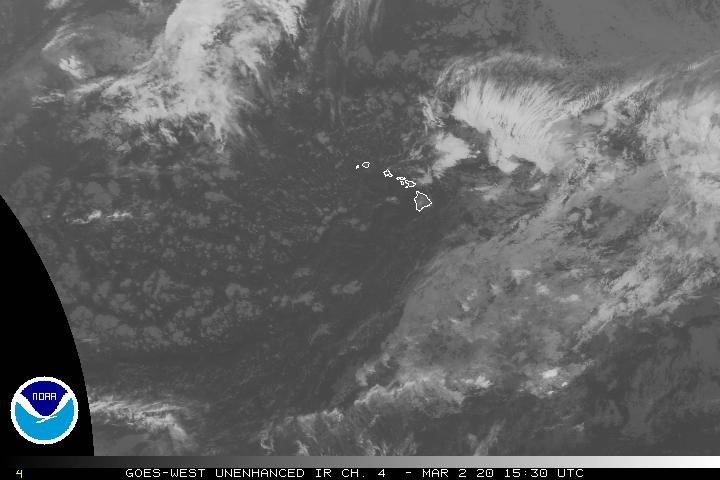
We can use the following links to see what’s going on in our area of the north central Pacific Ocean. Here's the latest NOAA satellite picture – the latest looping satellite image…and finally the latest looping radar image for the Hawaiian Islands.
~~~ Hawaii Weather Commentary ~~~
Our winds are finally tapering off…and are now veering to the east-southeast and southeast. Here's a weather chart showing the north central Pacific, with a near 1024 millibar high pressure cell to our northeast…moving east. We also now see areas of low pressure, along with a strong low pressure system, troughs and cold fronts to our southwest through northwest. Our local winds continued to gust up to 30+ mph range early this evening, across most of the state. As we move through the rest of this weekend however, our winds will become quite a bit lighter, especially Sunday into Monday. This will occur as those areas of low pressure noted above, gradually move closer…prompting east-southeast to southeast breezes over our area.
There will be a few passing showers along our windward sides…nothing much however through Sunday into early Monday. Here's a satellite image, showing just a few patches of low clouds upstream of our islands tonight, most of which will pass by on the now east-southeast to southeast breezes. As for Sunday, it will finally be considerably less windy, and less showery along our windward sides too. It appears that the leading edge of high cirrus clouds to our southwest and west, will get into our area overnight into Sunday. These high clouds won't bring rain, although will definitely begin filtering and dimming our sunshine during the day Sunday, at least likely.
It still looks quite certain that the Kauai and Oahu side of the island chain will receive showers later Christmas Eve day into Christmas Day…with still a chance elsewhere. What looks likely is that an area of deep tropical moisture to our west and southwest, will edge in just close enough, to give the western islands precipitation during the Christmas holiday period. At very least, the next couple of days will be cloudy…what some could classify as gloomy. This satellite image, shows an extensive area of bright white clouds to the southwest of the state. At the same time, there's also a cold front approaching the state from the northwest, although it's expected to stall before arriving.
It appears that Maui County and the Big Island will miss most of this showery weather, as most of the more serious weather will remain over the ocean west of the state. However, these clouds and showers to our southwest, as they migrate northward, may extend over at least some parts of the state during the Christmas holiday…stay tuned. At any rate, we'll see the trade winds arriving back into our area by Wednesday, ushering in fairly typical early winter trade wind weather conditions through next Friday. Looking even further ahead, it looks like a cold front will approach the state next weekend, which may veer our winds around to the southeast again. I'll be back again Sunday morning with more updates on all of the above, I hope you have a great Saturday night wherever you happen to be spending it! Aloha for now…Glenn.
Friday night film: This time around I went to see one that I've been really looking forward to for quite a while. It was called The Hobbit: An Unexpected Journey, starring Martin Freeman, Ian McKellen, Elijah Wood, Orlando Bloom, Cate Blanchett…among so many more.
The synopsis: Bilbo Baggins, who is swept into an epic quest to reclaim the lost Dwarf Kingdom of Erebor from the fearsome Dragon Smaug. Approached out of the blue by the Wizard Gandalf the Grey, Bilbo finds himself joining a company of 13 Dwarves led by the legendary warrior, Thorin Oakenshield. Their journey will take them into the Wild, through treacherous lands swarming with Goblins, Orcs and deadly Wargs, as well as a mysterious and sinister figure known only as the Necromancer.
Although their goal lies to the East and the wastelands of the Lonely Mountain, first they must escape the Goblin tunnels, where Bilbo meets the creature that will change his life forever…Gollum.
Here, alone with Gollum, on the shores of an underground lake, the unassuming Bilbo Baggins not only discovers depths of ingenuity and courage that surprise even him, he also gains possession of Gollum's "precious" ring that holds unexpected and useful qualities…A simple, gold ring that is tied to the fate of all Middle-earth in ways Bilbo cannot begin to know.
The reviews on this film are mixed, which surprised me some. I mean, from what one person called garbage, to others that were giving it an 11 on a scale of 1-10. I'm learning to overlook most of the critical comments however, and just go on my own intuition. The one thing that did unnerve me a bit, was that the film is 2 hours 46 minutes long! That's a long time to sit still, so it will take a great film to keep my attention throughout. As it turned out, the length wasn't an issue whatsoever. I really like the film, and I didn't find any slow spots along the way. I loved reading the Hobbit series of books, and the film was quite marvelous too! If you are a Hobbit fan, I highly recommend you take the time to see it. As for a grade, I feel it warrants a very strong B+ grade. Here's the 8 minute trailer – I suggest viewing the full screen version.
World-wide tropical cyclone activity:
Atlantic Ocean/Caribbean Sea: There are no active tropical cyclones
Gulf of Mexico: There are no active tropical cyclones
Eastern Pacific Ocean: There are no active tropical cyclones
Central Pacific Ocean: There are no active tropical cyclones
Western Pacific Ocean: There are no active tropical cyclones
South Pacific Ocean: There are no active tropical cyclones
North and South Indian Oceans: Newly formed tropical cyclone 04A is now active…located approximately 525 NM east-southeast of Cape Guardafui, Somalia. The Joint Typhoon Warning Center (JTWC) is showing 40 knot sustained winds, with gusts to near 50 knots. This cyclone will strengthen, although isn't expected to reach 65 knots. Here's a graphical track map, along with a satellite image of 04A.
Interesting: On a recent day when global doomsday predictions failed to pan out, NASA had more good news for the Earth: An asteroid feared to be on a collision course with our planet no longer poses a threat. Uncertainties about the orbit of the asteroid, known as 2011 AG5, previously allowed for a less than a 1% chance it would hit the Earth in February 2040, NASA said.
To narrow down the asteroid's future course, NASA put out a call for more observation. Astronomers from the University of Hawaii at Manoa took up the task and managed to observe the asteroid over several days in October. "An analysis of the new data conducted by NASA's Near-Earth Object Program Office at the Jet Propulsion Laboratory in Pasadena, California, shows that the risk of collision in 2040 has been eliminated," NASA declared Friday.
The new observations, made with the Gemini 8-meter telescope in Mauna Kea, Hawaii, reduce the orbit uncertainties by more than a factor of 60. That means the Earth's position in February 2040 is not in range of the asteroid's possible future paths. The asteroid, which is 460 feet in diameter, will get no closer to Earth than 890,000 kilometers (553,000 miles), or more than twice the distance to the moon, NASA said.
A collision with Earth would have released about 100 megatons of energy, several thousand times more powerful than the atomic bombs that ended World War II, according to the Gemini Observatory. Observing the asteroid wasn't easy, said David Tholen, an astronomer at the University of Hawaii Institute for Astronomy.
The asteroid's position was very close to the sun, so astronomers had to observe it when the sky was dark. Tholen told CNN there was about a half-hour between when the asteroid got high enough in the sky for the telescope to point at it and before the sky became too light to observe it. Because the astronomers were looking at the asteroid low in the sky, they were viewing it through a lot of atmosphere, which scattered some of the light and made the object fainter, he said.
"The second effect is the turbulence of the atmosphere makes things fainter," Tholen said. "We had to keep trying over and over until we got one of those nights when the atmosphere was calm." Tholen and the team also discovered the asteroid is elongated, so that as it rotates, its brightness changes.
That was another challenge for the astronomers: Because they didn't know the asteroid's rotation period, they didn't know when it would wax and wane, and when it would grow too faint to see. "This object was changing its brightness by a factor of three or four — it was just enormously variable," Tholen said.
"It was hit and miss depending on which night you observed it." Many predicted the end of the world would come Friday, the day on which a long phase in the ancient Mayan calendar came to an end. Some believe the day actually comes Sunday. Modern-day Mayans say the end of the calendar phase doesn't mean the end of the world — just the end of an era, and the start of a new one.
 Email Glenn James:







Nancy Says:
I love John Severson's artwork! Is he still on Maui doing artwork?Thanks for sharing that one today.~~~Hi Nancy, yes John is great…and yes he still lives on Maui. Happy Holidays! Aloha, Glenn