











Air Temperatures – The following maximum temperatures were recorded across the state of Hawaii Thursday afternoon:
Lihue, Kauai – 77
Honolulu airport, Oahu – 79
Molokai airport – 76
Kahului airport, Maui – 76
Kona airport – 83
Hilo airport, Hawaii – 77
Air Temperatures ranged between these warmest and coolest spots near sea level – and on the highest mountain tops around the state…as of 530pm Thursday evening:
Barking Sands, Kauai – 81
Kahului, Maui – 70
Haleakala Summit – 36 (near 10,000 feet on Maui)
Mauna Kea Summit – 27 (near 13,800 feet on the Big Island)
Hawaii’s Mountains – Here’s a link to the live web cam on the summit of near 13,800 foot Mauna Kea on the Big Island of Hawaii. This web cam is available during the daylight hours here in the islands…and when there’s a big moon shining down during the night at times. Plus, during the nights you will be able to see stars, and the sunrise and sunset too…depending upon weather conditions. Here's the Haleakala Crater webcam on Maui.
Tropical Cyclone activity in the eastern and central Pacific – Here’s the latest weather information coming out of the National Hurricane Center, covering the eastern north Pacific. You can find the latest tropical cyclone information for the central north Pacific (where Hawaii is located) by clicking on this link to the Central Pacific Hurricane Center. A satellite image, which shows the entire ocean area between Hawaii and the Mexican coast…can be found here. The 2012 hurricane season is over in the eastern and central Pacific…resuming on May 15th and June 1st 2013.
Aloha Paragraphs

Clear to partly cloudy, cloudy periods,
passing showers windward sides at
times…some along the leeward sides
here and there too
Blustery trade winds…strong and gusty
Small craft wind advisory…most marine zones
High surf advisory for east shores of all islands
Today is the official beginning of Winter, the winter solstice
The following numbers represent the most recent top wind gusts (mph), along with directions as of Thursday evening:
30 Lihue, Kauai – NE
52 Kuaokala, Oahu – NE
40 Molokai – NE
46 Kahoolawe – NE
33 Kahului, Maui – NE
45 Lanai – NE
44 Waikoloa, Big Island – NE
Here are the latest 24-hour precipitation totals (inches) for each of the islands as of Thursday evening:
1.14 Mount Waialeale, Kauai
1.41 Manoa Lyon Arboretum, Oahu
1.40 Molokai
0.00 Kahoolawe
6.63 Puu Kukui, Maui
7.76 Saddle Quarry, Big Island
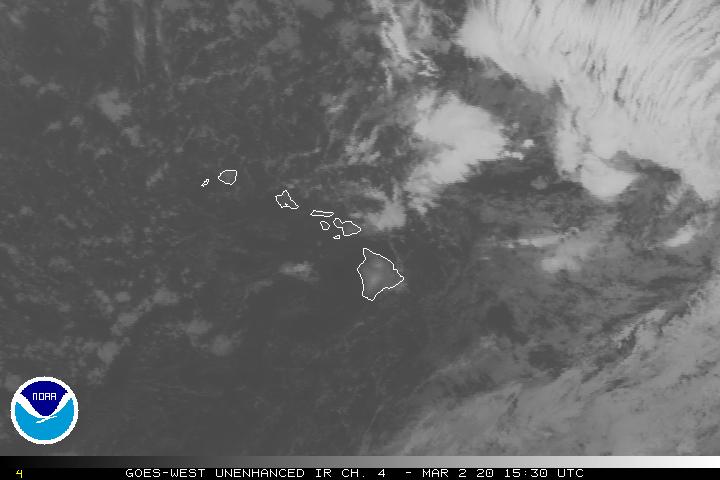
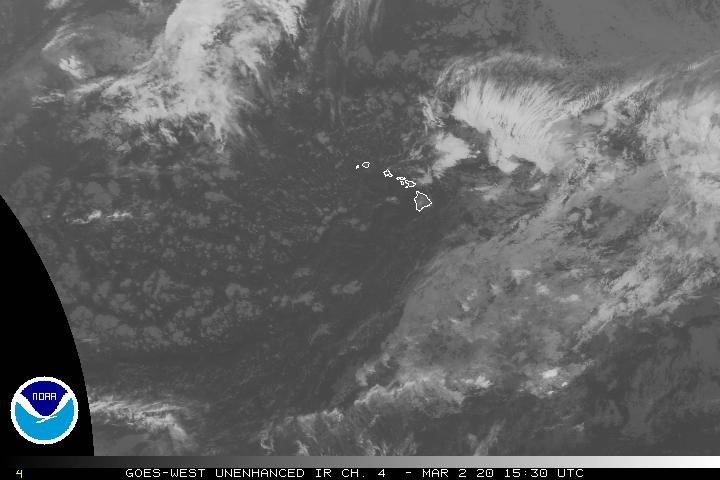
We can use the following links to see what’s going on in our area of the north central Pacific Ocean. Here's the latest NOAA satellite picture – the latest looping satellite image…and finally the latest looping radar image for the Hawaiian Islands.
~~~ Hawaii Weather Commentary ~~~
Strong and gusty trade winds will continue to blow across our islands…although will gradually taper off as we get into the weekend. Here's a weather chart showing the north central Pacific, with a near 1033 millibar high pressure cell to our north…with a weaker near 1023 millibar high pressure cell far to east-northeast. Our local winds will continue to gust up between 40-50+ mph for the time being, at least in those windiest locations around the state. As we get into the later part of the upcoming weekend, our winds may become quite a bit lighter, as a trough of low pressure forms to the west and southwest of the state then…prompting southeast breezes. This of course suggests that we could see volcanic haze (vog) returning to some areas of the smaller islands then into Monday.
The current forecast shows more showers for our windward sides…into Friday morning. Here's a satellite image, showing scattered low clouds upstream of our islands, with a showery band of clouds moving through the state this evening. This band of clouds has dropped lots of rainfall over some of our windward coasts and slopes during the last 12-24 hours. A couple of the largest amounts include the very generous 6.63" atop the West Maui Mountains (Puu Kukui)…and the even more impressive 7.76" in the Saddle Quarry gauge on the Big Island! Our leeward sides will see a few passing showers too, blown over there by the strong and gusty trade wind flow. Here's a looping radar image of the state, so we can keep an eye on these incoming showers. It looks like somewhat drier air will arrive later Friday, and likely into the weekend as well. If we check out this larger satellite image, we see that some high thin cirrus clouds are arriving from the west…which will give us nice colors at sunset this evening, and then again for sunrise on Friday.
Looking ahead, as far as the upcoming Christmas holiday…it still looks like we'll see an increase in showers. The exact forecast for this important time period remains a little difficult. There have been some differences in what the models are serving up as a weather solution. They vary from having a deep Kona low pressure system forming to our west or southwest…to having a cold front swing down through the state later Monday into Tuesday. The most dynamic change of course would be the Kona low…bringing lots of precipitation our way from the deeper tropics to our southwest.
It looks to me like Kauai and Oahu will get wet later Christmas Eve, with those showers shifting down over Maui County on Christmas Day, although not quite reaching the Big Island into the 26th. We still have more time to see what the models spew out, bear with me please. I'll be providing more updates regularly on this ongoing forecast problem, as we move forward each day towards Christmas. ~~~ I'll be back early Friday morning with your next new weather narrative, I hope you have a great Thursday night until then! Aloha for now…Glenn.
World-wide tropical cyclone activity:
Atlantic Ocean/Caribbean Sea: There are no active tropical cyclones
Gulf of Mexico: There are no active tropical cyclones
Eastern Pacific Ocean: There are no active tropical cyclones
Central Pacific Ocean: There are no active tropical cyclones
Western Pacific Ocean: There are no active tropical cyclones
South Pacific Ocean: There are no active tropical cyclones
North and South Indian Oceans: There are no active tropical cyclones
Interesting: Salinity is the saltiness or dissolved salt content (such as sodium chloride, magnesium and calcium sulfates, and bicarbonates) of a body of water. Salinity is an ecological factor of considerable importance, influencing the types of organisms that live in a body of water. As well, salinity influences the kinds of plants that will grow either in a water body, or on land fed by a water (or by a groundwater).
For ages salinity was mostly affected by slow geologic type processes. The ocean's salinity field is driven primarily by evaporation, precipitation, and river discharge, all key elements of the Earth's hydrological cycle. Observations show the salinity field has been changing in recent decades but more rapidly than expected and by mad made effects.
The saltiness, or salinity, of the oceans is controlled by how much water is entering the oceans from rivers and rain versus how much is evaporating. This is the water cycle or the continuous movement of water on, above and below the surface of the Earth.
The water moves from one reservoir to another, such as from river to ocean, or from the ocean to the atmosphere, by the physical processes of evaporation, condensation, precipitation, infiltration, runoff, and subsurface flow. The more sunshine and heat there is, the more water can evaporate, leaving the salts behind in higher concentrations in some places.
Over time, those changes spread out as water moves, changing the salinity profiles of the oceans. Oceanographers from Scripps Institution of Oceanography and Lawrence Livermore National Laboratory fingerprinted salinity changes from 1955 to 2004 from 60 degrees south latitude to 60 degrees north latitude and down to the depth of 700 meters in the Atlantic, Pacific and Indian oceans.
The ocean data was compared to 11,000 years of ocean data generated by simulations from 20 of the latest global climate models. When they did that they found that the changes seen in the oceans matched those that would be expected from human forcing of the climate. When they combined temperature changes with the salinity, the human imprint is even clearer.
"These results add to the evidence that human forcing of the climate is already taking place, and already changing the climate in ways that will have a profound impact on people throughout the world in coming decades," the oceanographers conclude.
The key points from their report are:
1. Climate change has altered the salinity field of the world's oceans.
2. Changes match model predictions over the top 125 meters.
3. The human effect signal is even stronger when salinity is taken jointly with temperature.
 Email Glenn James:
Rob Edgett Says:
guess i didn't google the right question the first time…
http://www.capitol.hawaii.gov/session2012/bills/SB2933_SD1_.HTM~~~I see, that’s what those buoys are for…thanks for letting us know Rob. Aloha, Glenn
Jean Tappan Says:
Happy Holidays, Glenn. I can't say that tomorrow is the beginning of winter–we've had temps below 10 degrees F for the last 3 weeks! Now that's winter. Not much snow this year but that's ok because I don't drive in it and Bill is recovering from knee replacement surgery so it is up to me to run the errands for a while. I'm hoping his recovery is quick or at least before the next snow event. Hope the holidays are fun for you. Stay healthy! No plans to visit this year, at least so far, but you never know. Best regards. Jean~~~Hi Jean, good to hear from you again, from up there in Alaska! Wow, cold weather for the last 3 weeks, at least I’m sure. I guess we’re all in line for even colder weather, or at least cooler at times here in the islands. Sorry to hear of Bill’s surgery, trust it will heal well…and quickly too. No plans, that’s the first time you’ve said that in many, many years, as you folks always come to Maui in the later Spring. Oh well, as you say, you never know. At any rate, here’s sending you two warm holiday wishes, and for that matter, to everyone that might be reading up in the north country! Aloha, Glenn
Rob Edgett Says:
Hi Glenn, What are the bouys off the Kamaole beaches for? I'm sure they weren't there last year…recording whale sounds?~~~Hi Ed, isn’t shaw.ca mean you live in Canada, I believe so at any rate. Well, about those bouys you refer to, the truth is that I don’t really know. Recording whale sounds seems like a good enough reason to have them stationed out there! If anyone knows, and wants to let us know, I’ll put your reply right here. Good question Rob, Aloha, Glenn