Air Temperatures – The following maximum temperatures were recorded across the state of Hawaii Sunday afternoon:
Lihue, Kauai – 84
Honolulu airport, Oahu – 79
Molokai airport – 84
Kahului airport, Maui – 84
Kona airport – 84
Hilo airport, Hawaii – 80
Air Temperatures ranged between these warmest and coolest spots near sea level – and on the highest mountain tops around the state…as of 530pm Sunday evening:
Lihue, Kauai – 79
Hana airport, Maui – 75
Haleakala Summit – M (near 10,000 feet on Maui)
Mauna Kea Summit – 32 (near 13,800 feet on the Big Island)
Hawaii’s Mountains – Here’s a link to the live web cam on the summit of near 13,800 foot Mauna Kea on the Big Island of Hawaii. This web cam is available during the daylight hours here in the islands…and when there’s a big moon shining down during the night at times. Plus, during the nights you will be able to see stars, and the sunrise and sunset too…depending upon weather conditions. Here's the Haleakala Crater webcam on Maui.
Tropical Cyclone activity in the eastern and central Pacific – Here’s the latest weather information coming out of the National Hurricane Center, covering the eastern north Pacific. You can find the latest tropical cyclone information for the central north Pacific (where Hawaii is located) by clicking on this link to the Central Pacific Hurricane Center. A satellite image, which shows the entire ocean area between Hawaii and the Mexican coast…can be found here. The 2012 hurricane season is over in the eastern and central Pacific…resuming on May 15th and June 1st 2013.
Aloha Paragraphs

Light to moderate breezes, locally
stronger, generally from the south
Wind advisory over the summits on Maui / Big Island
High surf advisory for north and west shores of…
Niihau, Kauai, and Molokai, and north shore of Oahu
Clouds with localized showers, generally light to moderate
The following numbers represent the most recent top wind gusts (mph), along with directions as of Sunday evening:
35 Lihue, Kauai – SW
30 Kuaokala, Oahu – SE
30 Molokai – SE
16 Kahoolawe – SE
20 Kula 1, Maui – SSW
16 Lanai – S
36 Keahole airport, Big Island – SSW
Here are the latest 24-hour precipitation totals (inches) for each of the islands as of Sunday evening:
0.97 Puu Opae, Kauai
0.04 Kuaokala, Oahu
0.00 Molokai
0.00 Lanai
0.00 Kahoolawe
0.00 Maui
0.26 Pahoa, Big Island
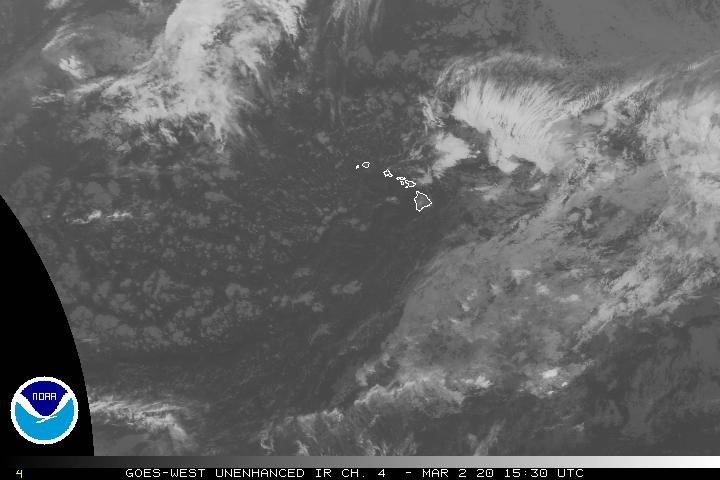
We can use the following links to see what’s going on in our area of the north central Pacific Ocean. Here's the latest NOAA satellite picture – the latest looping satellite image…and finally the latest looping radar image for the Hawaiian Islands.
~~ Hawaii weather commentary ~~
Warm southerly breezes…with stronger winds around locally. We currently have high pressure systems (weather map), located over the ocean far to the west and east of Hawaii…with an associated ridge extending westward from the eastern high pressure cell…to over Maui County and the Big Island. Meanwhile, we find a gale low pressure system, and its associated cold front to our northwest. This front will reach Kauai early Monday…moving down to Oahu during the day. Our winds are expected to remain on the light side for the next couple of days, although locally stronger in places. We'll find the return of a fairly typical trade wind weather pattern, filling back into our area on Thursday.
A slow moving cold front is expected to arrive early Monday on Kauai…although light precipitation is expected. Here's a large satellite image, showing you the impressive cloud band that's over the state now…along with a looping radar image, so we can keep track of any associated showers. Looking further ahead, the next cold front is expected to reach down towards the islands early Monday, which might result in some more showers for Kauai. This front then will stall or dissipate near Oahu, with perhaps a few light showers there too. The latest change from the models, brings back light trade winds into our Hawaiian Islands weather picture during the second half of the new week. I'll be back early Monday morning with your next new weather narrative. I hope you have a good Sunday night wherever you happen to be spending it! Aloha for now…Glenn.
World-wide tropical cyclone activity:
Atlantic Ocean/Caribbean Sea: There are no active tropical cyclones
Gulf of Mexico: There are no active tropical cyclones
Eastern Pacific Ocean: There are no active tropical cyclones
Central Pacific Ocean: There are no active tropical cyclones
Western Pacific Ocean: Super Typhoon Bopha (26W) remains active in the western Pacific…located approximately 630 NM southeast of Manila, Philippines. Sustained winds have increased back up to 140 knots, with gusts to near 170 knots. The JTWC indicates that this very strong super typhoon will be crossing through the southern Philippine Islands soon…and then out into the South China Sea. Here's the JTWC graphical track map…along with a satellite image.
South Pacific Ocean: There are no active tropical cyclones
North and South Indian Oceans: There are no active tropical cyclones
Interesting: Instead of limiting imports of electronic waste, the Asia—Pacific region should set up a robust recycling system, says Crispin Maslog. Garbage in, garbage out is a phrase to describe what happens when computers find the wrong solution in response to the wrong input data.
But when computers and other electronic products have outlived their usefulness, they literally do become rubbish and join an ever-growing mass of e-waste or e-scrap. Up to 50 million tonnes of this waste is generated worldwide every year.
The biggest exporters of e-waste are Europe, Japan and the US. And much of it is being dumped on developing nations. It is a growing trend. A market research report published last month said that rapid developments in technology for laptops, tablets and smart phones is encouraging the equally rapid abandonment of old models in Asia, causing a sharp rise in e-waste.
The study noted that the constant upgrades are spurring the need for the safe disposal of such waste. Simply abandoning the millions of obsolete computers, mobile phones and TV sets to decompose, or using unsafe treatment methods such as burning, leaves behind hazardous waste including lead, cadmium and mercury.
The need for safe disposal is a major challenge for both developed and developing countries, and makes e-waste management both a health and an environmental issue. Developing countries themselves produce e-waste. In South-East Asia and the Pacific, countries such as Thailand and the Philippines are starting to discard significant amounts of e-waste.
In parts of Asia, there is a high demand for the precious metals in electronic waste exported from elsewhere in Asia or developed countries, despite recipient countries having little capacity to process it safely.
 Email Glenn James: